
Bruce Dowbiggin
Check Out Time: Knowing Enough Is Enough

“An aged man is but a paltry thing,
A tattered coat upon a stick, unless
Soul clap its hands and sing, and louder sing
For every tatter in its mortal dress”. W.B. Yeats
Damn that Tom Brady. Because of the now-retired NFL GOAT it is widely believed that an athlete in his 40s can still triumph over younger men. That a good diet, plenty of sleep and keen desire can sustain you against twenty-two year olds. It ain’t so.
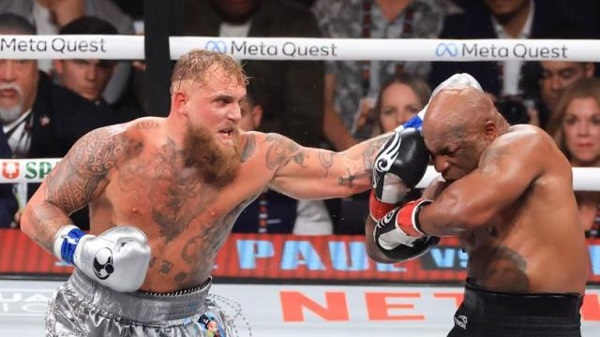
Those needing a reminder of what nature intends for athletes pushing their 40s— and later— got a sobering reminder the past while. First on the docket was Mike Tyson, the former heavyweight champion and a man who inspired fear the way Taylor Swift inspires teenage girls and vapid prime ministers.
In an effort to shake his aging fist at time, the 58-year-old Tyson agreed to fight 27-year-old media-influencer-turned-boxer Jake Paul. Tyson has been through a lot since his days when opponents barely lasted a minute in the ring with him. He lost his crown, married actress Robin Givens and had what was clearly a breakdown both physically and mentally.

In recent years he’s re-invented himself by playing Mike Tyson in movies (his tiger is stolen by a dentist in The Hangover) and on Broadway. He’s evolved into some sort of Cormac McCarthy sage, unflinching in the face of his mortality. Here he talks to a very young interviewer about his legacy and his wish to have no part of one. His precise words were, “”I don’t believe in the word ‘legacy.’ I think that’s another word for ego. Legacy doesn’t mean nothing. That’s just some word everybody grabbed on to.”
So the decision to take on Paul, who has only a dozen pro fights, in a Netflix special drew a lot of curiosity. With his facial tattoo and still-impressive physique he made many believe he could summon up enough to defeat a showboating Paul (El Gallo) who played the heel in the run-up.
Then Tyson had an ulcer flareup. Which caused him to lose half the blood in his body. The fight was delayed from July to November 15 at AT&T Stadium, home of the Dallas Cowboys. Videos of Tyson training seemed to show that, even after the medical issues, he could still deliver enough firepower to make the fight credible. For good measure, Tyson slapped Paul during the weigh-in. Just like the old days.
On fight night sixty-five million tuned in. But the Tyson of old was now old Tyson. He had little to offer, and, by fight’s end, Paul was toying with Tyson. The unanimous decision was a forgone conclusion. Even in defeat Tyson declared himself satisfied having shown his family and himself he could credibly train for a fight after his medical problems.
But the big winner was Father Time.
The Big Guy is also wining in his bet with legendary QB Aaron Rodgers who vowed in 2022 to make the Green Bay Packers regret letting him go in favour of Jordan Love. Rodgers, who’s almost as quixotic as Tyson, signed with the New York Jets who felt themselves only a QB away from a playoff berth or even a trip to the Super Bowl.
That dream lasted just four plays into the Jets first game of 2023. The elusive, rifle-armed Rodgers sat pathetically on the turf, his season done with a torn achilles tendon and the Jets hopes delayed for a year. During his convalescence there were rumours of an early comeback. None came.

So this September the expectations were palpable for Rodgers, now 40, to finally lead their Jets to success. It took only a few games to note that, while he could still throw a great football, Rodgers could not move as he once had in the pocket. He was sacked pitilessly by opponents. The rival Buffalo Bills pounded the Jets, leaving them far behind the the AFC East standings.
At which point Rodgers’ enigmatic personality become the story in the catty New York press. As first the coach, Robert Saleh, and then the GM, Joe Douglas, were fired. Stories emerged that Rodgers was calling the shots with ownership. Fans turned on him. This past week the 3-8 Jets made the internal decision to cut ties with Rodgers at season’s end.
Will someone sign this version of Rodgers for 2025? Sure. And Joe Biden will regain his faculties. Rodgers’ hopes to “not go gentle into that good night” will not be his call.
Finally, there was the news this week that 39-year-old Alex Ovechkin of the Washington Capitals had suffered a broken fibula and would miss 6-8 weeks. However you feel about Ovechkin’s friendship with Putin , there was admiration for his relentless pursuit of Wayne Gretzky’s record for most regular-season goals (894) in a career.

After a slow start the Capitals captain was on pace to break the record sometime in February. Then came the leg-on-leg collision with Utah’s Jack McBain. In his first 19 seasons Ovie had missed just 35 games to injury. Now this. But that’s how it goes as a 39-year-old playing a young man’s game.
There’s a good chance he now may have to wait till next year— when he’s 40— to break the mark. Ask Aaron Rodgers how that 40-something coming-back-from injury thing works.
At least there was one great athlete accepting the encroachment of 40. Rafael Nadal wound up his brilliant career at the Davis Cup after winning 22 Grand Slam tournaments. “I don’t have the chance to be competitive the way I like to be competitive,” he said in a news conference. “My body is not able to give me the possibility.”

The now-retired Roger Federer, who saw his lead over Nadal in Grand Slams go from 6-12 to 20-22, summed up Nadal. “You beat me — a lot. More than I managed to beat you… You challenged me in ways no one else could.” You could also say he got out while the getting was good. For that, Rafa, clap hands and sing.
Bruce Dowbiggin @dowbboy is the editor of Not The Public Broadcaster A two-time winner of the Gemini Award as Canada’s top television sports broadcaster, he’s a regular contributor to Sirius XM Canada Talks Ch. 167. His new book Deal With It: The Trades That Stunned The NHL And Changed hockey is now available on Amazon. Inexact Science: The Six Most Compelling Draft Years In NHL History, his previous book with his son Evan, was voted the seventh-best professional hockey book of all time by bookauthority.org . His 2004 book Money Players was voted sixth best on the same list, and is available via brucedowbigginbooks.ca.

“Of all tyrannies, a tyranny sincerely exercised for the good of its victims may be the most oppressive. It would be better to live under robber barons than under omnipotent moral busybodies.” C.S. Lewis
One of the aims of logical positivism has been Boomers’ quest to kill Western religion and the pursuit of faith in order to make room for the state. Symbols are banned. Churches are burned. Infidels are rewarded. Esoteric faith systems applauded. Yet, as 2026 dawns, it appears that, not only is traditional religion not dead, it might just be making a comeback with younger generations who’ve grown skeptical of their parents’ faux religion of self.
How? In an age of victim status, traditional religion is suddenly a cuddly TikTok puppy. Hard to imagine that the force that spread imperialism and war across the globe for centuries being a victim. But yes. Only Christians and Jews are singled out for censure In Carney’s Canada The zeal to repeal God has backfired. Faith is off the canvas and punching back. (And we are NOT talking about the Woke pope.)
The purveyors of “old-time religion” will still find themselves facing a determined opponent well on the way to moral inversion. And a compliant population. As blogger Melanie in Saskatchewan points out, “Canadians were sold a calm, competent adult in the room. What they got was an unelected system engineer quietly converting moral claims into financial constraints. This is not leadership. It is non-consensual governance.

The freedoms that make dissent possible are being used to hollow out dissent. The protections meant to guard against abuse are being used to avoid scrutiny. And the law—stripped of its moral imagination—is asked to do what it cannot: resolve psychic conflict through paperwork.”
The sophistry of the superior class demands submission. C.S. Lewis warned of this inversion in God In The Dock. “To be “cured” against one’s will and cured of states which we may not regard as disease is to be put on a level of those who have not yet reached the age of reason or those who never will; to be classed with infants, imbeciles, and domestic animals.”
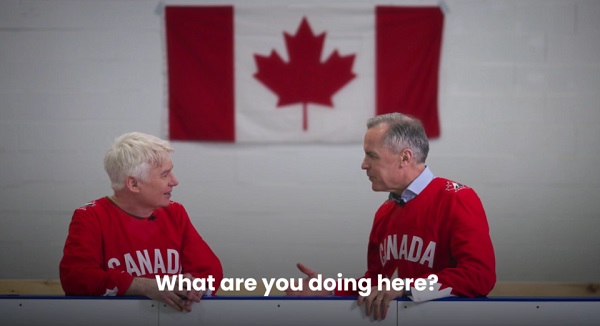
In Canada that compliant class has embraced Mark Carney as the great stabilizer. “Canadians keep asking the wrong question about Mark Carney,” says blogger Melanie in Saskatchewan. “They keep asking whether he is a good politician. That is like asking whether a locksmith is a good interior decorator.
Carney is not here to govern. He is here to re-engineer the operating system of the country while the Liberal Party provides the helpful stage props and applause track. And judging by how little scrutiny this government receives, the audience seems perfectly content to clap at whatever is placed in front of them, provided it comes with soothing words like “stability,” “resilience,” and “the experts agree”.
Adds Dr. Andrea Wagner, Canadians “hide behind procedure. Behind policy. Behind institutions. Behind NDAs. Behind committees, processes, protocols. Behind phrases like “we’re reviewing this internally” and “that’s beyond my authority.” They hide behind the pretense of empathy while quietly perpetuating injustice. They hide behind performative busy-ness: “I wish I had time,” “I’m swamped,” “I’ve been unwell.” There is enormous power in powerlessness—and Canadians wield it masterfully.”
The problem, says Melanie in Saskatchewan, is not that Mark Carney in full power is incompetent. The problem is that he is extremely competent at something Canadians never actually consented to. Technocrats redesign the machinery so that the outcome becomes inevitable. No messy debate. No inconvenient voters. No public reckoning. Just “the framework,” “the model,” “the standard,” and eventually the quiet conclusion that there is “no alternative.”
And this is precisely the world Mark Carney comes from. ”He did not rise through grassroots politics or party service. He rose through central banks, global finance institutions, and elite climate-finance bodies that speak fluent acronym and consider democracy an optional inconvenience. The man does not campaign. He architects.”
While the Conservative Party of Canada still polls evenly with the Liberals they are playing a different game, one they— with their traditional tactics— are not wired to win in a battle of systems with Carney. This cringeworthy “Keep It Up” endorsement of Carney by former CPC leader Erin O’Toole speaks to why they are further from power than ever.
The manufactured crisis over indigenous Rez school graves illustrates the method. “To call out intimidation or dehumanization is to risk being reframed as the aggressor. The person who names harm becomes the disturbance; the one who weaponizes grievance becomes the protected party. Justice no longer asks what happened, only who claims injury first. This is not accidental. It is the logical endpoint of a culture that has confused victimhood with virtue and pain with authority.

Suffering, once something to be alleviated, has become something to be curated. Identity now precedes evidence; accusation outruns inquiry. The system does not ask whether harm is real or proportional—only whether it can be procedurally contained. And containment, I am learning, is often preferred to truth.”
There are still some who believe there remains a way out of this. Here’s Paul Wells on Substack with a valid conclusion— which most sentient people reached by the end of Trudeau’s first term. “Canada has spent too long thinking of itself as a warehouse for the world instead of designing and building for itself. It’s time for a shared mindset of ambition quality and real investment in physical and human capital so Canadians become Canada’s designers and builders of livable cities rather than bystanders to our own future.”
But it’s hard to square that with the gap Carney’s already has. “The tragedy is that the Liberal Party is perfectly happy to hand (Carney) the country and then scold the public for noticing. If Canadians want a future where choices are still made by voters instead of algorithms and advisory panels, they are going to have to stop applauding this performance and start asking the one question that truly terrifies technocrats and their obedient political enablers.”

This system monolith taking over life is why the abrasive, defiant Donald Trump emerged. Vast segments of America employ him to defy the EU scolds with their censorship regimes. His defiance is categorical— which is why it frightens Canadians. The man from Mitch & Murray delivered a few truths to them and they soiled themselves. Paradise will never be the same!. Bad Trump! But an almost-octogenarian has little runway left himself. Who can continue the resistance to the Carney system engineers?
In the past organized religion was a refuge from the maelstrom of the secular storm. There was comfort in the message. Thus, the Liberals’ current need to destroy faith. So the epidemic of churches burned is ignored. The intrusive demonstrations of militant Islam are tolerated. (Carney says Muslim virtues are Canadian virtues.) History is re-written. Heroes debunked.
If Soviet Russia is any indication, the traditional faiths can survive and act as a bulwark against the technocrats— if they find their Pope John Paul II.. The Catholic and Orthodox faiths furnished a way out from behind the Iron Curtain. As organizations not co-opted by the state in the West religions can provide a moral backbone to expose and defeat the secular globalists.
Whether you are a believer or not they provide a pushback to restore the moral clarity C.S. described. It’s not too late as 2026 dawns. But if nothing is done in the West — if Canada accepts EU censorship and global ID— then writing this column in 2027 could well be defined as a criminal act.
“That which you most need will be found where you least want to look.” Carl Jung
Bruce Dowbiggin @dowbboy is the editor of Not The Public Broadcaster A two-time winner of the Gemini Award as Canada’s top television sports broadcaster, his 2025 book Deal With It: The Trades That Stunned The NHL And Changed Hockey is now available on Amazon. Inexact Science: The Six Most Compelling Draft Years In NHL History, his previous book with his son Evan, was voted the seventh-best professional hockey book of all time by bookauthority.org . His new poetry collection In Other Words is available via brucedowbigginbooks.ca and on Kindle books at https://www.amazon.ca/dp/1069802700
“The unifying theme that enables the Liberal party to maintain its hold over Canada is persistent anti-Americanism…I hope Canadians finally mature, acknowledge that we are neither superior nor inferior to the United States, and abandon our collective national inferiority complex.” Conrad Black quotes a friend.
Canadian media have almost always been reflexively anti-American. Fair enough. Abandoned by Britain they needed to push back. But the real fear of being consumed by the rebel colonies to the south has morphed into a fear of Donald Trump reminding Canada that it has been riding first class while paying economy.
Bashing noisy, bumptious America has always been good business if you owned a Canadian newspaper or television/radio network. The performative worship of Canadian leaders who cocked a snook at the Yankees led, in recent times, to the open-mouthed support for the fatuous Trudeaupian line of monarchs. As Ray Davies sang, “each one a dedicated follower of fashion.”
Since Pierre “The Bold” Trudeau succeeded Lester Pearson and ascended to the throne of the Family Compact in 1968, Canadian policy from Viet Nam to Trump has become “What are the Americans doing? Then let’s do the opposite”. Sample of spite: CBS TV pulled a controversial 60 Minutes news story —but it aired in Canada after being leaked by pissed-off CBS employees.
Yes, there was the brief Harper interregnum when Canada actually fought a military campaign alongside the U.S. in Afghanistan. But mostly it was Jean “Golf Balls” Chretien sitting out the Iraq War.
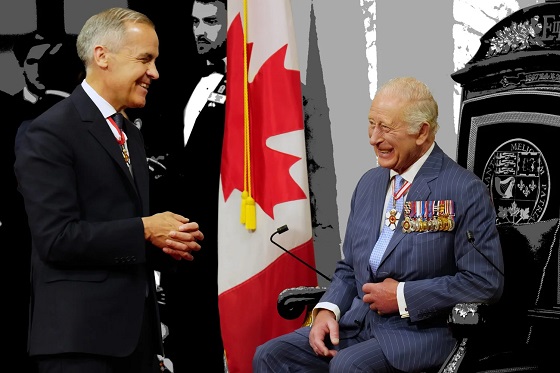
Alas, all good things must end. Or at least pause. People were starting to notice that Justy was a Chinese trusty, his Montreal riding campaign funded by hundreds of Chinese “businessman” from far away. The tragi-comic Trudeuapian succession hit a speed bump with Mark Carney being brought in to domesticate Canada in manner satisfactory to Brookfield and the EU.

But no one is betting the Libs won’t turn to a third generation of Quebec fashionistas— in the form of another Trudeau progeny— when all else fails.
As usual caustic Conrad Black sums up Canada best. With Quebec and Alberta talking separation he quotes a friend on the state of the nation. “What exists instead is a Liberal Party that manages — often quite poorly — the finances of a collection of provinces and territories, while relying on its media apparatus to shape and safeguard its narrative. It resembles a hedge fund supported by an image consulting firm.” (Insert your convict felon/ anglo wannabe reference here.)
There is no doubt that, as 2025 skulks out, the “image-consulting firm” painting rosy pictures of the Laurentian Elite is in for a a challenge. Justin thought using Trump as his pretext could achieve peace by buying up the lads and lasses of the fourth estate. It worked with Covid and the Truckers Convoy as the column writers/ panel hosts dutifully wrote it like he called it (even as the international press chided Trudeau.).
But even those good times didn’t last, forcing the Libs to do a presto-chango before Justin could lead them to a catastrophic defeat in the spring election. Once more, faced with Trump’s aggressive posture toward trade with Canada, the press closed ranks over Elbows Up, portraying CPC leader Pierre Poilievre as Dick Dastardly.
But new polling shows that the burst of enthusiasm for more Liberal pantomime is wearing thin. The new “new” trade deal promised with Trump has dissipated. The threat to private home ownership in B.C. by government’s indigenous land concessions has sent a chill through the middle class. The NDP fainting goats who bought Elbows Up are headed back to Crazytown, likely under Avi Lewis.
Now, at last, the reckoning promised by the Conservatives’ 20-point lead in polling this time last year may be at hand. While the diehards will go their graves mumbling land acknowledgements and 32 pronouns, there is hope that the under 60s— who emphatically support the Tories— will force change.
What change? Tristan Hopper in the National Post suggests that one place to start reforming the jalopy of Canadian government is in the oceans of money lavished on cause-related political leeches. Seeing the Bondi Beach slaughter by ISIS radicals many now question how long before Toronto or Montreal experiences a similar tragedy at the hands of jihadis who are lavishly supported by tax money.
Yes, not all Muslims in the West are terrorists. But almost all terrorists in the West are Muslim. Hate-spewing Hamas groupies from college faculty are regularly allowed major intersections with police protection as they promise to wipe out infidels. Till now it’s been poor form to even mention, let alone criticize, this pantomime.
Withdrawing financial aid to these groups and their academic fellow travellers would immediately rob these brigands of their impact. The cries of despair from cutting the cord would also expose those in the Commons who have coddled these vipers with grants and ministries.
Similar hacking at the slush money aimed at every other form of leftist posing— from trans to indigenous to illegal immigrants— would also mark the end of free money. Of course there will be caterwauling from the Elizabeth May Free Lunch crew. But with the threat of Canada coming apart with Quebec and Alberta/ Saskatchewan headed for the door those usual dissenting voices will be muted.
Only one thing stands in the way of this culling. That is PM Mark Carney coercing one more MP to cross the floor to his party, cementing its majority status for up to four more years. While the At Issue panels slap their flippers in glee at Poilievre’s demise, the rest of the nation will be less enthralled with the new realities of censorship, trade and housing.

As Stephen Punwasi states. “People in Canada can’t afford homes & prices can’t fall because debt was securitized with widespread fraud—so taxpayers will subsidize foreign speculation. It’s like they hired the mayor of Vancouver to run housing. Oh—they did, eh? Kids, run.”
Bruce Dowbiggin @dowbboy is the editor of Not The Public Broadcaster A two-time winner of the Gemini Award as Canada’s top television sports broadcaster, his 2025 book Deal With It: The Trades That Stunned The NHL And Changed Hockey is now available on Amazon. Inexact Science: The Six Most Compelling Draft Years In NHL History, his previous book with his son Evan, was voted the seventh-best professional hockey book of all time by bookauthority.org . His new poetry collection In Other Words is available via brucedowbigginbooks.ca and on Kindle books at https://www.amazon.ca/dp/1069802700
Georgia county admits illegally certifying 315k ballots in 2020 presidential election

Why Japan wants Western Canadian LNG

Sweden Fixed What Canada Won’t Even Name

Land use will be British Columbia’s biggest issue in 2026
-
 International2 days ago
“Captured and flown out”: Trump announces dramatic capture of Maduro
-
 International2 days ago
Trump Says U.S. Strike Captured Nicolás Maduro and Wife Cilia Flores; Bondi Says Couple Possessed Machine Guns
-
Energy1 day ago
The U.S. Just Removed a Dictator and Canada is Collateral Damage
-
 International1 day ago
US Justice Department Accusing Maduro’s Inner Circle of a Narco-State Conspiracy
-
 Haultain Research1 day ago
Trying to Defend Maduro’s Legitimacy
-
 Business2 days ago
Vacant Somali Daycares In Viral Videos Are Also Linked To $300 Million ‘Feeding Our Future’ Fraud
-
 Daily Caller22 hours ago
Trump Says US Going To Run Venezuela After Nabbing Maduro
-
International1 day ago
U.S. Claims Western Hemispheric Domination, Denies Russia Security Interests On Its Own Border