
Energy
Canadians will soon be versed in massive West Coast LPG mega-project

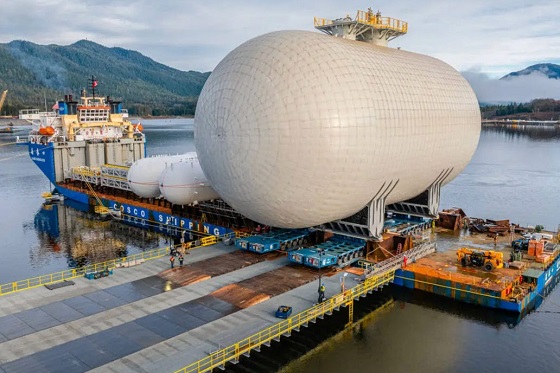


Welcome to the world of REEF
Most Canadians, know who Connor McDavid is.
Most Canadians, know who Connor Bedard is.
And, well … most Canadians know who Howie Mandel is, right?
Household words.
But do any Canadians, know what REEF is? Probably not.
The Ridley Island Energy Export Facility project, a large-scale terminal near Prince Rupert, B.C., being built by AltaGas to export liquefied petroleum gas (LPG) and other bulk liquids to global markets.
Did you know it is providing valuable propane to Japan? No, not for barbecues, but for crucial energy demands in the Asian nation.
Japan uses propane (LP gas) for a wide range of purposes, including household use for cooking, water heating, and room heating, as well as for a majority of taxis, industrial applications, and as a raw material for town gas production.
Construction is progressing, with a target startup around the end of 2026. The project involves building significant infrastructure, including large storage tanks.
And it just so happens that Resource Works CEO Stewart Muir, paid a visit this past week to get a close-up look at a part of Canada’s export story that almost nobody talks about: a brand-new accumulator tank built to hold chilled propane and butane.
“It’s the largest of its kind anywhere. Two more are on the way, and together they’ll form a critical piece of the AltaGas Ltd. REEF project,” Muir said in a report.
”What stood out to me is the larger pattern: projects like this only happen because of the crown jewel of the B.C. economy — the Montney Formation.”
“It’s the triple-word-score of Canadian resource development: LNG, valuable natural gas liquids like propane, and the diluent streams that help unlock Canada’s single biggest export category, crude oil.”
 |
Like the oilsands, the industry has long known about the Montney formation, which stretches 130,000 square kilometres in a football-shaped diagonal from northeast British Columbia into northwest Alberta.
According to CBC News, underneath this huge tract of land, the National Energy Board (NEB) estimates there’s 90 billion barrels of oil equivalent (boe), most of it natural gas. That’s more than half the size of the oilsands, yet the Montney has received only a fraction of the attention, at least from the public at large.
For oil and gas types, the gold rush is on.
Without question, and despite the ire of green groups who seem to be against any kind of resource development in Canada, the Montney is the quiet force multiplier behind local jobs, municipal tax bases, and the national balance of trade.
And it’s all being done at the highest environmental standard, with producers like Tourmaline Oil Corp already posting a 41% reduction in CO2 emission intensity and a target of 55% less methane emission intensity.
”Congrats to AltaGas for pushing this project forward, and a nod as well to other major employers on the North Coast — Trigon, CN and Pembina, writes Muir.
“Quietly and steadily, they’re building the future prosperity of Canadians. And thanks to Mayor Herb Pond, who took the time to walk us through the regional dynamics that make this corridor such a strategic asset.”
Muir was gobsmacked by the size of the project.
Sources say Alberta’s midstream bottleneck and rapid growth of Shale oil and gas exploration and production, has created an absolute glut in ethane, propane and butane. Ridley Island takes this glut and transports it to the Prince Rupert region by railcar and exports to Asian markets.
 |
Ridley Island’s current export capacity of 92,000 bpd is undergoing aggressive expansion to growth by another 115,000 bpd over the next few years in two more phases of construction.
Recent images detail active construction efforts of the storage, jetty and rail infrastructure.
Alas, every issue that threatens to derail the ambitions of Canada’s oil and gas industry — access to market, First Nations land rights, public acceptance of infrastructure projects and, especially, the climate consequences of burning fossil fuels — is writ large in the Montney.
There are now seven separate lawsuits, and threats of further escalation, centred on claims by the Lax Kw’alaams and Metlakatla First Nations (collectively the Coast Tsimshian) that they were misled and lied to by the Crown when they agreed to developments on their traditional lands at Prince Rupert, John Ivison at the National Post reported.
The dispute over a future propane export facility at the port has spread to other resource projects, and the two First Nations have launched lawsuits against the Ksi Lisims LNG project that was one of the Liberal government’s major projects announced by the prime minister last week.
Further, the conflict threatens to negatively impact any plans Ottawa and the province of Alberta have to build an oil pipeline to the port.
Prime Minister Mark Carney’s recent announcements giving the green light to Alberta’s oil & gas industry has stirred the energy pot to new levels.
B.C. Premier David Eby — who prides himself on Indigenous virtue signalling — is pissed off. It appears he was largely left out of the loop and he is digging in.
Eby said the B.C. government needs to make sure this pipeline project doesn’t become an “energy vampire.”
“With all of the variables that have yet to be fulfilled — no proponent, no route, no money, no First Nations support — that it cannot draw limited federal resources, limited Indigenous governance resources, limited provincial resources away from the real projects that will employ people,” Eby added.
B.C.’s Coastal First Nations also say they will use “every tool in their toolbox” to keep oil tankers out of the northern coastal waters.
It is now apparent that all roads, or, shall we say, pipelines, lead to Prince Rupert.
The feds now face an imposing uphill battle, to leverage their standing as a regulator and resolve a dispute that threatens Canada’s crucial growth agenda.
— with files from CBC News, National Post
THE MAKICHUK REPORT is free today.
But if you enjoyed this post, you can tell THE MAKICHUK REPORT that their writing is valuable by pledging a future subscription.

You won’t be charged unless they enable payments.


From the Fraser Institute
By Jason Clemens and Elmira Aliakbari
The challenge of GHG emissions in 2050 is not in the industrial world but rather in the developing world, where there is still significant basic energy consumption using timber and biomass.
The new Memorandum of Understanding (MOU) between the federal and Alberta governments lays the groundwork for substantial energy projects and infrastructure development over the next two-and-a-half decades. It is by all accounts a step forward, though, there’s debate about how large and meaningful that step actually is. There is, however, a fundamental flaw in the foundation of the agreement: it’s commitment to net zero in Canada by 2050.
The first point of agreement in the MOU on the first page of text states: “Canada and Alberta remain committed to achieving net zero greenhouse gas emissions by 2050.” In practice, it’s incredibly difficult to offset emissions with tree planting or other projects that reduce “net” emissions, so the effect of committing to “net zero” by 2050 means that both governments agree that Canada should produce very close to zero actual greenhouse gas (GHG) emissions. Consider the massive changes in energy production, home heating, transportation and agriculture that would be needed to achieve this goal.
So, what’s wrong with Canada’s net zero 2050 and the larger United Nations’ global goal for the same?
Let’s first understand the global context of GHG reductions based on a recent study by internationally-recognized scholar Vaclav Smil. Two key insights from the study. First, despite trillions being spent plus international agreements and regulatory measures starting back in 1997 with the original Kyoto agreement, global fossil fuel consumption between then and 2023 increased by 55 per cent.
Second, fossil fuels as a share of total global energy declined from 86 per cent in 1997 to 82 per cent in 2022, again, despite trillions of dollars in spending plus regulatory requirements to force a transition away from fossil fuels to zero emission energies. The idea that globally we can achieve zero emissions over the next two-and-a-half decades is pure fantasy. Even if there is an historic technological breakthrough, it will take decades to actually transition to a new energy source(s).
Let’s now understand the Canada-specific context. A recent study examined all the measures introduced over the last decade as part of the national plan to reduce emissions to achieve net zero by 2050. The study concluded that significant economic costs would be imposed on Canadians by these measures: inflation-adjusted GDP would be 7 per cent lower, income per worker would be more than $8,000 lower and approximately 250,000 jobs would be lost. Moreover, these costs would not get Canada to net zero. The study concluded that only 70 per cent of the net zero emissions goal would be achieved despite these significant costs, which means even greater costs would be imposed on Canadians to fully achieve net zero.
It’s important to return to a global picture to fully understand why net zero makes no sense for Canada within a worldwide context. Using projections from the International Energy Agency (IEA) in its latest World Energy Outlook, the current expectation is that in 2050, advanced countries including Canada and the other G7 countries will represent less than 25 per cent of global emissions. The developing world, which includes China, India, the entirety of Africa and much of South America, is estimated to represent at least 70 per cent of global emissions in 2050.
Simply put, the challenge of GHG emissions in 2050 is not in the industrial world but rather in the developing world, where there is still significant basic energy consumption using timber and biomass. A globally-coordinated effort, which is really what the U.N. should be doing rather than fantasizing about net zero, would see industrial countries like Canada that are capable of increasing their energy production exporting more to these developing countries so that high-emitting energy sources are replaced by lower-emitting energy sources. This would actually reduce global GHGs while simultaneously stimulating economic growth.
Consider a recent study that calculated the implications of doubling natural gas production in Canada and exporting it to China to replace coal-fired power. The conclusion was that there would be a massive reduction in global GHGs equivalent to almost 90 per cent of Canada’s total annual emissions. In these types of substitution arrangements, the GHGs would increase in energy-producing countries like Canada but global GHGs would be reduced, which is the ultimate goal of not only the U.N. but also the Carney and Smith governments as per the MOU.
Finally, the agreement ignores a basic law of economics. The first lesson in the very first class of any economics program is that resources are limited. At any given point in time, we only have so much labour, raw materials, time, etc. In other words, when we choose to do one project, the real cost is foregoing the other projects that could have been undertaken. Economics is mostly about trying to understand how to maximize the use of limited resources.
The MOU requires massive, literally hundreds of billions of dollars to be used to create nuclear power, other zero-emitting power sources and transmission systems all in the name of being able to produce low or even zero-emitting oil and gas while also moving to towards net zero.
These resources cannot be used for other purposes and it’s impossible to imagine what alternative companies or industries would have been invested in. What we do know is that workers, entrepreneurs, businessowners and investors are not making these decisions. Rather, politicians and bureaucrats in Ottawa and Edmonton are making these decisions but they won’t pay any price if they’re wrong. Canadians pay the price. Just consider the financial fiasco unfolding now with Ottawa, Ontario and Quebec’s subsidies (i.e. corporate welfare) for electric vehicle batteries.
Understanding the fundamentally flawed commitment to Canadian net zero rather than understanding a larger global context of GHG emissions lays at the heart of the recent MOU and unfortunately for Canadians will continue to guide flawed and expensive policies. Until we get the net zero policies right, we’re going to continue to spend enormous resources on projects with limited returns, costing all Canadians.

Jason Clemens
Executive Vice President, Fraser Institute

Elmira Aliakbari

From the Daily Caller News Foundation
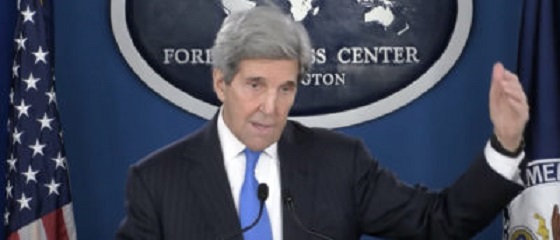
John Kerry, one of the grandest and most persistent climate scolds of the 21stcentury, lurched back into the news this week when he was knighted by Britain’s King Charles, a prominent climate scold in his own right.
In fact, their shared efforts involving flying off on carbon-spewing private jets to lecture the masses to live smaller, more costly lives in the name of fighting climate change was the motivation for the award, as the King thanked Kerry for his “services to tackling climate change.” That seems to be a bit of a grammatical error, but when royalty is involved, no one really cares, do they?
“King Charles and I share the same point of view — that there’s an urgency to doing things,” Kerry told the Globe in an interview. “He’s been ahead of most folks on this from the time I can remember… He always had a commitment to nature.”
Unfortunately for the U.K.’s citizens, the Labour government’s “commitment to nature” mainly appears to involve covering thousands of acres of bucolic British farmland with massive solar arrays and felling thousands of forest trees to make home to big wind installations these days.
Projects like those – frequently forced by the central government on objecting rural communities – form the centerpiece of Secretary of State for Energy Security and Net Zero Ed Miliband’s program to deindustrialize the formerly formidable British economy.
That program – based on the shared philosophy of King Charles and Kerry – has sent the U.K.’s utility rates skyrocketing to the highest on earth. It has also rendered the former global power dependent on imports from foreign nations for its energy security, with China the most prominent among them.
Such are the fruits of the King Charles/Kerry “point of view.” Most would agree with Kerry’s statement that “there’s an urgency to doing things.” The problem is that pretty much everything he and the King have been doing in this realm across the first quarter of the 21st century leads inevitably to serfdom to the Chinese Communist Party.
In an interview with the Financial Times the same day, Kerry repeated much of the tiresome dogma of his alarmist religion, in the process excoriating President Donald Trump as a “denier” and calling U.S. corporate leaders cowards for straying from the narrative he and the King prefer. “It is not that they don’t believe [in climate change] or they don’t want to move forward. They are just scared,” Kerry said of the corporate CEOs, adding, “The process of Donald Trump in the last months, coupled with the justice department, coupled with his vengeance programs, has scared… a lot of people.”
But a more believable alternative explanation for the shift away from the twin manias of ESG and DEI by many companies in recent years is that these corporate leaders have a fiduciary duty to maximize returns on capital to their investors. The problem for Kerry and his disciples is that the preferred alternatives they have advanced too often devolved into unprofitable boondoggles that fail to satisfy that duty. Kerry wants to place the entire blame on Trump – who, ironically, was recently honored by King Charles himself with an unprecedented second state dinner. But the truth is that shift started in earnest in 2023, when Joe Biden’s autopen was still in charge of the ship of American state.
That shift has certainly accelerated this year, as companies have been freed from the incessant hectoring of the Biden government and are now being denied access to the ruinous green subsidies from the IRA that so radically distorted energy markets. This has little to do with climate denialism or cowardice and much to do with sound business practice and CEOs properly carrying out the mandates of their high positions. No amount of hyperbolic talking points from Kerry or the King can change that reality.
In the end, Kerry’s remarks come off as a lot of sound and fury signifying nothing. Now in the twilight of his career, he has become a relic, a totem of a fading global religion whose end cannot come soon enough.
David Blackmon is an energy writer and consultant based in Texas. He spent 40 years in the oil and gas business, where he specialized in public policy and communications.


From Underdog to Top Broodmare

Landmark 2025 Study Says Near-Death Experiences Can’t Be Explained Away

STUDY: TikTok, Instagram, and YouTube Shorts Induce Measurable “Brain Rot”
Red Deer’s Jason Stephan calls for citizen-led referendum on late-term abortion ban in Alberta
-
Opinion2 days ago
Landmark 2025 Study Says Near-Death Experiences Can’t Be Explained Away
-
Focal Points2 days ago
STUDY: TikTok, Instagram, and YouTube Shorts Induce Measurable “Brain Rot”
-
Alberta2 days ago
Red Deer’s Jason Stephan calls for citizen-led referendum on late-term abortion ban in Alberta
-
 Business1 day ago
Blacked-Out Democracy: The Stellantis Deal Ottawa Won’t Show Its Own MPs
-
 Health2 days ago
Tens of thousands are dying on waiting lists following decades of media reluctance to debate healthcare
-
 Artificial Intelligence18 hours ago
Google denies scanning users’ email and attachments with its AI software
-
 Agriculture1 day ago
Health Canada pauses plan to sell unlabeled cloned meat
-
 Indigenous2 days ago
Indigenous activist wins landmark court ruling for financial transparency