
Business
Canadian official keeping Parliament closed is a member of Trudeau’s family foundation

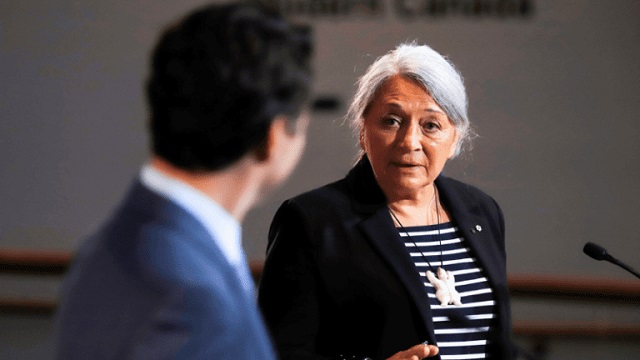

From LifeSiteNews
“How is there no conflict of interest with Mary Simon, especially? This is very similar to Freeland sitting on the WEF board?”
Canada’s governor general, who is keeping Parliament closed on behalf of Prime Minister Justin Trudeau, is a member of the Pierre Elliott Trudeau Foundation, an organization named after Justin’s father that was founded in part by his family.
According to the Pierre Elliott Trudeau Foundation website, Governor General of Canada Mary Simon, who has been keeping Parliament suspended at the request of Prime Minister Justin Trudeau, is a mentor for the Pierre Elliott Trudeau Foundation.
The website lists Simon as a “champion of the social, economic, and human rights of Canadian Inuit people, she shares with the Foundation community the experience she acquired in senior leadership positions in various land claims organizations.”
The Trudeau Foundation labels itself as “an independent and non-partisan charity established in 2001 as a living memorial to the former prime minister.” However, the foundation is under investigation after it received a large donation alleged to be connected to the Chinese Communist Party.
Simon now serves as Canada’s Governor General, the federal representative of the Canadian monarch. As such, Trudeau’s request to suspend Parliament to allow for a Liberal leadership race was approved by Simon before taking affect.
Parliament has now been closed for over a month, since January 6, and is scheduled to remain closed until March 24, despite calls from both Canadians and politicians to reopen the legislature.

Currently, Canada is unable to fully address issues facing Canadians, including U.S. President Donald Trump’s tariff threats. Regardless of this, Trudeau has refused to reopen Parliament, a decision enabled by Simon.
Many online have pointed out that Simon’s role in the Foundation could cause conflict of interest when dealing with Trudeau.
“Friendly reminder that the Governor General of Canada, Mary Simon, is a member of the Trudeau Foundation,” one user wrote on X. “Has any Member of Parliament raised this as an issue of conflict of interest?”
“The Trudeau foundation along with Trudeau must be investigated,” another declared.
“How is there no conflict of interest with Mary Simon, especially? This is very similar to Freeland sitting on the WEF board?” he questioned.
In addition to being a mentor for the Trudeau foundation, records reveal that the Trudeau government increased Simon’s 2025 salary to $378,000 following the $15,200 increase. Simon’s salary has increased by $49,300 since she took office in 2021.
“Can anyone in government explain how Canadians are getting more value from the governor general, because her taxpayer-funded salary just increased by more than $1,200 a month,” Canadian Taxpayer Federation Federal Director Franco Terrazzano said.

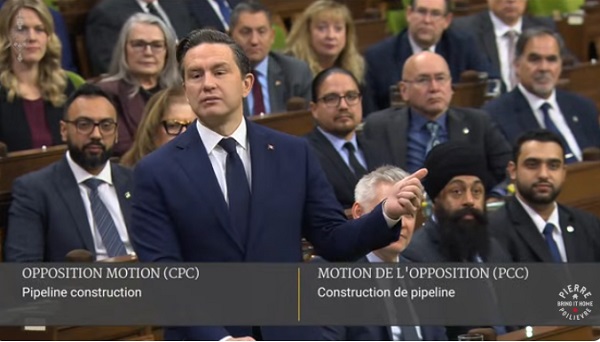
From Pierre Poilievre
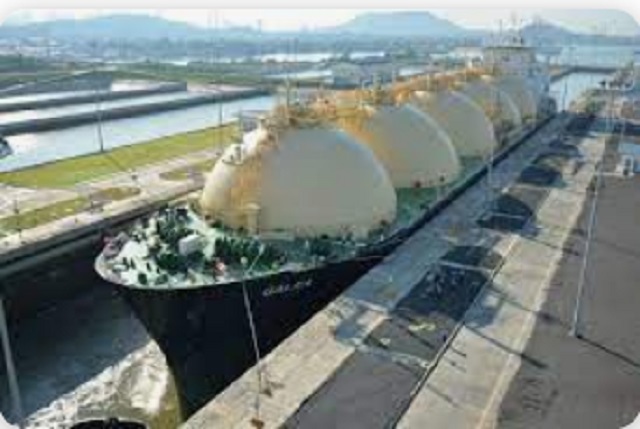
From the Frontier Centre for Public Policy
By Ian Madsen
Canada’s growing LNG exports are opening global markets and reducing dependence on U.S. prices, if Ottawa allows the pipelines and export facilities needed to reach those markets
Canada’s LNG advantage is clear, but federal bottlenecks still risk turning a rare opening into another missed opportunity
Canada is finally in a position to profit from global LNG demand. But that opportunity will slip away unless Ottawa supports the pipelines and export capacity needed to reach those markets.
Most major LNG and pipeline projects still need federal impact assessments and approvals, which means Ottawa can delay or block them even when provincial and Indigenous governments are onside. Several major projects are already moving ahead, which makes Ottawa’s role even more important.
The Ksi Lisims floating liquefaction and export facility near Prince Rupert, British Columbia, along with the LNG Canada terminal at Kitimat, B.C., Cedar LNG and a likely expansion of LNG Canada, are all increasing Canada’s export capacity. For the first time, Canada will be able to sell natural gas to overseas buyers instead of relying solely on the U.S. market and its lower prices.
These projects give the northeast B.C. and northwest Alberta Montney region a long-needed outlet for its natural gas. Horizontal drilling and hydraulic fracturing made it possible to tap these reserves at scale. Until 2025, producers had no choice but to sell into the saturated U.S. market at whatever price American buyers offered. Gaining access to world markets marks one of the most significant changes for an industry long tied to U.S. pricing.
According to an International Gas Union report, “Global liquefied natural gas (LNG) trade grew by 2.4 per cent in 2024 to 411.24 million tonnes, connecting 22 exporting markets with 48 importing markets.” LNG still represents a small share of global natural gas production, but it opens the door to buyers willing to pay more than U.S. markets.
LNG Canada is expected to export a meaningful share of Canada’s natural gas when fully operational. Statistics Canada reports that Canada already contributes to global LNG exports, and that contribution is poised to rise as new facilities come online.
Higher returns have encouraged more development in the Montney region, which produces more than half of Canada’s natural gas. A growing share now goes directly to LNG Canada.
Canadian LNG projects have lower estimated break-even costs than several U.S. or Mexican facilities. That gives Canada a cost advantage in Asia, where LNG demand continues to grow.
Asian LNG prices are higher because major buyers such as Japan and South Korea lack domestic natural gas and rely heavily on imports tied to global price benchmarks. In June 2025, LNG in East Asia sold well above Canadian break-even levels. This price difference, combined with Canada’s competitive costs, gives exporters strong margins compared with sales into North American markets.
The International Energy Agency expects global LNG exports to rise significantly by 2030 as Europe replaces Russian pipeline gas and Asian economies increase their LNG use. Canada is entering the global market at the right time, which strengthens the case for expanding LNG capacity.
As Canadian and U.S. LNG exports grow, North American supply will tighten and local prices will rise. Higher domestic prices will raise revenues and shrink the discount that drains billions from Canada’s economy.
Canada loses more than $20 billion a year because of an estimated $20-per-barrel discount on oil and about $2 per gigajoule on natural gas, according to the Frontier Centre for Public Policy’s energy discount tracker. Those losses appear directly in public budgets. Higher natural gas revenues help fund provincial services, health care, infrastructure and Indigenous revenue-sharing agreements that rely on resource income.
Canada is already seeing early gains from selling more natural gas into global markets. Government support for more pipelines and LNG export capacity would build on those gains and lift GDP and incomes. Ottawa’s job is straightforward. Let the industry reach the markets willing to pay.
Ian Madsen is a senior policy analyst at the Frontier Centre for Public Policy.


Media bound to pay the price for selling their freedom to (selectively) offend

Sometimes An Ingrate Nation Pt. 2: The Great One Makes His Choice

Recent price declines don’t solve Toronto’s housing affordability crisis

From Exception to Routine. Why Canada’s State-Assisted Suicide Regime Demands a Human-Rights Review
-
 COVID-191 day ago
University of Colorado will pay $10 million to staff, students for trying to force them to take COVID shots
-
 Bruce Dowbiggin1 day ago
Integration Or Indignation: Whose Strategy Worked Best Against Trump?
-
 Focal Points2 days ago
Common Vaccines Linked to 38-50% Increased Risk of Dementia and Alzheimer’s
-
 espionage1 day ago
Western Campuses Help Build China’s Digital Dragnet With U.S. Tax Funds, Study Warns
-
 Opinion2 days ago
The day the ‘King of rock ‘n’ roll saved the Arizona memorial
-
 Bruce Dowbiggin1 day ago
Wayne Gretzky’s Terrible, Awful Week.. And Soccer/ Football.
-
 Agriculture1 day ago
Canada’s air quality among the best in the world
-
 Business1 day ago
Canada invests $34 million in Chinese drones now considered to be ‘high security risks’