
CBDC Central Bank Digital Currency
Can the COVID Scamsters Stick the Landing?


corbettreport.com
But it’s another thing altogether for those conspirators to follow through on that psyop and actually achieve their desired end goal: the erection of the biosecurity state.
For those of us who managed to maintain our sanity over the last five years, the question is not whether COVID was a psyop—the answer to that question was obvious from the start—but whether the COVID conspirators have accomplished their objectives.
So, where do we stand in 2025? Did the COVID scamsters win?
Lockdowns
One of the intended effects of the COVID psyop was to take the concept of lockdowns and social distancing from the realm of obscure authoritarian fantasy to stone-cold reality.
As I pointed out in my 2020 video on “What NO ONE is Saying About The Lockdowns,” the idea of using school shutdowns, mandatory lockdowns and social distancing as pandemic prevention measures was first floated by Albequerque high school student Laura Glass for her local science fair project. (For those who are interested, she won third place!)
Prior to 2020, the notion of locking down healthy populations to prevent the spread of disease was still pie-in-the-sky fantasy. No government had seriously attempted to impose lockdowns or social distancing on a mass scale and the very thought of mass quarantines and government-imposed, electronically monitored lockdowns would have been laughed off as conspiracy paranoia.
On the other side of the 2020 divide, however, lockdowns became not only thinkable but an essential tool in the biosecurity state’s toolbelt.
Since 2020, for example, we have seen the extent to which lockdowns penetrated the popular imagination reflected in such ideas as “climate lockdowns.” After all, if locking people in their homes worked for a planetary health emergency, why not use it for a planetary climate emergency?
Yet another example of the mindset shift that has occurred over the past five years arrived last week when the UK Covid-19 Inquiry delivered its verdict that the lockdowns the UK government imposed during the scamdemic were “too little, too late“ and that they could have saved 23,000 lives by locking down earlier.
This is, of course, nonsense. Actually, it’s worse than nonsense; it’s nonsense based on made-up numbers from a known liar. As Off-Guardian point out in their (shadow-banned) tweet on the subject:
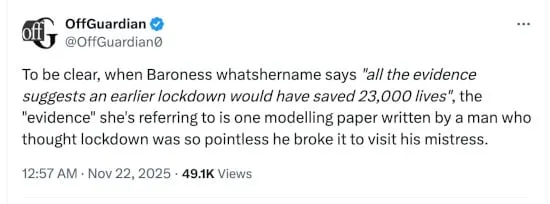
For those who don’t know, the tweet is referring to this passage from the inquiry’s report:
Professor Ferguson told the Inquiry that in later work which analyzed the impact of restrictions in England: “we explicitly modelled the counterfactual scenario of moving the lockdown of 23rd March back to 16th March, and estimated mortality … would have been reduced by 48%.“ That could have equated to a reduction in deaths in England from 48,600 to approximately 25,600 in the first wave up to 1 July 2020.
“Professor Ferguson” is, lest we forget, Neil Ferguson, the “virus modeller” (or should that be the “Liberal Lysenko“?) from Imperial College London who produced the computer model suggesting that 500,000 Britons were destined for the grave unless the UK government imposed a national lockdown. Ferguson has since walked back that claim and now denies calling for a lockdown at all, but it should be kept in mind that his about-face came after he was caught breaking the UK lockdown restrictions to carry on an affair with his married lover.
This is also the same Neil Ferguson who used his amazing “virus modeling” powers to predict 50,000 deaths from the UK’s 2002 mad cow outbreak (actual number of deaths: 177) and up to 200 million deaths from a potential, theoretical bird flu outbreak (which has yet to arrive).
Ferguson’s projection of what could have resulted if the government had locked down faster and earlier suffers from the same “garbage in, garbage out” tomfoolery as the Club of Rome’s environmental apocalypticism. Keep in mind that the number of people who would supposedly have been saved by a quicker UK lockdown is based on a fundamentally flawed input: the number of people who the UK government assert died of COVID. Those of us who called out the scam from the start have been noting for years that these COVID death tolls are statistical chicanery, since they rely on the fraudulent claim that everyone who died with COVID—as measured by the scientifically meaningless PCR test—had in fact died of COVID.
In other words, Ferguson’s numbers are plucked out of thin air and aren’t worth the paper they’re written on. They should not be taken seriously by anyone, whatever their opinion on the efficacy of lockdowns.
But, as usual, the damage has been done. The controlled establishment media has run their headlines about the lives that could have been saved by earlier lockdowns, and the type of people who still get their news from these mockingbird repeaters will now be more certain than ever that social distancing and quarantining populations is the right thing to do in the event of a declared health emergency.
Chalk that one up as a win for the COVID scamsters.
QR Codes, Vaccine Passports and Digital ID
Even more important to the would-be medical tyrants than the normalization of lockdowns and social distancing, however, was the creation of the technological infrastructure upon which the biosecurity state is enabled. This digital infrastructure includes:
- the QR codes that people were habituated into scanning before being allowed access to or egress from various quarantine zones;
- the vaccine passports that were used to assess compliance with vaccine mandates; and
- the various contract tracing apps and self-quarantine apps that were employed to keep track of citizens as they moved from place to place.
If you’ve read about my recent experience trying to order breakfast in Malaysia, you’ll know that, once again, the COVIDians have been remarkably successful in achieving their objectives. As I found out during that Malaysian sojourn, scanning QR codes to access online menus and using cashless payment systems to pay for purchases is becoming so normalized in certain parts of the world that it can be difficult to so much as order breakfast without a smartphone and cellular service. Indeed, the smartphone has become a virtual prerequisite for participation in the public space, and it was the scamdemic that allowed the shift to 100% dependence on smartphones to take place.
One recent demonstration of this smartphone requirement for participation in public life came from an email I received this week from a Corbett Reporter in Canada. He was trying to send a registered letter to the US via Canada Post but was informed that his addressed envelope alone would no longer do. Instead, he now had to fill out an online form and print off a special tracking number in order to mail the item. Not owning a smartphone, he was out of luck. He would have to go home, fill out the online forms on his desktop, print out the paperwork and bring it back to the post office. He opted not to send the letter, vowing instead to never again mail anything to the US.
Living in Japan as I do, the only surprising part of his story is that Canada held off making this change in their postal system for so long. Japan Post implemented the same electronic system for international mail four years ago. Of course, at that time the COVID border closures and postal delivery issues were used as the excuse for the intrusive new policy. But, given that country after country is now bringing in similar measures, the reality is clear: the change to a computer-dependent postal system is a global directive that was pushed, using the cover of COVID contagion, during the scamdemic. The end result is that one must either carry their smartphone with them at all times or spend extra time at home filling out online forms and printing off paperwork if they want to send mail internationally.
Of course, all of these technological “upgrades” to our daily experience—from the smartphone postal system to the QR code menus to the cashless payment systems—serve the same agenda. They are meant to pave the way toward the apotheosis of the biosecurity state: the consolidation of all our information into a single government-issued digital identity app. Soon, we will be giving the government real-time access to all of our daily movements, transactions and interactions and will be signing in with government-issued digital credentials everywhere we go online and in real life.
In the event of the next scamdemic, the scammers will hardly have to do anything at all. The QR code check-ins, vaccine passport checks and cashless payments will already be so much a part of our daily life that we’ll hardly notice any new scamdemic-related restrictions on our activities.
That’s another win for Team COVID. But they’re not done yet.
Clot shots
Another key goal of the scamdemic, of course, was to fast track government approval of mRNA and DNA “vaccine” technologies.

We know this, of course, because the conspirators told us as much in their own words. Who can forget the October 2019 Milken Institute-hosted discussion on the “Universal Flu Vaccine“? In case you have forgotten, that was the conference in which such luminaries as Tony Fauci and Rick Bright lamented that the poor, beleaguered Big Pharma corporations were going to have to spend billions of dollars and at least a decade of hard work proving the safety and efficacy of their DNA/mRNA injection techniques…unless some health emergency arose to justify the emergency approval of these experimental technologies.
So, were Fauci and Bright and their co-conspirators successful in their fast-tracking task? Did they circumvent a decade of regulatory approval work for their Big Pharma buddies? Well, if the point was to invoke a health emergency to get emergency approval for these clot shot monstrosities, then we need look no further than “Operation Warp Speed” for proof that the COVID conspirators were, in fact, remarkably successful.
And let’s never forget that Trump considers the Warp Speed MAGA jabs to be “one of the greatest things ever in politics or in the military!”
Lest there be any doubt about Trump’s devotion to this technology, let’s not forget that he hosted an event launching his $500 billion AI-pushing “Stargate” project on his third day in office earlier this year, at which Larry Ellison discussed using AI to develop personalized mRNA cancer vaccines. And just two months ago, Bill Gates used his place of honor at a White House banquet to boast that he and Trump were discussing “vaccines and gene editing” in their joint effort to “tak[e] American innovation to the next level.”
But this isn’t just about Trump, and it isn’t just about what’s happening in the US. This is a worldwide agenda. And, if this smattering of headlines from the past few months is any indication, the COVID era has given a gigantic shot in the arm (pun intended) to the clot shot “vaccine” manufacturers:
Experimental mRNA flu vaccine shows superior efficacy against symptomatic illness (just don’t ask about the side effects)
COVID Vaccine Tech May Reduce Disabilities in Snakebite Victims
Personalized mRNA Vaccines Will Revolutionize Cancer Treatment—If Funding Cuts Don’t Doom Them
The Dawn of Personalized DNA Vaccines
And, exactly in line with my reporting in Who Is Bill Gates? there’s this recent report
New Gates-Funded Microneedle Patch Implant Installs Both mRNA and Quantum Dot Markings Into the Body
Yes, it’s safe to say we are now ensconced in the era of genetic intervention masquerading as “vaccines.”
That’s another win for the WHO mafia.
Mission Accomplished?
I could go on. I haven’t even mentioned yet the passage of the WHO’s pandemic treaty or how its provisions actually encourage the work of the bioweapons industry…in the name of “defense” against such weapons, naturally. (A “poor man’s nuke,” anyone?)
But you get the point. Just as it’s difficult to deny that the COVID scamdemic was the biggest psyop of our lifetime, it’s equally difficult to deny that the perpetrators of that scam have been remarkably successful, achieving so many of their 2030 Agenda items in one fell swoop.
So, did the conspirators win?
The answer to this question is even more important than it might seem at first glance. History, as we know, is written by the winners, so if the WHO goons and their string-pullers and paymasters did indeed win, then our grandchildren will grow up learning about the terrible plague that threatened to wipe out the global population in 2020. They’ll read about how some crazy kooks resisted the loving lockdowns of the government and warned against the life-saving vaccines. They’ll truly believe we were only saved by the skin of our teeth thanks to our benevolent masters imposing lockdowns, mRNA clot shots and masks on us all (though they should have locked us down sooner and harder!).
This is why spreading the truth about these events is so vital. We must not let the lies stand. If these lies are written into the history books, then the conspirators really have won.
If you agree with me, share this report (or at least the evidence linked herein) with someone you love.
Like this type of essay? Then you’ll love The Corbett Report Subscriber newsletter, which contains my weekly editorial as well as recommended reading, viewing and listening.
If you’re a Corbett Report member, you can sign in to corbettreport.com and read the newsletter today.
Not a member yet? Sign up today to access the newsletter and support this work.
Are you already a member and don’t know how to sign in to the website? Contact me HERE and I’ll be happy to help you get logged in!
Subscribe to The Corbett Report


From LifeSiteNews
By David James
The aim is to have the digital euro fully in place by 2030 in order to move Europe fully into the United Nations’ post-capitalist system described in Agenda 2030.
It always pays to scrutinize closely the comments of financial elites because they are rarely honest about their intentions. An instance is the comments of Christine Lagarde, president of the European Central Bank (ECB) who said there will be a vote next month in the European Union parliament on the next step toward creating a digital euro, which would be a central bank digital currency (CBDC).
A central bank digital currency is money issued by the central bank in digital form as opposed to digital credit issued by banks, which is the dominant form of money in Western societies. She claims that it will mean more freedom for Europeans and that there is nothing to fear.
Lagarde anticipates launching the digital euro in about 18 months. The aim is to have it fully in place by 2030 in order to move Europe fully into the United Nations’ post-capitalist system that is described in Agenda 2030.
Lagarde’s blandishments about what the digital euro represents do not survive close examination. She acknowledged that the main concern of the population is the privacy implications, claiming the ECB is looking at a technology that will offer protections. The private banks, she said, will apply the “rules of scrutiny” that already have access to the transactions. “We are not interested in the data. The private banks are interested in the data.”
Lagarde also said that the “people have dictated” the transition to a digital euro. This looks dubious. Neither the EU Commission nor the ECB is democratically elected. And if the main concern people have with a CBDC is privacy, then why would people prefer it over cash, which is immune to scrutiny? It is not as if a digital euro would satisfy an unmet need. Digital money – credit and online transactions – is already freely available in the banking system.
The ECB is also speaking out of both sides of its mouth, saying on one hand that the digital euro will only complement cash and on the other that cash will be eliminated.
Lagarde made it clear that the aim is to phase out cash completely. Agenda 2030, she claims, “can only be enforced in a cashless economy.” Why? What is it about cash that makes environmental policies impossible to implement? The answer is surely that a digital euro is needed to control people’s behavior, forcing them to comply with environmental rules.
Previous comments by central bankers suggest there is good reason for Europeans to be extremely suspicious. In 2021, the general manager of the Bank for International Settlements, Agustín Carstens, said: “We don’t know who’s using a $100 bill today and we don’t know who’s using a 1,000-peso bill today. The key difference with the CBDC is the central bank will have absolute control on the rules and regulations that will determine the use of that expression of central bank liability, and also we will have the technology to enforce that.”
The pretext for the financial power play is climate change and the push toward net zero. A European CBDC is not, as implied by Lagarde, the creation of a new digital monetary mechanism. As economist Richard Werner points out, that already exists – credit and debit cards, for example. The significance of a digital euro is that it threatens the banking system.
A CBDC, like cash, has no interest rate on it. So why would people continue to use credit produced by private entities such as banks or credit card companies – currently over 95 percent of the money supply – on which they have to pay interest? As the Reserve Bank of New Zealand noted, CBDCs have the potential to destroy private banks.
That problem does not seem to concern the ECB, however. Indeed, fundamentally altering the banking system may be what they are aiming for. Lagarde said “climate compliance” will become a core element of bank supervision, not a separate initiative, “because climate change presents significant, material financial risks to banks and the entire financial system.”
The ECB’s supervision will mandate that banks integrate the management of climate-related and environmental risks into their existing risk management processes, particularly through new prudential transition planning requirements under what is called CRD VI. European banking, it seems, will no longer be defined by profitability and fiscal soundness but also by the politics of climate change.
The slipperiness of the ECB‘s arguments point to a much darker ambition. Werner says when CBDCs are connected to digital IDs “we are talking about the most totalitarian control system in human history … it gives you as a controller complete visibility on what everyone is doing, every transaction.
“The monitoring is only one aspect. These CBDCs are programmable and you can use big data algorithms, which they sell to us as artificial intelligence, in order to have rules about who can buy what and for what purpose, at what time and at what place – and therefore control all your movement. In the history of dictatorships, there never has been such a powerful control tool.”
There is a flaw, though, in the ECB’s push to change Europe’s financial architecture that may prove fatal to its ambitions. The EU and ECB do not have genuine central control. When the euro was established in 1998, the only way Germany was able to join was on the condition there was no consolidation of the government debt. So, although the ECB notionally sets interest rates for the zone, government debt is held at the national level and each country’s interest rate differs.
The ECB is thus a central bank in name only, unlike the U.S. Federal Reserve, or for that matter most country’s central banks, that oversee their national government debt. A European nation can choose to exit the EU, and each has to have its own monetary policy in spite of the ECB setting a uniform rate.
The push to create a digital euro is most likely an attempt to deal with these contradictions, but at best it will be a makeshift solution and it will take very little for it to fall apart. Disintegration of the European Union, and the common currency, is not out of the question.
Meanwhile, the U.S. is going in the opposite direction. In July, the U.S. House of Representatives passed the Anti-CBDC Surveillance State Act, which prevents the Federal Reserve from issuing a retail CBDC directly to individuals.
European debt is becoming increasingly parlous, especially in France where there have even been suggestions that there might need to be assistance from the International Monetary Fund. Italy’s debt, which is 138 percent of GDP, is also problematic. Lagarde is hoping for a rollout of the digital euro in 2027 and completion in 2030. But the Euro zone, and the ECB that oversees it, may not last that long.
From LifeSiteNews
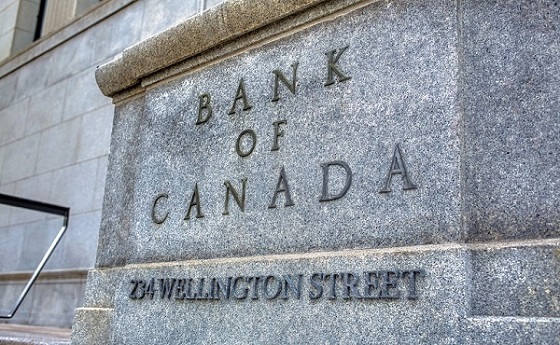
A new report released by the Bank of Canada proposed a ‘promising architecture well-suited for basic payments’ through the use of a digital dollar, though most Canadians are wary of such an idea.
Canada’s central bank has been studying ways to introduce a central bank digital currency (CBDC) for use for online retailers, according to a new report, despite the fact that recent research suggests Canadians are wary of any type of digital dollar.
In a new 47-page report titled, “A Retail CBDC Design For Basic Payments Feasibility Study,” which was released on June 13, 2025, the Bank of Canada (BOC) identified a “promising architecture well-suited for basic payments” through the use of a digital dollar.
The report reads that CBDCs “can be fast and cheap for basic payments, with high privacy, although some areas such as integration with retail payments systems, performance of auditing and resilience of the core system state require further investigation.”
While the report authors stopped short of fully recommending a CBDC, they noted it is a decision that could happen “outside the scope of this analysis.”
“Our framing highlights other promising architectures for an online retail CBDC, whose analysis we leave as an area for further exploration,” reads the report.
When it comes to a digital Canadian dollar, the Bank of Canada last year found that Canadians are very wary of a government-backed digital currency, concluding that a “significant number” of citizens would resist the implementation of such a system.
Indeed, a 2023 study found that most Canadians, about 85 percent, do not want a digital dollar, as previously reported by LifeSiteNews.
The study found that a “significant number” of Canadians are suspicious of government overreach and would resist any measures by the government or central bank to create digital forms of official money.
The BOC has said that it would continue to look at other countries’ use and development of CBDCs and will work with other “central banks” to improve so-called cross border payments.
Last year, as reported by LifeSiteNews, the BOC has already said that plans to create a digital “dollar,” also known as a central bank digital currency (CBDC), have been shelved.
Digital currencies have been touted as the future by some government officials, but, as LifeSiteNews has reported before, many experts warn that such technology would restrict freedom and could be used as a “control tool” against citizens, similar to China’s pervasive social credit system.
The BOC last August admitted that the creation of a CBDC is not even necessary, as many people rely on cash to pay for things. The bank concluded that the introduction of a digital currency would only be feasible if consumers demanded its release.
Conservative Party leader Pierre Poilievre has promised, should he ever form the government, he would oppose the creation of a digital dollar.
Contrast this to Canada’s current Liberal Prime Minister Mark Carney. He has a history of supporting central bank digital currencies and in 2022 supported “choking off the money” donated to the Freedom Convoy protests against COVID mandates.


Is there a cure for Alzheimer’s Disease?

Learning the Truth about “Children’s Graves” and Residential Schools is More Important than Ever

The Unmasking of Vaccine Science

Media bound to pay the price for selling their freedom to (selectively) offend
-
 Alberta2 days ago
Alberta Sports Hall of Fame Announces Class of 2026 Inductees
-
 Censorship Industrial Complex2 days ago
Conservative MP Leslyn Lewis slams Liberal plan targeting religious exemption in hate speech bil
-
 Business2 days ago
Canada’s climate agenda hit business hard but barely cut emissions
-
 Health2 days ago
News RFK Jr.’s vaccine committee to vote on ending Hepatitis B shot recommendation for newborns
-
 International1 day ago
FBI may have finally nabbed the Jan. 6 pipe bomber
-
 Bruce Dowbiggin1 day ago
Integration Or Indignation: Whose Strategy Worked Best Against Trump?
-
 Business1 day ago
Carney’s Toronto cabinet meetings cost $530,000
-
 espionage1 day ago
Digital messages reportedly allege Chinese police targeted dissident who died suspiciously near Vancouver