Connect with us

espionage

Bombshell report indicates Clinton, Soros group plotted to ‘demonize’ Trump

Published

8 minute read

From The Center Square

By 

“Julie [Smith] says it will be a long-term affair to demonize Putin and Trump. Now it is good for a post-convention bounce. Later the FBI will put more oil on the fire”

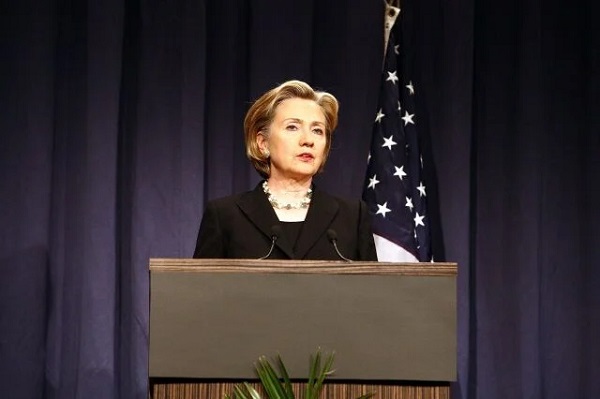
Newly declassified intelligence documents indicate that Hillary Clinton, her 2016 presidential campaign managers, and a top member of a George Soros group plotted to fabricate the Trump-Russia collusion campaign to distract the public from Clinton’s email scandal.

Declassified by the Senate Judiciary Committee on Thursday, the 29-page “Durham annex” from 2023 chronicles the Office of Special Counsel’s (OSC) investigation into purported efforts by the Clinton campaign and its allies to falsely tie Russia’s cyber interference attempts during election season to Trump.

In its investigation, OSC uncovered emails that appeared to be sent by Leonard Benardo, senior vice president of Soros’ Open Society Foundations, to people involved in Clinton’s campaign. Soros is a billionaire funder of Democratic campaigns.

The emails appear to show that Benardo engaged in discussions with Julianne Smith, one of Clinton’s foreign policy advisors, about how to use reports of Russian interference in the election to Clinton’s advantage and Trump’s detriment. Benardo later told OSC he had no recollection of writing the emails.

In an email dated July 25, 2016, Benardo told an undisclosed person that “politicization is on the table” and that he and Smith had been discussing ways to create a story casting Trump as “an agent of influence” in Russian President Vladimir Putin’s attempts to undermine the election “in the interest of Donald Trump.”

“Julie [Smith] says it will be a long-term affair to demonize Putin and Trump. Now it is good for a post-convention bounce. Later the FBI will put more oil on the fire,” Benardo wrote, indicating that Clinton’s campaign planned to use the FBI to push the story.

While the FBI established early on that Putin ordered “cyber influence operations” to undermine faith in the U.S. democratic process, it found no evidence that Putin interfered on behalf of Trump.

But former President Barack Obama and his senior advisors reportedly pressured the Intelligence Community to assert otherwise, according to documents declassified last week. Obama has denied the allegations.

The Clinton campaign’s goal, it appeared, was to divert Americans’ attention away from her email scandal, since “Hillary is hardly good-looking as far as credibility is concerned,” Benardo added.

Clinton served as Secretary of State under the Obama administration from 2009 to 2013, where she used a private email server for official agency communications, putting thousands of emails with sensitive or classified information at risk.

According to a follow-up email by Benardo dated two days later, Clinton personally approved of the plan to fabricate the Trump-Russia collusion.

“HRC approved Julia’s idea about Trump and Russian hackers hampering U.S. elections. That should distract people from her own missing email, especially if the affair goes to the Olympic level,” Benardo wrote.

“The point is making the Russian play a U.S. domestic issue. Say something like a critical infrastructure threat for the election to feel menace since both POTUS and VPOTUS have acknowledged the fact IC would speed up searching for evidence that is regrettably still unavailable,” he clarified.

Upon finding the emails, the Office of Special Council questioned Benardo, who told them he did not know who “Julie” referred to and he did not draft the emails “to the best of his recollection.”

Clinton, when questioned by OSC, said the plan she apparently approved “looked like Russian disinformation.” Campaign Chair John Podesta and other advisors each denied the validity of the emails and each called the emails “ridiculous.”

Smith was also interviewed and said she recalled neither drafting or receiving the emails nor proposing a plan to Clinton or other campaign leadership to try tying Putin to Trump. She also denied enlisting the FBI to further such efforts.

But OSC found that the verified communications between Smith and campaign advisors implied otherwise. The same day Benardo purportedly sent the email about how the FBI “will put oil on the fire,” Smith texted a Clinton campaign advisor and asked them to “see if [Special Assistant to the President and National Security Council member] will tell you if there is a formal fbi or other investigation into the hack?”

The Clinton campaign advisor, whose name is redacted, replied that the person in question “won’t say anything more to me. Sorry. Told me she went as far as she could.”

Ultimately, OSC determined that “it is a logical deduction that [redacted] Smith was, at a minimum, playing a role in the Clinton campaign’s efforts to tie Trump to Russia,” and that available evidence “supports the notion that the campaign might have wanted or expected the FBI or other agencies to aid the effort” via a formal investigation.

“In short, neither the Office nor [redacted] have been able to determine definitively whether the purported Clinton campaign plan [redacted] was entirely genuine, partially true, a composite pulled from multiple sources, exaggerated in certain respects, or fabricated in its entirety,” OSC concluded, adding that regardless, the entire affair was “concerning.”

As of Thursday afternoon, Clinton and her former campaign advisors have not responded to the Durham annex’s publication, despite outcry from Republicans. The Trump administration is presenting the report as the “smoking gun” confirming recent allegations that Obama, Clinton, and the Intelligence Community created a deliberate smear campaign to delegitimize Trump’s first presidency.

“Based on the Durham annex, the Obama FBI failed to adequately review and investigate intelligence reports showing the Clinton campaign may have been ginning up the fake Trump-Russia narrative for Clinton’s political gain, which was ultimately done through the Steele Dossier and other means,” U.S. Sen. Chuck Grassley, R-Iowa, said Thursday.

“History will show that the Obama and Biden administration’s law enforcement and intelligence agencies were weaponized against President Trump,” he added. “This political weaponization has caused critical damage to our institutions and is one of the biggest political scandals and cover-ups in American history.”

Todayville is a digital media and technology company. We profile unique stories and events in our community. Register and promote your community event for free.

Follow Author

Artificial Intelligence

UK Police Pilot AI System to Track “Suspicious” Driver Journeys

Published on

logo

By

AI-driven surveillance is shifting from spotting suspects to mapping ordinary life, turning everyday travel into a stream of behavioral data

Police forces across Britain are experimenting with artificial intelligence that can automatically monitor and categorize drivers’ movements using the country’s extensive number plate recognition network.
Internal records obtained by Liberty Investigates and The Telegraph reveal that three of England and Wales’s nine regional organized crime units are piloting a Faculty AI-built program designed to learn from vehicle movement data and detect journeys that algorithms label “suspicious.”
For years, the automatic number plate recognition (ANPR) system has logged more than 100 million vehicle sightings each day, mostly for confirming whether a specific registration has appeared in a certain area.
The new initiative changes that logic entirely. Instead of checking isolated plates, it teaches software to trace entire routes, looking for patterns of behavior that resemble the travel of criminal networks known for “county lines” drug trafficking.
The project, called Operation Ignition, represents a change in scale and ambition.
Unlike traditional alerts that depend on officers manually flagging “vehicles of interest,” the machine learning model learns from past data to generate its own list of potential targets.
Official papers admit that the process could involve “millions of [vehicle registrations],” and that the information gathered may guide future decisions about the ethical and operational use of such technologies.
What began as a Home Office-funded trial in the North West covering Merseyside, Greater Manchester, Cheshire, Cumbria, Lancashire, and North Wales has now expanded into three regional crime units.
Authorities describe this as a technical experiment, but documents point to long-term plans for nationwide adoption.
Civil liberty groups warn that these kinds of systems rarely stay limited to their original purpose.
Jake Hurfurt of Big Brother Watch said: “The UK’s ANPR network is already one of the biggest surveillance networks on the planet, tracking millions of innocent people’s journeys every single day. Using AI to analyse the millions of number plates it picks up will only make the surveillance dragnet even more intrusive. Monitoring and analysing this many journeys will impact everybody’s privacy and has the potential to allow police to analyse how we all move around the country at the click of a button.”
He added that while tackling organized drug routes is a legitimate goal, “there is a real danger of mission creep – ANPR was introduced as a counter-terror measure, now it is used to enforce driving rules. The question is not whether should police try and stop gangs, but how could this next-generation use of number plate scans be used down the line?”
The find and profile app was built by Faculty AI, a British technology firm with deep ties to government projects.
The company, which worked with Dominic Cummings during the Vote Leave campaign, has since developed data analysis tools for the NHS and Ministry of Defence.
Faculty recently drew attention after it was contracted to create software that scans social media for “concerning” posts, later used to monitor online debate about asylum housing.
Faculty declined to comment on its part in the ANPR initiative.
Chief constable Chris Todd, chair of the National Police Chiefs’ Council’s data and analytics board, described the system as “a small-scale, exploratory, operational proof of concept looking at the potential use of machine learning in conjunction with ANPR data.”
He said the pilot used “a very small subset of ANPR data” and insisted that “data protection and security measures are in place, and an ethics panel has been established to oversee the work.”
William Webster, the Biometrics and Surveillance Camera Commissioner, said the Home Office was consulting on new legal rules for digital and biometric policing tools, including ANPR.
“Oversight is a key part of this framework,” he said, adding that trials of this kind should take place within “a ‘safe space’” that ensures “transparency and accountability at the outset.”
A Home Office spokesperson said the app was “designed to support investigations into serious and organised crime” and was “currently being tested on a small scale” using “a small subset of data collected by the national ANPR network.”
From a privacy standpoint, the concern is not just the collection of travel data but what can be inferred from it.
By linking millions of journeys into behavioral models, the system could eventually form a live map of how people move across the country.
Once this analytical capacity becomes part of routine policing, the distinction between tracking suspects and tracking citizens may blur entirely.
Continue Reading

espionage

Carney Floor Crossing Raises Counterintelligence Questions aimed at China, Former Senior Mountie Argues

Published on

Michael Ma has recently attended events with Chinese consulate officials, leaders of a group called CTCCO, and the Toronto “Hongmen,” where diaspora community leaders and Chinese diplomats advocated Beijing’s push to subordinate Taiwan. These same entities have also appeared alongside Canadian politicians at a “Nanjing” memorial in Toronto.

By Garry Clement

Michael Ma’s meeting with consulate-linked officials proves no wrongdoing—but, Garry Clement writes, the timing and optics highlight vulnerabilities Canada still refuses to treat as a security issue.

I spent years in the Royal Canadian Mounted Police learning a simple rule. You assess risk based on capability, intent, and opportunity — not on hope or assumptions. When those three factors align, ignoring them is negligence.

That framework applies directly to Canada’s relationship with the People’s Republic of China — and to recent political events that deserve far more scrutiny than they have received.

Michael Ma’s crossover to the Liberal Party may be completely legitimate, although numerous observers have noted oddities in the timing, messaging, and execution surrounding Ma’s move, which brings Mark Carney within one seat of majority rule.

There is no evidence of wrongdoing.

But from a law enforcement and national security perspective, that is beside the point. Counterintelligence is not about proving guilt after the fact; it is about identifying vulnerabilities before damage is done — and about recognizing when a situation creates avoidable exposure in a known threat environment.

A constellation of ties and public appearances — reported by The Bureau and the National Post — has fueled questions about Ma’s China-facing judgment and vetting. Those reports describe his engagement with a Chinese-Canadian Conservative network that intervened in party leadership politics by urging Erin O’Toole to resign for his “anti-China” stance after 2021 and later calling for Pierre Poilievre’s ouster — while advancing Beijing-aligned framing on key Canada–China disputes.

The National Post has also reported that critics point to Ma’s pro-Beijing community endorsement during his campaign, and his appearance at a Toronto dinner for the Chinese Freemasons — where consular officials used the forum to promote Beijing’s “reunification” agenda for Taiwan. Ma reportedly offered greetings and praised the organization, but did not indicate support for annexation.

Open-source records also show that the same Toronto Chinese Freemasons and leaders Ma has met from a group called CTCCO sponsored and supported Ontario’s “Nanjing Massacre Commemorative Day” initiative (Bill 79) — a campaign celebrated in Chinese state and Party-aligned media, alongside public praise from PRC consular officials in Canada.

China Daily reported in 2018 that the Nanjing memorial was jointly sponsored by CTCCO and the Chinese Freemasons of Canada (Toronto), supported by more than $180,000 in community donations.

Photos show that PRC consular officials and Toronto politicians appeared at related Nanjing memorial ceremonies, including Zhao Wei, the alleged undercover Chinese intelligence agent later expelled from Canada after The Globe and Mail exposed Zhao’s alleged targeting of Conservative MP Michael Chong and his family in Hong Kong.

The fact that Michael Ma recently met with some of the controversial pro-Beijing community figures and organizations described above — including leaders from the Hongmen ecosystem and the CTCCO — does not prove any nefarious intent in either his Conservative candidacy or his decision to cross the floor to Mark Carney.

But it does demonstrate something Ottawa keeps avoiding: the PRC’s influence work is often conducted in plain sight, through community-facing institutions, elite access, and “normal” relationship networks — the very channels that create leverage, deniability, and political pressure over time.

Canada’s intelligence community has been clear.

The Canadian Security Intelligence Service has repeatedly identified the People’s Republic of China as the most active and persistent foreign interference threat facing Canada. These warnings are not abstract. They are rooted in investigations, human intelligence, and allied reporting shared across the Five Eyes intelligence alliance.

At the center of Beijing’s approach is the United Front Work Department — a Chinese Communist Party entity tasked with influencing foreign political systems, cultivating elites, and shaping narratives abroad. In policing terms, it functions as an influence and access network: operating legally where possible, covertly where necessary, and always in service of the Party’s strategic objectives.

What differentiates the People’s Republic of China from most foreign actors is legal compulsion.

Under China’s National Intelligence Law, Chinese citizens and organizations can be compelled to support state intelligence work and to keep that cooperation secret. In practical terms, that creates an inherent vulnerability for democratic societies: coercive leverage — applied through family, travel, business interests, community pressure, and fear.

This does not mean Chinese-Canadians are suspect.

Quite the opposite — many are targets of intimidation themselves. But it does mean the Chinese Communist Party has a mechanism to exert pressure in ways democratic states do not. Ignoring that fact is not tolerance; it is a failure to understand the threat environment.

In the RCMP, we were trained to recognize that foreign interference rarely announces itself. It operates through relationships, access, favors, timing, and silence. It does not require ideological agreement — only opportunity and leverage.

That is why transparency matters. When political figures engage with representatives of an authoritarian state known for interference operations, the burden is not on the public to “prove” concern is justified. The burden is on officials to explain why there is none — and to demonstrate that basic safeguards are in place.

Canada’s allies have already internalized this reality. Australia, the United States, and the United Kingdom have all publicly acknowledged and legislated against People’s Republic of China political interference. Their assessments mirror ours. Their conclusions are the same.

In the United States, the Linda Sun case — covered by The Bureau — illustrates, in the U.S. government’s telling, how United Front–style influence can be both deniable and effective: built through diaspora-facing proxies, insider access, and relationship networks that rarely look like classic espionage until the damage is done.

And this is not a niche concern.

Think tanks in both the United States and Canada — as well as allied research communities in the United Kingdom and Europe — have documented the scale and persistence of these political-influence ecosystems. Nicholas Eftimiades, an associate professor at Penn State and a former senior National Security Agency analyst, has estimated multiple hundreds of such entities are active in the United States. How many operate in Canada is the question Ottawa still refuses to treat with urgency — and, if an upcoming U.S. report is any indication, the answer may be staggering.

Canada’s hesitation to address United Front networks is not due to lack of information. It is due to lack of resolve.

From a law enforcement perspective, this is troubling. You do not wait for a successful compromise before tightening security. You act when the indicators are present — especially when your own intelligence agencies are sounding the alarm.

National security is not ideological. It is practical.

The Bureau is a reader-supported publication.

To receive new posts and support my work, consider becoming a free or paid subscriber.

Continue Reading

Trending

X