
Daily Caller
Biden-Harris Admin’s Multi-Billion Dollar Electric School Bus Program Is A Huge Gift To China, House Report Finds


From the Daily Caller News Foundation
By Owen Klinsky
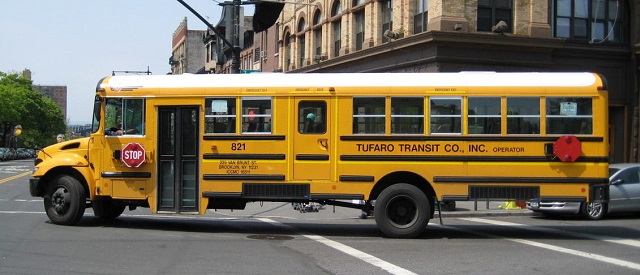
The Biden-Harris administration’s $5 billion Clean School Bus Program uses nearly 400% more taxpayer dollars per school bus and benefits the Chinese Communist Party (CCP), a House report revealed Tuesday.
The 51-page report from the House Committee on Energy and Commerce found promoting electric school buses and other electric vehicles (EVs) enriches the CCP as the EV supply chain is roughly 90% dependent on China, raising both national security and human rights concerns. It also highlighted immense expenses for taxpayers, with the average electric school bus under the first iteration of the Clean School Bus Program — the first of three iterations — costing $381,191, nearly four times that of a typical full-sized diesel school bus.
“It is clear the $5 billion Clean School Bus Program is overall a failure and, in many cases, a waste of Americans’ hard-earned taxpayer dollars,” Republican Congresswoman Cathy McMorris Rodgers, who chairs the House Committee on Energy and Commerce, said in a statement regarding the report’s findings. “The program, led by the radical Biden-Harris EPA [Environmental Protection Agency], props up a market that relies heavily upon a supply chain dominated by the Chinese Communist Party.”
Funded by the 2021 Bipartisan Infrastructure Law, the Clean School Bus Program provided the Biden-Harris EPA with funds over five years to “replace existing school buses with zero-emission and clean school buses.”

Kamala Harris led the Biden Administration's $5,000,000,000 EV school bus program.
After 3 years, just 60 buses are on the road.
That's over $83,300,000 per bus.
A vote for Kamala is a vote to waste more tax dollars on failed green programs.
— Daniel Turner (@DanielTurnerPTF) July 29, 2024
China currently accounts for approximately two-thirds of global EV battery cell production, while the U.S. manufactured just 7% as of 2022, raising national security concerns as the U.S. would likely have to depend on Chinese EV technology for its electric school buses, according to the report. Furthermore, the government-subsidized purchases of electric school buses under the Clean School Bus Program incentivize pre-existing human rights abuses in the EV supply, including the use of Uyghur forced labor in China’s Xinjiang region.
The report also identified limited range as an issue, with standard electric school buses from leading manufacturer BlueBird able to travel just 120 miles on a single charge, while some propane models can travel 400 miles before needing to refuel. The range problem can also be exacerbated by cold and warm weather conditions, with a study from the National Renewable Energy Laboratory finding electric transit buses lose roughly a third of their range at 25 degrees Fahrenheit compared to ideal conditions.
Electric school buses also increase the risk of fraud due to a lack of documentation requirements for contractors, with the EPA relying solely on self-certified applications and estimates created by applicants, according to the report. A separate July report from a Maryland county’s Office of the Inspector General resulted in millions of dollars in “wasteful spending.”
“The EPA launched the Clean School Bus program without sufficient safeguards and considerations for practical hurdles applicants may face. For example, the EPA did not require documentation for some of the required application information and allowed contractors enthused at the opportunity to receive federal funding to apply on behalf of unknowing school districts, some of which eventually withdraw from the program,” the report states. “The EPA failed to account for the considerable electric infrastructure upgrades that electrifying a school bus fleet could require, potentially leading to delays for schools in utilizing their new buses.”
The White House did not immediately respond to a request for comment.

Business
Some Of The Wackiest Things Featured In Rand Paul’s New Report Alleging $1,639,135,969,608 In Gov’t Waste


From the Daily Caller News Foundation
Republican Kentucky Sen. Rand Paul released the latest edition of his annual “Festivus” report Tuesday detailing over $1 trillion in alleged wasteful spending in the U.S. government throughout 2025.
The newly released report found an estimated $1,639,135,969,608 total in government waste over the past year. Paul, a prominent fiscal hawk who serves as the chairman of the Senate Homeland Security and Governmental Affairs Committee, said in a statement that “no matter how much taxpayer money Washington burns through, politicians can’t help but demand more.”
“Fiscal responsibility may not be the most crowded road, but it’s one I’ve walked year after year — and this holiday season will be no different,” Paul continued. “So, before we get to the Feats of Strength, it’s time for my Airing of (Spending) Grievances.”
Dear Readers:
As a nonprofit, we are dependent on the generosity of our readers.
Please consider making a small donation of any amount here.
Thank you!
The 2025 “Festivus” report highlighted a spate of instances of wasteful spending from the federal government, including the Department of Health and Human Services (HHS) spent $1.5 million on an “innovative multilevel strategy” to reduce drug use in “Latinx” communities through celebrity influencer campaigns, and also dished out $1.9 million on a “hybrid mobile phone family intervention” aiming to reduce childhood obesity among Latino families living in Los Angeles County.
The report also mentions that HHS spent more than $40 million on influencers to promote getting vaccinated against COVID-19 for racial and ethnic minority groups.
The State Department doled out $244,252 to Stand for Peace in Islamabad to produce a television cartoon series that teaches children in Pakistan how to combat climate change and also spent $1.5 million to promote American films, television shows and video games abroad, according to the report.
The Department of Veterans Affairs (VA) spent more than $1,079,360 teaching teenage ferrets to binge drink alcohol this year, according to Paul’s report.
The report found that the National Science Foundation (NSF) shelled out $497,200 on a “Video Game Challenge” for kids. The NSF and other federal agencies also paid $14,643,280 to make monkeys play a video game in the style of the “Price Is Right,” the report states.
Paul’s 2024 “Festivus” report similarly featured several instances of wasteful federal government spending, such as a Las Vegas pickleball complex and a cabaret show on ice.
The Trump administration has been attempting to uproot wasteful government spending and reduce the federal workforce this year. The administration’s cuts have shrunk the federal workforce to the smallest level in more than a decade, according to recent economic data.
Festivus is a humorous holiday observed annually on Dec. 23, dating back to a popular 1997 episode of the sitcom “Seinfeld.” Observance of the holiday notably includes an “airing of grievances,” per the “Seinfeld” episode of its origin.
From the Daily Caller News Foundation
I’ve written frequently here in recent years about the financial fiasco that has hit Ford Motor Company and other big U.S. carmakers who made the fateful decision to go in whole hog in 2021 to feed at the federal subsidy trough wrought on the U.S. economy by the Joe Biden autopen presidency. It was crony capitalism writ large, federal rent seeking on the grandest scale in U.S. history, and only now are the chickens coming home to roost.
Ford announced on Monday that it will be forced to take $19.5 billion in special charges as its management team embarks on a corporate reorganization in a desperate attempt to unwind the financial carnage caused by its failed strategies and investments in the electric vehicles space since 2022.
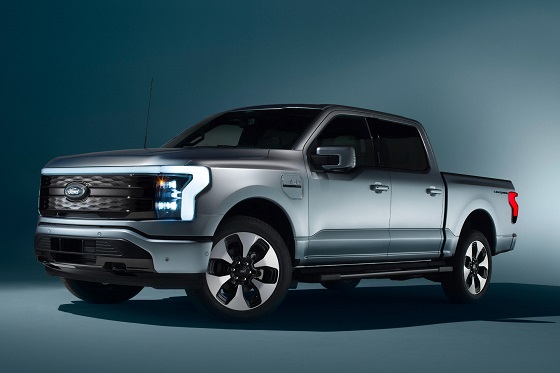
Cancelled is the Ford F-150 Lightning, the full-size electric pickup that few could afford and fewer wanted to buy, along with planned introductions of a second pricey pickup and fully electric vans and commercial vehicles. Ford will apparently keep making its costly Mustang Mach-E EV while adjusting the car’s features and price to try to make it more competitive. There will be a shift to making more hybrid models and introducing new lines of cheaper EVs and what the company calls “extended range electric vehicles,” or EREVs, which attach a gas-fueled generator to recharge the EV batteries while the car is being driven.
Dear Readers:
As a nonprofit, we are dependent on the generosity of our readers.
Please consider making a small donation of any amount here.
Thank you!
“The $50k, $60k, $70k EVs just weren’t selling; We’re following customers to where the market is,” Farley said. “We’re going to build up our whole lineup of hybrids. It’s gonna be better for the company’s profitability, shareholders and a lot of new American jobs. These really expensive $70k electric trucks, as much as I love the product, they didn’t make sense. But an EREV that goes 700 miles on a tank of gas, for 90% of the time is all-electric, that EREV is a better solution for a Lightning than the current all-electric Lightning.”
It all makes sense to Mr. Farley, but one wonders how much longer the company’s investors will tolerate his presence atop the corporate management pyramid if the company’s financial fortunes don’t turn around fast.
To Ford’s and Farley’s credit, the company has, unlike some of its competitors (GM, for example), been quite transparent in publicly revealing the massive losses it has accumulated in its EV projects since 2022. The company has reported its EV enterprise as a separate business unit called Model-E on its financial filings, enabling everyone to witness its somewhat amazing escalating EV-related losses since 2022:
• 2022 – Net loss of $2.2 billion
• 2023 – Net loss of $4.7 billion
• 2024 – Net loss of $5.1 billion
Add in the company’s $3.6 billion in losses recorded across the first three quarters of 2025, and you arrive at a total of $15.6 billion net losses on EV-related projects and processes in less than four calendar years. Add to that the financial carnage detailed in Monday’s announcement and the damage from the company’s financial electric boogaloo escalates to well above $30 billion with Q4 2025’s damage still to be added to the total.
Ford and Farley have benefited from the fact that the company’s lineup of gas-and-diesel powered cars have remained strongly profitable, resulting in overall corporate profits each year despite the huge EV-related losses. It is also fair to point out that all car companies were under heavy pressure from the Biden government to either produce battery electric vehicles or be penalized by onerous federal regulations.
Now, with the Trump administration rescinding Biden’s harsh mandates and canceling the absurdly unattainable fleet mileage requirements, Ford and other companies will be free to make cars Americans actually want to buy. Better late than never, as they say, but the financial fallout from it all is likely just beginning to be made public.
- David Blackmon is an energy writer and consultant based in Texas. He spent 40 years in the oil and gas business, where he specialized in public policy and communications.


Death by a thousand clicks – government censorship of Canada’s internet

Chinese Billionaire Tried To Build US-Born Baby Empire As Overseas Elites Turn To American Surrogates

Viral TikTok video shows 7-year-old cuddling great-grandfather before he’s euthanized
Politicians should be honest about environmental pros and cons of electric vehicles
-
 Agriculture2 days ago
Why is Canada paying for dairy ‘losses’ during a boom?
-
 Alberta2 days ago
Alberta’s new diagnostic policy appears to meet standard for Canada Health Act compliance
-
 Business19 hours ago
State of the Canadian Economy: Number of publicly listed companies in Canada down 32.7% since 2010
-
 Bruce Dowbiggin21 hours ago
Hunting Poilievre Covers For Upcoming Demographic Collapse After Boomers
-
 Alberta20 hours ago
Housing in Calgary and Edmonton remains expensive but more affordable than other cities
-
 Censorship Industrial Complex17 hours ago
Canadian university censors free speech advocate who spoke out against Indigenous ‘mass grave’ hoax
-
 Censorship Industrial Complex2 days ago
Top constitutional lawyer warns against Liberal bills that could turn Canada into ‘police state’
-
 Automotive2 days ago
Canada’s EV gamble is starting to backfire