
Alberta
ATA Collect $72 Million in Dues But Couldn’t Pay Striking Teachers a Dime




 Marco Navarro-Génie
They Built a Sustaining Rainbow Bureaucracy Instead of a Warchest
Alberta’s teachers walked off the job twice in a few years, which surprised anyone who still believed the old line that teachers avoid confrontation. A strike strips an organization to its essentials. It reveals whether a union carries real strength or only the appearance of it. When the Alberta Teachers’ Association entered a province-wide strike, it took on the posture of a century-old institution, but it drew on reserves of something far younger and far leaner. One question hangs in the air: How did a union that has existed since 1918 arrive at a major labour showdown with so little capacity to sustain its members?
Haultain’s Substack is a reader-supported publication.
To receive new posts and support our work, please consider becoming a free or paid subscriber.
Try it out.
The answer, it turns out, is that the ATA spent a century perfecting the art of growing and protecting itself, but not the teachers who pay for it.
Early unions understood that withdrawing labour meant stepping into a void. Wages vanished at the factory door. Families survived on whatever the union could provide. From small collections grew one of the essential principles of organized labour: A union prepares for conflict by saving in peacetime. It builds the means to protect its members when negotiations break down.
When unions matured, industrial organizations built strike funds large enough to hold firm through prolonged stalemates. These reserves became equalizers. Without them, employers waited for hunger to do the work. With them, a union could bargain in earnest. Strike pay bought time. Time forced movement. Time was power.
Consider what proper unions accomplish. CUPE maintains a national strike fund holding $132.8 million as of 2023. With 650,000 members, that’s about $200 per member in reserve. CUPE pays striking workers $300 per week from day one, rising to $350 after eight weeks. OPSEU maintains a $70 million strike fund, paying $200 per week plus $50 per dependent, increasing to $300 per week at week four.
By contrast, the ATA had $25 million in its Special Emergency Fund when the recent strike began. That money lasted just over two weeks, covering member benefits, not strike pay. For a union with 51,000 members, that’s less than $500 per teacher. After those two weeks, the Association drained its general cash reserves. By the end of the three-week strike, the SEF was depleted. Compare this to CUPE’s $132 million for 650,000 members or OPSEU’s $70 million for 180,000 members, and the ATA’s inadequacy becomes stark.
A century of life gives any organization the chance to build such strength. Over decades it becomes serious. Over a century it becomes formidable. Yet when the association decided to strike on October 6, 2025, it had nothing approaching the reserve needed for a long contest. A union prepared for endurance needs a fund measured in the high tens of millions, not the low twenties. That cushion was missing.
Of course, it was missing. Building a war chest means acknowledging you might actually have to fight a war. Far safer to build a peacetime palace and hope nobody notices when the enemy arrives at the gates.
This weakness grew from the inward turn that overtakes institutions with stable revenue and public status. What begins as a tool for members becomes an organism that primarily protects itself. After the Teaching Profession Act of 1936 entrenched its place in Alberta’s landscape, the ATA expanded like any other public body—without constraint or self-examination. Staff increased. Departments multiplied. New programs became permanent fixtures. Over time, the structure thickened into bureaucracy.
Robert Michels observed more than a century ago that organizations drift toward oligarchy because staff become the custodians of continuity. Members cycle in and out. Staff remain. As this instinct grows, the organization develops a belief that its first duty is to preserve itself. The ATA is no exception. Salaries for staff, internal operations, communication units, legal services, research branches, and advocacy initiatives occupy the foreground of its budget. The association’s annual budget is approximately $50 million, with discretionary programming accounting for less than a quarter. The remainder goes to staff salaries, operations, and fixed expenditures. A strike fund becomes an afterthought. Annual fees for 2025-26 are set at $1,422 per teacher, generating roughly $72 million in yearly revenue. Where did it all go?
The ATA’s books are not open, but there is public evidence of where some spending goes. Much went to campaigns that had precious little to do with wages, benefits, or working conditions. The ATA maintains an elaborate apparatus devoted to social justice advocacy. It supports the Alberta GSA Network, produces extensive resources on sexual and gender minorities, runs a “Walking Together” reconciliation program complete with 25 Indigenous education facilitators, publishes anti-racism materials, maintains Diversity Equity Networks, and employs staff dedicated to promoting SOGI (Sexual Orientation and Gender Identity) inclusion in classrooms. When Premier Danielle Smith announced policies requiring parental notification for name and pronoun changes in schools, the ATA mobilized its complete communications apparatus to oppose the measures, with President Jason Schilling calling them “irresponsible and dangerous” and a “distraction from more important issues.” If that were so, Schilling allowed his organization to be distracted.
I am not passing judgment on whether their causes lack merit or that teachers shouldn’t care about them. That’s their business and their money. But a union exists first and foremost to protect the material interests of its members. When teachers lose a month’s salary because their union spent decades building a rainbow bureaucracy instead of a strike fund, the priorities become clear. The ATA allocated resources to produce toolkits on creating “SOGI-inclusive classrooms” and funded campaigns about transgender policy while its Special Emergency Fund remained woefully inadequate. It hired facilitators to deliver workshops on dismantling anti-Indigenous racism, but couldn’t pay striking teachers a dime. This is ideology dressed up as unionism, performance masquerading as protection.
Haultain’s Substack is a reader-supported publication.
To receive new posts and support our work, please consider becoming a free or paid subscriber.
Try it out.
And here’s the greater irony: when teachers walked the picket lines, union executives kept drawing their salaries. Strike or no strike, the apparatus hummed along. The people running the ATA never missed a paycheque while the members they represent watched their bank accounts drain. In the 2025 strike, teachers lost a month’s salary. In return for this sacrifice, they gained precisely nothing. The settlement forced upon them by the government’s Back to School Act offered no improvement over what was available before they walked out. In fact, 89.5 per cent of teachers had already rejected this very offer on September 29, before the strike even began. In an era of persistent inflation, that lost income hurts. It hurt while union apparatchiks cashed their cheques on schedule.

The pattern of misplaced priorities extends beyond budgeting. When governments announce reforms, the ATA responds with press conferences, research papers, social media campaigns, and policy briefs. These are the tools of a professional bureaucracy, revolutionary in rhetoric, managerial in practice. They convey activity. They project influence. They cost a fortune. The ATA spent approximately $1.2 million on communications advocacy campaigns. Yet none of these tools matter when the government decides to hold firm during wage negotiations. Only endurance matters. Endurance rests on savings. Discipline has been scarce, but glossy newsletters have been plentiful.
The ATA fashions itself as the vanguard of progressive change, draping its pronouncements in the language of social justice and systemic transformation. It speaks like Che Guevara but budgets like a mid-tier insurance company. This is the defanged wolf: all growl, no bite. When push comes to shove, when teachers actually need material support to withstand a strike and make it count, the revolutionary rhetoric evaporates like morning dew. What remains is a comfortable administrative class that has confused advocacy theatre with actual power.
For a union that seeks to control so much of the province’s educational life, the ATA demonstrated a remarkable inability to control its own strike capacity. When the moment arrived to exercise the most fundamental power a union possesses—the withdrawal of labour—it had nothing. This is not the behaviour of a serious labour organization. This is the behaviour of a professional association that occasionally remembers it is supposed to be a union.
The ATA speaks of solidarity and resolve. It encourages teachers to show unity. It frames strikes as moral moments. It talks tough, pushed by its political branch, the NDP. Yet solidarity without resources is fragile. Resolve without savings falters when the bills arrive. A union that accepts going on strike without the means to sustain its membership hands the employer a strategic advantage from the outset. Employers read the same budgets. A union with a thin reserve can shout but cannot stand long, no matter what assurances Nenshi and their political allies make. The employer knows time will do the work. The people insulated from this reality are the NDP MLAs who cheered them on and the union administrators whose paycheques never depend on winning the fight.
It becomes difficult to tell whether the ATA has become an arm of the NDP or whether the NDP serves as the political branch of the ATA. Either way, the relationship has proven costly and fruitless. Opposition leader Naheed Nenshi stood ready with soundbites throughout the strike, encouraging teachers to hold firm while offering nothing of material value. NDP MLAs treated striking teachers and disrupted students as convenient instruments to embarrass the government, cheering on a labour action that could never succeed without the financial backing to sustain it. The enemy of your employer is not necessarily your friend. An independent union would have recognized this and built its strength accordingly, rather than spending resources and political capital on an alliance that delivers applause but not wages.
But it’s a professional association and not a conventional trade union, many will say. Members chose to strike against the leadership’s recommendations. That only seals the argument: It is an admission that the organization has no business going on strike. And if the membership voted for a strike, the leadership should have resigned. No youth leader would ever accept leading Girl Guides into a battlefield against seasoned warriors.
If the NDP functions as the political arm of the ATA, then the union has wasted considerable time and treasure on a supremely ineffective partner. A union serious about protecting its members would invest in strike capacity, not in subsidizing a moribund political movement that cannot deliver victories.
The institutional incentives explain much of this failure. Once an organization builds programs and layers of administration, cutting them becomes painful. Every department has defenders. Every initiative has champions. A strike fund has no constituency except prudence, and prudence has no allies among radicals. Prudence is no match for the seductive appeal of another communications coordinator or tattoo-covered diversity officer. Virtue-signalling solidarity wants no sacrifice. It is easier still when the people making these decisions know they will be paid regardless of whether the teachers they represent can hold out through week three of a strike.
Alberta teachers should demand clarity. They have paid dues for generations. They are told the association exists to protect them. Protection cannot be rhetorical. It must take the form of financial strength when the moment demands it. If the ATA built a bureaucracy instead of a war chest, if it prioritized the comfort of its administrative class over the security of its members, then teachers deserve that truth without varnish. They deserve to know why their union leadership never missed a meal while asking them to tighten their belts for the cause.
The defanged wolf is hurt now. It lashes out with its claws, backing recall campaigns against elected officials and organizing petitions to defund non-ATA school instruction. A Calgary high school teacher and ATA governing council representative wants to end public funding for Alberta’s independent schools, where roughly 2,000 teachers work outside ATA membership, costing the association approximately $2.84 million in foregone dues revenue annually. The petition to defund independent schools masquerades as concern for public education but reeks of institutional self-interest. Those 2,000 teachers represent nearly $3 million in annual dues that never reach ATA coffers. The defunding campaign is not about protecting students. It is about eliminating competition and conscripting teachers into membership. This is the Borg logic of an assimilating monopoly, not solidarity.
Wolves can be declawed, too. A union that cannot win at the bargaining table but insists on fighting everywhere else will find itself further diminished, further isolated, and ultimately less able to serve the teachers who still pay its bills. Vindictiveness is not a substitute for competence, and performative rage cannot replace the strength that comes from prudent preparation.
A century of dues offered the ATA a chance to build real power for its members. That chance slipped away into offices, programs, campaigns, and the salaries of people who never had to worry about surviving a strike because they were never actually on strike. The next century should begin with a different understanding of duty, rooted in prudence rather than performance, in stewardship rather than self-preservation, and in the recognition that a union leadership that doesn’t share the risks of its members has no business sending them into battle.
A defanged wolf can howl all it wants. Until it grows its teeth back, no one needs to take it seriously.
To receive new posts and support our work, please consider becoming a free or paid subscriber.
Try it out.

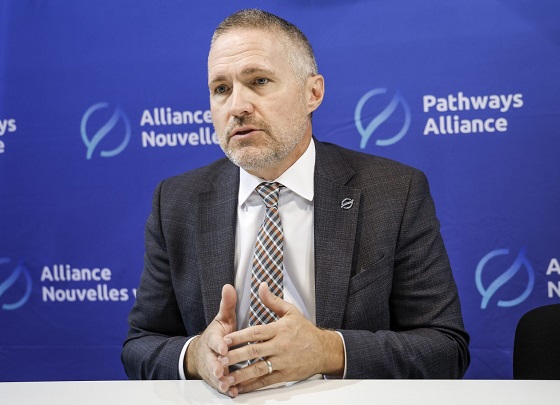
Pathways Alliance CEO Kendall Dilling is interviewed at the World Petroleum Congress in Calgary, Monday, Sept. 18, 2023.THE CANADIAN PRESS/Jeff McIntosh
From Resource Works
Carbon capture gives biggest bang for carbon tax buck CCS much cheaper than fuel switching: report
Canada’s climate change strategy is now joined at the hip to a pipeline. Two pipelines, actually — one for oil, one for carbon dioxide.
The MOU signed between Ottawa and Alberta two weeks ago ties a new oil pipeline to the Pathways Alliance, which includes what has been billed as the largest carbon capture proposal in the world.
One cannot proceed without the other. It’s quite possible neither will proceed.
The timing for multi-billion dollar carbon capture projects in general may be off, given the retreat we are now seeing from industry and government on decarbonization, especially in the U.S., our biggest energy customer and competitor.
But if the public, industry and our governments still think getting Canada’s GHG emissions down is a priority, decarbonizing Alberta oil, gas and heavy industry through CCS promises to be the most cost-effective technology approach.
New modelling by Clean Prosperity, a climate policy organization, finds large-scale carbon capture gets the biggest bang for the carbon tax buck.
Which makes sense. If oil and gas production in Alberta is Canada’s single largest emitter of CO2 and methane, it stands to reason that methane abatement and sequestering CO2 from oil and gas production is where the biggest gains are to be had.
A number of CCS projects are already in operation in Alberta, including Shell’s Quest project, which captures about 1 million tonnes of CO2 annually from the Scotford upgrader.
What is CO2 worth?
Clean Prosperity estimates industrial carbon pricing of $130 to $150 per tonne in Alberta and CCS could result in $90 billion in investment and 70 megatons (MT) annually of GHG abatement or sequestration. The lion’s share of that would come from CCS.
To put that in perspective, 70 MT is 10% of Canada’s total GHG emissions (694 MT).
The report cautions that these estimates are “hypothetical” and gives no timelines.
All of the main policy tools recommended by Clean Prosperity to achieve these GHG reductions are contained in the Ottawa-Alberta MOU.
One important policy in the MOU includes enhanced oil recovery (EOR), in which CO2 is injected into older conventional oil wells to increase output. While this increases oil production, it also sequesters large amounts of CO2.
Under Trudeau era policies, EOR was excluded from federal CCS tax credits. The MOU extends credits and other incentives to EOR, which improves the value proposition for carbon capture.
Under the MOU, Alberta agrees to raise its industrial carbon pricing from the current $95 per tonne to a minimum of $130 per tonne under its TIER system (Technology Innovation and Emission Reduction).
The biggest bang for the buck
Using a price of $130 to $150 per tonne, Clean Prosperity looked at two main pathways to GHG reductions: fuel switching in the power sector and CCS.
Fuel switching would involve replacing natural gas power generation with renewables, nuclear power, renewable natural gas or hydrogen.
“We calculated that fuel switching is more expensive,” Brendan Frank, director of policy and strategy for Clean Prosperity, told me.
Achieving the same GHG reductions through fuel switching would require industrial carbon prices of $300 to $1,000 per tonne, Frank said.
Clean Prosperity looked at five big sectoral emitters: oil and gas extraction, chemical manufacturing, pipeline transportation, petroleum refining, and cement manufacturing.
“We find that CCUS represents the largest opportunity for meaningful, cost-effective emissions reductions across five sectors,” the report states.

Fuel switching requires higher carbon prices than CCUS.
Measures like energy efficiency and methane abatement are included in Clean Prosperity’s calculations, but again CCS takes the biggest bite out of Alberta’s GHGs.
“Efficiency and (methane) abatement are a portion of it, but it’s a fairly small slice,” Frank said. “The overwhelming majority of it is in carbon capture.”

From left, Alberta Minister of Energy Marg McCuaig-Boyd, Shell Canada President Lorraine Mitchelmore, CEO of Royal Dutch Shell Ben van Beurden, Marathon Oil Executive Brian Maynard, Shell ER Manager, Stephen Velthuizen, and British High Commissioner to Canada Howard Drake open the valve to the Quest carbon capture and storage facility in Fort Saskatchewan Alta, on Friday November 6, 2015. Quest is designed to capture and safely store more than one million tonnes of CO2 each year an equivalent to the emissions from about 250,000 cars. THE CANADIAN PRESS/Jason Franson
Credit where credit is due
Setting an industrial carbon price is one thing. Putting it into effect through a workable carbon credit market is another.
“A high headline price is meaningless without higher credit prices,” the report states.
“TIER credit prices have declined steadily since 2023 and traded below $20 per tonne as of November 2025. With credit prices this low, the $95 per tonne headline price has a negligible effect on investment decisions and carbon markets will not drive CCUS deployment or fuel switching.”
Clean Prosperity recommends a kind of government-backstopped insurance mechanism guaranteeing carbon credit prices, which could otherwise be vulnerable to political and market vagaries.
Specifically, it recommends carbon contracts for difference (CCfD).
“A straight-forward way to think about it is insurance,” Frank explains.
Carbon credit prices are vulnerable to risks, including “stroke-of-pen risks,” in which governments change or cancel price schedules. There are also market risks.
CCfDs are contractual agreements between the private sector and government that guarantees a specific credit value over a specified time period.
“The private actor basically has insurance that the credits they’ll generate, as a result of making whatever low-carbon investment they’re after, will get a certain amount of revenue,” Frank said. “That certainty is enough to, in our view, unlock a lot of these projects.”
From the perspective of Canadian CCS equipment manufacturers like Vancouver’s Svante, there is one policy piece still missing from the MOU: eligibility for the Clean Technology Manufacturing (CTM) Investment tax credit.
“Carbon capture was left out of that,” said Svante co-founder Brett Henkel said.
Svante recently built a major manufacturing plant in Burnaby for its carbon capture filters and machines, with many of its prospective customers expected to be in the U.S.
The $20 billion Pathways project could be a huge boon for Canadian companies like Svante and Calgary’s Entropy. But there is fear Canadian CCS equipment manufacturers could be shut out of the project.
“If the oil sands companies put out for a bid all this equipment that’s needed, it is highly likely that a lot of that equipment is sourced outside of Canada, because the support for Canadian manufacturing is not there,” Henkel said.
Henkel hopes to see CCS manufacturing added to the eligibility for the CTM investment tax credit.
“To really build this eco-system in Canada and to support the Pathways Alliance project, we need that amendment to happen.”
Resource Works News

From the Canadian Energy Centre
Canada’s energy landscape changed significantly in 2025, with mounting U.S. economic pressures reinforcing the central role oil and gas can play in safeguarding the country’s independence.
Here are the Canadian Energy Centre’s top five most-viewed stories of the year.
5. Alberta’s massive oil and gas reserves keep growing – here’s why

The Northern Lights, aurora borealis, make an appearance over pumpjacks near Cremona, Alta., Thursday, Oct. 10, 2024. CP Images photo
Analysis commissioned this spring by the Alberta Energy Regulator increased the province’s natural gas reserves by more than 400 per cent, bumping Canada into the global top 10.
Even with record production, Alberta’s oil reserves – already fourth in the world – also increased by seven billion barrels.
According to McDaniel & Associates, which conducted the report, these reserves are likely to become increasingly important as global demand continues to rise and there is limited production growth from other sources, including the United States.
4. Canada’s pipeline builders ready to get to work

Photo courtesy Coastal GasLink
Canada could be on the cusp of a “golden age” for building major energy projects, said Kevin O’Donnell, executive director of the Mississauga, Ont.-based Pipe Line Contractors Association of Canada.
That eagerness is shared by the Edmonton-based Progressive Contractors Association of Canada (PCA), which launched a “Let’s Get Building” advocacy campaign urging all Canadian politicians to focus on getting major projects built.
“The sooner these nation-building projects get underway, the sooner Canadians reap the rewards through new trading partnerships, good jobs and a more stable economy,” said PCA chief executive Paul de Jong.
3. New Canadian oil and gas pipelines a $38 billion missed opportunity, says Montreal Economic Institute

Steel pipe in storage for the Trans Mountain Pipeline expansion in 2022. Photo courtesy Trans Mountain Corporation
In March, a report by the Montreal Economic Institute (MEI) underscored the economic opportunity of Canada building new pipeline export capacity.
MEI found that if the proposed Energy East and Gazoduq/GNL Quebec projects had been built, Canada would have been able to export $38 billion worth of oil and gas to non-U.S. destinations in 2024.
“We would be able to have more prosperity for Canada, more revenue for governments because they collect royalties that go to government programs,” said MEI senior policy analyst Gabriel Giguère.
“I believe everybody’s winning with these kinds of infrastructure projects.”
2. Keyera ‘Canadianizes’ natural gas liquids with $5.15 billion acquisition

Keyera Corp.’s natural gas liquids facilities in Fort Saskatchewan, Alta. Photo courtesy Keyera Corp.
In June, Keyera Corp. announced a $5.15 billion deal to acquire the majority of Plains American Pipelines LLP’s Canadian natural gas liquids (NGL) business, creating a cross-Canada NGL corridor that includes a storage hub in Sarnia, Ontario.
The acquisition will connect NGLs from the growing Montney and Duvernay plays in Alberta and B.C. to markets in central Canada and the eastern U.S. seaboard.
“Having a Canadian source for natural gas would be our preference,” said Sarnia mayor Mike Bradley.
“We see Keyera’s acquisition as strengthening our region as an energy hub.”
1. Explained: Why Canadian oil is so important to the United States

Enbridge’s Cheecham Terminal near Fort McMurray, Alberta is a key oil storage hub that moves light and heavy crude along the Enbridge network. Photo courtesy Enbridge
The United States has become the world’s largest oil producer, but its reliance on oil imports from Canada has never been higher.
Many refineries in the United States are specifically designed to process heavy oil, primarily in the U.S. Midwest and U.S. Gulf Coast.
According to the Alberta Petroleum Marketing Commission, the top five U.S. refineries running the most Alberta crude are:
- Marathon Petroleum, Robinson, Illinois (100% Alberta crude)
- Exxon Mobil, Joliet, Illinois (96% Alberta crude)
- CHS Inc., Laurel, Montana (95% Alberta crude)
- Phillips 66, Billings, Montana (92% Alberta crude)
- Citgo, Lemont, Illinois (78% Alberta crude)

Georgia county admits illegally certifying 315k ballots in 2020 presidential election

Alberta Next Panel calls to reform how Canada works

Canadian government launches trial version of digital ID for certain licenses, permits

End Supply Management—For the Sake of Canadian Consumers
-
International2 days ago
Georgia county admits illegally certifying 315k ballots in 2020 presidential election
-
 Business2 days ago
What Do Loyalty Rewards Programs Cost Us?
-
 Haultain Research2 days ago
Sweden Fixed What Canada Won’t Even Name
-
 Energy2 days ago
Why Japan wants Western Canadian LNG
-
 Business2 days ago
Land use will be British Columbia’s biggest issue in 2026
-
 Business2 days ago
The Real Reason Canada’s Health Care System Is Failing
-
 Business2 days ago
Dark clouds loom over Canada’s economy in 2026
-
 Business2 days ago
Federal funds FROZEN after massive fraud uncovered: Trump cuts off Minnesota child care money