
Censorship Industrial Complex
Assistant AG tells House committee she’s ‘not familiar’ with major social media censorship lawsuit


From LifeSiteNews
“If the allegations made by the plaintiffs are true, the present case arguably involves the most massive attack on free speech in United States history”
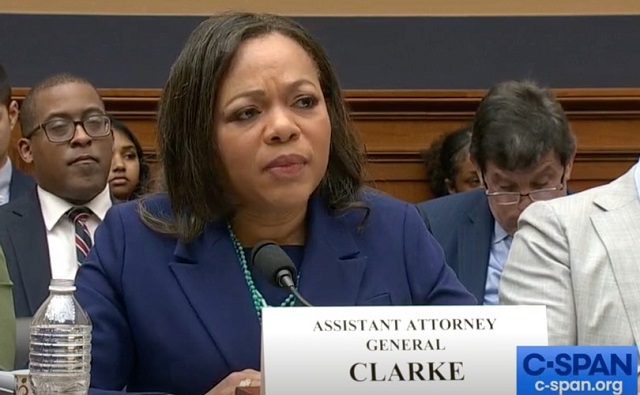
The assistant attorney general for the Department of Justice’s Civil Rights Division stunned a Republican lawmaker in a Tuesday hearing when she said she hadn’t heard of a major First Amendment lawsuit currently before the U.S. Supreme Court. The case alleges that members of the Biden administration colluded with social media companies to suppress content deemed to be “misinformation,” including COVID-19-related content and information related to Hunter Biden.
In a Tuesday hearing before the House Judiciary Subcommittee on the Constitution and Limited Government, Assistant AG Kristen Clarke said she was “not familiar” with the ongoing litigation in the first amendment lawsuit Missouri v. Biden, a major case that LifeSiteNews has extensively covered.
Clarke made the remarks after Republican U.S. Rep. Dan Bishop of North Carolina cited a July 4 opinion by Judge Terry Doughty stating that the plaintiffs “are likely to succeed on the merits of their First Amendment claim.”
“If the allegations made by the plaintiffs are true, the present case arguably involves the most massive attack on free speech in United States history,’” Doughty said in his opinion, which Rep. Bishop referenced in the Tuesday hearing. The U.S. Supreme Court has subsequently agreed to take up the case, now dubbed Murthy v. Missouri.
READ: Supreme Court will decide whether Biden admin illegally pushed Big Tech to censor conservatives
Noting that the litigation has been strictly civil to date, Bishop asked Clarke whether “any criminal investigation or criminal prosecution of the persons responsible for that activity” is “underway in the [DOJ] civil rights division?”
“Congressman, I’m not familiar with this litigation, but [I’m] happy to bring your question back,” Clarke said.
Bishop asked Clarke to confirm whether she was saying she was “not aware of the Missouri v. Biden litigation that is currently being taken up by the United States Supreme Court.”
“Is that correct?” Bishop said.
“Unfortunately, I’m not, Congressman,” Clarke said.

The Assistant AG for Civil Rights at the DOJ has ZERO awareness of the Missouri v. Biden case, which is set to be heard by SCOTUS.
A US District Court called the Biden admin's actions in the case “the most massive attack against free speech in United States’ history."
Wow. pic.twitter.com/61hJBjwr2I
— Rep. Dan Bishop (@RepDanBishop) December 5, 2023
As LifeSiteNews has reported, the First Amendment lawsuit argues that numerous Biden administration officials had “colluded with and/or coerced social-media platforms to suppress disfavored speakers, viewpoints, and content.”
“In their attempts to suppress alleged disinformation, the Federal Government, and particularly the Defendants named here, are alleged to have blatantly ignored the First Amendment’s right to free speech,” the lawsuit claims.
The plaintiffs in the case are two states, Missouri and Louisiana, along with three doctors who have publicly spoken out against the prevailing COVID-19 narrative: Aaron Kheriaty, Dr. Martin Kulldorff, and Dr. Jayanta “Jay” Bhattacharya. Co-Director of Health Freedom Louisiana Jill Hines and Jim Hoft, owner of the news site The Gateway Pundit, are also plaintiffs in the case.
RELATED: This Supreme Court case could strike a blow against the Deep State and Big Tech
In September, the U.S. Court of Appeals for the Fifth Circuit allowed the suit to proceed against the Surgeon General as well as members of the Executive Office of the President of the United States, the CDC, and the FBI.
According to the filing, the plaintiffs allege that government officials employed “public pressure campaigns, private meetings, and other forms of direct communication” against so-called “disinformation,” “misinformation,” and “malinformation,” and “colluded with and/or coerced social-media platforms to suppress disfavored speakers, viewpoints, and content on social-media platforms.”
Per the Fifth Circuit, the plaintiffs “had posts and stories removed or downgraded by” social media companies that government officials had “urged … to remove disfavored content and accounts from their sites.”
The federal court noted that the plaintiffs said the content that was “removed or downgraded” had “touched on a host of divisive topics like the COVID-19 lab-leak theory, pandemic lockdowns, vaccine side effects, election fraud, and the Hunter Biden laptop story.”
“The Plaintiffs maintain that although the platforms stifled their speech, the government officials were the ones pulling the strings,” the ruling stated.
The U.S. Supreme Court agreed in late October to take up the case, though it has allowed the Biden administration to continue its communications with social media companies in the meantime.



Speech Crimes on Campus
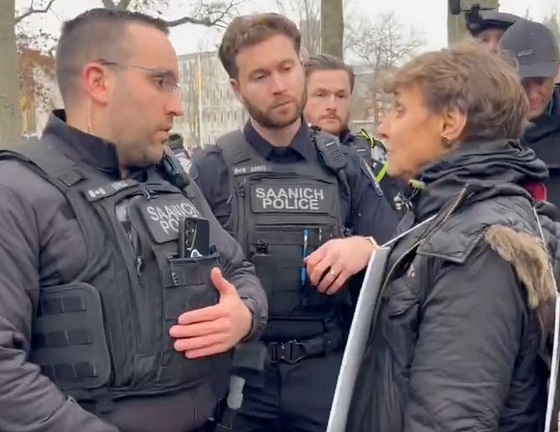
Frances Widdowson, a former colleague professor at Mount Royal University, was arrested this past week on the University of Victoria campus. Her offence? Walking, conversing, and asking questions on a university campus. She was not carrying a megaphone, making threats, organizing a protest, or waving foreign flags. She was planning quietly to discuss, with whoever wished it, a widespread claim that has curiously evaded forensic scrutiny in Canada for five years: that the remains of 215 Indigenous children lie beneath the grounds of the former Kamloops Residential School.
UVic Campus security did not treat her as a scholar. Nor even as a citizen. They treated her as a contaminating source.
The director of security, a woman more reminiscent of a diversity consultant than a peace officer, almost shaking, presented Widdowson with papers and told her to vacate “the property.” When Widdowson questioned the order, citing her Charter rights and the university’s public nature, she was told to leave. She refused, and she was arrested. No force, no defiance, only a refusal to concede that inquiry is trespass.
Widdowson is no provocateur in the modern sense. She is not a shock-jock in a cardigan. She is a once-tenured academic with a long record of challenging orthodoxies in Indigenous policy, identity politics, and campus culture.
In 2008, she co-authored Disrobing the Aboriginal Industry, a book that deconstructed the bureaucratic machinery that profits from preserving Indigenous dependency. The book was methodical, sourced, and daring enough to be labelled heretical in some quarters, but simultaneously boringly Marxist materialistic.
Her arguments have made people uncomfortable for a long time. When I assigned her book to my political science students in the Department of Policy Studies, where Frances also taught, I was summoned by the department head’s office. Someone in my class complained about the book, though I ignored what was said, and the technocratic colleague, as chair of the department, had prepared a host of arguments to chastise me for assigning the book.
Widdowson was good enough to be hired as a colleague of that department, but they were all afraid of her ideas, and perhaps her manner. I have often wondered if the folks in the Mount Royal hiring committee had bothered to read her book. Hey, they had a female Marxist applying for a teaching job. Knowing how they operate makes me think they made giant assumptions about Frances.
My bureaucratic colleague relented. I got the impression that the department head was putting on a show, going through motions he didn’t want to engage in, but which he had to perform for administrative purposes. He had to act on the complaint, though the complaint had no substance. He tried to tell me that the ideas in the book might offend some students, and then went on with the typical dribble about being caring, but agreed that protecting feelings was not the objective of an education, nor the job of a professor.
Haultain’s Substack is a reader-supported publication.
To receive new posts and support our work, please consider becoming a free or paid subscriber.
Try it out.
I went to my campus office after the conversation with the department head, typed up a memo detailing our discussion, and emailed it to him to ensure there was a record of my viewpoint. The email got no response. He never mentioned it again, and to this day, 15 or 16 years later, we still haven’t spoken about it.
Some academic arguments are meant to shake things up. That is the purpose of scholarship: to stir the sediment of consensus. To challenge conventional views. Marxist or no, scholars are supposed to push the envelope. Expand the boundaries of our understanding. But in today’s academic culture, discomfort is treated as injury and dissent as violence. So, Widdowson was treated as a threat merely by walking and speaking.
Was the university within its legal rights to remove her? Possibly. Universities can invoke property rights, ironically in Cowichan territory, and provincial legislation sometimes grants them a curious status: publicly funded yet selectively private. But the question is not merely legal. It is cultural and constitutional.
The University of Victoria is a publicly funded institution, governed under provincial authority and subsidized by taxpayers. Its grounds, though some claim they are on unceded Indigenous territory, are functionally administered by the Crown. The university is not a monastery. While it is not a temple to be kept free of doubt, it is not a temple to be torched either. It is a civic institution. An institution of higher learning. When it uses its resources to shield ideology and expel dissenters, it forfeits its academic character.
Consider the contrast. On this same campus, as on many others across the country, protests have called for the destruction of Israel and the extermination of Jews. Banners are waved, slogans chanted, and genocidal euphemisms like “from the river to the sea” are uttered without hesitation. These demonstrations, some of which praise Hamas or glorify martyrdom, proceed unimpeded. Security stands down. The administration issues boilerplate statements about inclusion and respect.
But when a female academic arrives to ask whether the number “215” refers to actual remains or mere radar anomalies, she is marched off by police. The imbalance is not accidental. It is a product of institutional capture.
Contemporary universities have adopted a new moral vocabulary. Terms like “safety,” “inclusion,” and “harm” are now treated as constitutional categories. But their terms are undefined, fluid, shaped by ideology rather than principle. “Safety” no longer refers to bodily security, but has become an emotional preference. “Inclusion” does not mean openness to different ideas and people, but a validation of specific identities. “Harm” is not an act, but a feeling.
Under this logic, Widdowson’s presence becomes a form of injury. Her questions are recast as wounds. And because feelings have been elevated to rights, her removal becomes a public good.
This ideology has structure. It is not random. It rests on a model of revolutionary politics in which dissent must not be part of the conversation. A differing opinion is an obstacle to be cleared. The new inclusivity has become a form of exclusion. It uses the language of welcome to police belief, and the rhetoric of tolerance to enforce conformity.
Charter rights were once the guardrails of public life. They are not supposed to vanish down the rabbit holes when one steps onto that university lawn. The right to free expression, to peaceful assembly, and to enter public space are not conditional on popularity. They are not subject to the feelings of a security director or the preferences of a DEI office.
Widdowson is testing this principle. She did not resist arrest, nor did she make a spectacle of herself. She acted as a citizen asserting a constitutional right. The courts may eventually rule on whether her rights were infringed. But the deeper issue is already visible.
If our public institutions can exile peaceful critics while accommodating radical political agitators who cheer for foreign terror movements, we are not in a neutral society. We are in an elite-managed consensus.
This consensus is enforced by policy. It does not need debate. The consensus managers already know what is true and treat challenges as threats. In this environment, universities are no longer places where young minds wrestle with the pangs of uncertainty. They are enforcing temples of doctrine. Their priests wear lanyards. Their rituals involve land acknowledgments. Their blasphemies include asking inconvenient questions about graves that no one has bothered to exhume.
Frances Widdowson may not be universally admired. No one is. Her conclusions are sharp. Her manner is uncompromising. But that is precisely why her treatment should alarm us. The test of a free society is not how it treats the agreeable, but how it tolerates the disagreeable, to paraphrase Bernard Crick.
When universities lose the confidence to host dissent, they cease to be universities in any meaningful sense. They become echo chambers with fancy libraries. They educate students in the same way a treadmill provides runners with travel: motion without movement.
We are at a moment of reckoning for universities and for Canadian liberal democracy. When citizens cannot openly raise questions without fear of removal, the Charter becomes ornamental. If the test of allowable speech is whether it affirms prevailing narrative and myths, then neither truth nor inquiry has a place among us.
Widdowson’s arrest is not an isolated event. It is a signal that tells us who is welcome in the public square and who is not. It tells us that the basic right to question popular opinions is now conditional. And it affirms for us what we already know: that the guardians of inclusion are, in practice, the agents of exclusion.
No democracy can afford such arbiters. Certainly not one that still calls itself liberal.
Haultain’s Substack is a reader-supported publication.
To receive new posts and support our work, please consider becoming a free or paid subscriber.
Try it out.
Censorship Industrial Complex
Canadian bishops condemn Liberal ‘hate speech’ proposal that could criminalize quoting Scripture
From LifeSiteNews
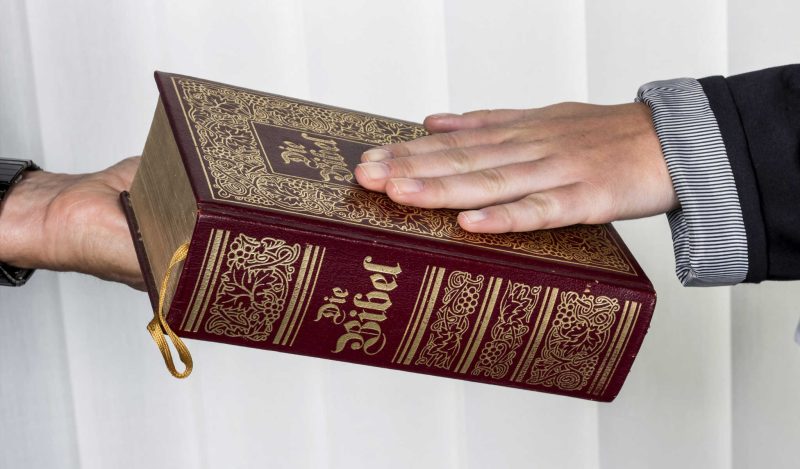
Canada’s Catholic bishops have condemned the proposed amendments to Bill C-9 warning that quoting the Bible in good faith could become punishable by up to two years in prison.
The Canadian Catholic bishops have condemned proposed restrictions on quoting religious texts, which would potentially criminalize sharing Bible passages.
In a December 4 letter to Liberal Prime Minister Mark Carney, the Canadian Conference of Catholic Bishops (CCCB) advocated against proposed amendments to Bill C-9, the “Combating Hate Act,” to allow Canadians to be punished for quoting Scripture.
“[T]he proposed elimination of the ‘good faith’ religious-text defence raises significant concerns,” the letter, signed by CCCB President Bishop Pierre Goudreault, explained. “This narrowly framed exemption has served for many years as an essential safeguard to ensure that Canadians are not criminally prosecuted for their sincere, truth-seeking expression of beliefs made without animus and grounded in long-standing religious traditions.”
Goudreault pointed out that “the removal of this provision risks creating uncertainty for faith communities, clergy, educators, and others who may fear that the expression of traditional moral or doctrinal teachings could be misinterpreted as hate speech and could subject the speaker to proceedings that threaten imprisonment of up to two years.”
“As legal experts have noted, the public’s understanding of hate-speech and its legal implications are often far broader than what the Criminal Code actually captures,” the letter continued. “Eliminating a clear statutory safeguard will likely therefore have a chilling effect on religious expression, even if prosecutions remain unlikely in practice.”
In conclusion, Goudreault recommended that Liberals either scrap the proposed amendment or issue a statement clarifying that “good-faith religious expression, teaching, and preaching will not be subject to criminal prosecution under the hate-propaganda provisions.”
He further suggested that the Liberals “commit to broad consultation with religious leaders, legal experts, and civil liberties organizations before any amendments are made to Bill C-9 that would affect religious freedom.”
“We believe it is possible to achieve the shared objective of promoting a society free from genuine hatred while also upholding the constitutional rights of millions of Canadians who draw moral and spiritual guidance from their faith traditions,” the letter continued.
As LifeSiteNews reported earlier this week, inside government sources revealed that Liberals agreed to remove religious exemptions from Canada’s hate speech laws, as part of a deal with the Bloc Québécois to keep Liberals in power.
Bill C-9, as reported by LifeSiteNews, has been blasted by constitutional experts as empowering police and the government to go after those it deems to have violated a person’s “feelings” in a “hateful” way.
Now, the Bloc amendment seeks to further restrict free speech. The amendment would remove the “religious exemption” defense, which has historically protected individuals from conviction for willful promotion of hatred if the statements were made “in good faith” and based on a “religious subject” or a “sincerely held” interpretation of religious texts such as passages from the Bible, Quran, or Torah.
As a result, quoting the Bible, Quran, or Torah to condemn abortion, homosexuality, or LGBT propaganda could be considered criminal activity.
Shortly after the proposed amendment was shared on social media, Conservatives launched a petition, calling “on the Liberal government to protect religious freedom, uphold the right to read and share sacred texts, and prevent government overreach into matters of faith.”
Already, in October, Liberal MP Marc Miller said that certain passages of the Bible are “hateful” because of what it says about homosexuality and those who recite the passages should be jailed.
“Clearly there are situations in these texts where these statements are hateful,” Miller said. “They should not be used to invoke or be a defense, and there should perhaps be discretion for prosecutors to press charges.”
His comments were immediately blasted by Conservative politicians throughout Canada, with Alberta provincial Conservative MLA and Minister of Municipal Affairs Dan Williams saying, “I find it abhorrent when MPs sitting in Ottawa – or anyone in positions of power – use their voice to attack faith.”


Media bound to pay the price for selling their freedom to (selectively) offend

Sometimes An Ingrate Nation Pt. 2: The Great One Makes His Choice

Recent price declines don’t solve Toronto’s housing affordability crisis

Alberta will defend law-abiding gun owners who defend themselves
-
National16 hours ago
Media bound to pay the price for selling their freedom to (selectively) offend
-
Bruce Dowbiggin15 hours ago
Sometimes An Ingrate Nation Pt. 2: The Great One Makes His Choice
-
 COVID-192 days ago
University of Colorado will pay $10 million to staff, students for trying to force them to take COVID shots
-
 Business2 days ago
Oil tanker traffic surges but spills stay at zero after Trans Mountain Expansion
-
 National2 days ago
Alberta will use provincial laws to stop Canadian gov’t from trying to confiscate legal firearms
-
 Energy2 days ago
ELZABETH MAY HAS IT WRONG: An Alberta to Prince Rupert Oil Pipeline Will Contribute to Greater Global Oil Tanker Safety
-
 Energy6 hours ago
The Trickster Politics of the Tanker Ban are Hiding a Much Bigger Reckoning for B.C.
-
 COVID-192 days ago
Canadian legislator introduces bill to establish ‘Freedom Convoy Recognition Day’ as a holiday