
Canadian Energy Centre
Analyst says LNG Canada likely to start exports before year-end

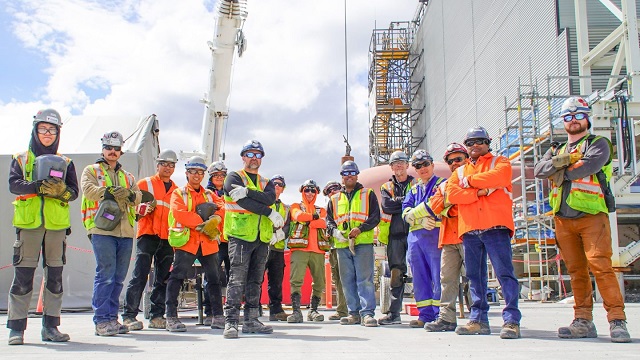

Welders with JGC-Fluor following completion of the final weld on the first production train at the LNG Canada project, in Kitimat, B.C. in July 2024. Since construction began in 2018, upwards of 380 pipe welders have worked on the LNG Canada project. Photo courtesy JGC-Fluor
From the Canadian Energy Centre
By Will Gibson
Canada’s first liquefied natural gas export terminal ‘on the cusp’ of its testing phase
Momentum is building for the long-awaited start-up of Canada’s first liquefied natural gas (LNG) export project.
Shipments from the LNG Canada terminal at Kitimat, B.C. may now start earlier than expected, later this year rather than mid-2025, according to Martin King, Canadian energy specialist with Houston-based RBN Energy.
“LNG Canada appears to be on the cusp of its testing phase and is likely to be exporting some cargoes of LNG before the end of this year,” King wrote recently.
He made the prediction after a senior executive with Shell, the project’s lead owner, said it could deliver its first cargo earlier than previously planned, in the wake of two key milestones.
Fluor reported in July it had completed the final weld on the first production train while Petronas, which holds a 25 per cent stake in LNG Canada, announced it would add three LNG vessels to its North American fleet, doubling its size.
A longtime industry insider sees the $18 billion LNG Canada terminal as a game changer.
“This is decades in the making. Canada has been trying to get its LNG business up and running since the 1970s but it has been sidetracked for one reason or another,” says Calgary-based consultant Racim Gribaa, who has worked in the industry for more than 25 years.
“This project is perfectly placed to take advantage of an awesome opportunity given the demand for LNG worldwide is growing exponentially.”
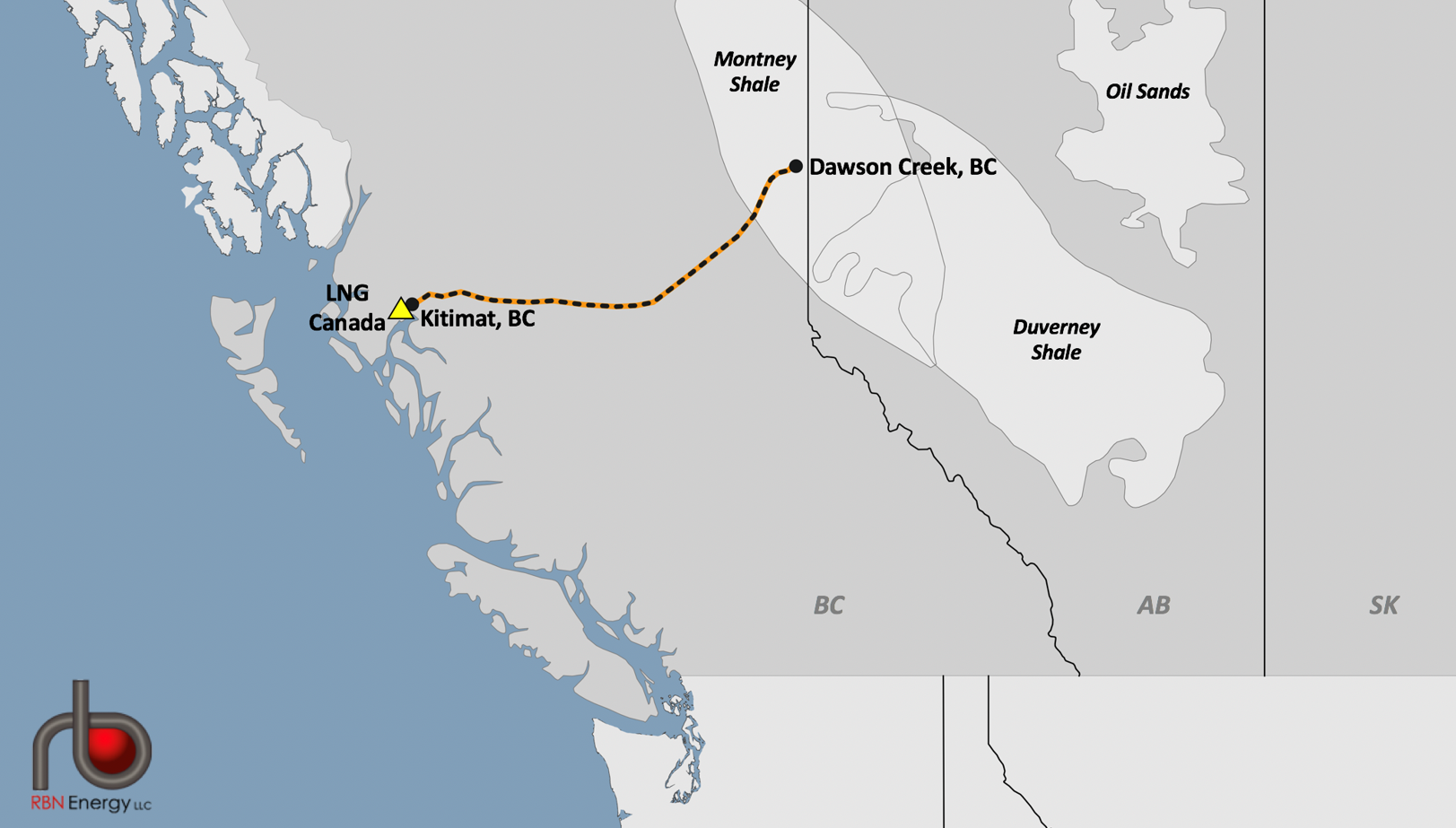

Map courtesy RBN Energy
The project, which will use the Coastal GasLink pipeline, completed in November 2023, to bring gas from northeastern British Columbia to the Kitimat terminal for processing and shipping, will have capacity to produce up to 14 million tonnes per year in its first phase.
While that’s a fraction of the 404 million tonnes of global demand in 2023, Gribaa says Asian buyers view LNG Canada as secure supplier in part due to its geography.
“The closest point to Asia is Canada’s west coast, so you have the shortest shipping route, which makes for optimal transportation costs. The traders and LNG industry see it as valuable for that reason,” says Gribaa, who previously worked in LNG trade in Qatar, one of the world’s largest exporters.
And the project is coming online at a time when worldwide demand is surging.
“The worldwide demand has effectively doubled every decade since 1990, when it was 50 MPTA. We are now closing in on 500 MPTA and that is accelerating,” Gribaa says.
“The world will need 10 LNG Canadas in 10 years and 100 more LNG Canadas in the next 30 years.”
The project has plans for a second phase that would double production to 28 million tonnes per year. Based on demand, Gribaa says “the question isn’t if it will go forward, it’s when the consortium will announce the expansion.”
World LNG demand growth will be particularly strong in Asia, where Shell’s four LNG Canada partners – Petronas (25 per cent), PetroChina (15 per cent), Mitsubishi (15 per cent) and Korea Gas Corporation (five per cent) – are headquartered.
“Each of these markets has historical demand for LNG and that demand will continue to grow in the coming decades,” he says, adding that LNG in Asia can be used for power generation and heavy industry, and to reduce air pollution from coal-fired power.
Overall, generating electricity in China with LNG from Canada rather than coal could reduce emissions by up to 62 per cent, according to a 2020 study published in the Journal for Cleaner Production.
A 2022 study by Wood Mackenzie found that growing Canada’s LNG industry could reduce net emissions in Asia by 188 million tonnes per year through 2050.


From the Canadian Energy Centre
By Will Gibson
Oil sands could maintain current production rates for more than 140 years
Investor interest in Canadian oil producers, primarily in the Alberta oil sands, has picked up, and not only because of expanded export capacity from the Trans Mountain pipeline.
Enverus Intelligence Research says the real draw — and a major factor behind oil sands equities outperforming U.S. peers by about 40 per cent since January 2024 — is the resource Trans Mountain helps unlock.
Alberta’s oil sands contain 167 billion barrels of reserves, nearly four times the volume in the United States.
Today’s oil sands operators hold more than twice the available high-quality resources compared to U.S. shale producers, Enverus reports.
“It’s a huge number — 167 billion barrels — when Alberta only produces about three million barrels a day right now,” said Mike Verney, executive vice-president at McDaniel & Associates, which earlier this year updated the province’s oil and gas reserves on behalf of the Alberta Energy Regulator.
Already fourth in the world, the assessment found Alberta’s oil reserves increased by seven billion barrels.
Verney said the rise in reserves despite record production is in part a result of improved processes and technology.
“Oil sands companies can produce for decades at the same economic threshold as they do today. That’s a great place to be,” said Michael Berger, a senior analyst with Enverus.
BMO Capital Markets estimates that Alberta’s oil sands reserves could maintain current production rates for more than 140 years.
The long-term picture looks different south of the border.
The U.S. Energy Information Administration projects that American production will peak before 2030 and enter a long period of decline.
Having a lasting stable source of supply is important as world oil demand is expected to remain strong for decades to come.
This is particularly true in Asia, the target market for oil exports off Canada’s West Coast.
The International Energy Agency (IEA) projects oil demand in the Asia-Pacific region will go from 35 million barrels per day in 2024 to 41 million barrels per day in 2050.
The growing appeal of Alberta oil in Asian markets shows up not only in expanded Trans Mountain shipments, but also in Canadian crude being “re-exported” from U.S. Gulf Coast terminals.
According to RBN Energy, Asian buyers – primarily in China – are now the main non-U.S. buyers from Trans Mountain, while India dominates purchases of re-exports from the U.S. Gulf Coast. .
BMO said the oil sands offers advantages both in steady supply and lower overall environmental impacts.
“Not only is the resulting stability ideally suited to backfill anticipated declines in world oil supply, but the long-term physical footprint may also be meaningfully lower given large-scale concentrated emissions, high water recycling rates and low well declines,” BMO analysts said.
From the Canadian Energy Centre
For Canada, the path to a stronger economy — and stronger global influence — runs through energy.
That’s the view of David Detomasi, a professor at the Smith School of Business at Queen’s University.
Detomasi, author of Profits and Power: Navigating the Politics and Geopolitics of Oil, argues that there is a moral case for developing Canada’s energy, both for Canadians and the world.

David Detomasi. Photo courtesy Smith School of Business, Queen’s University
CEC: What does being an energy superpower mean to you?
DD: It means Canada is strong enough to affect the system as a whole by its choices.
There is something really valuable about Canada’s — and Alberta’s — way of producing carbon energy that goes beyond just the monetary rewards.
CEC: You talk about the moral case for developing Canada’s energy. What do you mean?
DD: I think the default assumption in public rhetoric is that the environmental movement is the only voice speaking for the moral betterment of the world. That needs to be challenged.
That public rhetoric is that the act of cultivating a powerful, effective economic engine is somehow wrong or bad, and that efforts to create wealth are somehow morally tainted.
I think that’s dead wrong. Economic growth is morally good, and we should foster it.
Economic growth generates money, and you can’t do anything you want to do in social expenditures without that engine.
Economic growth is critical to doing all the other things we want to do as Canadians, like having a publicly funded health care system or providing transfer payments to less well-off provinces.
Over the last 10 years, many people in Canada came to equate moral leadership with getting off of oil and gas as quickly as possible. I think that is a mistake, and far too narrow.
Instead, I think moral leadership means you play that game, you play it well, and you do it in our interest, in the Canadian way.
We need a solid base of economic prosperity in this country first, and then we can help others.
CEC: Why is it important to expand Canada’s energy trade?
DD: Canada is, and has always been, a trading nation, because we’ve got a lot of geography and not that many people.
If we don’t trade what we have with the outside world, we aren’t going to be able to develop economically, because we don’t have the internal size and capacity.
Historically, most of that trade has been with the United States. Geography and history mean it will always be our primary trade partner.
But the United States clearly can be an unreliable partner. Free and open trade matters more to Canada than it does to the U.S. Indeed, a big chunk of the American people is skeptical of participating in a global trading system.
As the United States perhaps withdraws from the international trading and investment system, there’s room for Canada to reinforce it in places where we can use our resource advantages to build new, stronger relationships.
One of these is Europe, which still imports a lot of gas. We can also build positive relationships with the enormous emerging markets of China and India, both of whom want and will need enormous supplies of energy for many decades.
I would like to be able to offer partners the alternative option of buying Canadian energy so that they are less reliant on, say, Iranian or Russian energy.
Canada can also maybe eventually help the two billion people in the world currently without energy access.
CEC: What benefits could Canadians gain by becoming an energy superpower?
DD: The first and primary responsibility of our federal government is to look after Canada. At the end of the day, the goal is to improve Canada’s welfare and enhance its sovereignty.
More carbon energy development helps Canada. We have massive debt, an investment crisis and productivity problems that we’ve been talking about forever. Economic and job growth are weak.
Solving these will require profitable and productive industries. We don’t have so many economic strengths in this country that we can voluntarily ignore or constrain one of our biggest industries.
The economic benefits pay for things that make you stronger as a country.
They make you more resilient on the social welfare front and make increasing defence expenditures, which we sorely need, more affordable. It allows us to manage the debt that we’re running up, and supports deals for Canada’s Indigenous peoples.
CEC: Are there specific projects that you advocate for to make Canada an energy superpower?
DD: Canada’s energy needs egress, and getting it out to places other than the United States. That means more transport and port facilities to Canada’s coasts.
We also need domestic energy transport networks. People don’t know this, but a big chunk of Ontario’s oil supply runs through Michigan, posing a latent security risk to Ontario’s energy security.
We need to change the perception that pipelines are evil. There’s a spiderweb of them across the globe, and more are being built.
Building pipelines here, with Canadian technology and know-how, builds our competitiveness and enhances our sovereignty.
Economic growth enhances sovereignty and provides the resources to do other things. We should applaud and encourage it, and the carbon energy sector can lead the way.


Death by a thousand clicks – government censorship of Canada’s internet

Chinese Billionaire Tried To Build US-Born Baby Empire As Overseas Elites Turn To American Surrogates

Viral TikTok video shows 7-year-old cuddling great-grandfather before he’s euthanized
Politicians should be honest about environmental pros and cons of electric vehicles
-
Alberta1 day ago
Alberta’s huge oil sands reserves dwarf U.S. shale
-
 Alberta1 day ago
Canada’s New Green Deal
-
 Energy22 hours ago
Canada’s sudden rediscovery of energy ambition has been greeted with a familiar charge: hypocrisy
-
 Business1 day ago
COP30 finally admits what resource workers already knew: prosperity and lower emissions must go hand in hand
-
 armed forces1 day ago
Ottawa’s Newly Released Defence Plan Crosses a Dangerous Line
-
 Indigenous1 day ago
Residential school burials controversy continues to fuel wave of church arsons, new data suggests
-
 Business20 hours ago
Ottawa Pretends To Pivot But Keeps Spending Like Trudeau
-
 Daily Caller21 hours ago
Paris Climate Deal Now Decade-Old Disaster