
Alberta
Alberta’s Danielle Smith confirms new ‘Bill of Rights’ will protect against forced vaccination

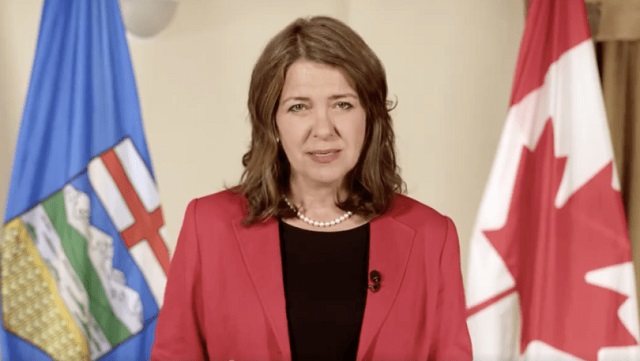

From LifeSiteNews
Smith has confirmed that new legislation will soon be put forth to enshrine the right to refuse ‘vaccination’ as well as a promise to protect ‘property rights’ in the province.
Alberta Premier Danielle Smith confirmed Tuesday that forthcoming legislation to strengthen the province’s “Bill of Rights,” which LifeSiteNews exclusively reported on last month, is indeed coming soon.
Smith confirmed that the new legislation will enshrine the right to refuse a “vaccination” as well as a promise to protect “property rights.”
In a video address, Smith outlined “forthcoming legislation” that will amend Alberta’s Bill of Rights to “strengthen” Albertans “civil liberties and freedoms.”
“As our society evolves, so too must our laws to ensure our rights and freedoms remain properly protected in an ever-changing world. One of the amendments we are making to the Bill of Rights is to reinforce the right of every Albertan to make their own choices regarding the medical treatments they receive,” said Smith.
In a few weeks time, our UCP Government will be introducing legislation to amend and strengthen the Alberta Bill of Rights, a document that has stood as a safeguard for our civil liberties and freedoms for decades.
These changes are a reaffirmation of the values that make… pic.twitter.com/5lQ5Mirbe3
— Danielle Smith (@ABDanielleSmith) September 24, 2024
“This includes ensuring that every individual in our province who has the mental capacity to do so will have the right to decide whether or not to receive a vaccination or other medical procedure.”
Smith, who leads the ruling United Conservative Party, noted that the recent COVID “years” have seen “challenges and hardship that can arise when that right to bodily autonomy is not adequately protected.”
“It is my firm conviction that no Albertan should ever be subjected or pressured into accepting a medical treatment without their full consent. For me, this addition to the Bill of Rights is about recognizing that,” she said.
Smith has allowed members of her caucus to host events and plan for future ones which expose the known dangers of the COVID shots.

The forthcoming legislation, Smith noted, will also include strengthening “property rights” as well as the right for legal firearms owners to not be targeted by the federal government of Prime Minister Justin Trudeau.
Smith acknowledges government’s role in pushing COVID shots 
During COVID in Alberta, as well as in all other parts of Canada, jab mandates in the private and public sectors became the norm. This resulted in thousands losing their jobs for choosing not to undergo an experimental medical procedure.
Indeed, in Alberta, the COVID shots were heavily promoted by Smith’s predecessor, Jason Kenney, who was UCP leader and premier at the time.
Ultimately, Kenney’s stance on COVID jab mandates contributed to his ouster, with Smith’s rise to power resting on her opposition to Kenney’s pro-mandate position. On her first day on the job and only minutes after being sworn in as premier, Smith said that during the COVID years the “unvaccinated” were the “most discriminated against” group of people in her lifetime.
Smith’s Tuesday message acknowledged the government’s role in mandating COVID shots. She said that in Alberta, “we believe that individuals have the right to make informed decisions about their own bodies without fear of undue pressure or interference by government.”
Smith’s announcement seems to confirm what LifeSiteNews previously reported, namely, that the new legislation is to include provision which guarantee each citizen has the “right” to medical “informed consent” as well as the “right” to “refuse vaccinations.”
Well before Smith’s announcement, LifeSiteNews was provided a copy of a draft version of the “Alberta Bill of Rights” from a source, who asked not to be named but who is well connected with the ruling UCP. LifeSiteNews was able to confirm the authenticity of the draft version of the bill through a second high-level source from within the UCP.
The UCP source also told LifeSiteNews that while the draft version of the bill is subject to change, it is hoped by all of those who worked on the final version of the draft that there will not be many changes. The source noted that while the bill does have support from many cabinet members of the UCP, there are a few who oppose the bill.
While not confirmed by Smith in her announcement, LifeSiteNews reported earlier this month that the forthcoming legislation also looks to include a provision that would cement parental rights as “God-given,” as well as the “right to life” from “conception, gestation in the womb.”


From the Fraser Institute
By Nadeem Esmail, Mackenzie Moir and Lauren Asaad
In October, Alberta’s provincial government announced forthcoming legislative changes that will allow patients to pay out-of-pocket for any diagnostic test they want, and without a physician referral. The policy, according to the Smith government, is designed to help improve the availability of preventative care and increase testing capacity by attracting additional private sector investment in diagnostic technology and facilities.
Unsurprisingly, the policy has attracted Ottawa’s attention, with discussions now taking place around the details of the proposed changes and whether this proposal is deemed to be in line with the Canada Health Act (CHA) and the federal government’s interpretations. A determination that it is not, will have both political consequences by being labeled “non-compliant” and financial consequences for the province through reductions to its Canada Health Transfer (CHT) in coming years.
This raises an interesting question: While the ultimate decision rests with Ottawa, does the Smith government’s new policy comply with the literal text of the CHA and the revised rules released in written federal interpretations?
According to the CHA, when a patient pays out of pocket for a medically necessary and insured physician or hospital (including diagnostic procedures) service, the federal health minister shall reduce the CHT on a dollar-for-dollar basis matching the amount charged to patients. In 2018, Ottawa introduced the Diagnostic Services Policy (DSP), which clarified that the insured status of a diagnostic service does not change when it’s offered inside a private clinic as opposed to a hospital. As a result, any levying of patient charges for medically necessary diagnostic tests are considered a violation of the CHA.
Ottawa has been no slouch in wielding this new policy, deducting some $76.5 million from transfers to seven provinces in 2023 and another $72.4 million in 2024. Deductions for Alberta, based on Health Canada’s estimates of patient charges, totaled some $34 million over those two years.
Alberta has been paid back some of those dollars under the new Reimbursement Program introduced in 2018, which created a pathway for provinces to be paid back some or all of the transfers previously withheld on a dollar-for-dollar basis by Ottawa for CHA infractions. The Reimbursement Program requires provinces to resolve the circumstances which led to patient charges for medically necessary services, including filing a Reimbursement Action Plan for doing so developed in concert with Health Canada. In total, Alberta was reimbursed $20.5 million after Health Canada determined the provincial government had “successfully” implemented elements of its approved plan.
Perhaps in response to the risk of further deductions, or taking a lesson from the Reimbursement Action Plan accepted by Health Canada, the province has gone out of its way to make clear that these new privately funded scans will be self-referred, that any patient paying for tests privately will be reimbursed if that test reveals a serious or life-threatening condition, and that physician referred tests will continue to be provided within the public system and be given priority in both public and private facilities.
Indeed, the provincial government has stated they do not expect to lose additional federal health care transfers under this new policy, based on their success in arguing back previous deductions.
This is where language matters: Health Canada in their latest CHA annual report specifically states the “medical necessity” of any diagnostic test is “determined when a patient receives a referral or requisition from a medical practitioner.” According to the logic of Ottawa’s own stated policy, an unreferred test should, in theory, be no longer considered one that is medically necessary or needs to be insured and thus could be paid for privately.
It would appear then that allowing private purchase of services not referred by physicians does pass the written standard for CHA compliance, including compliance with the latest federal interpretation for diagnostic services.
But of course, there is no actual certainty here. The federal government of the day maintains sole and final authority for interpretation of the CHA and is free to revise and adjust interpretations at any time it sees fit in response to provincial health policy innovations. So while the letter of the CHA appears to have been met, there is still a very real possibility that Alberta will be found to have violated the Act and its interpretations regardless.
In the end, no one really knows with any certainty if a policy change will be deemed by Ottawa to run afoul of the CHA. On the one hand, the provincial government seems to have set the rules around private purchase deliberately and narrowly to avoid a clear violation of federal requirements as they are currently written. On the other hand, Health Canada’s attention has been aroused and they are now “engaging” with officials from Alberta to “better understand” the new policy, leaving open the possibility that the rules of the game may change once again. And even then, a decision that the policy is permissible today is not permanent and can be reversed by the federal government tomorrow if its interpretive whims shift again.
The sad reality of the provincial-federal health-care relationship in Canada is that it has no fixed rules. Indeed, it may be pointless to ask whether a policy will be CHA compliant before Ottawa decides whether or not it is. But it can be said, at least for now, that the Smith government’s new privately paid diagnostic testing policy appears to have met the currently written standard for CHA compliance.

Nadeem Esmail

Mackenzie Moir

Lauren Asaad
Policy Analyst, Fraser Institute

From the Fraser Institute
By Tegan Hill and Austin Thompson
In cities across the country, modest homes have become unaffordable for typical families. Calgary and Edmonton have not been immune to this trend, but they’ve weathered it better than most—largely by making it easier to build homes.
Specifically, faster permit approvals, lower municipal fees and fewer restrictions on homebuilders have helped both cities maintain an affordability edge in an era of runaway prices. To preserve that edge, they must stick with—and strengthen—their pro-growth approach.
First, the bad news. Buying a home remains a formidable challenge for many families in Calgary and Edmonton.
For example, in 2023 (the latest year of available data), a typical family earning the local median after-tax income—$73,420 in Calgary and $70,650 in Edmonton—had to save the equivalent of 17.5 months of income in Calgary ($107,300) or 12.5 months in Edmonton ($73,820) for a 20 per cent down payment on a typical home (single-detached house, semi-detached unit or condominium).
Even after managing such a substantial down payment, the financial strain would continue. Mortgage payments on the remaining 80 per cent of the home’s price would have required a large—and financially risky—share of the family’s after-tax income: 45.1 per cent in Calgary (about $2,757 per month) and 32.2 per cent in Edmonton (about $1,897 per month).
Clearly, unless the typical family already owns property or receives help from family, buying a typical home is extremely challenging. And yet, housing in Calgary and Edmonton remains far more affordable than in most other Canadian cities.
In 2023, out of 36 major Canadian cities, Edmonton and Calgary ranked 8th and 14th, respectively, for housing affordability (relative to the median after-tax family income). That’s a marked improvement from a decade earlier in 2014 when Edmonton ranked 20th and Calgary ranked 30th. And from 2014 to 2023, Edmonton was one of only four Canadian cities where median after-tax family income grew faster than the price of a typical home (in Calgary, home prices rose faster than incomes but by much less than in most Canadian cities). As a result, in 2023 typical homes in Edmonton cost about half as much (again, relative to the local median after-tax family income) as in mid-sized cities such as Windsor and Kelowna—and roughly one-third as much as in Toronto and Vancouver.
To be clear, much of Calgary and Edmonton’s improved rank in affordability is due to other cities becoming less and less affordable. Indeed, mortgage payments (as a share of local after-tax median income) also increased since 2014 in both Calgary and Edmonton.
But the relative success of Alberta’s two largest cities shows what’s possible when you prioritize homebuilding. Their approach—lower municipal fees, faster permit approvals and fewer building restrictions—has made it easier to build homes and helped contain costs for homebuyers. In fact, homebuilding has been accelerating in Calgary and Edmonton, in contrast to a sharp contraction in Vancouver and Toronto. That’s a boon to Albertans who’ve been spared the worst excesses of the national housing crisis. It’s also a demographic and economic boost for the province as residents from across Canada move to Alberta to take advantage of the housing market—in stark contrast to the experience of British Columbia and Ontario, which are hemorrhaging residents.
Alberta’s big cities have shown that when governments let homebuilders build, families benefit. To keep that advantage, policymakers in Calgary and Edmonton must stay the course.

Tegan Hill
Director, Alberta Policy, Fraser Institute

Austin Thompson
Senior Policy Analyst, Fraser Institute


Trump DOJ seeks to quash Pfizer whistleblower’s lawsuit over COVID shots

Alberta introducing three “all-season resort areas” to provide more summer activities in Alberta’s mountain parks

The case for expanding Canada’s energy exports

Trump admin wants to help Canadian woman rethink euthanasia, Glenn Beck says
-
 International2 days ago
Bondi Beach Shows Why Self-Defense Is a Vital Right
-
 Crime2 days ago
Bondi Beach Survivor Says Cops Prevented Her From Fighting Back Against Terrorists
-
 Automotive2 days ago
Ford’s EV Fiasco Fallout Hits Hard
-
 Crime2 days ago
The Uncomfortable Demographics of Islamist Bloodshed—and Why “Islamophobia” Deflection Increases the Threat
-
 Frontier Centre for Public Policy1 day ago
Canada Lets Child-Porn Offenders Off Easy While Targeting Bible Believers
-
 Alberta2 days ago
Danielle Smith slams Skate Canada for stopping events in Alberta over ban on men in women’s sports
-
 International2 days ago
TOTAL AND COMPLETE BLOCKADE: Trump cuts off Venezuela’s oil lifeline
-
 International2 days ago
House Rejects Bipartisan Attempt To Block Trump From Using Military Force Against Venezuela