
Business
Albertans give most on average but Canadian generosity hits lowest point in 20 years

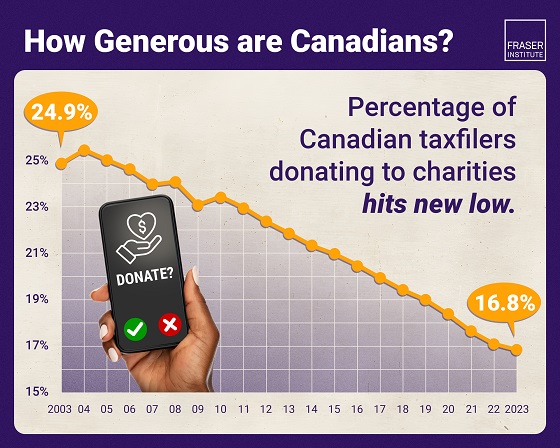

From the Fraser Institute
By Jake Fuss and Grady Munro
The number of Canadians donating to charity—as a percentage of all tax filers—is at the lowest point in 20 years, finds a new study published by the
Fraser Institute, an independent, non-partisan Canadian public policy think-tank.
“The holiday season is a time to reflect on charitable giving, and the data shows Canadians are consistently less charitable every year, which means charities face greater challenges to secure resources to help those in need,” said Jake Fuss, director of Fiscal Studies at the Fraser Institute and co-author of Generosity in Canada: The 2025 Generosity Index.
The study finds that the percentage of Canadian tax filers donating to charity during the 2023 tax year—just 16.8 per cent—is the lowest proportion of Canadians donating since at least 2003. Canadians’ generosity peaked at 25.4 per cent of tax-filers donating in 2004, before declining in subsequent years.
Nationally, the total amount donated to charity by Canadian tax filers has also fallen from 0.55 per cent of income in 2013 to 0.52 per cent of income in 2023.
The study finds that Manitoba had the highest percentage of tax filers that donated to charity among the provinces (18.7 per cent) during the 2023 tax year while New Brunswick had the lowest (14.4 per cent).
Likewise, Manitoba also donated the highest percentage of its aggregate income to charity among the provinces (0.71 per cent) while Quebec and Newfoundland and Labrador donated the lowest (both 0.27 per cent).

“A smaller proportion of Canadians are donating to registered charities than what we saw in previous decades, and those who are donating are donating less,” said Fuss.
“This decline in generosity in Canada undoubtedly limits the ability of Canadian charities to improve the quality of life in their communities and beyond,” said Grady Munro, policy analyst and co-author.
Generosity of Canadian provinces and territories
Ranking (2025) % of tax filers who claiming donations Average of all charitable donations % of aggregate income donated
Manitoba 18.7 $2,855 0.71
Ontario 17.2 $2,816 0.58
Quebec 17.1 $1,194 0.27
Alberta 17.0 $3,622 0.68
Prince Edward Island 16.6 $1,936 0.45
Saskatchewan 16.4 $2,597 0.52
British Columbia 15.9 $3,299 0.61
Nova Scotia 15.3 $1,893 0.40
Newfoundland and Labrador 15.0 $1,333 0.27
New Brunswick 14.4 $2,076 0.44
Yukon 14.1 $2,180 0.27
Northwest Territories 10.2 $2,540 0.20
Nunavut 5.1 $2,884 0.15
NOTE: Table based on 2023 tax year, the most recent year of comparable data in Canada
Generosity in Canada: The 2025 Generosity Index
- Manitoba had the highest percentage of tax filers that donated to charity among the provinces (18.7%) during the 2023 tax year while New Brunswick had the lowest (14.4%).
- Manitoba also donated the highest percentage of its aggregate income to charity among the provinces (0.71%) while Quebec and Newfoundland and Labrador donated the lowest (both 0.27%).
- Nationally, the percentage of Canadian tax filers donating to charity has fallen over the last decade from 21.9% in 2013 to 16.8% in 2023.
- The percentage of aggregate income donated to charity by Canadian tax filers has also decreased from 0.55% in 2013 to 0.52% in 2023.
- This decline in generosity in Canada undoubtedly limits the ability of Canadian charities to improve the quality of life in their communities and beyond.

Jake Fuss
Director, Fiscal Studies, Fraser Institute

Grady Munro
Policy Analyst, Fraser Institute


The Canadian Taxpayers Federation is calling on the federal, Ontario and municipal governments to publicly reject subsidizing a new arena for the Ottawa Senators.
“Politicians need to stand up for taxpayers and tell the Ottawa Senators’ lobbyists NO,” said Noah Jarvis, CTF Ontario Director. “Prime Minister Mark Carney, Ontario Premier Doug Ford and Ottawa Mayor Mark Sutcliffe all need to publicly reject giving taxpayers’ money to the owners of the Ottawa Senators.”
The Ottawa Citizen recently reported that “the Ottawa Senators have a team off the ice lobbying federal and provincial governments for funds to help pay the hefty price tag for a new arena.”
The Ottawa Senators said they don’t intend on asking the city of Ottawa for taxpayer dollars. However, the Ottawa Citizen reported that “it’s believed Senators’ owner Michael Andlauer would like a similar structure to the [Calgary] arena deal.” The Calgary arena deal included municipal subsidies.
As of December 2024, the Ottawa Senators were worth just under $1.2 billion, according to Forbes.
Meanwhile, both the federal and Ontario governments are deep in debt. The federal debt will reach $1.35 trillion by the end of the year. The Ontario government is $459 billion in debt. The city of Ottawa is proposing a 3.75 per cent property tax increase in 2026.
“Governments are up to their eyeballs in debt and taxpayers shouldn’t be forced to fund a brand-new fancy arena for a professional sports team,” said Franco Terrazzano, CTF Federal Director. “If the owners of the Ottawa Senators want to build a fancy new arena, then they should be forced to fund it with ticket sales not tax hikes.”


The Downtown Business Association (DBA) Board of Directors has made the decision to wind down the Association’s operations at the end of 2025.
The Board determined that the Association is no longer able to operate sustainably under the financial framework available for 2026. After exploring all reasonable alternatives, the Board concluded that it could not continue without reducing services to a level that would no longer provide meaningful value to levy-paying businesses.
The DBA does not receive any operating funding from City Hall in a regular year, all funds raised are through Business Improvement Area Levy that consists of a mandatory levy placed on all businesses operating within the Business Improvement Area. These funds are legislated under the Municipal
Government Act, to be used to promote the Business Improvement Area, which is achieved through marketing and event initiatives along with providing advocacy support primarily to local government on behalf of the business community.
In recent years, the DBA has been a committed advocate for re-examining the approach to Downtown Governance. The Board has consistently maintained that the responsibility for funding downtown initiatives in such a socially charged environment should not rest solely with the business community.
Despite their efforts, the DBA recognized that the funds generated through the Business Improvement Area Levy were insufficient to effectively address the growing challenges of the current operating environment. This ongoing financial strain highlighted the need for a more equitable and sustainable
model to re-establish the downtown as a safe and welcoming heart of the city.
At the annual DBA budget presentation to City Hall, the DBA requested the essential funding needed to implement the Greater Downtown Governance Committee’s recommendations — work that the DBA is uniquely positioned to lead and has been delivering despite depleting resources for many years. The request was not approved. Instead, The City offered a one-time $100,000 Grant-in-Lieu, paired with a proposed 60% increase to the Business Improvement Area levy in 2026.
After careful analysis, the Board concluded that increasing the levy would place undue strain on already challenged businesses and compromise the DBA’s role as a trusted advocate. Operating with the reduced funding of $225,000 would require further staff reductions in an already under resourced environment and a significant reduction in programs, making it impossible to deliver the level of support that downtown businesses deserve and vitally need.
Beginning January 1, 2026, the City of Red Deer will become the primary contact point for matters previously supported by the DBA, including downtown support programs, business-district coordination, events, safety and cleanliness support, and stakeholder engagement. The DBA will work with City staff to support a smooth transition.
The DBA will continue to provide Clean Team services through the delivery of the City-funded environmental contract until February 1st, 2026.
Quote from CEO, Amanda Gould:
“To our business community, we have always operated with your best interests in our heart, continually driving the vision of a thriving downtown environment that serves every member of our community. The changes ahead will have a significant impact on downtown, as there will no longer be an organization dedicated to ensuring the downtown remains top-of-mind, leading events, marketing initiatives, or advocating on your behalf. It is likely you will experience less coordinated support and collective representation.
After 13 years of service to you and our beautiful downtown, it is with great personal sadness that we find ourselves here, but our message remains clear – addressing the unique challenges of our downtown should not rest solely on your shoulders. We cannot, in good faith, collect a levy that does not enable us to provide the essential services needed for our evolving downtown landscape”.
Quote from DBA Board Chair, Brandon Bouchard:
“The incredible staff at the Downtown Business Association have consistently delivered on their mandate with outstanding dedication and effectiveness. Through their efforts, they have successfully promoted the downtown area, organized impactful marketing and event initiatives, and provided steadfast
advocacy support for the business community. Their work has extended well beyond the legislated requirements, as they have proactively responded to the evolving needs of downtown businesses, adapting to challenges and supporting operations within a complex and changing environment.
Despite the staff’s relentless commitment to positioning the DBA as an effective leader for downtown interests, the absence of a sustainable funding model has made it impossible to continue delivering meaningful support. The Board cannot, in good conscience, propose a levy that does not enable the
Association to meet the required level of service, address the shifting priorities of the business community, or respond to the continually evolving needs of the downtown”.


From Exception to Routine. Why Canada’s State-Assisted Suicide Regime Demands a Human-Rights Review
Power Struggle: Governments start quietly backing away from EV mandates
Unceded is uncertain

University of Colorado will pay $10 million to staff, students for trying to force them to take COVID shots
-
 Automotive1 day ago
The $50 Billion Question: EVs Never Delivered What Ottawa Promised
-
 Health2 days ago
US podcaster Glenn Beck extends a lifeline to a Saskatchewan woman waiting for MAiD
-
Local Business22 hours ago
Red Deer Downtown Business Association to Wind Down Operations
-
 C2C Journal23 hours ago
Wisdom of Our Elders: The Contempt for Memory in Canadian Indigenous Policy
-
 Alberta22 hours ago
Alberta introducing three “all-season resort areas” to provide more summer activities in Alberta’s mountain parks
-
 Censorship Industrial Complex2 days ago
Liberals gain support for ‘hate speech’ bill targeting Bible passages against homosexuality
-
International21 hours ago
Trump admin wants to help Canadian woman rethink euthanasia, Glenn Beck says
-
 Business2 days ago
Storm clouds of uncertainty as BC courts deal another blow to industry and investment