
Alberta
Alberta government can deliver tax cut by ending corporate welfare


From the Fraser Institute
By Tegan Hill
In a recent CBC interview, Premier Danielle Smith said she would “love to be able to accelerate our tax cut,” referring to her campaign promise to create a new 8 per cent tax bracket for personal income below $60,000, before adding that her government might not be able to maintain a balanced budget and introduce the cut. Fortunately, there’s a way Smith could achieve both: eliminate corporate welfare.
First, some background on Alberta’s recent tax changes.
In 2015, the provincial NDP government replaced Alberta’s single personal income tax rate of 10 per cent with a five-bracket system including a bottom rate of 10 per cent and a top rate of 15 per cent. Due to this change (and tax changes at the federal level, which increased the top federal income tax rate from 29 per cent to 33 per cent), Albertans faced significantly higher personal income tax rates.
Smith’s proposed tax cut would reduce Alberta’s bottom rate from 10 per cent to 8 per cent and is expected to save Albertans earning $60,000 or more $760 annually. While this change would fail to restore Alberta’s previous tax advantage, it would be a step in the right direction.
But due to fear of incurring a budget deficit, Smith has delayed fully implementing the $1.4 billion tax cut until 2027, contingent on the government being able to maintain a balanced budget.

Which takes us back to corporate welfare.
In 2019, after adjusting for inflation, the Alberta government spent $2.4 billion on subsidies to select businesses and industries. (In 2021, the latest year of available data, it spent $3.3 billion, however the pandemic may have contributed to this number.) And that’s not counting other forms of government handouts such as loan guarantees, direct investment and regulatory privileges for particular firms or industries. Put simply, eliminating corporate welfare would be more than enough to offset Smith’s proposed tax cut, which she promised Albertans in 2023.
Moreover, a significant body of research shows that corporate welfare fails to generate widespread economic benefits. Think of it this way; if businesses that receive subsidies were viable without subsidies, they wouldn’t need government handouts. Moreover, the government must impose higher tax rates on everyone else to pay for these subsidies. Higher taxes discourage productive activity, including business investment, which fuels economic growth. And the higher the rates, the more economic activity they discourage. Put simply, subsidies depress economic activity in some parts of an economy to encourage it in others.
For the same reason, corporate welfare also typically fails to generate new jobs on net. Indeed, while subsidies may create jobs in one specific industry, they pull those jobs away from other sectors that are likely more productive because they don’t need the subsidy.
The Smith government is hesitant to introduce Alberta’s tax cut if it can’t maintain a balanced budget, but if the government eliminates corporate welfare, it can avoid red ink while also fulfilling a promise it made to Alberta workers.



From LifeSiteNews
It is not yet clear if the flag motion applies to other flags, such as LGBT ones.
Western Canada’s largest city has put in place what amounts to a ban on politically charged flags from flying at city-owned buildings.
“Calgary’s Flag Policy means any country recognized by Canada may have their flag flown at City Hall on their national day,” said Calgary’s new mayor Jeromy Farkas on X last month.
“But national flag-raisings are now creating division. Next week, we’ll move to end national flag-raisings at City Hall to keep this a safe, welcoming space for all.”
The motion to ban foreign flags from flying at government buildings was introduced on December 15 by Calgary councilor Dan McLean and passed by a vote of 8 to 7. He had said the previous policy to allow non-Canadian flags to fly, under former woke mayor Jyoti Gondek, was “source of division within our community.”
“In recent months, this practice has been in use in ways that I’ve seen have inflamed tensions, including instances where flag raisings have been associated with anti-Semitic behavior and messaging,” McLean said during a recent council meeting.
The ban on flag raising came after the Palestinian flag was allowed to be raised at City Hall for the first time.
Farkas, shortly after being elected mayor in the fall of 2025, had promised that he wanted a new flag policy introduced in the city.
It is not yet clear if the flag motion applies to other flags, such as LGBT ones.
Despite Farkas putting forth the motion, as reported by LifeSiteNews he is very much in the pro-LGBT camp. However, he has promised to focus only on non-ideological issues during his term.
McLean urged that City Hall must be a place of “neutrality, unity, and respect” for everyone.
“When City Hall becomes a venue for geopolitical expressions, it places the city in the middle of conflicts that are well beyond our municipal mandates,” he said.
As reported by LifeSiteNews, other jurisdictions in Canada are considering banning non-Canadian flags from flying over public buildings.
Recently a political party in British Columbia, OneBC, introduced legislation to ban non-domestic government flags at public buildings in British Columbia.
Across Canada there has also been an ongoing issue with so-called “Pride” flags being raised at schools and city buildings.
From Resource Works
Can we please just get on with building one through British Columbia instead?
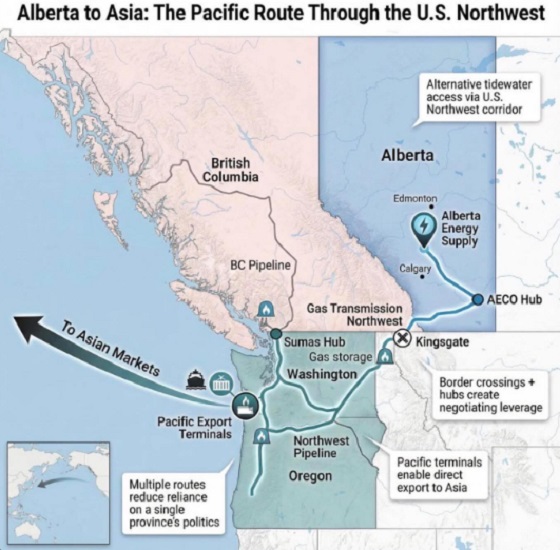
Alberta Premier Danielle Smith is signalling she will look south if Canada cannot move quickly on a new pipeline, saying she is open to shipping oil to the Pacific via the U.S. Pacific Northwest. In a year-end interview, Smith said her “first preference” is still a new West Coast pipeline through northern British Columbia, but she is willing to look across the border if progress stalls.
“Anytime you can get to the West Coast it opens up markets to get to Asia,” she said. Smith also said her focus is building along “existing rights of way,” pointing to the shelved Northern Gateway corridor, and she said she would like a proposal submitted by May 2026.
Deadlines and strings attached
The timing matters because Ottawa and Edmonton have already signed a memorandum of understanding that backs a privately financed bitumen pipeline to a British Columbia port and sends it to the new Major Projects Office. The agreement envisages at least one million barrels a day and sets out a plan for Alberta to file an application by July 1, 2026, while governments aim to finish approvals within two years.
The bargain comes with strings. The MOU links the pipeline to the Pathways carbon capture network, and commits Alberta to strengthen its TIER system so the effective carbon credit price rises to at least 130 dollars a tonne, with details to be settled by April 1, 2026.
Shifting logistics
If Smith is floating an American outlet, it is partly because Pacific Northwest ports are already drawing Canadian exporters. Nutrien’s plan for a $1-billion terminal at Washington State’s Port of Longview highlighted how trade logistics can shift when proponents find receptive permitting lanes.
But the political terrain in Washington and Oregon is unforgiving for fossil fuel projects, even for natural gas. In 2023, federal regulators approved TC Energy’s GTN Xpress expansion over protests from environmental groups and senior officials in West Coast states, with opponents warning about safety and wildfire risk. The project would add about 150 million cubic feet per day of capacity.
A record of resistance
That decision sits inside a longer record of resistance. The anti-development activist website “DeSmog” eagerly estimated that more than 70 percent of proposed coal, oil, and gas projects in the Pacific Northwest since 2012 were defeated, often after sustained local organizing and legal challenges.
Even when a project clears regulators, economics can still kill it. Gas Outlook reported that GTN later said the expansion was “financially not viable” unless it could obtain rolled-in rates to spread costs onto other utilities, a request regulators rejected when they approved construction.
Policy direction is tightening too. Washington’s climate framework targets cutting climate pollution 95 percent by 2050, alongside “clean” transport, buildings, and power measures that push electrification. Recent state actions described by MRSC summaries and NRDC notes reinforce that direction, including moves to help utilities plan a transition away from gas.
Oregon is moving in the same direction. Gov. Tina Kotek issued an executive order directing agencies to move faster on clean energy permitting and grid connections, tied to targets of cutting emissions 50 percent by 2035 and 90 percent by 2050, the Capital Chronicle reported.
For Smith, the U.S. corridor talk may be leverage, but it also underscores a risk, the alternative could be tougher than the Canadian fight she is already waging. The surest way to snuff out speculation is to make it unnecessary by advancing a Canadian project now that the political deal is signed. As Resource Works argued after the MOU, the remaining uncertainty sits with private industry and whether it will finally build, rather than keep testing hypothetical routes.
Resource Works News


Death by a thousand clicks – government censorship of Canada’s internet

Chinese Billionaire Tried To Build US-Born Baby Empire As Overseas Elites Turn To American Surrogates

Viral TikTok video shows 7-year-old cuddling great-grandfather before he’s euthanized

Politicians should be honest about environmental pros and cons of electric vehicles
-
 Agriculture20 hours ago
Why is Canada paying for dairy ‘losses’ during a boom?
-
 Automotive1 day ago
Ford’s EV Fiasco Fallout Hits Hard
-
 Crime2 days ago
The Uncomfortable Demographics of Islamist Bloodshed—and Why “Islamophobia” Deflection Increases the Threat
-
 Alberta21 hours ago
Alberta’s new diagnostic policy appears to meet standard for Canada Health Act compliance
-
 Censorship Industrial Complex22 hours ago
Top constitutional lawyer warns against Liberal bills that could turn Canada into ‘police state’
-
 espionage2 days ago
Carney Floor Crossing Raises Counterintelligence Questions aimed at China, Former Senior Mountie Argues
-
 International2 days ago
Ottawa is still dodging the China interference threat
-
 Health2 days ago
All 12 Vaccinated vs. Unvaccinated Studies Found the Same Thing: Unvaccinated Children Are Far Healthier