
Addictions
Alberta and opioids III: You can’t always just stop

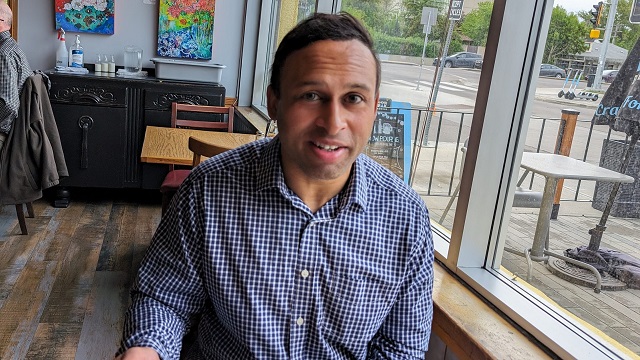
Monty Ghosh at Highlevel Diner, May 30. Photo: Paul Wells
By Paul Wells

This is the concluding installment in a series on drugs in Alberta. Previously:
i. “Worse Than I’ve Ever Seen,” June 4
ii. “Alberta’s System Builder,” June 7
To support ambitious reporting on important issues, please consider a paid subscription:
A matter of expectations
Street family
My tour guide for much of my visit to Edmonton was Dr. Monty Ghosh, a clinician who’s on faculty at the University of Calgary and the University of Edmonton. He seems to talk to everybody who works with substance users in Alberta, from his own patients to front-line clinicians to the Alberta government. His relations with the latter go up and down, but he urged me to talk to Marshall Smith, the chief of staff to premier Danielle Smith.
On my first night in Edmonton Ghosh walked me around a neighbourhood that included the George Spady Society supervised-consumption site, the Hope Mission’s Herb Jamieson Centre, and the Royal Alexandra Hospital, which has a supervised-consumption service on its premises.
A lot of people use the services these places provide. Other people don’t. Shelters in particular are tricky: they’re usually for single people who arrive alone. “The Hope, the Herb, the Navigation Centre, offering the world,” one Edmonton Police Service officer told me. “But all these places have one thing in common: rules.” If you have a spouse or a pet, you want to keep your drug supply or you want to stay close to your “street family” — the community spirit in neighbourhoods like this is striking, and might be surprising to people who prefer to stay away — a shelter’s probably not for you.
Several of the places we visited weren’t ready to welcome us when we showed up unannounced. To say the least, they’re busy. That was the case at Radius Community Health and Healing, an institutional building in a more residential part of the neighbourhood. Radius is a drop-in clinic and, as we’ll see, quite a bit more.
On a sunny weekday afternoon, more than a dozen people stood, sat or lay on the building’s front steps and truncated lawn. One lay on his back, shirtless, not moving visibly. Ghosh asked the man whether he was all right, asked again, finally nudged him. The man stirred, looked around. Ghosh apologized mildly for bothering him, then checked in on two other people who also weren’t moving. They turned out to be all right too.
Francesco Mosaico, Radius’s medical director, was on his way home for the day when we arrived, but we made plans to talk the next day. When I returned, I met Mosaico and Radius’s executive director, Tricia Smith, in her office.
I think it’s important to hear them out, because when drug use becomes the object of political debate, it’s natural to talk as though policy decisions are the main thing keeping people from getting well. This can lead to a lot of blame on one hand, and to excessive optimism on the other. In fact the biggest thing that keeps people from getting well is often the entire sum of their lives until now, compounded by the influence of drugs that are more potent than anything earlier generations had to deal with.
The most complex patients
Radius offers primary care to people “experiencing multiple barriers,” Smith said. That can include homelessness, addiction, severe mental health problems, criminal records. The centre’s team includes 12 family physicians and three psychiatrists. They currently see about 3,000 patients.
Radius has Western Canada’s only non-profit dental clinic. The centre runs a respite program for people who are not sick enough to be in acute care but are too sick to be managing independently on their own. It has a program for pregnant women experiencing homelessness. It runs on a harm-reduction model, so they don’t need to be drug-free to go into the program. It has an interdisciplinary Assertive Community Treatment team to help people with mental-health and substance problems find and stay in market apartments, with frequent assistance. There’s a supervised consumption site in the basement.
“In fact,” Smith said, “we actually have an exemption from the College of Physicians and Surgeons of Alberta to filter out and keep the most complex patients. The least complex, we refer elsewhere.” I couldn’t get care in Radius if I tried; they’d politely refer me elsewhere. They’re for the people who need the most help.
After my visit, Smith wrote to me to add another program to the list: Kindred House, which for more than 25 yearss has supported women and Trans women sex workers. “The women we see are from age 18 to 50, predominantly Indigenous, have intergenerational trauma, past/current trauma, substance use issues, often houseless or couch surfing,” Smith wrote.
Smith has been at Radius for three and a half years. While I was there, I asked her how work at Radius is going. “It’s going fabulously, honestly,” she said. She arrived early in the COVID pandemic, after eight years in Alberta government departments — which in turn followed 20 years as a Canadian Forces army nurse, including in combat zones. “I’m in the right place,” she said of Radius. “It felt like coming home.”
How come? “The staff, the team, the work, the dedication. It just feels like family. I missed that. Being in the military was a big thing. This work that this group does is just really amazing. The team is amazing and it’s hard, but it’s good work.”
And how’s the workload evolving? “Unfortunately, for this population, the struggles are only increasing, and the number of individuals that are experiencing those challenges is not getting less,” she said. “The workload isn’t going anywhere. It’s getting more difficult.”
Paul Wells is a reader-supported publication. To receive new posts and support my work, consider becoming a free or paid subscriber.
“Especially in the last couple years, I don’t think things have ever been worse for the vulnerable population,” Mosaico, Radius’s medical director, added. The same housing crunch that has made homes less affordable for everyone has put thousands of the most vulnerable on the street. Results: more frequent frostbite or burns from lamps lit to keep from freezing. Body lice. Trauma from watching friends die. And to Mosaico’s astonishment, frequent shigella outbreaks.
“Shigella’s a bacteria that causes torrential bloody diarrhea. It can be treated with a single dose of antibiotics. But if you’re homeless and you don’t have a place to take care of yourself… 70 percent of the cases have had to be hospitalized in the last two years…. I mean, they’re talking about potentially calling it an endemic disease, and it’s a disease of destitution. You see it in refugee camps in developing countries, not in the capital of Alberta, you know?”
Ten thousand times deadlier
Radius also works closely with the Alberta government to integrate its services with the “recovery-oriented system of care” that I told you about last week. There are two Radius staffers working at the Integrated Care Centre the police set up to replace the old, passive holding cells for overnight detention. There are two more at the Navigation Centre, which steers people toward social and government services. If there’s an Alberta model, they’re part of it. So I was fascinated by the response when I asked my hosts the basic question that sent me to Alberta: Why are so many people dying?
“I think it’s the nature of the drugs,” Mosaico said. “You know, people used to overdose and die. But I’ve been here 17 years. I think in the first 10 or 11 years it wasn’t very common to hear about overdoses by opioids. Every once in a while you’d hear about it, but it wasn’t a daily thing. Whereas now with fentanyl and carfentanil, it’s really dangerous.”
Carfentanil is 10,000 times more potent than morphine, 100 times more than fentanyl. The Edmonton Police won’t return stolen cars they recover until they’ve scrubbed them thoroughly, because even trace amounts of these drugs are too dangerous. “We’re finding clients who use methamphetamines and swear up and down they’re not taking opioids,” Mosaico said. “And then we do urine tests and it’s there. We think their dealers are lacing methamphetamine with fentanyl because it increases the addiction.”
The other big thing on his mind, Mosaico said, is that any program to guide users into recovery will bump up against the fact that different people have often lived starkly different lives.
93% 4+
“I don’t know if you’re familiar with Adverse Childhood Experiences — the ACEs study,” Mosaico said. I was, barely, but I needed a refresher.
The original study began in 1985 in San Diego, under Vincent Felitti, who ran an obesity clinic, and Rob Anda from the Centres for Disease Control. (If you want to learn more about the study, this article and this speech on Youtube are good places to start.)
“They surveyed 17,000 people,” Mosaico said. “They found, you know, if people had developmental trauma — so, trauma between the ages of 0 and 18 — and there are 10 different forms of trauma that the study bore out as being detrimental. Things like physical, emotional, sexual abuse; physical, emotional neglect; substance use in the family; untreated mental illness in the family; separation from biological parents; maternal figure being treated violently; and a household member going to jail.
“If those things occurred, you would just tally up the number of types of trauma and you’d get a score out of 10. What they found was, if you scored four or greater, that there seem to be adverse health effects in adulthood. And it wasn’t just the presence of addictions or mental illness. It was lung disease, heart disease, liver disease, certain forms of cancer, diabetes, obesity.” This is almost folk wisdom today, but at the time, Felitti and Anda were amazed at the strength of the correlations between childhood trauma and adult physical and mental health.
The original test has been widely replicated, and it usually finds that the proportion of people in a sample who’ve had four or more adverse childhood experiences is about 12%. So something like every eighth person you meet had a really difficult childhood, and while you can’t predict for individuals from statistical trends, there’s a good chance they’re still living with the fallout.
The team at Radius surveyed a large sample of the population under their care. The prevalence of high-risk ACE scores was about 93 percent, compared to 12 in the general population,” Mosaico said.
“Harvard has a center on the developing child, which has pulled together a lot of the science that explains the neurobiological link between the adverse trauma and the adverse health effects. They talk about limitations in the development of executive function, of decision-making, emotional regulation. Impulse control is underdeveloped, neuroanatomically in the brain. And instead what over-develops is the fight-or-flight response.
“So you’re dealing with a population that, because of their experiences, isn’t the same as the general population . And then that’s compounded by the fact that a high percentage of those clients who have high ACE scores also have traumatic brain injuries from living rough on the street. They also have adult trauma that compounds the childhood trauma. They have [fetal alcohol spectrum disorder], which impairs executive function even further.
“I hear these success stories and I think they’re wonderful, when you hear about people who have a difficult life and then they straighten up. And then, you know, they go back to their jobs and their families and they become leaders in their communities. But this is a population which is over-represented in every aspect of society, negatively as it were. In the prisons and child family welfare services. In the health system, you know, prevalence of HIV, tuberculosis, Hepatitis C, STIs, all that.
“And you look at them and you think, even if they managed to wait, you know, six months to get into an addiction recovery bed, after waiting for weeks to get into detox and they go through the program, what do they go back to? Most of them had to drop out of school. They have criminal records, which makes it hard to get a job. They’re disconnected and estranged from their families. They haven’t learned social skills.
“I had a client who lived in dumpsters for two and a half years. The fact that he just stayed housed — on income support — for the rest of his life was a huge win, right? It was important for his dignity, his quality of life. It’s just a matter of adjusting your expectations of what might actually be realistic.”
Thank you for reading Paul Wells. This post is public so feel free to share it.
Dr. Larson writes
The idea for these stories goes back to February, when it first became clear to me that 2023 would be Alberta’s worst year for overdose fatalities. I asked the communications team at the University of Calgary for names of people to talk to. Many weeks went by, because sometimes it’s ridiculous how hard it is to extract myself from Ottawa routine. After I published the second article in this series, the one where Marshall Smith showed me all the stuff Alberta is building, I received an email from Dr. Bonnie R. Larson, who’s on faculty at the University of Calgary. She thought I should have talked to her, and she thought I was too credulous in reporting the Alberta government’s side. I asked if I could publish part of her email. Here it is.
What cannot be taken for granted is Mr. Smith’s view that his goals are different, somehow nobler, than those of us on the front line. Smith paints a picture that front line providers’ priorities are at odds with his own. His perspective is at once undemocratic, insulting, and arrogant, belittling those who are doing the hard work of keeping people alive every day.
I will not have Smith speak for me in his suggestion that front liners lack system knowledge and that is why we support harm reduction. This ignores the excellent evidence supporting harm reduction interventions at the population level. Smith seems to think he knows from whence I “enter this conversation”. If so, why does he not engage me and my expert colleagues? Where I “enter this conversation” is at 20 years of working with the affected community and 13 years of post-secondary education. The only reason I am what Smith likes to dismiss as a “radical harm reduction activist”, is because the UCP, immediately upon taking office, set out to destroy harm reduction in Alberta. Nobody would have ever needed to fight this soul-destroying battle in the first place if Smith hadn’t put Alberta squarely on its current path of destruction. Yes, we should hope for a better tomorrow but that doesn’t excuse ignoring the past and present.
I would ask you to think about several additional factors that your analysis appears to ignore, including who actually benefits, in power and wealth, from Smiths’ system of so-called care? DId you consider the other ways that the UCP policy direction is moving the entire publicly-funded system steadily towards profit? Gunn (McCullough Centre) was a wonderful non-profit facility that helped many of my patients find their way to recovery from substance use disorders. While I agree that people should not have to pay for treatment, the question remains: in whose pockets do those tax dollars ultimately land?
You report that Smith indicates that they are “monitoring” the entire system. Where is the data from that monitoring? They have had five years now to show some outcomes, but who am I, just a lowly street doctor, to ask for population data? What I do know is that if deaths begin to decline, it is because so many are already gone. You should ask to see the data about which Smith so proudly boasts.
Smith’s entire premise that he is fixing the ‘addiction crisis’ is a fallacy. Addictions are not increasing. Deaths by drug poisonings are, however, and Smith’s circus is only making that worse. Allow me to spell it out for you: harm reduction addresses the drug poisoning crisis that is, no question, taking a horrific toll in Alberta and nationally. Smith’s ROSC, in contrast, addresses a figmentary addictions crisis.
One last tip. Medications used for opioid agonist treatment are not harm reduction, they are treatment. Nobody here is against treatment or recovery. But Marshall Smith is against harm reduction. Why can’t we just have the full spectrum of care??? Polarization is created by politicians to benefit politicians.
I don’t endorse everything Dr. Larson writes here. The data, or a lot of it, seems to me to be publicly available on the province’s impressive dashboard website. Use the tabs at the top of the page to navigate. And indeed, the story the dashboard tells is alarming, which, as I explained in this series’ first instalment, is why I flew west. But Larson’s years of front-line work has earned her, at the very least, a right of rebuttal.
Synthesis
On my last day in Edmonton, I met Monty Ghosh at Highlevel Diner, at the outer edge of the hip Strathcona neighbourhood on the south of the North Saskatchewan River. Highlevel is famous for its cinnamon buns, which, if I’m going to be honest, are noteworthy mostly for being large.
If the Alberta government and its most vociferous critics are thesis and antithesis, Ghosh tries to provide synthesis. He helped design the National Overdose Response Service, or NORS, which provides some of the emergency-response capability supervised consumption sites offer to people who aren’t near such a site or can’t use it for other reasons. He’s been critical of the Alberta government, but both sides keep lines of communication open.
I asked him about diverted safe supply — the idea that pharmaceutical opioids used in safe-supply programs in BC, principally hydromorphone tablets, are being sold or distributed away from their intended use. “I know it happens,” Ghosh said. “We sometimes get clients from British Columbia who come to Alberta to try to escape BC, because they’re looking for a fresh start. They’re looking for support and they’ll tell me themselves that they’ve diverted their safe supply.”
But what are the quantities? Trivial so far, Ghosh maintains. “Have I seen hydromorphone come into our province? Not at all, not yet.” This is the same thing I heard from Warren Driechel, the Edmonton deputy police chief.
Why do people divert their prescribed safe supply anyway? The answer Ghosh gave me was the answer I heard from everyone I asked. “They never used it. It just was not effective. The potency of the hydromorphone that they’re getting was nowhere near touching the fentanyl that they were using. It wasn’t dealing with the cravings, it wasn’t dealing with withdrawals, they felt it was useless. So what did they do? They sold it. They’re incredibly poor, they cannot afford their substance-use concerns and so therefore they supplement with revenue from hydromorphone.”
Before I flew to Edmonton, when Ghosh and I were trying to gauge on the phone what each of us thought of this infernal crisis, he figured out that I was interested in the differences between government policy in British Columbia and Alberta. “I’m not sure you want to hear this,” he said, “but I think it’s going to be bad everywhere.” I said that’s what I think too. Perhaps I surprised him.
I don’t know what happens next. Maybe things just stop getting worse everywhere on their own, for big complex reasons that resist easy analysis. Overdose deaths were lower last year in the United States, the capital of this hellscape, than the year before.
If not… well, we shall see. I wonder what happens in year six or seven of the effort the Alberta government is building. Is there resentment among people in ordinary hospitals and correctional facilities, who don’t have access to bespoke programs and personal attention? Does the ROSC system become bureaucratized after the first generation of administrators moves on?
Or does it start to win converts? David Eby, the NDP premier of British Columbia, has started putting distance between himself and his public-health advisors on legalization and safe supply. A new appointment in BC is being closely watched in Edmonton.
Or, conversely, does the Alberta recovery effort bump up against the limits imposed by the substances involved and by human nature? Reported recovery rates from addiction vary widely, depending in part on how you measure them. This paper puts the rate at less than 30%. If you even manage to double it, that still leaves a large cohort who aren’t getting better. Would their neighbours see them as people who “failed recovery” or “blew their chance?”
I won’t claim to know. I do hope that in the year ahead, more Canadians check their assumptions and stow their cheap certainties. Especially those who aspire to positions of leadership.
For the full experience subscribe to Paul Wells.


From the Brownstone Institute
Every morning, hundreds of millions of people perform a socially approved ritual. They line up for coffee. They joke about not being functional without caffeine. They openly acknowledge dependence and even celebrate it. No one calls this addiction degenerate. It is framed as productivity, taste, wellness—sometimes even virtue.
Now imagine the same professional discreetly using a nicotine pouch before a meeting. The reaction is very different. This is treated as a vice, something vaguely shameful, associated with weakness, poor judgment, or public health risk.
From a scientific perspective, this distinction makes little sense.
Caffeine and nicotine are both mild psychoactive stimulants. Both are plant-derived alkaloids. Both increase alertness and concentration. Both produce dependence. Neither is a carcinogen. Neither causes the diseases historically associated with smoking. Yet one has become the world’s most acceptable addiction, while the other remains morally polluted even in its safest, non-combustible forms.
This divergence has almost nothing to do with biology. It has everything to do with history, class, marketing, and a failure of modern public health to distinguish molecules from mechanisms.
Two Stimulants, One Misunderstanding
Nicotine acts on nicotinic acetylcholine receptors, mimicking a neurotransmitter the brain already uses to regulate attention and learning. At low doses, it improves focus and mood. At higher doses, it causes nausea and dizziness—self-limiting effects that discourage excess. Nicotine is not carcinogenic and does not cause lung disease.
Caffeine works differently, blocking adenosine receptors that signal fatigue. The result is wakefulness and alertness. Like nicotine, caffeine indirectly affects dopamine, which is why people rely on it daily. Like nicotine, it produces tolerance and withdrawal. Headaches, fatigue, and irritability are routine among regular users who skip their morning dose.
Pharmacologically, these substances are peers.
The major difference in health outcomes does not come from the molecules themselves but from how they have been delivered.
Combustion Was the Killer
Smoking kills because burning organic material produces thousands of toxic compounds—tar, carbon monoxide, polycyclic aromatic hydrocarbons, and other carcinogens. Nicotine is present in cigarette smoke, but it is not what causes cancer or emphysema. Combustion is.
When nicotine is delivered without combustion—through patches, gum, snus, pouches, or vaping—the toxic burden drops dramatically. This is one of the most robust findings in modern tobacco research.
And yet nicotine continues to be treated as if it were the source of smoking’s harm.
This confusion has shaped decades of policy.
How Nicotine Lost Its Reputation
For centuries, nicotine was not stigmatized. Indigenous cultures across the Americas used tobacco in religious, medicinal, and diplomatic rituals. In early modern Europe, physicians prescribed it. Pipes, cigars, and snuff were associated with contemplation and leisure.
The collapse came with industrialization.
The cigarette-rolling machine of the late 19th century transformed nicotine into a mass-market product optimized for rapid pulmonary delivery. Addiction intensified, exposure multiplied, and combustion damage accumulated invisibly for decades. When epidemiology finally linked smoking to lung cancer and heart disease in the mid-20th century, the backlash was inevitable.
But the blame was assigned crudely. Nicotine—the named psychoactive component—became the symbol of the harm, even though the damage came from smoke.
Once that association formed, it hardened into dogma.
How Caffeine Escaped
Caffeine followed a very different cultural path. Coffee and tea entered global life through institutions of respectability. Coffeehouses in the Ottoman Empire and Europe became centers of commerce and debate. Tea was woven into domestic ritual, empire, and gentility.
Crucially, caffeine was never bound to a lethal delivery system. No one inhaled burning coffee leaves. There was no delayed epidemic waiting to be discovered.
As industrial capitalism expanded, caffeine became a productivity tool. Coffee breaks were institutionalized. Tea fueled factory schedules and office routines. By the 20th century, caffeine was no longer seen as a drug at all but as a necessity of modern life.
Its downsides—dependence, sleep disruption, anxiety—were normalized or joked about. In recent decades, branding completed the transformation. Coffee became lifestyle. The stimulant disappeared behind aesthetics and identity.
The Class Divide in Addiction
The difference between caffeine and nicotine is not just historical. It is social.
Caffeine use is public, aesthetic, and professionally coded. Carrying a coffee cup signals busyness, productivity, and belonging in the middle class. Nicotine use—even in clean, low-risk forms—is discreet. It is not aestheticized. It is associated with coping rather than ambition.
Addictions favored by elites are rebranded as habits or wellness tools. Addictions associated with stress, manual labor, or marginal populations are framed as moral failings. This is why caffeine is indulgence and nicotine is degeneracy, even when the physiological effects are similar.
Where Public Health Went Wrong
Public health messaging relies on simplification. “Smoking kills” was effective and true. But over time, simplification hardened into distortion.
“Smoking kills” became “Nicotine is addictive,” which slid into “Nicotine is harmful,” and eventually into claims that there is “No safe level.” Dose, delivery, and comparative risk disappeared from the conversation.
Institutions now struggle to reverse course. Admitting that nicotine is not the primary harm agent would require acknowledging decades of misleading communication. It would require distinguishing adult use from youth use. It would require nuance.
Bureaucracies are bad at nuance.
So nicotine remains frozen at its worst historical moment: the age of the cigarette.
Why This Matters
This is not an academic debate. Millions of smokers could dramatically reduce their health risks by switching to non-combustion nicotine products. Countries that have allowed this—most notably Sweden—have seen smoking rates and tobacco-related mortality collapse. Countries that stigmatize or ban these alternatives preserve cigarette dominance.
At the same time, caffeine consumption continues to rise, including among adolescents, with little moral panic. Energy drinks are aggressively marketed. Sleep disruption and anxiety are treated as lifestyle issues, not public health emergencies.
The asymmetry is revealing.
Coffee as the Model Addiction
Caffeine succeeded culturally because it aligned with power. It supported work, not resistance. It fit office life. It could be branded as refinement. It never challenged institutional authority.
Nicotine, especially when used by working-class populations, became associated with stress relief, nonconformity, and failure to comply. That symbolism persisted long after the smoke could be removed.
Addictions are not judged by chemistry. They are judged by who uses them and whether they fit prevailing moral narratives.
Coffee passed the test. Nicotine did not.
The Core Error
The central mistake is confusing a molecule with a method. Nicotine did not cause the smoking epidemic. Combustion did. Once that distinction is restored, much of modern tobacco policy looks incoherent. Low-risk behaviors are treated as moral threats, while higher-risk behaviors are tolerated because they are culturally embedded.
This is not science. It is politics dressed up as health.
A Final Thought
If we applied the standards used against nicotine to caffeine, coffee would be regulated like a controlled substance. If we applied the standards used for caffeine to nicotine, pouches and vaping would be treated as unremarkable adult choices.
The rational approach is obvious: evaluate substances based on dose, delivery, and actual harm. Stop moralizing chemistry. Stop pretending that all addictions are equal. Nicotine is not harmless. Neither is caffeine. But both are far safer than the stories told about them.
This essay only scratches the surface. The strange moral history of nicotine, caffeine, and acceptable addiction exposes a much larger problem: modern institutions have forgotten how to reason about risk.
Author


From the Frontier Centre for Public Policy
Manitoba is choosing to expand the same drug policy model that other provinces are abandoning, policies that normalize addiction while sidelining treatment, recovery, and public safety.
The New Democrat premier of British Columbia, David Eby, stood before reporters last spring and called his government’s decision to permit public drug use in certain spaces a failure.
The policy was part of the broader “harm reduction” strategy meant to address overdose deaths. Instead, it had stirred public anger, increased street disorder and had helped neither users nor the communities that host them. “We do not accept street disorder that makes communities feel unsafe,” Eby said. The province scrapped the plan.
In Alberta, the Conservative government began shutting down safer-supply prescribing due to concerns about drug diversion and misuse. The belief that more opioids can resolve the opioid crisis is losing credibility.
Ontario Progressive Conservatives are moving away from harm reduction by shutting down supervised consumption sites near schools and limiting safer-supply prescribing. Federal funding for programs is decreasing, and the province is shifting its focus to treatment models, even though not all sites are yet closed.
Yet amid these non-partisan reversals, Manitoba’s government has announced its intention to open a supervised drug-use site in Winnipeg. Premier Wab Kinew said, “We have too many Manitobans dying from overdose.” True. But it does not follow that repeating failed approaches will yield different results.
Reversing these failed policies is not a rejection of compassion. It is a recognition that good intentions do not produce good outcomes. Vancouver and Toronto have hosted supervised drug-use sites for years. The death toll keeps rising. Drug deaths in British Columbia topped 2,500 in 2023, even with the most expansive harm reduction infrastructure in the country. A peer-reviewed study published this year found that hospitalizations from opioid poisoning rose after B.C.’s safer-supply policy was implemented. Emergency department visits increased by more than three cases per 100,000 population, with no corresponding drop in fatal overdoses.
And the problem persists day to day. Paramedics in B.C. responded to nearly 4,000 overdose calls in July 2024 alone. The monthly call volume has exceeded 3,000 almost every month this year. These are signs of crisis management without a path to recovery.
There are consequences beyond public health. These policies change the character of neighbourhoods. Businesses suffer. Residents feel unsafe. And most tragically, the person using drugs is offered little more than a cot, a nurse and a quiet signal to continue. Real help, like treatment, housing and purpose, remains out of reach.
Somewhere along the way, bureaucracies stopped asking what recovery looks like. They have settled for managing human decline. They call it compassion. But it is really surrender, wrapped in medical language.
Harm reduction had its time. It made sense when it first emerged, during the AIDS crisis, when dirty needles spread HIV. Back then, the goal was to stop a deadly virus. Today, that purpose has been lost.
When policy drifts into ideology, reality becomes an afterthought. Underneath today’s approach is the belief that drug use is inevitable, that people cannot change, that liberty means letting others fade away quietly. These ideas do not reflect science. They do not reflect hope. They reflect despair. They reflect a politics that prioritizes the appearance of compassion over effectiveness.
What Manitoba needs is treatment access that meets the scale of the problem. That means detox beds, recovery homes and long-term care focused on restoring lives. These may not generate the desired headlines, but they work. They are demanding. They are slow. And they offer respect to the person behind the addiction.
There are no shortcuts. No policy will undo decades of pain overnight. But a policy that keeps people stuck using is not mercy. It is maintenance with no way out.
A government that believes in its people should not copy failure.
Marco Navarro-Genie is vice-president of research at the Frontier Centre for Public Policy and co-author, with Barry Cooper, of Canada’s COVID: The Story of a Pandemic Moral Panic (2023).




-
 International2 days ago
“Captured and flown out”: Trump announces dramatic capture of Maduro
-
 International2 days ago
Trump Says U.S. Strike Captured Nicolás Maduro and Wife Cilia Flores; Bondi Says Couple Possessed Machine Guns
-
Energy1 day ago
The U.S. Just Removed a Dictator and Canada is Collateral Damage
-
 International1 day ago
US Justice Department Accusing Maduro’s Inner Circle of a Narco-State Conspiracy
-
 Haultain Research1 day ago
Trying to Defend Maduro’s Legitimacy
-
 Business2 days ago
Vacant Somali Daycares In Viral Videos Are Also Linked To $300 Million ‘Feeding Our Future’ Fraud
-
 Daily Caller22 hours ago
Trump Says US Going To Run Venezuela After Nabbing Maduro
-
International1 day ago
U.S. Claims Western Hemispheric Domination, Denies Russia Security Interests On Its Own Border