
Energy
A Wealth-Creating Way of Reducing Global CO2 Emissions


From the C2C Journal
By Gwyn Morgan

It is Prime Minister Justin Trudeau’s contention there’s no “business case” for exporting Canada’s abundant, inexpensively produced natural gas as LNG. But Canadians might do well to politely decline management consulting advice from a former substitute drama teacher who was born into wealth and has never had to meet a payroll, balance a budget or make a sale. Bluntly stated, someone who has shown no evidence of being able to run the proverbial lemonade stand. And one whose real agenda, the evidence shows, is to strangle the nation’s most productive and wealth-generating industry. With the first LNG ship finally expected to dock at Kitimat, B.C. over the next year and load Canada’s first-ever LNG export cargo, Gwyn Morgan lays out the business and environmental cases for ramping up our LNG exports – and having them count towards Canada’s greenhouse gas reduction targets.
Pierre Poilievre’s Axe the (carbon) Tax campaign is a spectacular success. But the Conservative Party of Canada needs its own plan to reduce greenhouse gas emissions from fossil fuels. Paradoxically, it’s a fossil fuel that provides much of the answer.
Canada’s rich endowment of natural gas resources offers an immense opportunity to reduce global carbon dioxide (CO2) emissions while also helping to rescue the Liberal-government-ravaged Canadian economy by exporting liquefied natural gas (LNG) to China, Japan, South Korea and the other coal-dependent Asia-Pacific countries. Switching from coal to natural gas for producing electricity and generating heat for buildings and industrial processes can typically reduce CO2 emissions by 50 percent for the same unit of output, while all-but eliminating the toxic compounds and lung-clogging particulates emitted from burning coal that shorten the lives of millions living in smog-stricken Asian cities.
More natural gas is urgently needed, since countries throughout Asia – especially China and India – are currently adding even more coal-burning power plants to meet rapidly growing electricity demand. The benefits of fuel-switching are not speculation, but a proven result: the United States’ pronounced switch starting in the mid-2000s from coal to natural gas for electricity materially reduced that country’s CO2 emissions (see accompanying graph), nearly equalling the entire European Union’s emissions cuts, as I wrote about in this previous column.

A study by respected consulting firm Wood Mackenzie, released in late 2022, determined the following:
But through a decade of trying to navigate Canada’s increasingly obstructive and Byzantine regulatory process, project proponents dropped out one by one. Today LNG Canada is the only one of those major projects left standing. (Two much smaller LNG projects, Woodfibre LNG in Howe Sound at Squamish, and Cedar LNG just a few kilometres from the LNG Canada project, are also proceeding, and one other large project proposed by the Nisga’a First Nation is making regulatory progress.) LNG Canada succeeded only because South African project leader Andy Calitz, backed by the enthusiasm of the Haisla Nation which saw the immense potential to create a self-sustaining, wealth-generating economy for its people, refused to give up.
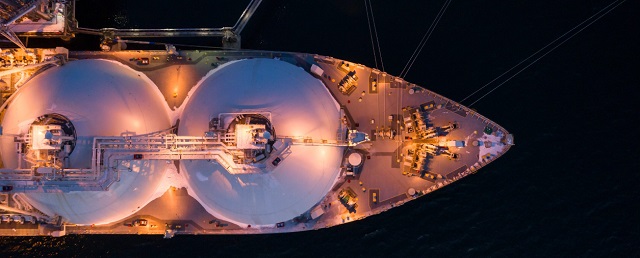
After five years of construction, the LNG Canada liquefaction facility and loading terminal are nearing completion, with the first LNG ship scheduled to sail to China in 2025 (possibly even this year). The Kitimat plant itself is just one component of Canada’s first LNG export project. TC Energy Corp.’s (formerly TransCanada Pipelines) $15 billion, recently completed Coastal GasLink pipeline will carry the required natural gas from the northeastern B.C. gas fields to the Kitimat terminal. And additional billions of dollars have been invested in drilling natural gas wells, proving up the immense reserves needed to feed the LNG facility for decades to come, and constructing field production systems.

The economic benefits are myriad. Aside from the jobs created and the wealth generated for the participating companies, B.C.’s annual natural gas royalties are forecast to double from $700 million in 2024 to $1.4 billion in 2027. Benefits for First Nations include significant employment and business opportunities, such as HaiSea Marine’s 50 percent interest in a $500 million contract.
And that’s just LNG Canada’s Phase 1, which will produce 14 million tonnes per annum (mtpa) of LNG, or approximately 1.8 billion cubic feet (bcf) per day. With that one project coming on-stream, about 10 percent of Canada’s total natural gas production will be exported to international markets, earning premium prices. Construction of Phase 2 is scheduled to begin in 2026 and will double the facility’s output, with first delivery scheduled for 2032. A report from Canada Action estimates that completion of both phases will reduce CO2 emissions in Asian countries as much as would removing 18 million cars from Canadian roads. That is a far more efficient and realistic way of reducing emissions than the Trudeau government’s current scheme to force everyone into electric vehicles within a decade.

A major barrier for LNG project sponsors has been Canadian regulators’ fixation on a project’s domestic emissions – which come mainly from producing the energy needed to operate the liquefaction and storage process and loading facility. These emissions are miniscule compared to the enormous emissions reductions when natural gas is used instead of coal in consuming countries. But in their zeal to force Canada to “net zero” emissions, government authorities initially tried to veto LNG Canada generating its electricity and compression power using some of the natural gas that will be already piped to the site, insisting instead upon hydroelectric power. This seriously delayed the project due to the need for B.C. Hydro to first build a new dam to supply the required power, along with a new, $3 billion transmission line that has not even begun its environmental review process.
Regulators finally waived their objection so the project could be finished, and it will initially use natural gas for power. But the same objection is now being raised with respect to another major LNG venture proposed in the same region. The Ksi Lisims LNG project would utilize a floating liquefaction and loading facility docked at lands owned by the Nisga’a First Nation north of Prince Rupert. Its natural gas would be supplied through an already-approved but never-built pipeline planned for one of the cancelled LNG projects. The $10 billion venture would have approximately two-thirds the capacity of LNG Canada Phase 1. The facility would be powered by hydroelectricity.

Ksi Lisims sounds like a great addition to Canada’s modest LNG lineup, one that British Columbians should applaud. Instead, the proponents have been assailed by objections over the greenhouse gas emissions from the facility and the natural gas production process, and concurrently the B.C. Wilderness Committee is calling on the province’s NDP government to veto any further LNG development. None of these zealots acknowledge the vastly greater reduction of greenhouse gas emissions that will be achieved as consuming countries switch to natural gas.
Prior to the December 2018 UN Climate Change Conference in Katowice, Poland, Canada’s Conservative Party urged leaders of their nation’s delegation to propose that the use of imported natural gas to displace coal and thereby reduce emissions in one country should count towards the exporting country’s emissions reduction targets. But this made far too much sense for our Prime Minister and his team of anti-fossil-fuel eco-zealots. A new federal government that encourages LNG projects might well see a return of those other big sponsors that were driven off.
And that brings us back to Pierre Poilievre and the need for a Conservative alternative to Trudeau’s carbon tax. LNG export would be not only vastly superior in reducing emissions, it would also create tens of billions of dollars in economic benefits for a beleaguered Canadian private sector. It is beyond high time. A Macdonald-Laurier Institute report, Estimating the True Size of Government in Canada, concludes that Canada’s private sector has shrunk to just 36 percent of the nation’s GDP. That’s right – Canada’s public sector now represents nearly two-thirds of the Canadian economy, if one includes in that measure the vast amounts governments spend on tax credits and other tax-related expenditures, plus the economic impacts of regulating the pricing or outputs of private industries. This is appalling.

Even more incomprehensible is a research report from the Harvard Kennedy School noting that “Communist” China’s private sector generates “approximately 60% of China’s GDP, 70% of its innovative capacity, 80% of urban employment and 90% of new jobs.” By those measures, the private sector in ostensibly free and democratic Canada, with its allegedly market-based economy, has been reduced to barely half the relative size of the private sector in authoritarian China.
It is clear that for Canada, getting out of the way of privately-driven growth in LNG exports would be a vastly superior environmental alternative to Trudeau’s economically destructive and politically divisive carbon tax, while also helping to reverse the decline of what was once a proud, thriving nation into an indebted, unproductive, government-dominated basket case.
Gwyn Morgan is a retired business leader who was a director of five global corporations.

From Energy Now
By Margareta Dovgal
Playing politics with pipelines is a time-honored Canadian tradition. Recent events in the House of Commons offered a delightful twist on the genre.
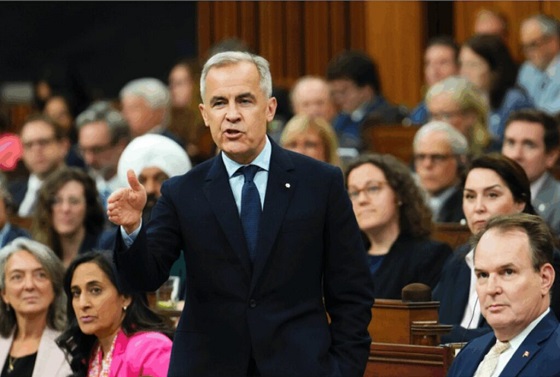
The Conservatives introduced a motion quoting the Liberals’ own pipeline promises laid out in the Memorandum of Understanding (MOU) with Alberta, nearly verbatim. The Liberals, true to form, killed it 196–139 with enthusiastic help from the NDP, Bloc, and Greens.
We all knew how this would end. Opposition motions like this never pass; no government, especially not one led by Mark Carney, is going to let the opposition dictate the agenda. There’s not much use feigning outrage that the Liberals voted it down. The more entertaining angle has been watching closely as Liberal MPs twist themselves into pretzels explaining why they had to vote “no” on a motion that cheers on a project they claim to support in principle.
Liberal MP Corey Hogan dismissed the motion as “game-playing” designed to “poke at people”.
And he’s absolutely right to call it a “trap” for the Liberals. But traps only work when you walk into them.
Indigenous Services Minister Mandy Gull-Masty deemed the motion an “immature waste of parliamentary time” and “clearly an insult towards Indigenous Peoples” because it didn’t include every clause of the original agreement. Energy Minister Tim Hodgson decried it as a “cynical ploy to divide us” that “cherry-picked” the MOU.
Yet the prize for the most tortured metaphor goes to the prime minister himself. Defending his vote against his own pipeline promise, Carney lectured the House that “you have to eat the entire meal, not just the appetizer.”
It’s a clever line, and it also reveals the problem. The “meal” Carney is serving is stuffed with conditions. Environmental targets or meaningful engagement with Indigenous communities aren’t unrealistic asks. A crippling industrial carbon price as a precondition might be though.
But the prime minister has already said the quiet part out loud.
Speaking in the House a few weeks ago, Carney admitted that the agreement creates “necessary conditions, but not sufficient conditions,” before explicitly stating: “We believe the government of British Columbia has to agree.”
There is the poison pill. Handing a de facto veto to a provincial government that has spent years fighting oil infrastructure is neither constitutionally required nor politically likely. Elevating B.C.’s “agreement” to a condition, which is something the MOU text itself carefully avoids doing, means that Carney has made his own “meal” effectively inedible.
Hodgson’s repeated emphasis that the Liberal caucus supports “the entire MOU, the entire MOU” only reinforces this theory.
This entire episode forces us to ask whether the MOU is a real plan to build a pipeline, or just a national unity play designed to cool down the separatist temperature in Alberta. My sense is that Ottawa knew they had to throw a bone to Premier Danielle Smith because the threat of the sovereignty movement is gaining real traction. But you can’t just create the pretense of negotiation to buy time.
With the MOU getting Smith boo’ed at her own party’s convention by the separatists, it’s debatable whether that bone was even an effective one to throw.
There is a way. The federal government has the jurisdiction. If they really wanted to, they could just do it, provided the duty to consult with and accommodate Indigenous peoples was satisfied. Keep in mind: no reasonable interpretation equates Section 35 of the Charter to a veto.
Instead, the MOU is baked with so many conditions that the Liberals have effectively laid the groundwork for how they’re going to fail.
With overly-hedged, rather cryptic messaging, Liberals have themselves given considerable weight to a cynical theory, that the MOU is a stalling tactic, not a foundation to get more Canadian oil to the markets it’s needed in. Maybe Hodgson is telling the truth, and caucus is unified because the radicals are satisfied that “the entire MOU” ensures that a new oil pipeline will never reach tidewater through BC.
So, hats off to the legislative affairs strategists in the Conservative caucus. The real test of Carney’s political power continues: can he force a caucus that prefers fantasy economics into a mold of economic literacy to deliver on the vision Canadians signed off on? Or will he be hamstrung trying to appease the radicals from within?
Margareta Dovgal is managing director of Resource Works Society.

From the Daily Caller News Foundation
By Steve Milloy
The Paris Climate Accord was adopted 10 years ago this week. It’s been a decade of disaster that President Donald Trump is rightly trying again to end.
The stated purpose of the agreement was for countries to voluntarily cut emissions to avoid the average global temperature exceeding the (guessed at) pre-industrial temperature by 3.6°F (2°C) and preferably 2.7°F (1.5°C).
Since December 2015, the world spent an estimated $10 trillion trying to achieve the Paris goals. What has been accomplished? Instead of reducing global emissions, they have increased about 12 percent. While the increase in emissions is actually a good thing for the environment and humanity, spending $10 trillion in a failed effort to cut emissions just underscores the agreement’s waste, fraud and abuse.
As a nonprofit, we are dependent on the generosity of our readers.
Please consider making a small donation of any amount here.
Thank you!
But wasting $10 trillion is only the tip of the iceberg.
The effort to cut emissions was largely based on forcing industrial countries to replace their tried-and-true fossil fuel-based energy systems with not-ready-for-prime-time wind, solar and battery-based systems. This forced transition has driven up energy costs and made energy systems less reliable. The result of that has been economy-crippling deindustrialization in former powerhouses of Germany and Britain.
And it gets worse.
European nations imagined they could reduce their carbon footprint by outsourcing their coal and natural gas needs to Russia. That outsourcing enriched Russia and made the European economy dependent on Russia for energy. That vulnerability, in turn, and a weak President Joe Biden encouraged Vladimir Putin to invade Ukraine.
The result of that has been more than one million killed and wounded, the mass destruction of Ukraine worth more than $500 billion so far and the inestimable cost of global destabilization. Europe will have to spend hundreds of billions more on defense, and U.S. taxpayers have been forced to spend hundreds of billions on arms for Ukraine. Putin has even raised the specter of using nuclear weapons.
President Barack Obama unconstitutionally tried to impose the Paris agreement on the U.S. as an Executive agreement rather than a treaty ratified by the U.S. Senate. Although Trump terminated the Executive agreement during his first administration, President Joe Biden rejoined the agreement soon after taking office, pledging to double Obama’s emissions cuts pledge to 50 percent below 2005 levels by 2030.
Biden’s emissions pledge was an impetus for the 2022 Inflation Reduction Act that allocated $1.2 trillion in spending for what Trump labeled as the Green New Scam. Although Trump’s One Big Beautiful Bill Act reduced that spending by about $500 billion and he is trying to reduce it further through Executive action, much of that money was used in an effort to buy the 2024 election for Democrats. The rest has been and will be used to wreck our electricity grid with dangerous, national security-compromising wind, solar and battery equipment from Communists China.
Then there’s this. At the Paris climate conference in 2015, U.S. Secretary of State John Kerry stated quite clearly that emissions cuts by the U.S. and other industrial countries were meaningless and would accomplish nothing since the developing world’s emissions would be increasing.
Finally, there is the climate realism aspect to all this. After the Paris agreement was signed and despite the increase in emissions, the average global temperature declined during the years from 2016 to 2022, per NOAA data.
The super El Nino experienced during 2023-2024 caused a temporary temperature spike. La Nina conditions have now returned the average global temperature to below the 2015-2016 level, per NASA satellite data. The overarching point is that any “global warming” that occurred over the past 40 years is actually associated with the natural El Nino-La Nina cycle, not emissions.
The Paris agreement has been all pain and no gain. Moreover, there was never any need for the agreement in the first place. A big thanks to President Trump for pulling us out again.
Steve Milloy is a biostatistician and lawyer. He posts on X at @JunkScience.


Trump DOJ seeks to quash Pfizer whistleblower’s lawsuit over COVID shots

Alberta introducing three “all-season resort areas” to provide more summer activities in Alberta’s mountain parks

Trump admin wants to help Canadian woman rethink euthanasia, Glenn Beck says

Growing Alberta’s fresh food future
-
 Business2 days ago
Ottawa Pretends To Pivot But Keeps Spending Like Trudeau
-
 International2 days ago
Bondi Beach Shows Why Self-Defense Is a Vital Right
-
 Automotive1 day ago
Ford’s EV Fiasco Fallout Hits Hard
-
Energy2 days ago
Liberals Twisted Themselves Into Pretzels Over Their Own Pipeline MOU
-
 Censorship Industrial Complex2 days ago
How Wikipedia Got Captured: Leftist Editors & Foreign Influence On Internet’s Biggest Source of Info
-
 Crime1 day ago
Bondi Beach Survivor Says Cops Prevented Her From Fighting Back Against Terrorists
-
 Crime2 days ago
The Uncomfortable Demographics of Islamist Bloodshed—and Why “Islamophobia” Deflection Increases the Threat
-
 Frontier Centre for Public Policy16 hours ago
Canada Lets Child-Porn Offenders Off Easy While Targeting Bible Believers