
National
Alberta will use provincial laws to stop Canadian gov’t from trying to confiscate legal firearms



From LifeSiteNews
Premier Danielle Smith confirmed that her government will introduce a motion to protect lawful gun owners from improper seizures and prosecution.
Alberta Premier Danielle Smith confirmed what she has promised for over a year now that her government will use its laws to stop Liberal Prime Minister Mark Carney’s federal gun-grab of legally purchased firearms from taking effect in the province.
“I just announced that our government will introduce a motion under the Alberta Sovereignty within a United Canada Act next week,” she posted on X over the weekend.
“This motion will protect lawful gun owners from improper seizures and prosecution, and ensure Albertans can protect their homes, families, and property.”
Smith’s motion was officially revealed on Tuesday. It reads, “A new motion under the Alberta Sovereignty within a United Canada Act will, if passed by the legislature, instruct all provincial entities, including law-enforcement agencies such as municipal police services and the RCMP, to decline to enforce or implement the federal gun seizure program.”
“The motion also makes clear that Albertans have the right to use reasonable force to defend themselves, their families and their homes from intruders,” it notes.
Smith has many times before, as reported by LifeSiteNews, promised her province will refuse to participate in his planned gun buyback program that aims to seize the legally purchased guns of Canadian firearm owners.
Alberta’s “Sovereignty Act” allows it to ignore federal laws that the province views as being unconstitutional.
Smith’s United Conservative Party (UCP) recently held its AGM, at which a motion to support so-called “Castle Laws” was introduced and passed.

She was recently quoted as saying, “If you don’t want to get shot, don’t break into someone’s house.”
Smith has promised that her government will introduce a so-called “Castle Law” to protect the rights of homeowners.
Violent crime against homeowners is on the rise in Canada. As reported by LifeSiteNews, Conservative leader Pierre Poilievre lashed out at Carney’s “catch and release” bail laws, saying they need to be rescinded while adding Canadians have a “right” to defend their homes. He made the comments after a 46-year-old father died defending his family home.
The Canadian government’s controversial gun grab Bill C-21, which bans many types of guns, including handguns, and mandates a buyback program became law on December 14, 2023, after senators voted 60- 24 in favor of the bill.
In May 2023, Bill C-21 passed in the House of Commons. After initially denying that the bill would impact hunters, former Prime Minister Justin Trudeau eventually admitted that C-21 would indeed ban certain types of hunting rifles.
Trudeau’s gun grab was first announced after a deadly mass shooting in Nova Scotia in May 2020 in which he banned over 1,500 “military-style assault firearms” with a plan to begin buying them back from owners.
Late last year, the Trudeau government extended the amnesty deadline for legal gun owners until October 30, 2025. It should be noted that this is around the same time a federal election was to take place.
When it comes to gun-related deaths in Canada, as reported by LifeSiteNews, Statistics Canada data shows that most violent gun crimes in the country last year were not committed at the hands of legal gun owners but by those who obtained the weapons illegally.

From Resource Works
Innovative housing solution minimizes community impact while supporting the massive labour force needed for the Woodfibre LNG project.
The Woodfibre LNG project — a national leader in Indigenous partnerships and a cornerstone of global energy security — relies on a large construction workforce that drives economic prosperity across the region. For many of these workers, “home” is a ship.
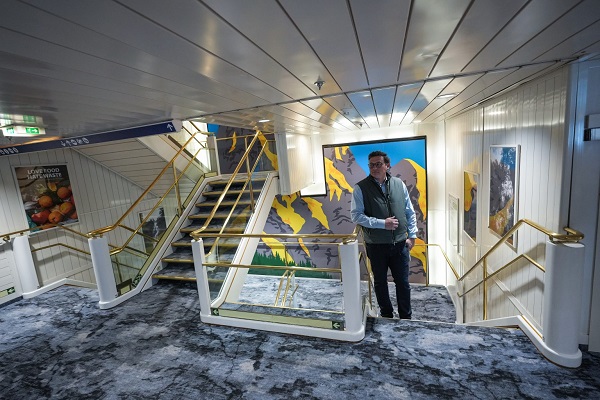
Refitted from a cruise liner into a dedicated accommodation vessel, or “floatel,” this innovative solution houses up to 600 workers near Squamish, B.C., while keeping pressure off local housing and minimizing the project’s community footprint.
These exclusive images, captured a year ago, offer a rare retrospective look inside the original floatel. MV Isabelle X. With a second accommodation ship, the MV Saga X, recently arrived, this photo essay gives a timely, ground-level view of life aboard: individual cabins, a full-service dining hall, recreation spaces and custom laundry facilities. It’s a glimpse into the offshore dormitory that anchors daily life for the crew bringing this vital energy project to completion.

An arcade room is seen on a “floatel” that Woodfibre LNG plans to use to house 600 construction workers at a liquefied natural gas export facility being built near Squamish, during a media tour in Vancouver, on Thursday, May 9, 2024. The ship arrived in B.C. waters in January after a 40-day journey from Estonia, where it had sheltered Ukrainian refugees, but the District of Squamish council voted three to four against a one-year permit for its use last week.

A dining area is seen on a “floatel” that Woodfibre LNG plans to use to house 600 construction workers at a liquefied natural gas export facility being built near Squamish, during a media tour in Vancouver, on Thursday, May 9, 2024. The ship arrived in B.C. waters in January after a 40-day journey from Estonia, where it had sheltered Ukrainian refugees, but the District of Squamish council voted three to four against a one-year permit for its use last week.

A cabin is seen on a “floatel” that Woodfibre LNG plans to use to house 600 construction workers at a liquefied natural gas export facility being built near Squamish, during a media tour in Vancouver, on Thursday, May 9, 2024. The ship arrived in B.C. waters in January after a 40-day journey from Estonia, where it had sheltered Ukrainian refugees, but the District of Squamish council voted three to four against a one-year permit for its use last week.

Bridgemans Services Group president Brian Grange stands at the stern on a renovated cruise ship known as a “floatel” that Woodfibre LNG plans to use to house 600 construction workers at a liquefied natural gas export facility being built near Squamish, during a media tour in Vancouver, on Thursday, May 9, 2024. The ship arrived in B.C. waters in January after a 40-day journey from Estonia, where it had sheltered Ukrainian refugees, but the District of Squamish council voted three to four against a one-year permit for its use last week.

A custom built heat pump unit that allows the ship to avoid using diesel while docked and at anchor is seen on a “floatel” that Woodfibre LNG plans to use to house 600 construction workers at a liquefied natural gas export facility being built near Squamish, during a media tour in Vancouver, on Thursday, May 9, 2024. The ship arrived in B.C. waters in January after a 40-day journey from Estonia, where it had sheltered Ukrainian refugees, but the District of Squamish council voted three to four against a one-year permit for its use last week.

The main entry and exit area for workers is seen on a “floatel” that Woodfibre LNG plans to use to house 600 construction workers at a liquefied natural gas export facility being built near Squamish, during a media tour in Vancouver, on Thursday, May 9, 2024. The ship arrived in B.C. waters in January after a 40-day journey from Estonia, where it had sheltered Ukrainian refugees, but the District of Squamish council voted three to four against a one-year permit for its use last week.

A renovated cruise ship known as a “floatel” that Woodfibre LNG plans to use to house 600 construction workers at a liquefied natural gas export facility being built near Squamish, is seen at anchor in the harbour in Vancouver, on Thursday, May 9, 2024. The ship arrived in B.C. waters in January after a 40-day journey from Estonia, where it had sheltered Ukrainian refugees, but the District of Squamish council voted three to four against a one-year permit for its use last week.

A tugboat and water taxi are seen docked at a renovated cruise ship known as a “floatel” that Woodfibre LNG plans to use to house 600 construction workers at a liquefied natural gas export facility being built near Squamish, at anchor in the harbour in Vancouver, on Thursday, May 9, 2024. The ship arrived in B.C. waters in January after a 40-day journey from Estonia, where it had sheltered Ukrainian refugees, but the District of Squamish council voted three to four against a one-year permit for its use last week.
All photos credited to THE CANADIAN PRESS/Darryl Dyck
Resource Works News
From the Canadian Energy Centre
Bigger project maintains decades-long marine safety record
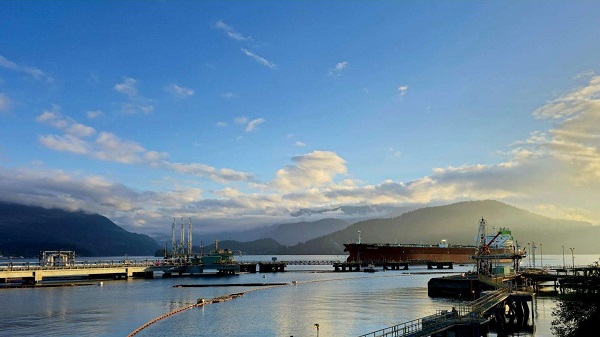
The Trans Mountain system continues its decades-long record of zero marine spills, even as oil tanker traffic has surged more than 800 per cent since the pipeline’s expansion in May 2024.
The number of tankers calling at Trans Mountain’s Westridge Marine Terminal in the Port of Vancouver in one month now rivals the number that used to go through in one year.
A global trend toward safer tanker operations
Trans Mountain’s safe operations are part of a worldwide trend. Global oil tanker traffic is up, yet spills are down, according to the International Tanker Owners Pollution Federation, a London, UK-based nonprofit that provides data and response support.

Graph courtesy International Tanker Owners Pollution Federation
Transport Canada reports a 95 per cent drop in ship-source oil spills and spill volumes since the 1970s, driven by stronger ship design, improved response and better regulations.
“Tankers are now designed much more safely. They are double-hulled and compartmentalized to mitigate spills,” said Mike Lowry, spokesperson for the Western Canada Marine Response Corporation (WCMRC).
WCMRC: Ready to protect the West Coast

One of WCMRC’s new response vessels arrives in Barkley Sound. Photo courtesy Western Canada Marine Response Corporation
From eight marine bases including Vancouver and Prince Rupert, WCMRC stands at the ready to protect all 27,000 kilometres of Canada’s western coastline.
Lowry sees the corporation as similar to firefighters — training to respond to an event they hope they never have to see.
In September, it conducted a large-scale training exercise for a worst-case spill scenario. This included the KJ Gardner — Canada’s largest spill response vessel and a part of WCMRC’s fleet since 2024.
“It’s part of the work we do to make sure everybody is trained and prepared to use our assets just in case,” Lowry said.
Expanding capacity for Trans Mountain

The K.J. Gardner is the largest-ever spill response vessel in Canada. Photo courtesy Western Canada Marine Response Corporation
WCMRC’s fleet and capabilities were doubled with a $170-million expansion to support the Trans Mountain project.
Between 2012 and 2024, the company grew from 13 people and $12 million in assets to more than 200 people and $213 million in assets.
“About 80 per cent of our employees are mariners who work as deckhands, captains and marine engineers on our vessels,” Lowry said.
“Most of the incidents we respond to are small marine diesel spills — the last one was a fuel leak from a forest logging vessel near Nanaimo — so we have deployed our fleet in other ways.”
Tanker safety starts with strong rules and local expertise

Tanker loading at the Westridge Marine Terminal in the Port of Vancouver. Photo courtesy Trans Mountain Corporation
Speaking on the ARC Energy Ideas podcast, Trans Mountain CEO Mark Maki said tanker safety starts with strong regulations, including the use of local pilots to guide vessels into the harbour.
“On the Mississippi River, you have Mississippi River pilots because they know how the river behaves. Same thing would apply here in Vancouver Harbour. Tides are strong, so people who are familiar with the harbor and have years and decades of experience are making sure the ships go in and out safely,” Maki said.
“A high standard is applied to any ship that calls, and our facility has to meet very strict requirements. And we have rejected ships, just said, ‘Nope, that one doesn’t fit the bill.’ A ship calling on our facilities is very, very carefully looked at.”

Working with communities to protect sensitive areas
Beyond escorting ships and preparing for spills, WCMRC partners with coastal communities to map sensitive areas that need rapid protection including salmon streams, clam beds and culturally important sites like burial grounds.
“We want to empower communities and nations to be more prepared and involved,” Lowry said.
“They can help us identify and protect the areas that they value or view as sensitive by working with our mapping people to identify those areas in advance. If we know where those are ahead of time, we can develop a protection strategy for them.”


Is there a cure for Alzheimer’s Disease?

Google denies scanning users’ email and attachments with its AI software

Learning the Truth about “Children’s Graves” and Residential Schools is More Important than Ever

The Unmasking of Vaccine Science
-
 MAiD2 days ago
From Exception to Routine. Why Canada’s State-Assisted Suicide Regime Demands a Human-Rights Review
-
 Business2 days ago
Carney government should privatize airports—then open airline industry to competition
-
 Alberta2 days ago
Carney’s pipeline deal hits a wall in B.C.
-
 Alberta1 day ago
Alberta Sports Hall of Fame Announces Class of 2026 Inductees
-
 Censorship Industrial Complex1 day ago
Conservative MP Leslyn Lewis slams Liberal plan targeting religious exemption in hate speech bil
-
 Business2 days ago
What’s Going On With Global Affairs Canada and Their $392 Million Spending Trip to Brazil?
-
 Business2 days ago
Is Carney Falling Into The Same Fiscal Traps As Trudeau?
-
 Energy1 day ago
Canada following Europe’s stumble by ignoring energy reality