
Censorship Industrial Complex
Justice Centre campaigning Canadian provinces to follow Alberta’s lead protecting professionals




Justice Centre launches national campaign to stop ideological overreach in regulated professions
The Justice Centre for Constitutional Freedoms announces the launch of a national campaign urging all provinces to adopt legislation that restores professional regulators to their proper role of overseeing competence and ethics, rather than compelling speech or imposing political ideology on regulated professionals who serve the public.
Across Canada, professionals such as doctors, nurses, teachers, social workers, engineers, dentists, lawyers and many others are governed by regulatory bodies created to uphold technical competence and ethical standards. Instead of focusing on those core responsibilities, however, many regulators have begun embedding political or ideological content into mandatory courses, codes of ethics and continuing education requirements.
At the same time, professionals are increasingly being investigated or disciplined not for misconduct, but for expressing personal views or declining to endorse political positions.
To help Canadians take action, the Justice Centre has created an online tool with a ready-to-send letter that goes directly to the provincial representatives responsible for the relevant legislation. All the user needs to do is select their province and enter their information, and the tool automatically delivers the letter to the appropriate recipient.

The prepared letter outlines three essential legislative amendments:
- prohibiting regulatory bodies from pursuing political objectives;
- prohibiting regulators from monitoring or controlling the speech of their members; and
- prohibiting regulators from embedding political or ideological content into definitions of competence and ethics.
Alberta is the first province to take meaningful steps toward addressing this growing problem. Its proposed legislation, called the Regulated Professions Amendment Act, is designed to prevent regulators from compelling speech, advancing political objectives or embedding ideology into definitions of competence and ethics.
The Justice Centre encourages all Canadians to visit our website today to take action and help protect the independence of regulated professionals.

Censorship Industrial Complex
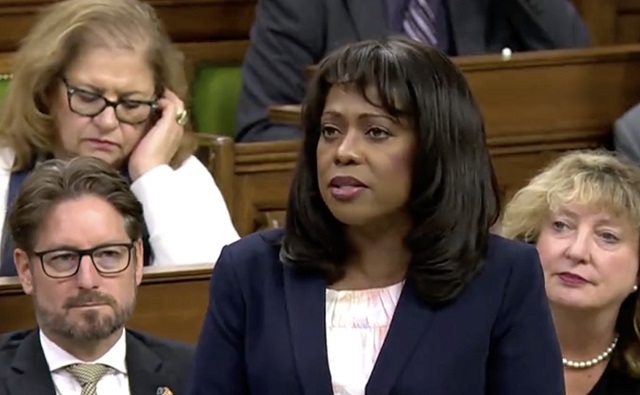
Conservative MP Leslyn Lewis slams Liberal plan targeting religious exemption in hate speech bil
From LifeSiteNews
Bill C-9 is being called an attempt to criminalize sections of the Bible, Quran, Torah, and other sacred texts in Canada.
Canadian Conservative MP Leslyn Lewis blasted a federal government plan to criminalize parts of the Bible as an attack on “Christians,” warning it sets a “dangerous precedent” for Canadian society.
“The Liberal government has agreed to remove the religious exemption in their hate speech bill, C-9, to secure Bloc support and push this bill through Parliament,” Lewis wrote Tuesday on X.
“This is not a minor adjustment. This shift comes at the direct expense of Christians and other religious communities across Canada.”
As reported by LifeSiteNews, a government insider revealed that the Liberal government of Prime Minister Mark Carney plans to remove religious exemptions from Canada’s hate-speech laws by modifying a bill.
Bill C-9, the Combating Hate Act, as reported by LifeSiteNews, has been blasted by constitutional experts as allowing empowered police and the government to go after those it deems have violated a person’s “feelings” in a “hateful” way.
A recent media report states that the Carney Liberals and the separatist Bloc Québécois want to amend Bill C-9, which would “criminalize sections of the Bible, Quran, Torah, and other sacred texts,” Conservative leader Pierre Poilievre noted yesterday on X.
Lewis warned that “no government” should “ever negotiate away religious liberty in exchange for political support.”
“No party should decide which beliefs are acceptable and which ones carry criminal risk,” she warned.
She added that the Liberal government of Carney’s plan to amend Bill C-9 is a “dangerous precedent.”
“Religious freedom is not a political tool. It is a Charter right, a constitutional protection, and a cornerstone of our society,” she warned.
Poilievre blasted the Liberals’ plan as well, warning Liberal-Bloc amendments to C-9 will “criminalize sections of the Bible, Quran, Torah, and other sacred texts.”
“Conservatives will oppose this latest Liberal assault on freedom of expression and religion,” he noted on X earlier this week.
In response, the party launched a petition over fear that religious texts could be criminalized.
Liberal MP Marc Miller had said earlier in the year that certain passages of the Bible are “hateful” because of what it says about homosexuality and those who recite the passages should be jailed. As reported by LifeSiteNews, he was recently appointed as a government minister by Prime Minister Mark Carney.

From the Frontier Centre for Public Policy
By Collin May
Targeting comedians is a sign of political insecurity
A democracy that fears its comedians is a democracy in trouble. That truth landed hard when Graham Linehan, the Irish writer behind Father Ted and The IT Crowd, stepped off a plane at Heathrow on Sept. 1, 2025, and was met by five London Metropolitan Police officers ready to arrest him for three posts on X.
Returning to the UK from Arizona, he was taken into custody on the charge of “suspicion of inciting violence”, an allegation levelled with increasing ease in an age wary of offence. His actual “crime” amounted to three posts, the most contentious being a joke about trans-identified men in exclusively female spaces and a suggestion that violated women respond with a swift blow to a very sensitive part of the male’s not-yet-physically-transitioned anatomy.
The reaction to Linehan’s arrest, from J.K. Rowling to a wide array of commentators, was unqualified condemnation. Many wondered whether free speech had become a museum piece in the UK. Asked about the incident, British Prime Minister Keir Starmer defended his country’s reputation for free expression but declined to address the arrest itself.
Canada has faced its own pressures on comedic expression. In 2022, comedian Mike Ward saw a 12-year legal saga end when the Supreme Court of Canada ruled five-to-four that the Quebec Human Rights Commission had no jurisdiction to hear a complaint about comments Ward made regarding a disabled Quebec boy. The ruling confirmed that human rights bodies cannot police artistic expression when no discrimination in services or employment has occurred. In that case, comic licence survived narrowly.
These cases reveal a broader trend. Governments and institutions increasingly frame comedy as a risk rather than a social pressure valve. In an environment fixated on avoiding perceived harm, humour becomes an easy and symbolic target. Linehan’s arrest underscores the fragility of free speech, especially in comedic form, in countries that claim to value democratic openness.
Comedy has long occupied an unusual place in public life. One of its earliest literary appearances is in Homer’s Iliad. A common soldier, Thersites, is ugly, sharp-tongued and irreverent. He speaks with a freedom others will not risk, mocking Agamemnon and voicing the frustrations of rank-and-file soldiers. He represents the instinct to puncture pretension. In this sense, comedy and philosophy share a willingness to speak uncomfortable truths that power prefers to avoid.
Aristotle, in his Poetics, noted that tragedy imitates noble actions and depicts people who are to be taken seriously. Comedy, by contrast, imitates those who appear inferior. Yet this lowly status is precisely what gives comedy its political usefulness. It allows performers to say what respectable voices cannot, revealing hypocrisies that formal discourse leaves untouched.
In the Iliad, Thersites does not escape punishment. Odysseus, striving to restore order, strikes him with Agamemnon’s staff, and the soldiers laugh as Thersites is silenced. The scene captures a familiar dynamic. Comedy can expose authority’s flaws, but authority often responds by asserting its dominance. The details shift across history, but the pattern endures.
Modern democracies are showing similar impatience. Comedy provides a way to question conventions without inviting formal conflict. When governments treat jokes as misconduct, they are not protecting the public from harm. They are signalling discomfort with scrutiny. Confident systems do not fear irreverence; insecure ones do.
The growing targeting of comedians matters because it reflects a shift toward institutions that view dissent, even in comedic form, as a liability. Such an approach narrows the space for open dialogue and misunderstands comedy’s role in democratic life. A society confident in itself tolerates mockery because it trusts its citizens to distinguish humour from harm.
In October, the British Crown Prosecution Service announced it would not pursue charges against Linehan. The London Metropolitan Police Service also said it would stop recording “non-crime hate incidents”, a controversial category used to document allegations of hateful behaviour even when no law has been broken. These reversals are welcome, but they do not erase the deeper unease that allowed the arrest to happen.
Comedy survives, but its environment is shifting. In an era where leaders are quick to adopt moral language while avoiding meaningful accountability, humour becomes more necessary, not less. It remains one of the few public tools capable of exposing the distance between political rhetoric and reality.
The danger is that in places where Agamemnon’s folly, leadership driven by pride and insecurity, takes root, those who speak uncomfortable truths may find themselves facing not symbolic correction but formal sanctions. A democracy that begins by targeting its jesters rarely stops there.
Collin May is a Senior Fellow with the Frontier Centre for Public Policy, a lawyer, and Adjunct Lecturer in Community Health Sciences at the University of Calgary, with degrees in law (Dalhousie University), a Masters in Theological Studies (Harvard) and a Diplome d’etudes approfondies (Ecole des hautes etudes, Paris).

Blacked-Out Democracy: The Stellantis Deal Ottawa Won’t Show Its Own MPs

Health Canada pauses plan to sell unlabeled cloned meat

Google denies scanning users’ email and attachments with its AI software

Is there a cure for Alzheimer’s Disease?
-
 Alberta2 days ago
Alberta will defend law-abiding gun owners who defend themselves
-
 Alberta2 days ago
This new Canada–Alberta pipeline agreement will cost you more than you think
-
 MAiD1 day ago
From Exception to Routine. Why Canada’s State-Assisted Suicide Regime Demands a Human-Rights Review
-
 Business2 days ago
New Chevy ad celebrates marriage, raising children
-
 Business1 day ago
Carney government should privatize airports—then open airline industry to competition
-
 MAiD2 days ago
Health Canada report finds euthanasia now accounts for over 5% of deaths nationwide
-
 Automotive2 days ago
Power Struggle: Governments start quietly backing away from EV mandates
-
 Great Reset2 days ago
Canada’s MAiD (State Sanctioned Murder) Report Just Dropped