
Business
Paying for Trudeau’s EV Gamble: Ottawa Bought Jobs That Disappeared

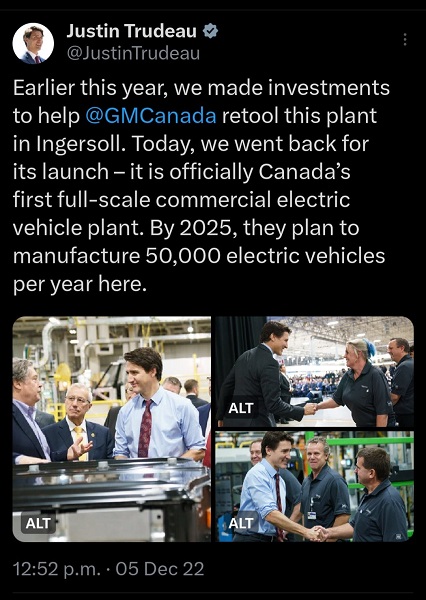


The jobs promised by the thousands never arrived. The debacle of Trudeau’s gamble in the EV sector offers a dire warning about Carney’s plans to “invest” in the economy of the future.
Every age invents new names for old mistakes. Ours calls them investments. Before the Carney government reluctantly unveils its November budget and promises another future paid for in advance, Canadians should remember Ingersoll, one of the last places their leaders tried to buy tomorrow.
In December 2022, Prime Minister Justin Trudeau told Canadians that government backing would help General Motors turn its Ingersoll plant into a beacon of green industry [See image above]. “We made investments to help GM retool this plant,” he wrote online, “and by 2025 it will be producing fifty thousand electric vehicles per year.” [That would mean 137 vehicles each day, or about six vehicles every hour]. It sounded like renewal. Supposedly, this was how the innumerate prime minister was building the economy of the future. In truth, it became an expensive demonstration of how progressive governments love to peddle rampant spending for sound strategy (1)(2).
On the whole, the Trudeau government boasted of having pledged over $50 billion in subsidies to various companies in the EV sector, some of which are failing and most of which are scaling down and exporting production capability to the US. The much-promised benefits have not materialized (3).
The specific Ingersoll plan began with 259 million dollars from Ottawa through the Strategic Innovation Fund and the Net Zero Accelerator. Ontario matched it with another 259 million. The half-billion-plus subsidy financed the plant’s switch from gasoline-powered Equinox production to BrightDrop electric delivery vans. Added to that were the usual incentives: research credits, accelerated write-downs, and energy subsidies. The promise was the mythical creation of thousands of “good middle-class jobs” (4)(5).
At the time, the CAMI Assembly plant employed about two thousand workers. When it closed for retooling in 2022, employment fell to almost none. The reopening in 2023 restored roughly 1,600 across two shifts. A year later, as orders slowed, one shift was cut and employment fell to about 1,300. By early 2025, layoffs cut the number to around eight hundred, and by October that year, when GM confirmed the end of BrightDrop production, fewer than seven hundred remained. The workforce had collapsed by nearly two-thirds from its pre-electric-vehicle conversion level. In statistical terms, two of the three employees the PM used for the photo-op in Ingersoll three years ago are unemployed today. That’s some economic performance.
The numbers expose the illusion. With 518 million dollars in public funds and only about 3,500 vans built in 2024, taxpayers paid about 148 thousand dollars for each vehicle GM produced. Counting only the federal contribution still yields $74,000 per van. Divided by the remaining jobs, the subsidy works out to more than half a million dollars per worker. The arithmetic refutes the fantasy of Prime Minister Trudeau’s speeches (10).
We are in 2025. Today is the future the Liberals promised the country. Neither Ottawa nor Queen’s Park will dwell on the above-stated facts today. When Crown Royal closed a plant in 2024, Premier Ford posed before the cameras and dumped a bottle of whisky to protest lost jobs. Now that a multinational massively subsidized by his own government has cut its workforce in Ingersoll by two-thirds, he will not torch a van or denounce General Motors from the front steps of Queen’s Park. It is easier to rage at private enterprise than to admit one’s own complicity (11).
The failure in Ingersoll was entirely predictable. Government enthusiasm outran commercial sense. The BrightDrop vans entered a market already filled by cheaper competitors in the United States and Asia. Demand never met expectation. Parking lots filled with unsold inventory. A company that lives by numbers did the rational thing: it slowed production, cut staff, and left. The Canadian taxpayer, bound by law and habit, stays behind to pay the bill (12).
The story reveals the weakness of Canada’s industrial policy and the ignorance of its political class. Instead of creating conditions for enterprise, such as reliable energy, stable regulation, and moderate taxes, progressive governments spend on applause. They judge success by the number of jobs announced, yet those very jobs vanish once the cameras go home. When the invoices arrive, they are paid by citizens, not by those who made the promises.
Subsidy breeds its own demand. Once one firm is rewarded, others line up to ask for the same. Lobbying replaces competition. Politicians, afraid to seem heartless, keep writing cheques. Each new administration claims to be more strategic than the last, yet the pattern persists. Canada announces, subsidizes, and retreats. No country ever bought its way into competitiveness, and none ever will.
Trudeau once said his government had “bet big on electric vehicles.” Betting big with other people’s money is not vision but gambling. The wager was not on technology or productivity but on narrative, on the naive idea that a moral intention [to save the planet] could replace market reality. The result was fewer jobs, a product the market did not want, and a claim of success that no longer convinced anyone. But Ontarians gave him their vote for it (1).
Premier Ford deserves no exemption. He campaigned on fiscal restraint and common sense, then followed Ottawa’s lead as if confused by his own rhetoric. His government’s matching subsidy gave the federal scheme the appearance of consensus; he legitimized the scheme. When it failed, he shared the liability and the silence. To underwrite failure once is an error; that they keep repeating it for political cover while the public supports them is folly (11).
Industrial policy in a free society should respect the limits of government competence and resist the fantasy of juvenile ideology. The state can uphold contract law and ensure that citizens have the skills to compete. It has a mixed record in building infrastructure. It cannot direct markets better than those who live or die by them. When it tries, it presents the size of a grant for the value of a result. Governments announce job numbers because they are visible. Productivity and value creation are not. Yet it is productivity that sustains work and dignity, not the temporary employment that disappears when the subsidy runs out or when the companies betray the deal.

The Ingersoll experiment also exposes a moral weakness that the public often falls for. Spending is treated as proof of caring. Subsidy is renamed investment (more on this coming soon). Failure is described as transition. When costs rise and goals vanish, the story is rewritten as a necessary learning curve. Yet nothing is learned, because the same people who lost public money yesterday are trusted with more tomorrow. That is not innovation but inertia.
A free economy does not need bribery to breathe. It requires the discipline of risk and the liberty to fail without dragging a country with it. Ingersoll was not undone by technology but by conceit. Prosperity cannot be decreed, and markets cannot be commanded into obedience.
That was Trudeau, the current PMO occupants will say. But Mark Carney has mastered the same rhetorical sleight that defined Trudeau’s industrial crusade. Spending becomes “investment,” and programs become “platforms.” Ahead of his first budget, he has declared that his government would “catalyze unprecedented investments in Canada over the next five years,” even as he announced departmental cuts and fiscal restraint. He will invest more and spend less, they say. The vocabulary of ambition disguises the contradiction. Billions for housing, energy, and “resilience” are presented not as costs but as commitments to a “higher” economic purpose. His plan for a new federal housing agency with thirteen billion dollars in start-up capital is billed as an investment in the future, though it is, in substance, immediate public spending under a moral banner (13)(14) they had dragged for years.
Carney’s speeches in Parliament and before cameras follow the same pattern of incantation. “We can build big. Build bold. Build now. Build one Canadian economy,” he told the House in June. In October, he promised that “the decades-long process of an ever-closer economic relationship between the Canadian and U.S. economies is over … we will invest in new infrastructure and industrial capacity to reduce our vulnerabilities.” The cadence of certainty masks the absence of limits, just like Justin’s promises. It’s hubris without ability. In their minds, announcing “investment” becomes a synonym for action itself, and ambition replaces accountability (15).
The structure of this rhetoric is identical to the Ingersoll fiasco. Then, as now, the government announced a future built on “investment,” fifty thousand vehicles a year, thousands of secure jobs, abundant prosperity and a greener tomorrow. Vast sums of money were spent supposedly to create that future before a single market test was conducted. Instead, the result was fewer jobs and no market at all.
Carney’s program of “building the future economy” repeats that template: promise vast returns from state-directed spending, redefine subsidy as vision, and rely on tomorrow to conceal today’s bill. The vocabulary of investment has become the language of evasion, reflecting its etymological origins in the Latin “investire,” which originally meant “to clothe.” In the way that politicians use it today, it is a return to its meaning of concealment. It has become a way to describe the use of public money without admitting the massive risk of loss.
As the Carney government prepares its first budget, Canadians should remember what happened when their leader last tried to buy a future with lavish “investment.” Another round of extravagant spending promises is already upon us: new partnerships, new funds with new names, new assurances that this time will be different.
But it will not be different. Judging by all the pre-budget warnings that “sacrifices will need to be made,” it will be worse. In that warning, Carney presupposes that the elderly who have been choosing between eating and heating their home, mothers standing in line at food banks, the record MAiD users, and the young people who have lost hope of emerging out of parental basements to dwellings they can own have all been lying on a bed of roses this last decade of Liberal rule.
The Ingersoll debacle, a foolishly ideological $500-million-plus gamble, is emblematic, of course. It is just the tip of the Liberals’ iceberg of waste. So when you hear Prime Minister Carney tell Canadians they must prepare to sacrifice, remember the long string of Ingersolls his party has gifted this country in recent years. The path of sacrifice the Liberals want now Canadians to walk is paved with the rubble of their own multibillion-dollar blunders.
Every age invents new names for old mistakes, almost as a way to excuse them, and then moves on, but ours invents new names and keeps making the same one over and over again. Entitled hubris knows no bounds.
The Liberal government is already messing up the economy of the present, and they badly botched the economy of the recent past. When using the same strategy clothed in varying language, the economy of the future will not fare better.
Haultain Research is a reader-supported publication.
To receive new posts and support our work, please consider becoming a free or paid subscriber.

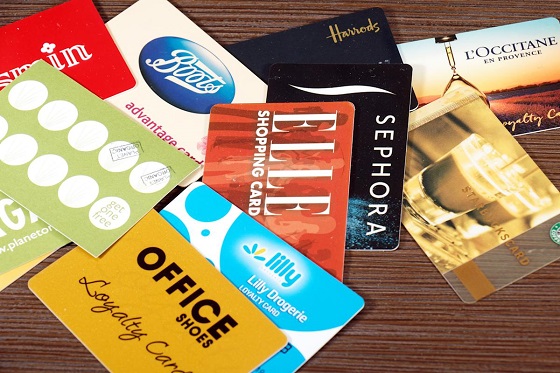

You’ve certainly been asked (begged!) to join up for at least one loyalty “points” program – like PC Optimum, Aeroplan, or Hilton Honors – over the years. And the odds are that you’re currently signed up for at least one of them. In fact, the average person apparently belongs to at no less than 14 programs. Although, ironically, you’ll need to sign up to an online equivalent of a loyalty program to read the source for that number.
Well all that warm, fuzzy “belonging” comes with some serious down sides. Let’s see how much they might cost us.
To be sure, there’s real money involved here. Canadians redeem at least two billion dollars in program rewards each year, and payouts will often represent between one and ten percent of the original purchase value.
At the same time, it’s estimated that there could be tens of billions of unredeemed dollars due to expirations, shifting program terms, and simple neglect. So getting your goodies isn’t automatic.
The Audit is a reader-supported publication.
To receive new posts and support my work, consider becoming a free or paid subscriber.
Just why do consumer-facing corporations agree to give away so much money in the fist place?
As you probably already know, it’s about your data. Businesses are willing to pay cold, hard cash in exchange for detailed descriptions of your age, sex, ethnicity, wealth, location, employment status, hobbies, preferences, medical conditions, political leanings, and, of course, shopping habits.
Don’t believe it works? So then why, after all these years, are points programs still giving away billions of dollars?
Every time you participate in such a program, the data associated with that activity will be collected and aggregated along with everything else known about you. It’s more than likely that points-based data is being combined with everything connected to your mobile phone account, email addresses, credit cards, provincial health card, and – possibly – your Social Insurance number. The depth and accuracy of your digital profile improves daily.
What happens to all that data? A lot of it is shared with – or sold to – partners or affiliates for marketing purposes. Some of it is accidentally (or intentionally) leaked to organized criminal gangs driving call center-related scams. But it’s all about getting to know you better in ways that maximize someone’s profits.
One truly scary way this data is used involves surveillance pricing (also known as price discrimination) – particularly as it’s described in a recent post by Professor Sylvain Charlebois.
The idea is that retailers will use your digital profile to adjust the prices you pay at the cash register or when you’re shopping online. The more loyal you are as a customer, the more you’ll pay. That’s because regular (“loyal”) customers are already reliable revenue sources. Companies don’t need to spend anything to build a relationship with you. But they’re more than willing to give up a few percentage points to gain new friends.
I’m not talking about the kind of price discrimination that might lead to higher prices for sales in, say, urban locations to account for higher real estate and transportation costs. Those are just normal business decisions.
What Professor Charlebois described is two customers paying different prices for the same items in the same stores. In fact, a recent Consumer Reports experiment in the U.S. involving 437 shoppers in four cities found the practice to be quite common.
But the nasty bit here is that there’s growing evidence that retailers are using surveillance pricing in grocery stores for basic food items. Extrapolating from the Consumer Reports study, such pricing could be adding $1,200 annually to a typical family’s spending on basic groceries.
I’m not sure what the solution is. It’s way too late to “unenroll” from our loyalty accounts. And government intervention would probably just end up making things worse.
But perhaps getting the word out about what’s happening could spark justified mistrust in the big retailers. No retailer enjoys dealing with grumpy customers.
Be grumpy.
The Audit is a reader-supported publication.
To receive new posts and support my work, consider becoming a free or paid subscriber.


If you think the CCP will treat foreigners better than its own people, when it extends its power over you, please think again: Dimon Liu’s warning to Canadian Parliament.
Editor’s Note: The Bureau is publishing the following testimony to Canada’s House of Commons committee on International Human Rights from Dimon Liu, a China-born, Washington, D.C.-based democracy advocate who testified in Parliament on December 8, 2025, about the human cost of China’s economic rise. Submitted to The Bureau as an op-ed, Liu’s testimony argues that the Canadian government should tighten scrutiny of high-risk trade and investment, and ensure Canada’s foreign policy does not inadvertently reward coercion. Liu also warns that the Chinese Communist Party could gain leverage over Canadians and treat them as it has done to its own subjugated population—an implied message to Prime Minister Mark Carney, who has pledged to engage China as a strategic partner without making that position clear to Canadians during his election campaign.
OTTAWA — It is an honor to speak before you at the Canadian Parliament.
My testimony will attempt to explain why China’s economic success is built on the backs of the largest number of displaced persons in human history.
It is estimated that these displaced individuals range between 300 to 400 million — it is equivalent to the total population of the United States being uprooted and forced to relocate. These displaced persons are invisible to the world, their sufferings unnoticed, their plights ignored.
In 1978, when economic reform began, China’s GDP was $150 billion USD.
In 2000, when China joined the WTO, it was approximately $1.2 trillion USD.
China’s current GDP is approximately $18 trillion USD.
In 2000 China’s manufacturing output was smaller than Italy’s.
Today it’s larger than America, Europe, Japan, and South Korea combined.
If you have ever wondered how China managed to grow so fast in such a short time, Charles Li, former CEO of the Hong Kong Stock Exchange, has the answers for you.
He listed 4 reasons: 1) cheapest land, 2) cheapest labor, 3) cheapest capital, and 4) disregard of environmental costs.

“The cheapest land” because the CCP government took the land from the farmers at little to no compensation.
“The cheapest labor,” because these farmers, without land to farm, were forced to find work in urban areas at very low wages.
The communist household registration system (hukou 戶口) ties them perpetually to the rural areas. This means they are not legal residents, and cannot receive social benefits that legal urban residents are entitled. They could be evicted at any time.
One well known incident of eviction occurred in November 2017. Cai Qi, now the second most powerful man in China after Xi Jinping, was a municipal official in Beijing. He evicted tens of thousands into Beijing’s harsh winter, with only days, or just moments of notice. Cai Qi made famous a term, “low-end population” (低端人口), and exposed CCP’s contempt of rural migrants it treats as second class citizens.
These displaced migrant workers have one tradition they hold dear — it is to reunite with their families during the Chinese Lunar New Year holiday, making this seasonal migration of 100 to 150 million people a spectacular event. In China’s economic winter of 2025 with waves of bankruptcies and factory closures, the tide of unemployed migrant workers returning home to where there is also no work, and no land to farm, has become a worrisome event.
Historically in the last 2,000 years, social instability has caused the collapse of many ruling regimes in China.
“The cheapest capital” is acquired through predatory banking practices, and through the stock markets, first to rake in the savings of the Chinese people; and later international investments by listing opaque, and state owned enterprises in leading stock markets around the world.
“A disregard of environmental costs” is a hallmark of China’s industrialization. The land is poisoned, so is the water; and China produces one-third of all global greenhouse gases.
Chinese Communist officials often laud their system as superior. The essayist Qin Hui has written that the Chinese communist government enjoys a human rights abuse advantage. This is true. By abusing its own people so brutally, the CCP regime has created an image of success, which will prove to be a mirage.
If you think the CCP will treat foreigners better than its own people, when it extends its power over you, please think again.
The Bureau is a reader-supported publication.
To receive new posts and support my work, consider becoming a free or paid subscriber.


Ottawa’s Newly Released Defence Plan Crosses a Dangerous Line

Carney Floor Crossing Raises Counterintelligence Questions aimed at China, Former Senior Mountie Argues

Canadian university censors free speech advocate who spoke out against Indigenous ‘mass grave’ hoax

All 12 Vaccinated vs. Unvaccinated Studies Found the Same Thing: Unvaccinated Children Are Far Healthier
-
 International2 days ago
Ottawa is still dodging the China interference threat
-
 Agriculture9 hours ago
End Supply Management—For the Sake of Canadian Consumers
-
 Business2 days ago
There’s No Bias at CBC News, You Say? Well, OK…
-
 Automotive2 days ago
Canada’s EV gamble is starting to backfire
-
 Alberta6 hours ago
Alberta Next Panel calls to reform how Canada works
-
 Digital ID7 hours ago
Canadian government launches trial version of digital ID for certain licenses, permits
-
 Business4 hours ago
The “Disruptor-in-Chief” places Canada in the crosshairs
-
 International2 days ago
2025: The Year The Narrative Changed