
Business
Poilievre: “Carney More Irresponsible Than Trudeau” as Housing, Jobs, and Energy Failures Mount

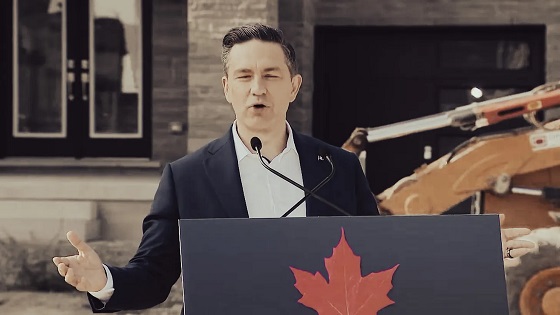


50,000 lost manufacturing jobs, 86,000 more unemployed, soaring housing costs, and blocking every LNG project while vowing to end the TFW program
Pierre Poilievre opened his press conference with a direct attack on Mark Carney and the Liberal record on housing, framing the crisis as the product of government mismanagement rather than market forces.
He began by pointing to Conservative MP Scott Aitchison, a former mayor, as an example of what can be done when local leaders “cut the taxes and the development charges and the wait times so that building can happen.” Then came the pivot: “What a contrast with Justin Trudeau — excuse me, with Mark Carney,” he said, before slamming Carney’s choice of Gregor Robertson as housing minister. Robertson, he reminded the crowd, presided over a 149% increase in Vancouver housing costs and more than doubled homebuilding taxes. Carney, Poilievre said, rewarded that record by handing him the national housing file.
The setting itself — Deco Homes, a family-run builder founded by Italian immigrants — was chosen deliberately. Poilievre praised the Gasper family for their role in building Canada’s homes and businesses, but then asked whether such families could do the same today. His answer was no. “After a decade of Liberal taxes, Liberal spending, out-of-control Liberal immigration, reckless crime policies… the Canadian promise is really broken.”
From there, he broadened the attack. He spoke of an entire generation priced out of homeownership, of immigration growing “three times faster than housing and jobs,” of crime rising, and of what he called “the worst economy in the G7.” And then he turned squarely on Carney: “Mr. Carney is actually more irresponsible than even Justin Trudeau was,” citing an 8% increase in government spending, 37% more for consultants, and 62 billion dollars in lost investment — the largest outflow in Canadian history, according to the National Bank.
The message was simple: Liberals talk, Conservatives build. Poilievre painted Carney as a man of speeches and promises, not results. “The mistake the media is making is they’re judging him by his words rather than his deeds,” he said.
It was an opening statement designed less to introduce policy — those details came later — and more to frame the battle. For Poilievre, Carney isn’t just Trudeau’s replacement. He’s Trudeau’s sequel, and in some ways worse.
During the Q and A portion of the presser; Pierre Poilievre was pressed on immigration today, and what he said was blunt. Canada, he argued, once had the “envy of the world” system: immigrants came in at numbers the country could absorb. There were jobs, housing, health care. Everyone integrated. Ten years later? He says the Liberals have destroyed that.

The facts he used were stark. According to Poilievre, Canada is bringing in people three times faster than homes and jobs are being created. He accused the government of allowing “massive abuses” of the international student program, the Temporary Foreign Worker program, and asylum claims, with what he called “rampant fraud” right under Ottawa’s nose.
He tied this directly to the economy: youth unemployment, he said, is the worst in three decades. At the same time, employers are importing more temporary foreign workers than ever, this year at a record high and using them for cheap labor under poor conditions. His line: “While our young people can’t find jobs, employers are able to exploit temporary foreign workers by giving them lower wages and terrible working conditions.”
But here’s the part that stands out politically. Poilievre said, “Immigrants are not to blame.” He put the responsibility squarely on Liberal governments, calling their immigration numbers “reckless and irresponsible.”
His fix? End the Temporary Foreign Worker program. Cut immigration levels back to “the right numbers and the right people” to fill jobs Canadians can’t do. Tighten border standards to keep criminals out. And, in his words, “always and everywhere put Canada first.”

Pierre Poilievre didn’t hold back when asked about Mark Carney’s record. His words: “Mr. Carney is actually more irresponsible than even Justin Trudeau was.” That’s not a throwaway line, he backed it with numbers.
According to Poilievre, Carney inherited what he called a “morbidly obese government” from Trudeau and made it worse: 8% bigger overall, 37% more for consultants, and 6% more bureaucracy. He says Carney’s deficit is set to be even larger than Trudeau’s.
Then the jobs number: 86,000 more unemployed people under Carney than under Trudeau. That, Poilievre argued, is the real measure, not the polished speeches Carney gives. His line: “The mistake the media is making is they’re judging him by his words rather than his deeds.”
He also went after Carney for what hasn’t happened: “He has not approved a single major national project.” Meanwhile, Poilievre says food price inflation is even worse today, crime policy hasn’t changed the same “catch and release” approach and every big promise Carney made has already been broken.

Pierre Poilievre was asked about Ukraine, and his answer wasn’t about speeches or handshakes in Brussels. It was about pipelines.
“The best way to put Canada first while helping Ukraine is to sell our oil and gas in Europe.” His argument: Vladimir Putin bankrolls his war because Europe still buys his fuel. Poilievre said if Canada had built the Energy East pipeline, we’d be shipping a million barrels of oil a day to Europe right now.
He went further: approve LNG plants immediately, liquefy tens of billions of dollars of Canadian gas, and ship it overseas to “fully displace” Russian sales. His line: “Instead of the money going to Putin’s war machine, it will go to the trades workers in this country.”
And then the indictment of the Liberals: “Mark Carney and the Liberals have blocked every single LNG project that has been put before them. As a result, we only have one plant and it was approved by Stephen Harper.”
So the contrast is stark. Carney talks about climate virtue. Poilievre says: build pipelines, sell fuel, kill Putin’s war economy, and pay Canadian workers. His closer: “That is how you put Canada first.”
Final Thoughts
So let’s just be honest. Under Mark Carney’s leadership, the numbers aren’t just bad they’re devastating. In a matter of months, Canada has lost 50,000 manufacturing jobs. These are not low-skill jobs; they are the backbone of the economy, the kind of work that built the middle class in this country. Add to that another 86,000 unemployed overall compared to when he took office. This is what Carney calls stability.
Now, if you’re a Temporary Foreign Worker, life looks pretty good. Ottawa has built an entire system around you cheap wages, little recourse, and companies happy to import you as disposable labor. If you’re a Carney insider, it looks even better. The government is 8% bigger than when Trudeau left, consultants are raking in 37% more, the bureaucracy is swelling. It’s one of the greatest insider rackets in modern Canadian politics.
But if you’re part of Canada’s middle class, if you’re a young person trying to buy a home, if you’re a worker trying to hold onto a job in a plant, a mill, or a construction site you are being hollowed out. You’re watching your wages stagnate, your housing costs explode, your jobs disappear overseas or into government-mandated “green transitions.” And when you ask for answers, what do you get? You get Patty Hajdu telling you not to be afraid of robots. You get Mark Carney telling you his deficits are “investments.” You get speeches about “climate virtue” and “AI literacy” while your livelihood collapses.
That’s the contrast Poilievre is trying to draw. On immigration, he says: let’s end the Temporary Foreign Worker scam, bring people in at a pace we can actually house and employ, and put Canadian workers first. On energy, he says: build the pipelines, approve the LNG projects, and stop funding Putin’s war by leaving Europe dependent on Russian fuel. On the economy, he says: stop measuring success by the size of government or the smoothness of a prime minister’s speeches, and start measuring it by the number of Canadians who can work, buy homes, and raise families in their own country.
So the choice is simple. Carney offers more of the same consultants, insiders, deficits, slogans, and the slow managed decline of a once-prosperous nation. Poilievre is offering something completely different: a chance to reverse the hollowing out of the middle class and to put Canadian jobs, Canadian energy, and Canadian sovereignty first.
If you’re an insider, Carney’s Canada works just fine. If you’re a middle-class Canadian, it’s a disaster. And that, in the end, is the dividing line in this country.

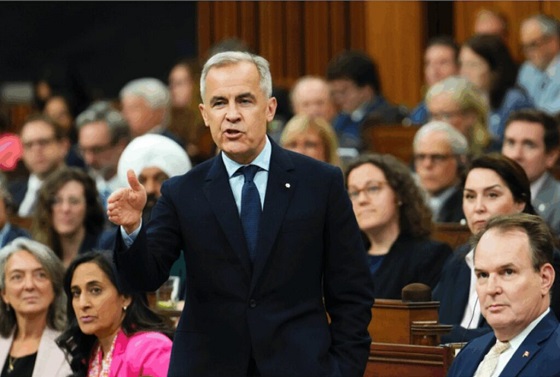

The Canadian Taxpayers Federation released its annual New Year’s Tax Changes report today to highlight the major tax changes in 2026.
“There’s some good news and bad news for taxpayers in 2026,” said Franco Terrazzano, CTF Federal Director. “The federal government cut income taxes, but it’s hiking payroll taxes. The government cancelled the consumer carbon tax, but it’s hammering Canadian businesses with a higher industrial carbon tax.”
Payroll taxes: The federal government is raising the maximum mandatory Canada Pension Plan and Employment Insurance contributions in 2026. These payroll tax increases will cost a worker up to an additional $262 next year.
For workers making $85,000 or more, federal payroll taxes (CPP and EI tax) will cost $5,770 in 2026. Their employers will also be forced to pay $6,219.
Income tax: The federal government cut the lowest income tax rate from 15 to 14 per cent. This will save the average taxpayer $190 in 2026, according to the Parliamentary Budget Officer.
Carbon taxes: The government cancelled its consumer carbon tax effective April 1, 2025. However, the government still charges carbon taxes through its industrial carbon tax and a hidden carbon tax embedded in fuel regulations.

The industrial carbon tax will increase to $110 per tonne in 2026. While the government hasn’t provided further details on how much the industrial carbon tax will cost Canadians, 70 per cent of Canadians believe businesses pass on most or some of the cost of the tax to consumers, according to a Leger poll.
Alcohol taxes: Federal alcohol taxes are expected to increase by two per cent on April 1, 2026. This alcohol tax hike will cost taxpayers about $41 million in 2026-27, according to industry estimates.
First passed in the 2017 federal budget, the alcohol escalator tax automatically increases excise taxes on beer, wine and spirits every year without a vote in Parliament. Since being imposed, the alcohol escalator tax has cost taxpayers about $1.6 billion, according to industry estimates.
“Canadians pay too much tax because the government wastes too much money,” Terrazzano said. “Canadians are overtaxed and need serious tax cuts to help make life more affordable and our economy more competitive.
“Prime Minister Mark Carney needs to significantly cut spending, provide major tax relief and scrap all carbon taxes.”
You can read the CTF’s New Year’s Tax Changes report here.
From the Fraser Institute
By Annika Segelhorst and Elmira Aliakbari
According to Steven Guilbeault, former environment minister under Justin Trudeau and former member of Prime Minister Carney’s cabinet, “Switching to an electric vehicle is one of the most impactful things Canadians can do to help fight climate change.”
And the Carney government has only paused Trudeau’s electric vehicle (EV) sales mandate to conduct a “review” of the policy, despite industry pressure to scrap the policy altogether.
So clearly, according to policymakers in Ottawa, EVs are essentially “zero emission” and thus good for environment.
But is that true?
Clearly, EVs have some environmental advantages over traditional gasoline-powered vehicles. Unlike cars with engines that directly burn fossil fuels, EVs do not produce tailpipe emissions of pollutants such as nitrogen dioxide and carbon monoxide, and do not release greenhouse gases (GHGs) such as carbon dioxide. These benefits are real. But when you consider the entire lifecycle of an EV, the picture becomes much more complicated.
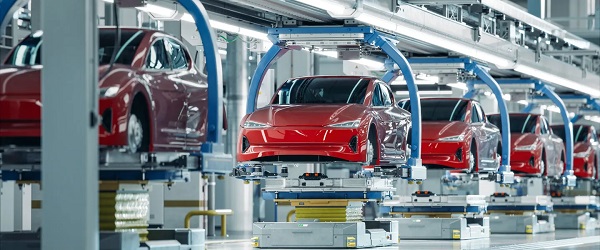
Unlike traditional gasoline-powered vehicles, battery-powered EVs and plug-in hybrids generate most of their GHG emissions before the vehicles roll off the assembly line. Compared with conventional gas-powered cars, EVs typically require more fossil fuel energy to manufacture, largely because to produce EVs batteries, producers require a variety of mined materials including cobalt, graphite, lithium, manganese and nickel, which all take lots of energy to extract and process. Once these raw materials are mined, processed and transported across often vast distances to manufacturing sites, they must be assembled into battery packs. Consequently, the manufacturing process of an EV—from the initial mining of materials to final assembly—produces twice the quantity of GHGs (on average) as the manufacturing process for a comparable gas-powered car.
Once an EV is on the road, its carbon footprint depends on how the electricity used to charge its battery is generated. According to a report from the Canada Energy Regulator (the federal agency responsible for overseeing oil, gas and electric utilities), in British Columbia, Manitoba, Quebec and Ontario, electricity is largely produced from low- or even zero-carbon sources such as hydro, so EVs in these provinces have a low level of “indirect” emissions.
However, in other provinces—particularly Alberta, Saskatchewan and Nova Scotia—electricity generation is more heavily reliant on fossil fuels such as coal and natural gas, so EVs produce much higher indirect emissions. And according to research from the University of Toronto, in coal-dependent U.S. states such as West Virginia, an EV can emit about 6 per cent more GHG emissions over its entire lifetime—from initial mining, manufacturing and charging to eventual disposal—than a gas-powered vehicle of the same size. This means that in regions with especially coal-dependent energy grids, EVs could impose more climate costs than benefits. Put simply, for an EV to help meaningfully reduce emissions while on the road, its electricity must come from low-carbon electricity sources—something that does not happen in certain areas of Canada and the United States.
Finally, even after an EV is off the road, it continues to produce emissions, mainly because of the battery. EV batteries contain components that are energy-intensive to extract but also notoriously challenging to recycle. While EV battery recycling technologies are still emerging, approximately 5 per cent of lithium-ion batteries, which are commonly used in EVs, are actually recycled worldwide. This means that most new EVs feature batteries with no recycled components—further weakening the environmental benefit of EVs.
So what’s the final analysis? The technology continues to evolve and therefore the calculations will continue to change. But right now, while electric vehicles clearly help reduce tailpipe emissions, they’re not necessarily “zero emission” vehicles. And after you consider the full lifecycle—manufacturing, charging, scrapping—a more accurate picture of their environmental impact comes into view.

Annika Segelhorst
Junior Economist

Elmira Aliakbari


Wayne Gretzky’s Terrible, Awful Week.. And Soccer/ Football.

Western Campuses Help Build China’s Digital Dragnet With U.S. Tax Funds, Study Warns

Common Vaccines Linked to 38-50% Increased Risk of Dementia and Alzheimer’s

The day the ‘King of rock ‘n’ roll saved the Arizona memorial
-
 Automotive2 days ago
The $50 Billion Question: EVs Never Delivered What Ottawa Promised
-
 Alberta1 day ago
Alberta introducing three “all-season resort areas” to provide more summer activities in Alberta’s mountain parks
-
 COVID-1921 hours ago
Trump DOJ seeks to quash Pfizer whistleblower’s lawsuit over COVID shots
-
 Business1 day ago
Storm clouds of uncertainty as BC courts deal another blow to industry and investment
-
 Agriculture1 day ago
Growing Alberta’s fresh food future
-
 International23 hours ago
Trump admin wants to help Canadian woman rethink euthanasia, Glenn Beck says
-
 Alberta22 hours ago
The case for expanding Canada’s energy exports
-
 Censorship Industrial Complex20 hours ago
Ottawa’s New Hate Law Goes Too Far