
Energy
DOJ urges federal judge to strike down climate change law


From The Center Square
By
The Trump administration is asking a federal judge to invalidate a New York law that seeks to punish fossil fuel companies for their alleged role in climate change.
In a motion for summary judgment, filed late Friday, the U.S. Department of Justice’s Environment and Natural Resources Division asked a U.S. District Court judge to “end New York’s lawless overreach” by “declaring the Superfund Act invalid and unenforceable, and permanently enjoining Defendants from taking any actions to implement or enforce it.”
“New York has declared war on those responsible for supplying our nation with reliable and affordable energy, and it is trampling over federal law in the process,” the filing states.
In May, the DOJ filed lawsuits against New York and Vermont, arguing that state laws requiring oil companies to contribute billions of dollars into funds to pay for damage caused by climate change were unconstitutional.
The legal challenge against New York alleges that the state’s “superfund” law is a “transparent monetary-extraction scheme” designed to fund the state’s infrastructure projects with money from out-of-state businesses.

“The Superfund Act is a brazen attempt to grab power from the federal government and force citizens of other States and nations to foot the bill for its infrastructure wish list,” the DOJ wrote in the 29-page complaint.
In both lawsuits, the Justice Department cited a Jan. 20 executive order signed by President Donald Trump declaring a national energy emergency to speed up permitting of energy projects, roll back environmental protections, and withdraw from an international pact to fight climate change. DOJ lawyers allege that the state climate change laws imperil domestic energy production.
New York’s Climate Leadership and Community Protection Act, signed by then-Gov. Andrew Cuomo in 2019, requires the state to reduce its excess greenhouse gas emissions and authorizes it to seek up to $75 billion in damages from fossil fuel companies. Regulations for the new law have yet to be issued, which prompted a lawsuit from green groups seeking the state to post them.
New York is also facing a lawsuit filed by 22 Republican attorneys general who argue that the law will do little to blunt the impact of climate change while passing on the costs to the state’s consumers in the form of higher energy bills. The outcome of that case is still pending.
Acting Assistant Attorney General Adam Gustafson said New York has “overstepped its authority in trying to impose crippling financial penalties on the world’s largest energy providers” and said the court must act to prevent further damage to the fossil fuel industry.
“Individual states have no authority to regulate nationwide and global greenhouse gas emissions,” he said in a statement. “The courts must put a stop to New York’s brazen disregard of federal law, the Constitution, and binding precedent, not to mention our Nation’s energy needs.”

Business
The world is no longer buying a transition to “something else” without defining what that is

From Resource Works
Even Bill Gates has shifted his stance, acknowledging that renewables alone can’t sustain a modern energy system — a reality still driving decisions in Canada.
You know the world has shifted when the New York Times, long a pulpit for hydrocarbon shame, starts publishing passages like this:
“Changes in policy matter, but the shift is also guided by the practical lessons that companies, governments and societies have learned about the difficulties in shifting from a world that runs on fossil fuels to something else.”
For years, the Times and much of the English-language press clung to a comfortable catechism: 100 per cent renewables were just around the corner, the end of hydrocarbons was preordained, and anyone who pointed to physics or economics was treated as some combination of backward, compromised or dangerous. But now the evidence has grown too big to ignore.
Across Europe, the retreat to energy realism is unmistakable. TotalEnergies is spending €5.1 billion on gas-fired plants in Britain, Italy, France, Ireland and the Netherlands because wind and solar can’t meet demand on their own. Shell is walking away from marquee offshore wind projects because the economics do not work. Italy and Greece are fast-tracking new gas development after years of prohibitions. Europe is rediscovering what modern economies require: firm, dispatchable power and secure domestic supply.
Meanwhile, Canada continues to tell itself a different story — and British Columbia most of all.
A new Fraser Institute study from Jock Finlayson and Karen Graham uses Statistics Canada’s own environmental goods and services and clean-tech accounts to quantify what Canada’s “clean economy” actually is, not what political speeches claim it could be.
The numbers are clear:
- The clean economy is 3.0–3.6 per cent of GDP.
- It accounts for about 2 per cent of employment.
- It has grown, but not faster than the economy overall.
- And its two largest components are hydroelectricity and waste management — mature legacy sectors, not shiny new clean-tech champions.
Despite $158 billion in federal “green” spending since 2014, Canada’s clean economy has not become the unstoppable engine of prosperity that policymakers have promised. Finlayson and Graham’s analysis casts serious doubt on the explosive-growth scenarios embraced by many politicians and commentators.
What’s striking is how mainstream this realism has become. Even Bill Gates, whose philanthropic footprint helped popularize much of the early clean-tech optimism, now says bluntly that the world had “no chance” of hitting its climate targets on the backs of renewables alone. His message is simple: the system is too big, the physics too hard, and the intermittency problem too unforgiving. Wind and solar will grow, but without firm power — nuclear, natural gas with carbon management, next-generation grid technologies — the transition collapses under its own weight. When the world’s most influential climate philanthropist says the story we’ve been sold isn’t technically possible, it should give policymakers pause.
And this is where the British Columbia story becomes astonishing.
It would be one thing if the result was dramatic reductions in emissions. The provincial government remains locked into the CleanBC architecture despite a record of consistently missed targets.
Since the staunchest defenders of CleanBC are not much bothered by the lack of meaningful GHG reductions, a reasonable person is left wondering whether there is some other motivation. Meanwhile, Victoria’s own numbers a couple of years ago projected an annual GDP hit of courtesy CleanBC of roughly $11 billion.
But here is the part that would make any objective analyst blink: when I recently flagged my interest in presenting my research to the CleanBC review panel, I discovered that the “reviewers” were, in fact, two of the key architects of the very program being reviewed. They were effectively asked to judge their own work.
You can imagine what they told us.
What I saw in that room was not an evidence-driven assessment of performance. It was a high-handed, fact-light defence of an ideological commitment. When we presented data showing that doctrinaire renewables-only thinking was failing both the economy and the environment, the reception was dismissive and incurious. It was the opposite of what a serious policy review looks like.
Meanwhile our hydro-based electricity system is facing historic challenges: long term droughts, soaring demand, unanswered questions about how growth will be powered especially in the crucial Northwest BC region, and continuing insistence that providers of reliable and relatively clean natural gas are to be frustrated at every turn.
Elsewhere, the price of change increasingly includes being able to explain how you were going to accomplish the things that you promise.
And yes — in some places it will take time for the tide of energy unreality to recede. But that doesn’t mean we shouldn’t be improving our systems, reducing emissions, and investing in technologies that genuinely work. It simply means we must stop pretending politics can overrule physics.
Europe has learned this lesson the hard way. Global energy companies are reorganizing around a 50-50 world of firm natural gas and renewables — the model many experts have been signalling for years. Even the New York Times now describes this shift with a note of astonishment.
British Columbia, meanwhile, remains committed to its own storyline even as the ground shifts beneath it. This isn’t about who wins the argument — it’s about government staying locked on its most basic duty: safeguarding the incomes and stability of the families who depend on a functioning energy system.
Resource Works News

From Resource Works
That a new oil pipeline from Alberta to BC is being aired by Ottawa and pushed by Alberta has, in turn, critics eagerly pushing carefully crafted scare stories.
Take the Green Party’s Elizabeth May, for one: She insists that oil tankers leaving Prince Rupert would be sailing through “Canada’s most dangerous waters and the fourth most dangerous waters in the world.”
First, this “dangerous waters” claim is unsubstantiated, unproven, and hyperbolic. It is apparently based on a line in a 1992 federal guide to marine-weather hazards on the west coast, but it is not credited or supported there.
Second, who says a new oil pipeline would go to Prince Rupert? No destination is specified in the memorandum of understanding published by Ottawa and Alberta.
It speaks of a commitment to “enable the export of bitumen from a strategic deep-water port to Asian markets.”
Energy Minister Tim Hodgson: “There is no route today. Under the MoU, what (Alberta) would need to do is work with the affected jurisdiction, British Columbia, and work with affected First Nations for that project to move forward. That’s what the work plan in the MoU calls for.”
First Nations concerned
Now, the MoU does say that this could include “if necessary” a change to the federal ban on oil tankers in northwest BC waters.
Some First Nations are strongly fighting the idea of oil tankers in northern BC waters citing fears of a catastrophic spill. The Assembly of First Nations (AFN), for example, is calling for the Canada-Alberta pipeline MoU to be scrapped.
“A pipeline to B.C.’s coast is nothing but a pipe dream,” said Chief Donald Edgars of Old Massett Village Council in Haida Gwaii.
And AFN National Chief Cindy Woodhouse Nepinak said: “Canada can create all the MOUs, project offices, advisory groups that they want: the chiefs are united. . . When it comes to approving large national projects on First Nations lands, there will not be getting around rights holders.”
Alberta group interested
But the Metis Settlements of Alberta say they’re interested in purchasing a stake in the proposed pipeline and want to “work with First Nations in British Columbia who oppose the project.”
The Alberta government’s Indigenous loan agency says a new oil pipeline to the BC coast could deliver “significant” returns for Indigenous Peoples.
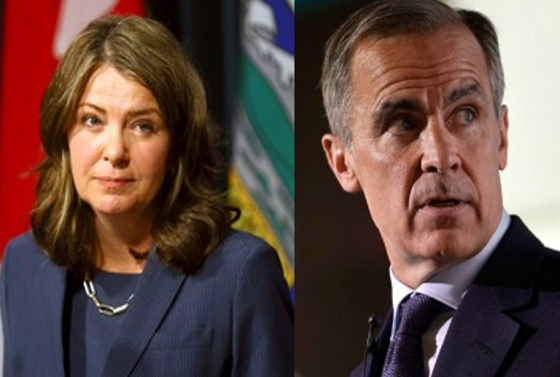
Alberta Premier Danielle Smith has suggested the pipeline could bring in $2 billion a year in revenue, and that it could be as much as 50 per cent owned by Indigenous groups — who would thus earn $1 billion a year,
“Can you imagine the impact that would have on those communities in British Columbia and in Alberta? It’s extraordinary.”
And we note that in 2019 the First Nations-proposed Eagle Spirit Energy Corridor, which aimed to connect Alberta’s oilpatch to Kitimat, garnered serious interest among Indigenous groups. It had buy-in from 35 First Nations groups along the proposed corridor, with equity-sharing agreements floated with 400 others. (The project died with passage of the tanker ban.)
Vancouver more likely
More recent chatter, including remarks by BC Premier David Eby, would suggest oil from a new pipeline would more likely be through Vancouver, rather than via Prince Rupert or Kitimat BC. And tankers have been carrying oil from the Trans Mountain Pipeline System’s Burnaby terminal since 1956 — with no spills.
Oft cited by northern-port opponents is the major spill of 258,000 barrels of crude oil (more than 40 million litres) from the tanker Exxon Valdez, which ran aground in Alaska’s Prince William Sound in 1989.
The resulting spill killed native and marine wildlife over 2,100 km of coastline. The U.S. National Transportation Safety Board found that the spill occurred due to human error. It cited a tired third mate on watch, and noted the captain had an alcohol problem.
But the Exxon Valdez was a single-hull tanker. Its spill led to the phasing out of single-hull tankers, replaced in the ensuing 36 years by new generations of double-hull vessels (with an inner and outer hull separated to contain spills if the outer hull ruptures), new tanker safety rules — and new ways of dealing with the far-fewer spills.
Among those new ways is the Western Canada Marine Response Corporation: “Our mandate is to ensure there is a state of preparedness in place when a marine spill occurs and to mitigate the impacts on B.C.’s coast. This includes the protection of wildlife, economic and environmental sensitivities, and the safety of both responders and the public.”
What about LNG carriers?
At the same time, fear-mongers are actively flogging scare stories on social media.
One opposition group sees future LNG carrier traffic along the southern BC coast as potentially numbering “in the realm of 800+ transits a year.”
Eight hundred a year? BC Ferries runs more than 185,000 a year. And the ferries don’t have tethered tugs helping them to get safely from LNG terminals. And they don’t have BC Coast Pilots on the bridge to keep progress safe. Oil tankers leaving the Port of Vancouver have both.
As marine captain Duncan MacFarlane of LNG Canada in Kitimat says: “LNG carriers are some of the most sophisticated ships in the world…Once loading operations are complete (at LNG Canada), three BC Pilots will join the ship and start navigating up the Douglas Channel, which is approximately 159 nautical miles out to the Prince Rupert pilot station.”
“LNG Canada has partnered with HaiSea Marine, which is a company formed between the Haisla Nation and Vancouver-based SeaSpan, to provide two escort tugs and three harbour-assist tugs to safely move the vessel out of the Douglas Channel…once the vessel drops the pilots at Prince Rupert, it starts a seven- to ten-day voyage to its discharge port. To assist with this, they’ll use satellite navigation, weather routing, and a variety of other technologies to get to their port the safest and most efficient way.”
The same would apply to oil tankers from any northern port in BC.
BC’s tanker-safety record
As the small-c conservative Fraser Institute points out: “Pipelines are 2.5 times safer than rail for oil transportation, and oil tankers have [the] safest record of all.”
And it adds: “The history of oil transport off of Canada’s coasts is one of incredible safety, whether of Canadian or foreign origin, long predating federal Bill C-48’s tanker ban. . . .new pipelines and additional transport of oil from (and along) B.C. coastal waters is likely very low environmental risk. In the meantime, a regular stream of oil tankers and large fuel-capacity ships have been cruising up and down the B.C. coast between Alaska and U.S. west coast ports for decades with great safety records.”
This last refers to the 200-230 tankers a year that now carry crude oil from Alaska through Canadian waters south of Haida Gwaii and then down BC’s Inside Passage or outer coastal waters to Juan de Fuca Strait and Washington refineries.
While these tankers do not transit Hecate Strait (the north end of which is the area of concern about spills from tankers from Prince Rupert or Kitimat) all these US tankers are double-hulled, must report positions, speeds and routes in real-time, must carry certified pilots, must use traffic-separation routes (like traffic lanes), and must slow to 11 knots in sensitive areas.
And as Pipeline Action says: “Canada is not inferior — If Norway can move tankers safely through fjords, if Japan can operate in some of the busiest waterways on Earth, if Alaska balances ecological protection with responsible shipping and if Eastern Canadian ports manage tankers every day, then Canada’s West Coast, with its governance standards, technical capacity and Indigenous partnership potential, can certainly do so.”
Resource Works News


University of Colorado will pay $10 million to staff, students for trying to force them to take COVID shots

Wayne Gretzky’s Terrible, Awful Week.. And Soccer/ Football.
Integration Or Indignation: Whose Strategy Worked Best Against Trump?

Western Campuses Help Build China’s Digital Dragnet With U.S. Tax Funds, Study Warns
-
 International2 days ago
Trump admin wants to help Canadian woman rethink euthanasia, Glenn Beck says
-
 Local Business2 days ago
Red Deer Downtown Business Association to Wind Down Operations
-
 COVID-192 days ago
Trump DOJ seeks to quash Pfizer whistleblower’s lawsuit over COVID shots
-
 Alberta2 days ago
The case for expanding Canada’s energy exports
-
 Crime2 days ago
U.S. seizes Cuba-bound ship with illicit Iranian oil history
-
 Business1 day ago
Albertans give most on average but Canadian generosity hits lowest point in 20 years
-
 International2 days ago
Marjorie Taylor Greene’s ’60 Minutes’ interview reveals power struggle between populists and RINOs
-
 Censorship Industrial Complex1 day ago
Ottawa’s New Hate Law Goes Too Far