
Business
Trump creates U.S. sovereign wealth fund – may purchase TikTok



Quick Hit:
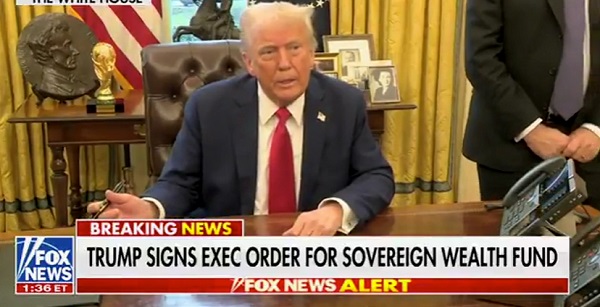
On Monday, President Trump signed an executive order to create the first-ever U.S. sovereign wealth fund, with TikTok potentially becoming one of its first acquisitions. Trump emphasized the fund’s potential to generate significant wealth, positioning the U.S. alongside countries like Saudi Arabia and China that have long operated similar funds.
Key Details:
-
Trump signed the order in the Oval Office, joined by Treasury Secretary Scott Bessent and Commerce Secretary Howard Lutnick, calling the move “a very exciting event.”
-
The fund may be capitalized through tariff revenues, with Trump hinting that TikTok could be included as an asset, possibly as part of a deal tied to avoiding new 10% tariffs on Chinese goods.
-
Bessent and Lutnick will oversee the fund’s creation, aiming to “monetize the asset side of the U.S. balance sheet” within the next year.
Diving Deeper:
President Trump on Monday signed an executive order to establish the first sovereign wealth fund in U.S. history, signaling a bold new approach to managing national assets. Speaking from the Oval Office, Trump described the initiative as “a very exciting event” and highlighted its potential to generate vast wealth for the country.

“Other countries have sovereign wealth funds, and they’re much smaller than the United States,” Trump noted. “We’re going to have one of the biggest funds in the world in a short period of time. The Saudi Arabia fund is large, but we’ll catch up.”
While the exact source of the fund’s initial capital hasn’t been confirmed, Trump has previously suggested that tariff revenues could play a key role. This aligns with his recent announcement of a 10% tariff on Chinese imports, which he framed as part of his strategy to combat fentanyl trafficking. Trump also floated the idea of including a stake in TikTok within the fund, hinting that Beijing might divest from the platform to sidestep the new tariffs.
Treasury Secretary Scott Bessent outlined the administration’s vision, stating, “We are going to monetize the asset side of the U.S. balance sheet for the American people. We’ve studied best practices from around the world, and it will include a mix of liquid assets and domestic investments.”
Commerce Secretary Howard Lutnick added that the sheer scale of the U.S. government’s operations presents a unique opportunity to create value for American citizens. “If we’re buying billions of COVID vaccines, maybe we should hold equity in these companies to benefit the health and wealth of the American people,” he said.
Trump envisions the fund investing in infrastructure, manufacturing, medical research, and more. During his campaign, he suggested the fund could be supported through tariffs and “other intelligent things,” emphasizing that it will be a tool to strengthen America’s economic independence and global competitiveness.
With sovereign wealth funds in countries like China, Saudi Arabia, and Singapore boasting assets exceeding $1 trillion, Trump’s move represents a significant shift in U.S. fiscal strategy, positioning the nation to compete directly in this arena for the first time.

Business
Some Of The Wackiest Things Featured In Rand Paul’s New Report Alleging $1,639,135,969,608 In Gov’t Waste


From the Daily Caller News Foundation
Republican Kentucky Sen. Rand Paul released the latest edition of his annual “Festivus” report Tuesday detailing over $1 trillion in alleged wasteful spending in the U.S. government throughout 2025.
The newly released report found an estimated $1,639,135,969,608 total in government waste over the past year. Paul, a prominent fiscal hawk who serves as the chairman of the Senate Homeland Security and Governmental Affairs Committee, said in a statement that “no matter how much taxpayer money Washington burns through, politicians can’t help but demand more.”
“Fiscal responsibility may not be the most crowded road, but it’s one I’ve walked year after year — and this holiday season will be no different,” Paul continued. “So, before we get to the Feats of Strength, it’s time for my Airing of (Spending) Grievances.”
Dear Readers:
As a nonprofit, we are dependent on the generosity of our readers.
Please consider making a small donation of any amount here.
Thank you!
The 2025 “Festivus” report highlighted a spate of instances of wasteful spending from the federal government, including the Department of Health and Human Services (HHS) spent $1.5 million on an “innovative multilevel strategy” to reduce drug use in “Latinx” communities through celebrity influencer campaigns, and also dished out $1.9 million on a “hybrid mobile phone family intervention” aiming to reduce childhood obesity among Latino families living in Los Angeles County.
The report also mentions that HHS spent more than $40 million on influencers to promote getting vaccinated against COVID-19 for racial and ethnic minority groups.
The State Department doled out $244,252 to Stand for Peace in Islamabad to produce a television cartoon series that teaches children in Pakistan how to combat climate change and also spent $1.5 million to promote American films, television shows and video games abroad, according to the report.
The Department of Veterans Affairs (VA) spent more than $1,079,360 teaching teenage ferrets to binge drink alcohol this year, according to Paul’s report.
The report found that the National Science Foundation (NSF) shelled out $497,200 on a “Video Game Challenge” for kids. The NSF and other federal agencies also paid $14,643,280 to make monkeys play a video game in the style of the “Price Is Right,” the report states.
Paul’s 2024 “Festivus” report similarly featured several instances of wasteful federal government spending, such as a Las Vegas pickleball complex and a cabaret show on ice.
The Trump administration has been attempting to uproot wasteful government spending and reduce the federal workforce this year. The administration’s cuts have shrunk the federal workforce to the smallest level in more than a decade, according to recent economic data.
Festivus is a humorous holiday observed annually on Dec. 23, dating back to a popular 1997 episode of the sitcom “Seinfeld.” Observance of the holiday notably includes an “airing of grievances,” per the “Seinfeld” episode of its origin.

From the Fraser Institute
By Nadeem Esmail and Mackenzie Moir
It’s an exciting time in Canadian health-care policy. But even the slew of new reforms in Alberta only go part of the way to using all the policy tools employed by high performing universal health-care systems.
For 2026, for the sake of Canadian patients, let’s hope Alberta stays the path on changes to how hospitals are paid and allowing some private purchases of health care, and that other provinces start to catch up.
While Alberta’s new reforms were welcome news this year, it’s clear Canada’s health-care system continued to struggle. Canadians were reminded by our annual comparison of health care systems that they pay for one of the developed world’s most expensive universal health-care systems, yet have some of the fewest physicians and hospital beds, while waiting in some of the longest queues.
And speaking of queues, wait times across Canada for non-emergency care reached the second-highest level ever measured at 28.6 weeks from general practitioner referral to actual treatment. That’s more than triple the wait of the early 1990s despite decades of government promises and spending commitments. Other work found that at least 23,746 patients died while waiting for care, and nearly 1.3 million Canadians left our overcrowded emergency rooms without being treated.
At least one province has shown a genuine willingness to do something about these problems.
The Smith government in Alberta announced early in the year that it would move towards paying hospitals per-patient treated as opposed to a fixed annual budget, a policy approach that Quebec has been working on for years. Albertans will also soon be able purchase, at least in a limited way, some diagnostic and surgical services for themselves, which is again already possible in Quebec. Alberta has also gone a step further by allowing physicians to work in both public and private settings.
While controversial in Canada, these approaches simply mirror what is being done in all of the developed world’s top-performing universal health-care systems. Australia, the Netherlands, Germany and Switzerland all pay their hospitals per patient treated, and allow patients the opportunity to purchase care privately if they wish. They all also have better and faster universally accessible health care than Canada’s provinces provide, while spending a little more (Switzerland) or less (Australia, Germany, the Netherlands) than we do.
While these reforms are clearly a step in the right direction, there’s more to be done.
Even if we include Alberta’s reforms, these countries still do some very important things differently.
Critically, all of these countries expect patients to pay a small amount for their universally accessible services. The reasoning is straightforward: we all spend our own money more carefully than we spend someone else’s, and patients will make more informed decisions about when and where it’s best to access the health-care system when they have to pay a little out of pocket.
The evidence around this policy is clear—with appropriate safeguards to protect the very ill and exemptions for lower-income and other vulnerable populations, the demand for outpatient healthcare services falls, reducing delays and freeing up resources for others.
Charging patients even small amounts for care would of course violate the Canada Health Act, but it would also emulate the approach of 100 per cent of the developed world’s top-performing health-care systems. In this case, violating outdated federal policy means better universal health care for Canadians.
These top-performing countries also see the private sector and innovative entrepreneurs as partners in delivering universal health care. A relationship that is far different from the limited individual contracts some provinces have with private clinics and surgical centres to provide care in Canada. In these other countries, even full-service hospitals are operated by private providers. Importantly, partnering with innovative private providers, even hospitals, to deliver universal health care does not violate the Canada Health Act.
So, while Alberta has made strides this past year moving towards the well-established higher performance policy approach followed elsewhere, the Smith government remains at least a couple steps short of truly adopting a more Australian or European approach for health care. And other provinces have yet to even get to where Alberta will soon be.
Let’s hope in 2026 that Alberta keeps moving towards a truly world class universal health-care experience for patients, and that the other provinces catch up.


Death by a thousand clicks – government censorship of Canada’s internet

Chinese Billionaire Tried To Build US-Born Baby Empire As Overseas Elites Turn To American Surrogates

Viral TikTok video shows 7-year-old cuddling great-grandfather before he’s euthanized

Politicians should be honest about environmental pros and cons of electric vehicles
-
 Agriculture1 day ago
Why is Canada paying for dairy ‘losses’ during a boom?
-
 Automotive2 days ago
Ford’s EV Fiasco Fallout Hits Hard
-
 Alberta1 day ago
Alberta’s new diagnostic policy appears to meet standard for Canada Health Act compliance
-
 Business17 hours ago
State of the Canadian Economy: Number of publicly listed companies in Canada down 32.7% since 2010
-
 Bruce Dowbiggin19 hours ago
Hunting Poilievre Covers For Upcoming Demographic Collapse After Boomers
-
 Alberta18 hours ago
Housing in Calgary and Edmonton remains expensive but more affordable than other cities
-
 Censorship Industrial Complex15 hours ago
Canadian university censors free speech advocate who spoke out against Indigenous ‘mass grave’ hoax
-
 Censorship Industrial Complex1 day ago
Top constitutional lawyer warns against Liberal bills that could turn Canada into ‘police state’