
Great Reset
Trump to virtually address globalist WEF meeting in Davos days after being sworn in



From LifeSiteNews
By Stephen Kokx
President Trump will appear via video at the left-wing World Economic Forum meeting on January 23 for a virtual discussion. He spoke at the event twice previously, in 2018 and again in 2020, and emphasized nationalist themes.
Incoming U.S. President Donald Trump will address this year’s World Economic Forum meeting in Davos, Switzerland, just days after being sworn in, the event’s organizers announced today.
Describing Trump’s scheduled virtual appearance as a “very special moment,” WEF CEO Børge Brende remarked that “there is a lot of interest … to decipher and to understand the policies of the new administration.”
Trump spoke at the event twice previously, once in 2018 and again in 2020. During his remarks, Trump hit on nationalist themes. “I will always put America first, just like the leaders of other countries should put their country first also,” he announced in 2018.
The theme of this year’s gathering is “Collaboration for the Intelligent Age” and will be held from January 20, which is Inauguration Day in the U.S., until January 25. Trump will appear via video on January 23 for a virtual discussion.

Last year, Heritage Foundation president Kevin Robert notably slammed the group’s globalist ideology when he spoke during a panel discussion. “The agenda that every single member of the administration needs to have is to compile a list of everything that’s ever been proposed at the World Economic Forum and object [to] all of them, wholesale,” he said.
Other world leaders scheduled to attend this year’s meeting include Ukrainian President Volodymyr Zelenskyy, European Commission President Ursula von der Leyen, Argentina President Javier Milei, and China’s vice premier Ding Xuexiang, among others. More than 1,200 business and world political leaders are expected to attend as well. In 2023, Elon Musk said the WEF is “increasingly becoming an unelected world government that the people never asked for and don’t want.”
Trump’s speech is sure to raise eyebrows on both sides of the political aisle, but especially among populists and nationalists on the political right, as his recent remarks about acquiring Greenland and annexing Canada have prompted speculation on social media that he is covertly pushing a globalist agenda.
The WEF was founded in 1971. Its annual meetings routinely feature an array of liberal politicians and global elites who push climate alarmism, censorship, artificial intelligence, LGBT ideology, and an array of other anti-Christian programs aimed at ushering in a one world government under the guise of defending democracy.

From LifeSiteNews
Karly Vavra, the little girl’s mother, told People that she chose to share the video in order to honor her grandfather—but also to normalize euthanasia.
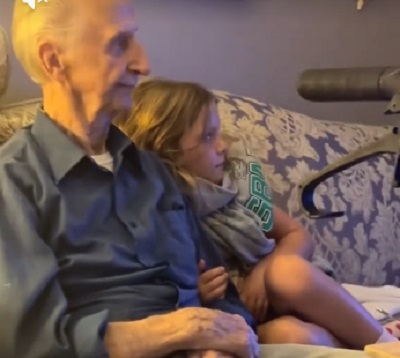
A video of a 7-year-old girl sharing a “final cuddle” with her great-grandfather before he is euthanized has gone viral on TikTok, racking up millions of views.
@karlsbergggg Sobbing 😭 #MAID #medicallyassisteddeath #grandpasgirl #greatgrandpa #greatgrandparents
The video shows the child curled up next to an elderly man, sitting straight on the couch, their final moments together captured. “This is my 96 year old grandpa with my 7 year old,” the caption reads. “He’s doing MAID soon. I tried explaining gently to my daughter that this was the last visit she’d have with him. This is what she did the second she walked in. He’s so happy.”
Karly Vavra, the little girl’s mother, told People that she chose to share the video in order to honor her grandfather—but also to normalize euthanasia. “The feeling is very bittersweet,” she said. “I look back with smiles and tears.” She admitted that she knows “my daughter didn’t fully understand these were her last moments with him.”
Her grandfather, who had chosen euthanasia, did understand the gravity of the moment. “My grandpa knew those were his last moments with her,” Vavra said. “Him looking down in that short moment, I believe, was his way of trying to hide emotions as he was a very proud man.” Her grandfather was scheduled to be killed by lethal injection just days later.
READ: Glenn Beck offers to fund life-saving surgery for Canadian woman approved for euthanasia
Vavra says her grandfather was always a favorite of neighborhood children, who were drawn to him. “I am so grateful both my kids got to know him, though, as not many children get [much] time, if any, with a great grandparent,” she said. “My grandpa was honestly the sweetest man. He loved children, gardening, golf, music and was VERY opinionated… Him and my kids were always laughing with each other, and he loved how loud and proud my daughter was! I hope she is strong like he was and always laughs and sees the brighter side.”
Vavra posted the video because she wanted to celebrate her grandfather’s euthanasia. “I posted this because I truly believe MAID can be a wonderful thing,” she told People. “Letting people go the way they want, with dignity, and not suffering… A lot of religions don’t believe in MAID and some comments were more aggressive than others. Seeing how negative some of the responses were made me really want to advocate for the MAID program.”
“Her connection to MAID began long before her own grandparents made their decisions, as she previously worked on a case in British Columbia after she says many of her coworkers opted not to participate,” People reported.
“I am a very open, understanding person and believe in ‘your body your choice’ which is why I volunteered,” she says...This year alone brought unimaginable loss for her family. “My parents and aunt have had a harder time because both their mom and dad decided to do MAID this year, so it’s definitely been a rough year, but we are sticking together as a family and really trying to cherish all our moments together,” Karly shares.
There are over 10,000 comments on Vavra’s TikTok video, many of them expressing horror at the normalization of putting elderly people to sleep like sick household pets.
“I always try to be honest with my children,” Vavra said. “I explained that Big Papa (what my kids called him) was in a lot of pain and that he would be going to meet Big Grandma on Saturday (my grandma also did MAID this year). I explained that a very nice doctor and nurses were coming and they were going to give him some medicine and he would fall into the best sleep ever but forever, and that he wouldn’t be in pain anymore.”
It is notable that despite the irreligious basis of euthanasia, spiritual language is often incorporated into euthanasia conversations in order to soften the reality of what is taking place.
This is a new Canadian reality: Children losing their parents, grandparents, and great-grandparents not to natural death, but to lethal injections. Their goodbyes are defined by moments that do not have to be the last but have been chosen. There could have been more conversations. More cuddles. More love. But there was not—and that was a decision. “Seeing her link arms with him was very touching but of course very painful,” Vavra said. “Both loving each other so much. I wish we could have had him forever.”
They could have had him longer.


From the Frontier Centre for Public Policy
By Lee Harding
Ottawa says Bill C-9 fights hate. Critics say it turns ordinary disagreement into a potential crime.
Discriminatory hate is not a good thing. Neither, however, is the latest bill by the federal Liberal government meant to fight it. Civil liberties organizations and conservative commentators warn that Bill C-9 could do more to chill legitimate speech than curb actual hate.
Bill C-9 creates a new offence allowing up to life imprisonment for acts motivated by hatred against identifiable groups. It also creates new crimes for intimidation or obstruction near places of worship or community buildings used by identifiable groups. The bill adds a new hate propaganda offence for displaying terrorism or hate symbols.
The Canadian Civil Liberties Association (CCLA) warns the legislation “risks criminalizing some forms of protected speech and peaceful protest—two cornerstones of a free and democratic society—around tens of thousands of community gathering spaces in Canada.” The CCLA sees no need to add to existing hate laws.
Bill C-9 also removes the requirement that the Attorney General consent to lay charges for existing hate propaganda offences. The Canadian Constitution Foundation (CCF) calls this a major flaw, noting it removes “an important safeguard for freedom of expression that has been part of Canada’s law for decades.” Without that safeguard, decisions to prosecute may depend more on local political pressures and less on consistent national standards.
Strange as it sounds, hatred just will not be what it used to be if this legislation passes. The core problem begins with how the bill redefines the term itself.
Previously, the Supreme Court of Canada said hatred requires “extreme manifestations” of detestation or vilification that involve destruction, abhorrence or portraying groups as subhuman or innately evil. Instead, Bill C-9 defines hatred as “detestation or vilification,” stronger than “disdain or dislike.” That is a notably lower threshold. This shift means that ordinary political disagreement or sharp criticism could now be treated as criminal hatred, putting a wide range of protected expression at real risk.
The bill also punishes a hateful motivation more than the underlying crime. For example, if a criminal conviction prompted a sentence of two years to less than five years, a hateful motivation would add as much as an additional five years of jail time.
On paper, most Canadians may assume they will never be affected by these offences. In practice, the definition of “hate” is already stretched far beyond genuine threats or violence.
Two years ago, the 1 Million March for Children took place across Canada to protest the teaching of transgender concepts to schoolchildren, especially the very young. Although such opposition is a valid position, unions, LGBT advocates and even Newfoundland and Labrador Conservatives adopted the “No Space For Hate” slogan in response to the march. That label now gets applied far beyond real extremism.
Public pressure also shapes how police respond to protests. If citizens with traditional values protest a drag queen story hour near a public library, attendees may demand that police lay charges and accuse officers of implicit hatred if they refuse. The practical result is clear: officers may feel institutional pressure to lay charges to avoid being accused of bias, regardless of whether any genuine threat or harm occurred.
Police, some of whom take part in Pride week or work in stations decorated with rainbow colours in June, may be wary of appearing insensitive or intolerant. There have also been cases where residents involved in home invasion incidents were charged, and courts later determined whether excessive force was used. In a similar way, officers may lay charges first and allow the courts to sort out whether a protest crossed a line. Identity-related considerations are included in many workplace “sensitivity training” programs, and these broader cultural trends may influence how such situations are viewed. In practice, this could mean that protests viewed as ideologically unfashionable face a higher risk of criminal sanction than those aligned with current political priorities.
If a demonstrator is charged and convicted for hate, the Liberal government could present the prosecution as a matter for the justice system rather than political discretion. It may say, “It was never our choice to charge or convict these people. The system is doing its job. We must fight hate everywhere.”
Provincial governments that support prosecution will be shielded by the inability to show discretion, while those that would prefer to let matters drop will be unable to intervene. Either way, the bill could increase tensions between Ottawa and the provinces. This could effectively centralize political authority over hate-related prosecutions in Ottawa, regardless of regional differences in values or enforcement priorities.
The bill also raises concerns about how symbols are interpreted. While most Canadians would associate the term “hate symbol” with a swastika, some have linked Canada’s former flag to extremism. The Canadian Anti-Hate Network did so in 2022 in an educational resource entitled “Confronting and preventing hate in Canadian schools.”
The flag, last used nationally in 1965, was listed under “hate-promoting symbols” for its alleged use by the “alt-right/Canada First movement” to recall when Canada was predominantly white. “Its usage in modern times is an indicator of hate-promoting beliefs,” the resource insisted. If a historic Canadian symbol can be reclassified this easily, it shows how subjective and unstable the definition of a “hate symbol” could become under this bill.
These trends suggest the legislation jeopardizes not only symbols associated with Canada’s past, but also the values that supported open debate and free expression. Taken together, these changes do not merely target hateful behaviour. They create a legal framework that can be stretched to police dissent and suppress unpopular viewpoints. Rest in peace, free speech.
Lee Harding is a research fellow for the Frontier Centre for Public Policy.

Wayne Gretzky’s Terrible, Awful Week.. And Soccer/ Football.

Western Campuses Help Build China’s Digital Dragnet With U.S. Tax Funds, Study Warns

Common Vaccines Linked to 38-50% Increased Risk of Dementia and Alzheimer’s

The day the ‘King of rock ‘n’ roll saved the Arizona memorial
-
 Automotive2 days ago
The $50 Billion Question: EVs Never Delivered What Ottawa Promised
-
 Alberta23 hours ago
Alberta introducing three “all-season resort areas” to provide more summer activities in Alberta’s mountain parks
-
 Health2 days ago
The Data That Doesn’t Exist
-
 Business1 day ago
Storm clouds of uncertainty as BC courts deal another blow to industry and investment
-
 Agriculture22 hours ago
Growing Alberta’s fresh food future
-
 Business2 days ago
The Climate-Risk Industrial Complex and the Manufactured Insurance Crisis
-
 COVID-1919 hours ago
Trump DOJ seeks to quash Pfizer whistleblower’s lawsuit over COVID shots
-
 International21 hours ago
Trump admin wants to help Canadian woman rethink euthanasia, Glenn Beck says