
Fraser Institute
Canada’s median health-care wait time hits 30 weeks—longest ever recorded


From the Fraser Institute
By Mackenzie Moir and Bacchus Barua
Canadian patients in 2024 waited longer than ever for medical treatment, finds a new study released today by the Fraser Institute, an independent, non-partisan Canadian public policy think-tank.
“While most Canadians understand that wait times are a major problem, we’ve now reached an unprecedented and unfortunate milestone for delayed access to care,” said Bacchus Barua, director of health policy studies at the Fraser Institute and co-author of Waiting Your Turn: Wait Times for Health Care in Canada, 2024.

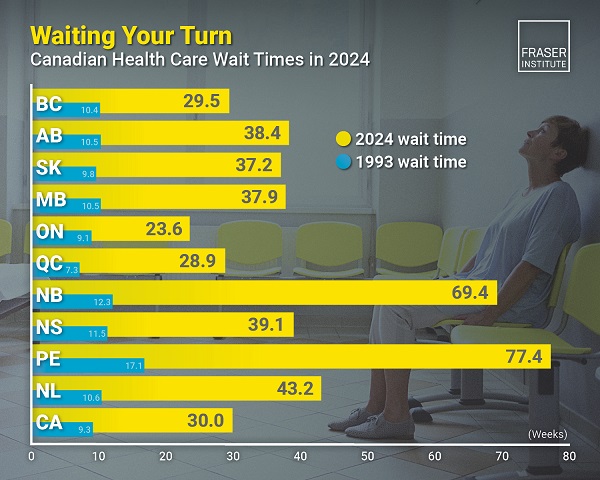
The annual study, based on a survey of physicians across Canada, this year reports a median wait time of 30 weeks from referral by a general practitioner (i.e. family doctor) to consultation with a specialist to treatment, for procedures across 12 medical specialties including several types of surgery.

This year’s median wait (30 weeks) is the longest ever recorded—longer than the 27.7 weeks in 2023 and the 20.9 weeks in 2019 (before the pandemic), and 222 per cent longer than the 9.3 weeks in 1993 when the Fraser Institute began tracking wait times. Among the provinces, Ontario recorded the shortest median wait time (23.6 weeks, up from 21.6 weeks in 2023) while Prince Edward Island recorded the longest (77.4 weeks—although data for P.E.I. should be interpreted with caution due to fewer survey responses compared to other provinces).
Among the various specialties, national median wait times were longest for orthopedic surgery (57.5 weeks) and neurosurgery (46.2 weeks), and shortest for radiation (4.5 weeks) and medical oncology treatments (4.7 weeks). For diagnostic technologies, wait times were longest for CT scans (8.1 weeks), MRIs (16.2 weeks) and ultrasounds (5.2 weeks).
“Long wait times can result in increased suffering for patients, lost productivity at work, a decreased quality of life, and in the worst cases, disability or death,” said Mackenzie Moir, senior policy analyst at the Fraser Institute and study co-author.
Median wait times by province (in weeks)

- In 2024, physicians across Canada reported a median wait time of 30.0 weeks between a referral from a GP and receipt of treatment. Up from 27.7 in 2023.
- This is 222% longer than the 9.3 week wait Canadian patients could expect in 1993.
- Ontario reported the shortest total wait (23.6 weeks), followed by Quebec (28.9 weeks) and British Columbia (29.5 weeks).
- Patients waited longest in Prince Edward Island (77.4 weeks), New Brunswick (69.4 weeks) and Newfoundland and Labrador (43.2 weeks).
- Patients waited the longest for Orthopaedic Surgery (57.5 weeks) and Neurosurgery (46.2 weeks).
- By contrast, patients faced shorter waits for Radiation Oncology (4.5 weeks) and Medical Oncology (4.7 weeks).
- The national 30 week total wait is comprised of two segments. Referral by a GP to consultation with a specialist: 15.0 weeks. Consultation with a specialist to receipt of treatment: 15.0 weeks.
- More than 1900 responses were received across 12 specialties and 10 provinces.
- After seeing a specialist, Canadian patients waited 6.3 weeks longer than what physicians consider to be clinically reasonable (8.6 weeks).
- Across 10 provinces, the study estimated that patients in Canada were waiting for 1.5 million procedures in 2024.
- Patients also suffered considerable delays for diagnostic technology: 8.1 weeks for CT scans, 16.2 weeks for MRI scans, and 5.2 weeks for Ultrasound.

Mackenzie Moir

Bacchus Barua


From the Fraser Institute
The holidays are a time when families reconnect and share cherished traditions, hearty meals and, occasionally, heated debates. This year, housing policy might be a touchy subject at the holiday dinner table. Homebuilding has not kept pace with housing demand in Canada, causing a sharp decline in affordability. Efforts to accelerate homebuilding are also changing neighbourhoods, sometimes in ways that concern residents. Add in a generational divide in how Canadians have experienced the housing market, and it’s easy to see how friends and family can end up talking past one another on housing issues.
Some disagreement about housing policy is inevitable. But in the spirit of the holidays, we can keep the conversation charitable and productive by grounding it in shared facts, respecting one another’s housing choices, and acknowledging the trade-offs of neighbourhood change.
One way to avoid needless conflict is to start with a shared factual baseline about just how unaffordable housing is today—and how that compares to the past.
The reality is that today’s housing affordability challenges are severe, but not entirely unprecedented. Over the past decade, prices for typical homes have grown faster than ordinary families’ after-tax incomes in nearly every major city. At the pandemic-era peak, the mortgage burden for a typical purchase was the worst since the early 1980s. The housing market has cooled in some cities since then, but not enough to bring affordability back to pre-pandemic levels—when affordability was already strained.
These facts provide some useful context for the holiday dinner table. Today’s aspiring homebuyers aren’t wrong to notice how hard it has become to enter the market, and earlier generations aren’t exaggerating when they recall the shock of double-digit interest rates. Housing affordability crises have happened in the past, but they are not the norm. Living through a housing crisis is not, and should not be, a generational rite of passage. Canada has had long periods of relative housing affordability—that’s what we should all want to work towards.
Even when we agree on the facts about affordability, conflicts can flare up when we judge one another’s housing choices. Casual remarks like “Who would want to live in a shoebox like that?” or “Why would anyone pay that much for so little?” or “Why are you still renting at your age?” may be well-intentioned but they ignore the constraints and trade-offs that shape where and how people live.
A small townhome with no yard might seem unappealing to someone who already owns a single-detached house, but for a first-time homebuyer who prioritizes living closer to work or childcare, it might be the best option they can afford.
At first glance, a new condo or townhome might look “overpriced” compared with nearby older single-family homes that offer more space. But buyers must budget for the full cost of ownership, including heating bills, maintenance and renovations, which can make the financial math on some “overpriced” new homes pencil out.
And renting isn’t necessarily a sign that someone is falling behind. Many renters are intentionally keeping their options open: to pursue job opportunities in other cities, to sort out their romantic lives before committing to homeownership, or to invest their money outside of real estate.
This isn’t just a dinner-table issue. The belief that “no one wants to live like that” leads some to support policies restricting apartments, townhomes or purpose-built rentals on the premise that they’re inherently undesirable. A better approach is to set fair rules and let builders respond to what Canadian families choose for themselves—not what we think they should want.
The hardest housing conversations are about where new homes should go, and who gets a say as neighbourhoods change.
It’s natural for homeowners to feel uneasy about how their neighbourhoods might change as a consequence of housing redevelopment. But aspiring homebuyers are also right to be frustrated when local restrictions prevent the kinds of homes Canadian families want from being built in the places they want to live. The economics is clear—allowing more housing styles to be built in more places means greater options and lower prices for renters and homebuyers.
There’s no simple way to balance the competing views of existing residents and aspiring homebuyers. But the conversation becomes more productive if both sides recognize an unavoidable trade-off—resistance to neighbourhood change reliably restricts housing options and makes housing less affordable, but redevelopment can entail real downsides for existing residents.
Everyone wants better housing outcomes for Canadian families, but we won’t get them by talking past one another. If we bring empathy to the table and stay clear eyed about the trade-offs, we’ll collectively make better housing policy decisions—and have calmer holiday dinners.

From the Fraser Institute
By Nadeem Esmail and Mackenzie Moir
It’s an exciting time in Canadian health-care policy. But even the slew of new reforms in Alberta only go part of the way to using all the policy tools employed by high performing universal health-care systems.
For 2026, for the sake of Canadian patients, let’s hope Alberta stays the path on changes to how hospitals are paid and allowing some private purchases of health care, and that other provinces start to catch up.
While Alberta’s new reforms were welcome news this year, it’s clear Canada’s health-care system continued to struggle. Canadians were reminded by our annual comparison of health care systems that they pay for one of the developed world’s most expensive universal health-care systems, yet have some of the fewest physicians and hospital beds, while waiting in some of the longest queues.
And speaking of queues, wait times across Canada for non-emergency care reached the second-highest level ever measured at 28.6 weeks from general practitioner referral to actual treatment. That’s more than triple the wait of the early 1990s despite decades of government promises and spending commitments. Other work found that at least 23,746 patients died while waiting for care, and nearly 1.3 million Canadians left our overcrowded emergency rooms without being treated.
At least one province has shown a genuine willingness to do something about these problems.
The Smith government in Alberta announced early in the year that it would move towards paying hospitals per-patient treated as opposed to a fixed annual budget, a policy approach that Quebec has been working on for years. Albertans will also soon be able purchase, at least in a limited way, some diagnostic and surgical services for themselves, which is again already possible in Quebec. Alberta has also gone a step further by allowing physicians to work in both public and private settings.
While controversial in Canada, these approaches simply mirror what is being done in all of the developed world’s top-performing universal health-care systems. Australia, the Netherlands, Germany and Switzerland all pay their hospitals per patient treated, and allow patients the opportunity to purchase care privately if they wish. They all also have better and faster universally accessible health care than Canada’s provinces provide, while spending a little more (Switzerland) or less (Australia, Germany, the Netherlands) than we do.
While these reforms are clearly a step in the right direction, there’s more to be done.
Even if we include Alberta’s reforms, these countries still do some very important things differently.
Critically, all of these countries expect patients to pay a small amount for their universally accessible services. The reasoning is straightforward: we all spend our own money more carefully than we spend someone else’s, and patients will make more informed decisions about when and where it’s best to access the health-care system when they have to pay a little out of pocket.
The evidence around this policy is clear—with appropriate safeguards to protect the very ill and exemptions for lower-income and other vulnerable populations, the demand for outpatient healthcare services falls, reducing delays and freeing up resources for others.
Charging patients even small amounts for care would of course violate the Canada Health Act, but it would also emulate the approach of 100 per cent of the developed world’s top-performing health-care systems. In this case, violating outdated federal policy means better universal health care for Canadians.
These top-performing countries also see the private sector and innovative entrepreneurs as partners in delivering universal health care. A relationship that is far different from the limited individual contracts some provinces have with private clinics and surgical centres to provide care in Canada. In these other countries, even full-service hospitals are operated by private providers. Importantly, partnering with innovative private providers, even hospitals, to deliver universal health care does not violate the Canada Health Act.
So, while Alberta has made strides this past year moving towards the well-established higher performance policy approach followed elsewhere, the Smith government remains at least a couple steps short of truly adopting a more Australian or European approach for health care. And other provinces have yet to even get to where Alberta will soon be.
Let’s hope in 2026 that Alberta keeps moving towards a truly world class universal health-care experience for patients, and that the other provinces catch up.


Alberta’s huge oil sands reserves dwarf U.S. shale

Canada’s sudden rediscovery of energy ambition has been greeted with a familiar charge: hypocrisy

COP30 finally admits what resource workers already knew: prosperity and lower emissions must go hand in hand

Canada’s New Green Deal
-
 armed forces8 hours ago
Ottawa’s Newly Released Defence Plan Crosses a Dangerous Line
-
 espionage7 hours ago
Carney Floor Crossing Raises Counterintelligence Questions aimed at China, Former Senior Mountie Argues
-
 Censorship Industrial Complex2 days ago
Canadian university censors free speech advocate who spoke out against Indigenous ‘mass grave’ hoax
-
 Health6 hours ago
All 12 Vaccinated vs. Unvaccinated Studies Found the Same Thing: Unvaccinated Children Are Far Healthier
-
 Energy9 hours ago
75 per cent of Canadians support the construction of new pipelines to the East Coast and British Columbia
-
 Energy2 days ago
‘The electric story is over’
-
 International2 days ago
Georgia county admits illegally certifying 315k ballots in 2020 presidential election
-
 Business2 days ago
Some Of The Wackiest Things Featured In Rand Paul’s New Report Alleging $1,639,135,969,608 In Gov’t Waste