
Connect with us

Economy

COP 29 leaders demand over a $1 trillion a year in climate reparations from ‘wealthy’ nations. They don’t deserve a nickel.

Published

12 minute read

From Energy Talking Points

The injustice of climate reparations

COP 29 is calling for over $1 trillion in annual climate reparations

  • A major theme of COP 29 is that the world should set a “New Collective Quantified Goal” wherein successful nations pay poor nations over $1 trillion a year to 1) make up for climate-related harm and 2) build them new “green energy” economies. In other words, climate reparations.¹
  • What would $1 trillion a year in climate reparations mean for you and your family?Assuming the money was paid equally by households considered high income (>$50 per day), your household would have to pay more than $5,000 a year in climate reparations taxes!²
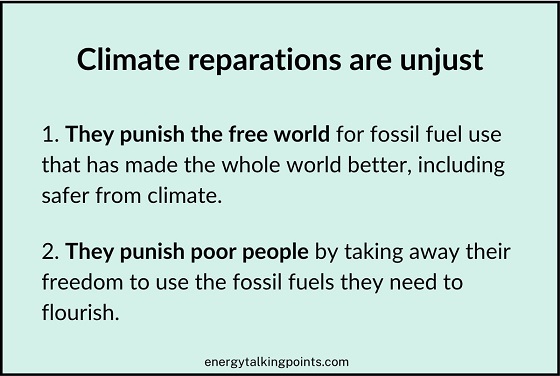
  • Climate reparations are based on two false assumptions:1. Free, wealthy countries, through their fossil fuel use, have made the world worse for poor countries.

    2. The poor world’s main problem is dealing with climate change, which wealth transfers will help them with.

But free, fossil-fueled countries have made life better for poor countries

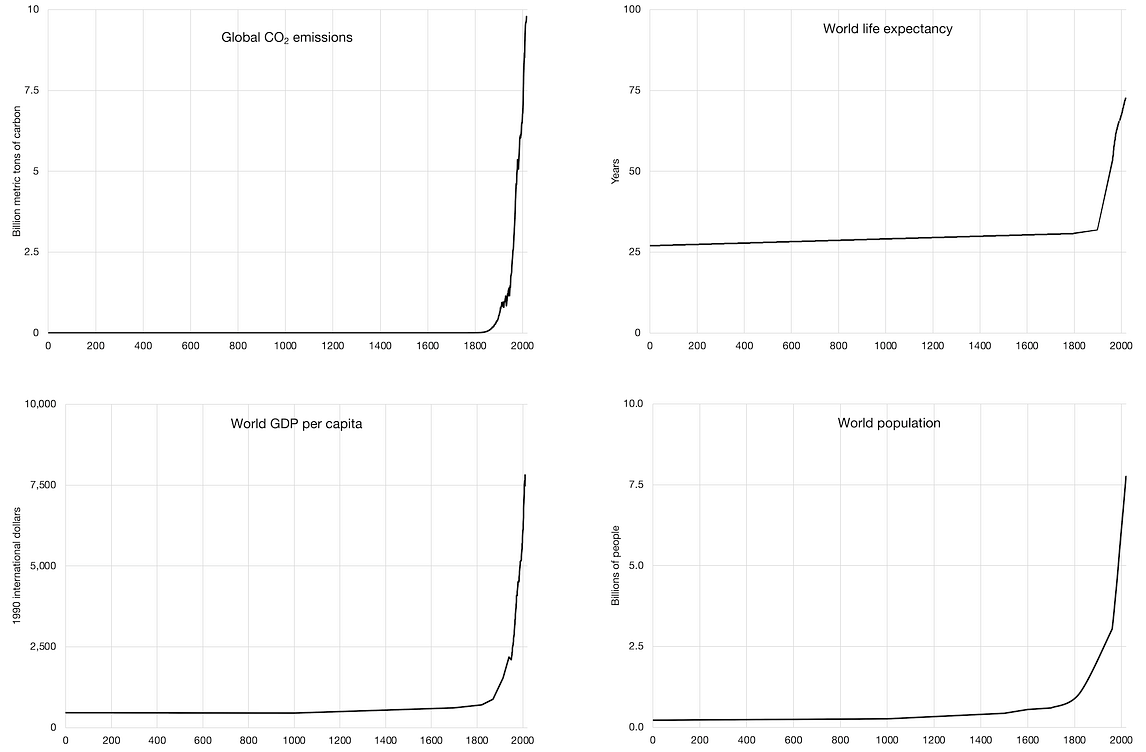
  • Free, wealthy countries, through their fossil fuel use, have not made the world worse for poor countries—they have made it far, far better.Observe what has happened to global life expectancies and income as fossil fuel use has risen. Life has gotten much better for everyone.³
  • The wealthy world’s fossil fuel use has improved life worldwide because by using fossil fuel energy to be incredibly productive, we have 1) made all kinds of goods cheaper and 2) been able to engage in life-saving aid, particularly in the realms of food, medicine, and sanitation.
  • Without the historic use of fossil fuels by the wealthy world, there would be no super-productive agriculture to feed 8 billion humans, no satellite-based weather warning systems, etc. Most of the individuals in poor countries would not even be alive today.

Free, fossil-fueled countries have made the poor safer from climate

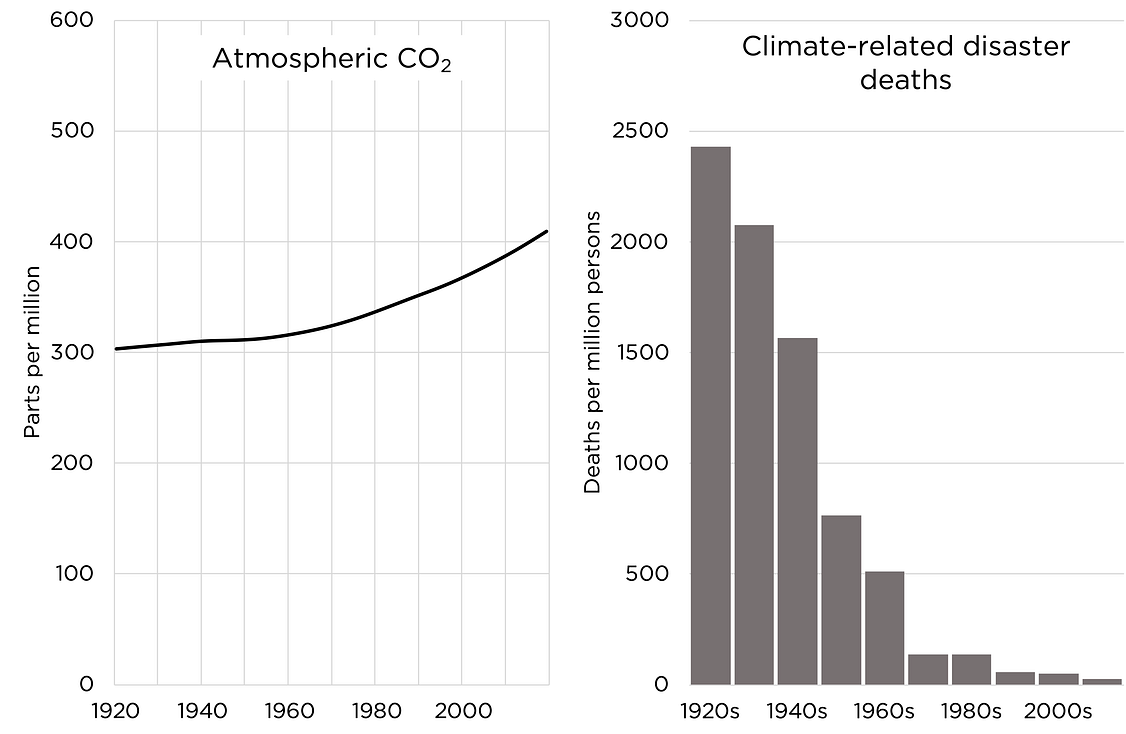
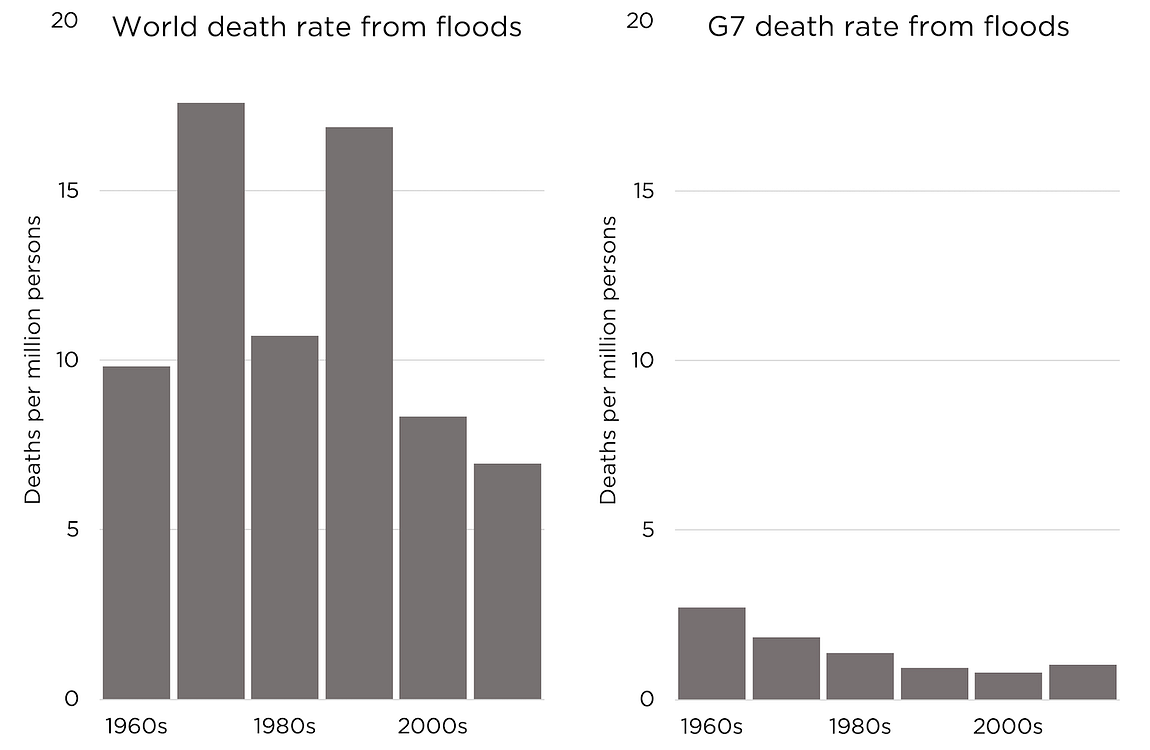
  • The wealthy world’s fossil fuel use has been particularly beneficial in the realm of climate.Over the last 100 years, the death rate from climate-related disasters plummeted by 98% globally.

    A big reason is millions of lives saved from drought via fossil-fueled crop transport.⁴

  • The “climate reparations” movement ignores the fact that the wealthy world’s fossil fuel use has made life better, including safer from climate, in the poor world.This allows it to pretend that the poor world’s main problem is dealing with rising CO2 levels.

The poor world’s problem is poverty, not rising CO2 levels

  • The poor world’s main problem is not rising CO2 levels, it is poverty—which is caused by lack of freedom, including the crucial freedom to use fossil fuels.Poverty makes everything worse, including the world’s massive natural climate danger and any danger from more CO2.
  • While it’s not true that the wealthy world has increased climate danger in the poor world—we have reduced it—it is true that the poor world is more endangered by climate than the wealthy world is.The solution is for the poor to get rich. Which requires freedom and fossil fuels.

Escaping poverty requires freedom and fossil fuels

  • Every nation that has risen out of poverty has done so via pro-freedom policies—specifically, economic freedom. 

    That’s how resource-poor places like Singapore and Taiwan became prosperous. Resource-rich places like Congo have struggled due to lack of economic freedom.

  • Even China, which is unfree in many ways (including insufficient protections against pollution) dramatically increased its standard of living via economic freedom—particularly in the realm of industrial development where it is now in many ways much freer than the US and Europe.
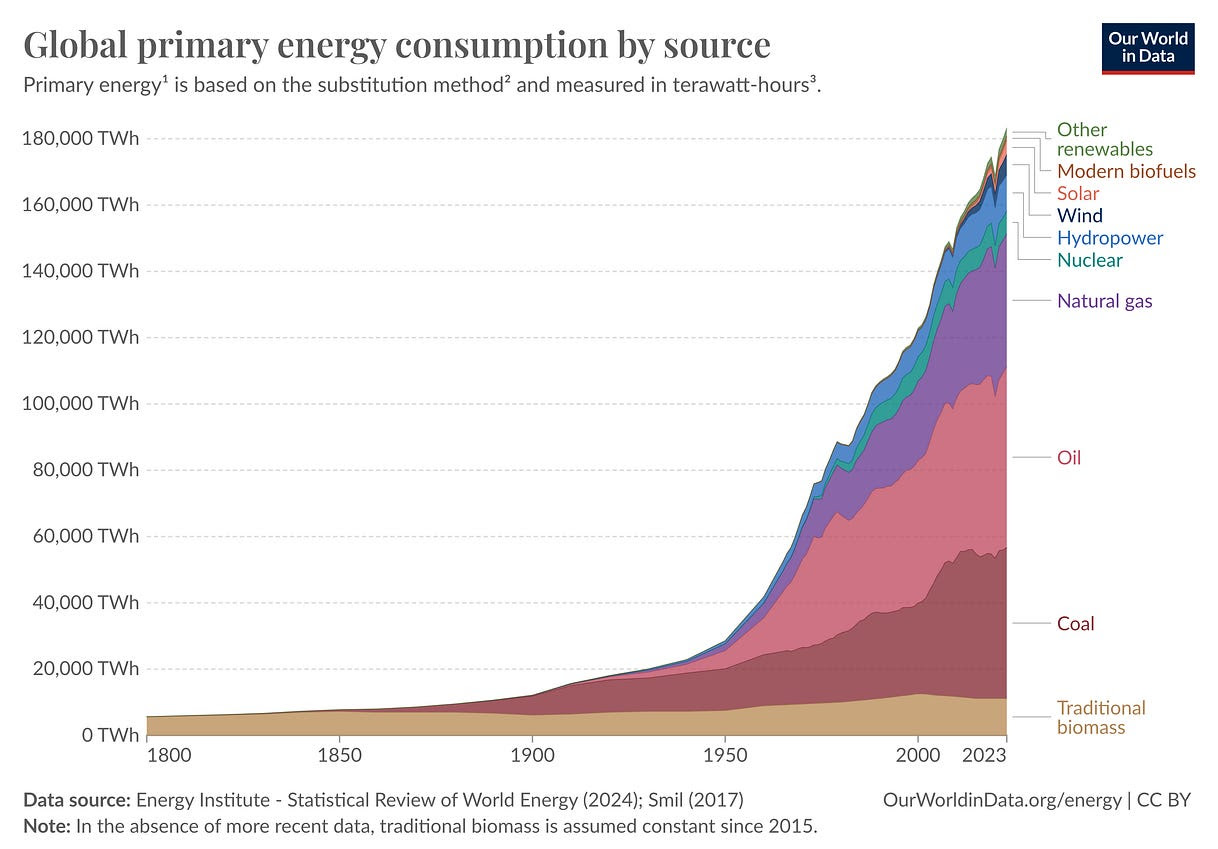
  • crucial freedom involved in rising prosperity has been the freedom to use fossil fuels.Fossil fuels are a uniquely cost-effective source of energy, providing energy that’s low-cost, reliable, versatile, and scalable to billions of people in thousands of places.⁶
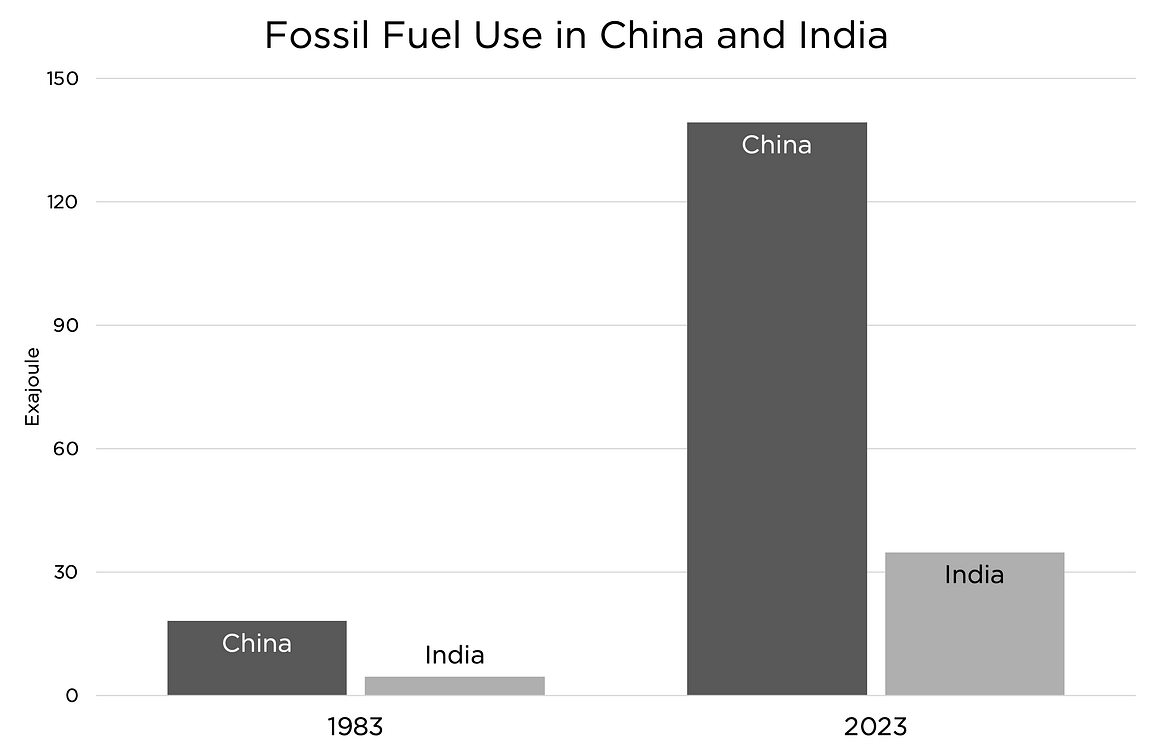
  • Time and again nations have increased their prosperity, including their safety from climate, via economic freedom and fossil fuels.Observe the 7X increase in fossil fuel use in China and India over the past 4 decades, which enabled them to industrialize and prosper.
  • For the world’s poorest people to be more prosperous and safer from climate, they need more freedom and more fossil fuels.The “climate reparations” movement seeks to deny them both.
  • The wealthy world should communicate to the poor world that economic freedom is the path to prosperity, and encourage the poor world to reform its cultural and political institutions to embrace economic freedom—including fossil fuel freedom.Our leaders are doing the opposite.

Climate reparations pay off dictators to take away fossil fuel freedom

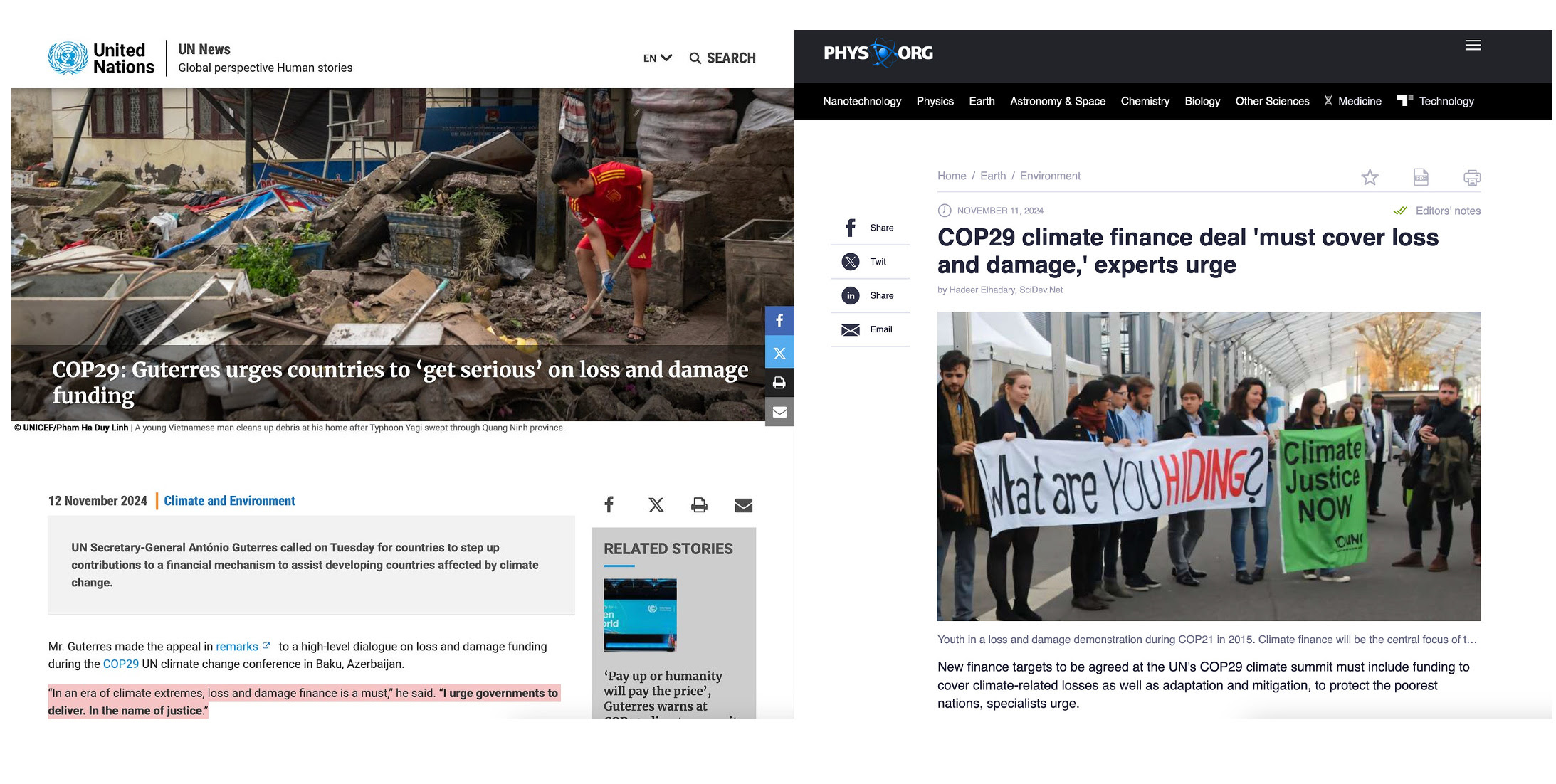
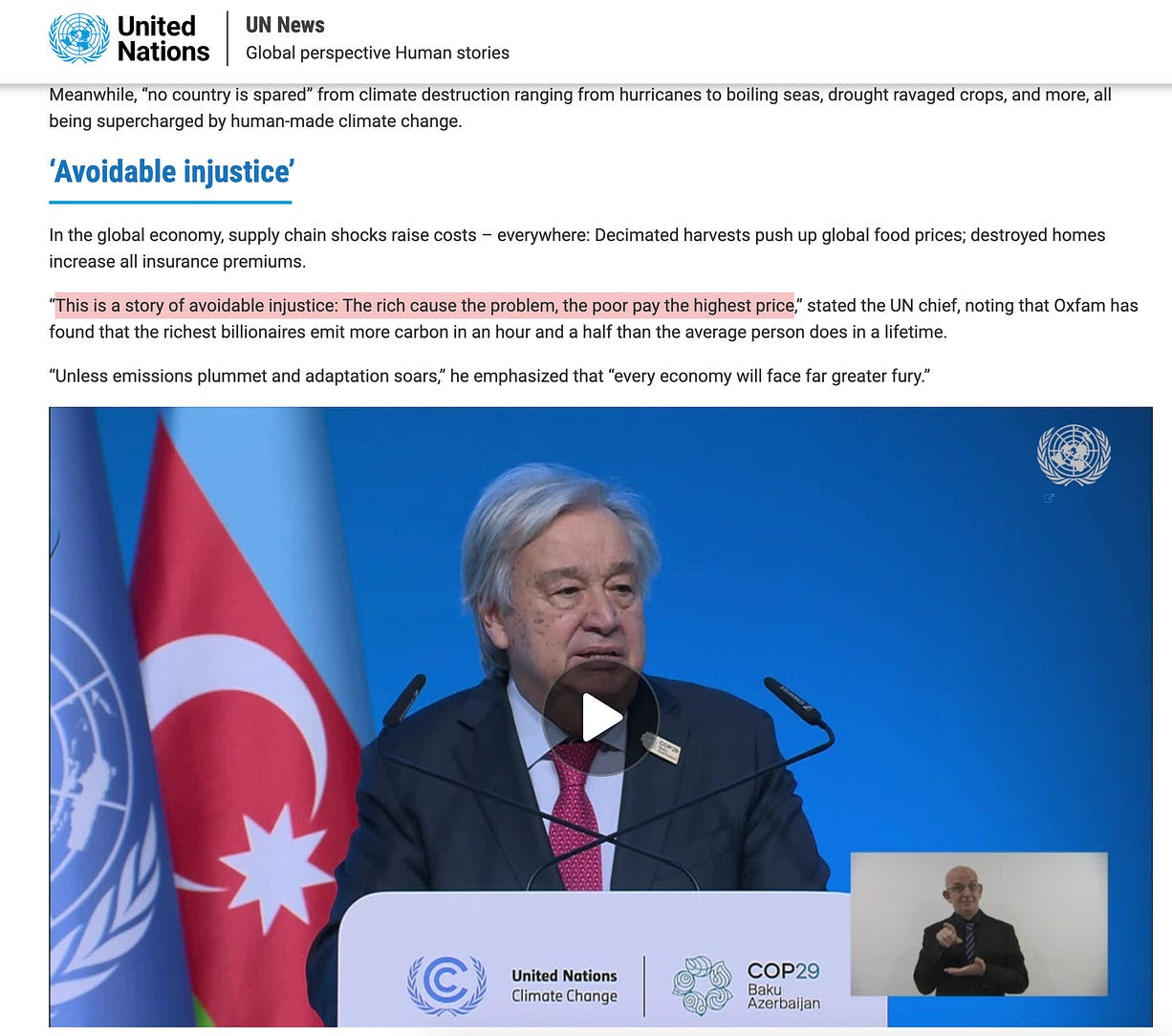
  • Instead of promoting economic freedom, including fossil fuel freedom, wealthy climate reparations advocates like Antonio Guterres are offering to entrench anti-freedom regimes by paying off their dictators and bureaucrats to eliminate fossil fuel freedom.This is disgusting.⁸
  • The biggest victim of “climate reparations” will be the world’s poorest countries, whose dictators will be paid off to prevent the fossil fuel freedom that has allowed not just the US and Europe but also China and India to dramatically increase their prosperity.
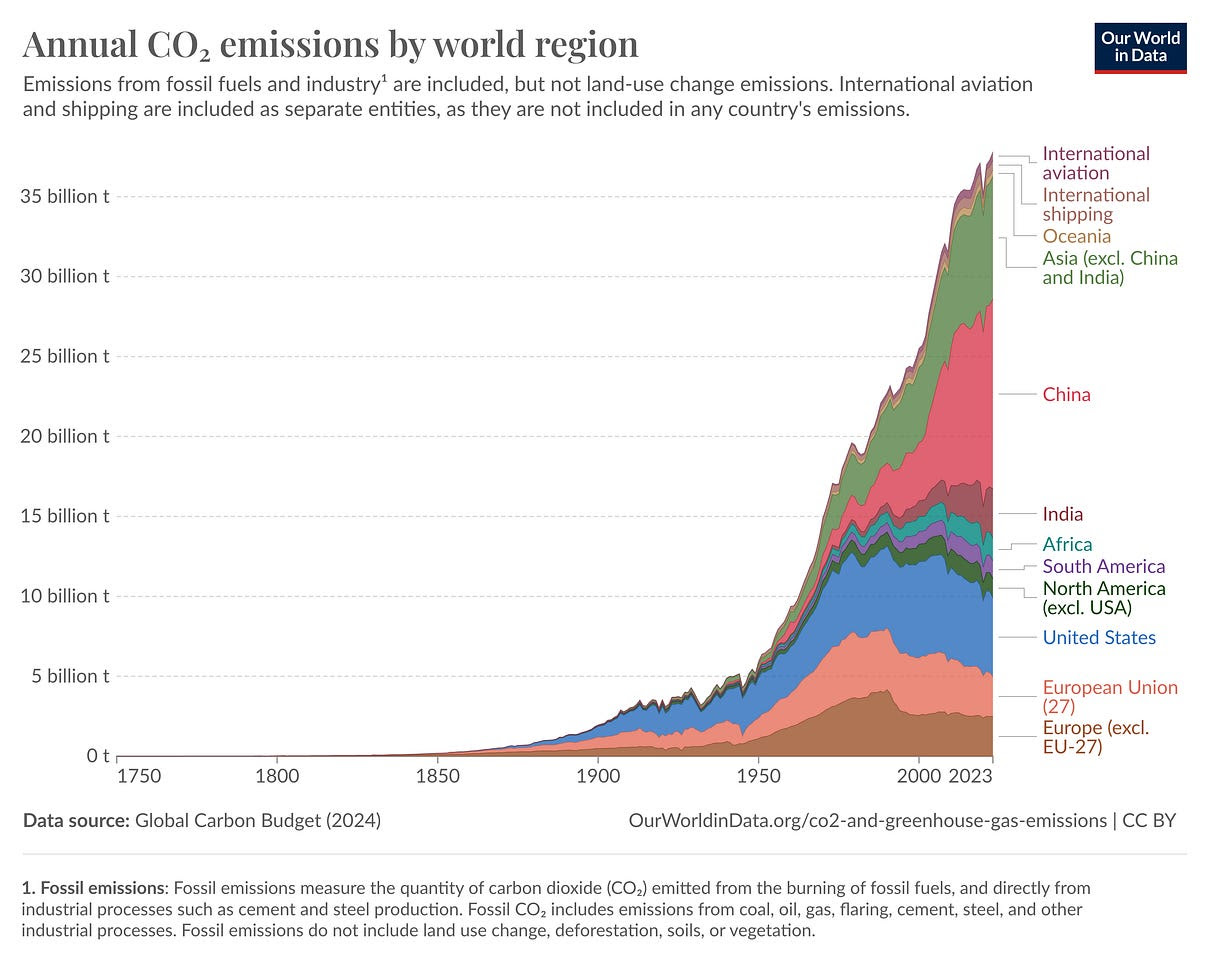
  • The biggest beneficiary of “climate reparations” will be China, which is already emitting more CO2 than the US and Europe combined. (Though less per capita.)While we flagellate and cripple ourselves, China will use fossil fuels in its quest to become the world’s superpower.⁹
  • The second biggest beneficiary of “climate reparations” will be corrupt do-gooders who get to add anti-fossil-fuel strings to “reparations” dollars and dictate how it’s spent—which will surely include lots of dollars for unreliable solar panels and wind turbines made in China.

Leaders must reject reparations and champion fossil fuel freedom

  • We need leaders in the US and Europe who proudly:1. Champion the free world’s use of fossil fuels as an enormous good for the world, including its climate safety.

    2. Encourage the poor world to embrace economic freedom and fossil fuels.

    Tell your Representative to do both.

Share


Popular links


“Energy Talking Points by Alex Epstein” is my free Substack newsletter designed to give as many people as possible access to concise, powerful, well-referenced talking points on the latest energy, environmental, and climate issues from a pro-human, pro-energy perspective.

Share Energy Talking Points by Alex Epstein

Scientific American – COP27 Summit Yields ‘Historic Win’ for Climate Reparations but Falls Short on Emissions Reductions
2  Global population was about 8.02 billion in 2023.

World Bank data

About 7% of world population are considered high income, which translates into about 562 million individuals. Considering 3 people per average household in high income households, this translates into about 187 million households.
Pew Research – Are you in the global middle class? Find out with our income calculator

$1 trillion per annum paid by 187 million households means the average household would pay about $5,300 per year.

Maddison Database 2010 at the Groningen Growth and Development Centre, Faculty of Economics and Business at University of Groningen
UC San Diego – The Keeling Curve

For every million people on earth, annual deaths from climate-related causes (extreme temperature, drought, flood, storms, wildfires) declined 98%–from an average of 247 per year during the 1920s to 2.5 in per year during the 2010s.

Data on disaster deaths come from EM-DAT, CRED / UCLouvain, Brussels, Belgium – www.emdat.be (D. Guha-Sapir).

Population estimates for the 1920s from the Maddison Database 2010, the Groningen Growth and Development Centre, Faculty of Economics and Business at University of Groningen. For years not shown, population is assumed to have grown at a steady rate.

Population estimates for the 2010s come from World Bank Data.

UC San Diego – The Keeling Curve

Data on disaster deaths come from EM-DAT, CRED / UCLouvain, Brussels, Belgium – www.emdat.be (D. Guha-Sapir).

Population estimates come from World Bank Data.

Our World in Data – Energy Production and Consumption
BP – Statistical Review of World Energy
UN News – ‘Pay up or humanity will pay the price’, Guterres warns at COP29 climate summit
Our World in Data – Annual CO₂ emissions from fossil fuels, by world region

Todayville is a digital media and technology company. We profile unique stories and events in our community. Register and promote your community event for free.

Follow Author

Business

Land use will be British Columbia’s biggest issue in 2026

Published on

By Resource Works

Tariffs may fade. The collision between reconciliation, property rights, and investment will not.

British Columbia will talk about Donald Trump’s tariffs in 2026, and it will keep grinding through affordability. But the issue that will decide whether the province can build, invest, and govern is land use.

The warning signs were there in 2024. Land based industries still generate 12 per cent of B.C.’s GDP, and the province controls more than 90 per cent of the land base, and land policy was already being remade through opaque processes, including government to government tables. When rules for access to land feel unsettled, money flows slow into a trickle.

The Cowichan ruling sends shockwaves

In August 2025, the Cowichan ruling turned that unease into a live wire. The court recognized the Cowichan’s Aboriginal title over roughly 800 acres within Richmond, including lands held by governments and unnamed third parties. It found that grants of fee simple and other interests unjustifiably infringed that title, and declared certain Canada and Richmond titles and interests “defective and invalid,” with those invalidity declarations suspended for 18 months to give governments time to make arrangements.

The reaction has been split. Supporters see a reminder that constitutional rights do not evaporate because land changed hands. Critics see a precedent that leaves private owners exposed, especially because unnamed owners in the claim area were not parties to the case and did not receive formal notice. Even the idea of “coexistence” has become contentious, because both Aboriginal title and fee simple convey exclusive rights to decide land use and capture benefits.

Market chill sets in

McLTAikins translated the risk into advice that landowners and lenders can act on: registered ownership is not immune from constitutional scrutiny, and the land title system cannot cure a constitutional defect where Aboriginal title is established. Their explanation of fee simple reads less like theory than a due diligence checklist that now reaches beyond the registry.

By December, the market was answering. National Post columnist Adam Pankratz reported that an industrial landowner within the Cowichan title area lost a lender and a prospective tenant after a $35 million construction loan was pulled. He also described a separate Richmond hotel deal where a buyer withdrew after citing precedent risk, even though the hotel was not within the declared title lands. His case that uncertainty is already changing behaviour is laid out in Montrose.

Caroline Elliott captured how quickly court language moved into daily life after a City Richmond letter warned some owners that their title might be compromised. Whatever one thinks of that wording, it pushed land law out of the courtroom and into the mortgage conversation.

Mining and exploration stall

The same fault line runs through the critical minerals push. A new mineral claims regime now requires consultation before claims are approved, and critics argue it slows early stage exploration and forces prospectors to reveal targets before they can secure rights. Pankratz made that critique earlier, in his argument about mineral staking.

Resource Works, summarising AME feedback on Mineral Tenure Act modernisation, reported that 69.5 per cent of respondents lacked confidence in proposed changes, and that more than three quarters reported increased uncertainty about doing business in B.C. The theme is not anti consultation. It is that process, capacity, and timelines decide whether consultation produces partnership or paralysis.

Layered on top is the widening fight over UNDRIP implementation and DRIPA. Geoffrey Moyse, KC, called for repeal in a Northern Beat essay on DRIPA, arguing that Section 35 already provides the constitutional framework and that trying to operationalise UNDRIP invites litigation and uncertainty.

Tariffs and housing will still dominate headlines. But they are downstream of land. Until B.C. offers a stable bargain over who can do what, where, and on what foundation, every other promise will be hostage to the same uncertainty. For a province still built on land based wealth, Resource Works argues in its institutional history that the resource economy cannot be separated from land rules. In 2026, that is the main stage.

Resource Works News

Continue Reading

Business

Dark clouds loom over Canada’s economy in 2026

Published on

From the Fraser Institute

By Jock Finlayson

The dawn of a new year is an opportune time to ponder the recent performance of Canada’s $3.4 trillion economy. And the overall picture is not exactly cheerful.

Since the start of 2025, our principal trading partner has been ruled by a president who seems determined to unravel the post-war global economic and security order that provided a stable and reassuring backdrop for smaller countries such as Canada. Whether the Canada-U.S.-Mexico trade agreement (that President Trump himself pushed for) will even survive is unclear, underscoring the uncertainty that continues to weigh on business investment in Canada.

At the same time, Europe—representing one-fifth of the global economy—remains sluggish, thanks to Russia’s relentless war of choice against Ukraine, high energy costs across much of the region, and the bloc’s waning competitiveness. The huge Chinese economy has also lost a step. None of this is good for Canada.

Yet despite a difficult external environment, Canada’s economy has been surprisingly resilient. Gross domestic product (GDP) is projected to grow by 1.7 per cent (after inflation) this year. The main reason is continued gains in consumer spending, which accounts for more than three-fifths of all economic activity. After stripping out inflation, money spent by Canadians on goods and services is set to climb by 2.2 per cent in 2025, matching last year’s pace. Solid consumer spending has helped offset the impact of dwindling exports, sluggish business investment and—since 2023—lacklustre housing markets.

Another reason why we have avoided a sharper economic downturn is that the Trump administration has, so far, exempted most of Canada’s southbound exports from the president’s tariff barrage. This has partially cushioned the decline in Canada’s exports—particularly outside of the steel, aluminum, lumber and auto sectors, where steep U.S. tariffs are in effect. While exports will be lower in 2025 than the year before, the fall is less dramatic than analysts expected 6 to 8 months ago.

Although Canada’s economy grew in 2025, the job market lost steam. Employment growth has softened and the unemployment rate has ticked higher—it’s on track to average almost 7 per cent this year, up from 5.4 per cent two years ago. Unemployment among young people has skyrocketed. With the economy showing little momentum, employment growth will remain muted next year.

Unfortunately, there’s nothing positive to report on the investment front. Adjusted for inflation, private-sector capital spending has been on a downward trajectory for the last decade—a long-term trend that can’t be explained by Trump’s tariffs. Canada has underperformed both the United States and several other advanced economies in the amount of investment per employee. The investment gap with the U.S. has widened steadily since 2014. This means Canadian workers have fewer and less up-to-date tools, equipment and technology to help them produce goods and services compared to their counterparts in the U.S. (and many other countries). As a result, productivity growth in Canada has been lackluster, narrowing the scope for wage increases.

Preliminary data indicate that both overall non-residential investment and business capital spending on machinery, equipment and advanced technology products will be down again in 2025. Getting clarity on the future of the Canada-U.S. trade relationship will be key to improving the business environment for private-sector investment. Tax and regulatory policy changes that make Canada a more attractive choice for companies looking to invest and grow are also necessary. This is where government policymakers should direct their attention in 2026.

Continue Reading

Trending

X