Connect with us

Censorship Industrial Complex

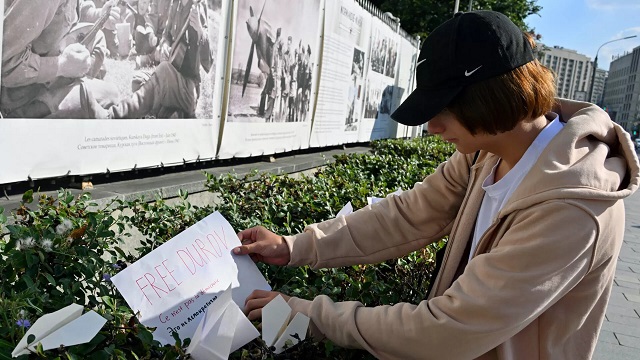
Telegram CEO Pavel Durov’s Arrest Is Part of a Global War on Free Speech

Published

9 minute read

From The Rattler 

By J.D. Tuccille

Governments around the world seek to suppress ideas and control communications channels

It’s appropriate that, days after the French government arrested Pavel Durov, CEO of the encrypted messaging app Telegram, for failing to monitor and restrict communications as demanded by officials in Paris, Meta CEO Mark Zuckerberg confirmed that his company, which owns Facebook, was subjected to censorship pressures by U.S. officials. Durov’s arrest, then, stands as less of a one-off than as part of a concerted effort by governments, including those of nominally free countries, to control speech.

“Telegram chief executive Pavel Durov is expected to appear in court Sunday after being arrested by French police at an airport near Paris for alleged offences related to his popular messaging app,” reported France24.

separate story noted claims by Paris prosecutors that he was detained for “running an online platform that allows illicit transactions, child pornography, drug trafficking and fraud, as well as the refusal to communicate information to authorities, money laundering and providing cryptographic services to criminals.”

Freedom for Everybody or for Nobody

Durov’s alleged crime is offering encrypted communications services to everybody, including those who engage in illegality or just anger the powers that be. But secure communications are a feature, not a bug, for most people who live in a world in which “global freedom declined for the 18th consecutive year in 2023,” according to Freedom House. Fighting authoritarian regimes requires means of exchanging information that are resistant to penetration by various repressive police agencies.

“Telegram, and other encrypted messaging services, are crucial for those intending to organize protests in countries where there is a severe crackdown on free speech. Myanmar, Belarus and Hong Kong have all seen people relying on the services,” Index on Censorship noted in 2021.

And if bad people occasionally use encrypted apps such as Telegram, they use phones and postal services, too. The qualities that make communications systems useful to those battling authoritarianism are also helpful to those with less benign intentions. There’s no way to offer security to one group without offering it to everybody.

Durov’s Second Clash With an Authoritarian Government

A CNN report on the case (I watch so you don’t have to) weirdly linked Durov to Russian President Vladimir Putin, insinuating the two are conspiring. But as Reuters helpfully points out, “Telegram, based in Dubai, was founded by Durov, who left Russia in 2014 after he refused to comply with demands to shut down opposition communities on his VK social media platform, which he has sold.”

The Internet Archive contains links to 2014 posts by Durov boasting, in Russian, that he refused to surrender information about Ukrainian users of VKontakte to the Putin regime and balked at barring the late Alexei Navalny’s opposition group from the service.

“I’m afraid there is no going back,” Durov told TechCrunch after leaving Russia to build Telegram. “Not after I publicly refused to cooperate with the authorities. They can’t stand me.”

Telegram was initially blocked in Russia, but the ban was unpopular and unsuccessful, and soon dropped. The service is now widely used by both Russians and Ukrainians as a digital battleground in their war.

Given that Telegram was founded by a free speech champion who fled his home country after refusing to monitor and censor speech for the authorities, it’s very easy to suspect that Pavel Durov has run afoul of authoritarians operating under a different flag, no matter the protestations of French President Emmanuel Macron that the arrest “is in no way a political decision” and that France “is deeply committed to freedom of expression and communication.”

This is the same Macron, after all, who last year, after riots he insisted were coordinated online, huffed “We have to think about the social networks, about the bans we’ll have to put in place. When things get out of control, we might need to be able to regulate or cut them off.”

More recently, free speech groups objected to European Union threats to censor political content on X—specifically, an interview with Republican presidential candidate Donald Trump.

The U.S. Has Its Own Free Speech Concerns

Matters are better in the United States, but not so much (as we have every right to demand). The Twitter Files and the Facebook Files revealed serious pressure brought to bear by the U.S. government on social media companies to stifle dissenting views and inconvenient (to the political class) news stories. If any further confirmation was needed, Zuckerberg sent a letter to the House Judiciary Committee on August 26 regretting the company’s role in succumbing to pressure to censor content.

“In 2021, senior officials from the Biden administration, including the White House, repeatedly pressured our teams for months to censor certain COVID-19 content, including humor and satire,” Zuckerberg wrote to Chairman Jim Jordan (R–Ohio). “I believe the government pressure was wrong, and I regret that we were not more outspoken about it.”

Zuckerberg also admitted to suppressing reports about the incriminating contents of Hunter Biden’s laptop at the FBI’s behest. “We’re ready to push back if something like this happens again,” he promised.

Fighting a Free Speech Recession

Durov’s arrest isn’t an isolated incident. It comes amid what Jacob Mchangama, (founder of the Danish think tank Justitia and executive director of The Future of Free Speech) calls “a free speech recession.” He warns that “liberal democracies, rather than constituting a counterweight to the authoritarian onslaught, are themselves contributing to the free-speech recession.”

“Recession” might be too soft a word to describe a phenomenon that has governments attempting to suppress ideas and arresting entrepreneurs who operate neutral communications channels. These are harsh policies with real costs in terms of human freedom.

Telegram didn’t respond to a request for comment, but in a public statement said, “it is absurd to claim that a platform or its owner are responsible for abuse of that platform.”

In a post from March, Pavel Durov himself commented, “All large social media apps are easy targets for criticism due to the content they host.” He vowed, “we shall solve any potential challenges the same way we do everything else — with efficiency, innovation and respect for privacy and freedom of speech.”

Durov’s arrest shows that he, like all champions of free expression, must wage their battles for liberty against the active opposition of government officials even in nominally free countries. Free speech is as important as ever, but more besieged than it has been in a long time.

Here are a few more good articles about liberty:

Todayville is a digital media and technology company. We profile unique stories and events in our community. Register and promote your community event for free.

Follow Author

Censorship Industrial Complex

US Condemns EU Censorship Pressure, Defends X

Published on

US Vice President JD Vance criticized the European Union this week after rumors reportedly surfaced that Brussels may seek to punish X for refusing to remove certain online speech.

In a post on X, Vance wrote, “Rumors swirling that the EU commission will fine X hundreds of millions of dollars for not engaging in censorship. The EU should be supporting free speech not attacking American companies over garbage.”

His remarks reflect growing tension between the United States and the EU over the future of online speech and the expanding role of governments in dictating what can be said on global digital platforms.

Screenshot of a verified social-media post with a profile photo, reading: "Rumors swirling that the EU commission will fine X hundreds of millions of dollars for not engaging in censorship. The EU should be supporting free speech not attacking American companies over garbage." Timestamp Dec 4, 2025, 5:03 PM and "1.1M Views" shown.

Vance was likely referring to rumors that Brussels intends to impose massive penalties under the bloc’s Digital Services Act (DSA), a censorship framework that requires major platforms to delete what regulators define as “illegal” or “harmful” speech, with violations punishable by fines up to six percent of global annual revenue.

For Vance, this development fits a pattern he’s been warning about since the spring.

In a May 2025 interview, he cautioned that “The kind of social media censorship that we’ve seen in Western Europe, it will and in some ways, it already has, made its way to the United States. That was the story of the Biden administration silencing people on social media.”

He added, “We’re going to be very protective of American interests when it comes to things like social media regulation. We want to promote free speech. We don’t want our European friends telling social media companies that they have to silence Christians or silence conservatives.”

Yet while the Vice President points to Europe as the source of the problem, a similar agenda is also advancing in Washington under the banner of “protecting children online.”

This week’s congressional hearing on that subject opened in the usual way: familiar talking points, bipartisan outrage, and the recurring claim that online censorship is necessary for safety.

The House Subcommittee on Commerce, Manufacturing, and Trade convened to promote a bundle of bills collectively branded as the “Kids Online Safety Package.”

The session, titled “Legislative Solutions to Protect Children and Teens Online,” quickly turned into a competition over who could endorse broader surveillance and moderation powers with the most moral conviction.

Rep. Gus Bilirakis (R-FL) opened the hearing by pledging that the bills were “mindful of the Constitution’s protections for free speech,” before conceding that “laws with good intentions have been struck down for violating the First Amendment.”

Despite that admission, lawmakers from both parties pressed ahead with proposals requiring digital ID age verification systems, platform-level content filters, and expanded government authority to police online spaces; all similar to the EU’s DSA censorship law.

Vance has cautioned that these measures, however well-intentioned, mark a deeper ideological divide. “It’s not that we are not friends,” he said earlier this year, “but there’re gonna have some disagreements you didn’t see 10 years ago.”

That divide is now visible on both sides of the Atlantic: a shared willingness among policymakers to restrict speech for perceived social benefit, and a shrinking space for those who argue that freedom itself is the safeguard worth protecting.

If you’re tired of censorship and surveillance, join Reclaim The Net.

Fight censorship and surveillance. Reclaim your digital freedom.

Get news updates, features, and alternative tech explorations to defend your digital rights.

Continue Reading

Censorship Industrial Complex

Frances Widdowson’s Arrest Should Alarm Every Canadian

Published on

Marco Navarro-Génie's avatar Marco Navarro-Génie

Speech Crimes on Campus

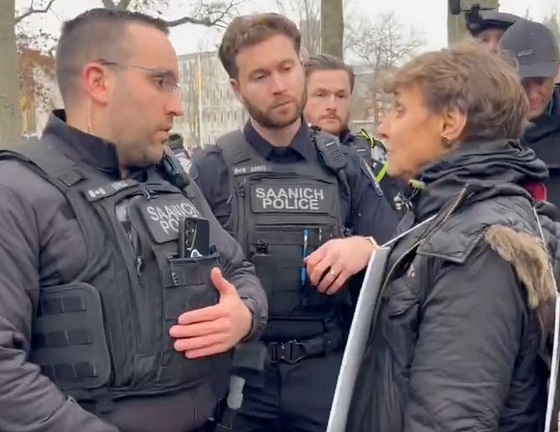
Frances Widdowson, a former colleague professor at Mount Royal University, was arrested this past week on the University of Victoria campus. Her offence? Walking, conversing, and asking questions on a university campus. She was not carrying a megaphone, making threats, organizing a protest, or waving foreign flags. She was planning quietly to discuss, with whoever wished it, a widespread claim that has curiously evaded forensic scrutiny in Canada for five years: that the remains of 215 Indigenous children lie beneath the grounds of the former Kamloops Residential School.

UVic Campus security did not treat her as a scholar. Nor even as a citizen. They treated her as a contaminating source.

The director of security, a woman more reminiscent of a diversity consultant than a peace officer, almost shaking, presented Widdowson with papers and told her to vacate “the property.” When Widdowson questioned the order, citing her Charter rights and the university’s public nature, she was told to leave. She refused, and she was arrested. No force, no defiance, only a refusal to concede that inquiry is trespass.

Widdowson is no provocateur in the modern sense. She is not a shock-jock in a cardigan. She is a once-tenured academic with a long record of challenging orthodoxies in Indigenous policy, identity politics, and campus culture.

In 2008, she co-authored Disrobing the Aboriginal Industry, a book that deconstructed the bureaucratic machinery that profits from preserving Indigenous dependency. The book was methodical, sourced, and daring enough to be labelled heretical in some quarters, but simultaneously boringly Marxist materialistic.

Her arguments have made people uncomfortable for a long time. When I assigned her book to my political science students in the Department of Policy Studies, where Frances also taught, I was summoned by the department head’s office. Someone in my class complained about the book, though I ignored what was said, and the technocratic colleague, as chair of the department, had prepared a host of arguments to chastise me for assigning the book.

Widdowson was good enough to be hired as a colleague of that department, but they were all afraid of her ideas, and perhaps her manner. I have often wondered if the folks in the Mount Royal hiring committee had bothered to read her book. Hey, they had a female Marxist applying for a teaching job. Knowing how they operate makes me think they made giant assumptions about Frances.

My bureaucratic colleague relented. I got the impression that the department head was putting on a show, going through motions he didn’t want to engage in, but which he had to perform for administrative purposes. He had to act on the complaint, though the complaint had no substance. He tried to tell me that the ideas in the book might offend some students, and then went on with the typical dribble about being caring, but agreed that protecting feelings was not the objective of an education, nor the job of a professor.

Share

Haultain’s Substack is a reader-supported publication.

To receive new posts and support our work, please consider becoming a free or paid subscriber.

Try it out.

I went to my campus office after the conversation with the department head, typed up a memo detailing our discussion, and emailed it to him to ensure there was a record of my viewpoint. The email got no response. He never mentioned it again, and to this day, 15 or 16 years later, we still haven’t spoken about it.

Some academic arguments are meant to shake things up. That is the purpose of scholarship: to stir the sediment of consensus. To challenge conventional views. Marxist or no, scholars are supposed to push the envelope. Expand the boundaries of our understanding. But in today’s academic culture, discomfort is treated as injury and dissent as violence. So, Widdowson was treated as a threat merely by walking and speaking.

Was the university within its legal rights to remove her? Possibly. Universities can invoke property rights, ironically in Cowichan territory, and provincial legislation sometimes grants them a curious status: publicly funded yet selectively private. But the question is not merely legal. It is cultural and constitutional.

The University of Victoria is a publicly funded institution, governed under provincial authority and subsidized by taxpayers. Its grounds, though some claim they are on unceded Indigenous territory, are functionally administered by the Crown. The university is not a monastery. While it is not a temple to be kept free of doubt, it is not a temple to be torched either. It is a civic institution. An institution of higher learning. When it uses its resources to shield ideology and expel dissenters, it forfeits its academic character.

Consider the contrast. On this same campus, as on many others across the country, protests have called for the destruction of Israel and the extermination of Jews. Banners are waved, slogans chanted, and genocidal euphemisms like “from the river to the sea” are uttered without hesitation. These demonstrations, some of which praise Hamas or glorify martyrdom, proceed unimpeded. Security stands down. The administration issues boilerplate statements about inclusion and respect.

But when a female academic arrives to ask whether the number “215” refers to actual remains or mere radar anomalies, she is marched off by police. The imbalance is not accidental. It is a product of institutional capture.

Contemporary universities have adopted a new moral vocabulary. Terms like “safety,” “inclusion,” and “harm” are now treated as constitutional categories. But their terms are undefined, fluid, shaped by ideology rather than principle. “Safety” no longer refers to bodily security, but has become an emotional preference. “Inclusion” does not mean openness to different ideas and people, but a validation of specific identities. “Harm” is not an act, but a feeling.

Under this logic, Widdowson’s presence becomes a form of injury. Her questions are recast as wounds. And because feelings have been elevated to rights, her removal becomes a public good.

This ideology has structure. It is not random. It rests on a model of revolutionary politics in which dissent must not be part of the conversation. A differing opinion is an obstacle to be cleared. The new inclusivity has become a form of exclusion. It uses the language of welcome to police belief, and the rhetoric of tolerance to enforce conformity.

Charter rights were once the guardrails of public life. They are not supposed to vanish down the rabbit holes when one steps onto that university lawn. The right to free expression, to peaceful assembly, and to enter public space are not conditional on popularity. They are not subject to the feelings of a security director or the preferences of a DEI office.

Widdowson is testing this principle. She did not resist arrest, nor did she make a spectacle of herself. She acted as a citizen asserting a constitutional right. The courts may eventually rule on whether her rights were infringed. But the deeper issue is already visible.

If our public institutions can exile peaceful critics while accommodating radical political agitators who cheer for foreign terror movements, we are not in a neutral society. We are in an elite-managed consensus.

This consensus is enforced by policy. It does not need debate. The consensus managers already know what is true and treat challenges as threats. In this environment, universities are no longer places where young minds wrestle with the pangs of uncertainty. They are enforcing temples of doctrine. Their priests wear lanyards. Their rituals involve land acknowledgments. Their blasphemies include asking inconvenient questions about graves that no one has bothered to exhume.

Frances Widdowson may not be universally admired. No one is. Her conclusions are sharp. Her manner is uncompromising. But that is precisely why her treatment should alarm us. The test of a free society is not how it treats the agreeable, but how it tolerates the disagreeable, to paraphrase Bernard Crick.

When universities lose the confidence to host dissent, they cease to be universities in any meaningful sense. They become echo chambers with fancy libraries. They educate students in the same way a treadmill provides runners with travel: motion without movement.

We are at a moment of reckoning for universities and for Canadian liberal democracy. When citizens cannot openly raise questions without fear of removal, the Charter becomes ornamental. If the test of allowable speech is whether it affirms prevailing narrative and myths, then neither truth nor inquiry has a place among us.

Widdowson’s arrest is not an isolated event. It is a signal that tells us who is welcome in the public square and who is not. It tells us that the basic right to question popular opinions is now conditional. And it affirms for us what we already know: that the guardians of inclusion are, in practice, the agents of exclusion.

No democracy can afford such arbiters. Certainly not one that still calls itself liberal.

Share

Haultain’s Substack is a reader-supported publication.

To receive new posts and support our work, please consider becoming a free or paid subscriber.

Try it out.


Continue Reading

Trending

X