
Crime
GUILTY; Home Grown ISIS Cell Convicted of First Degree Murder


News release from Honking for Freedom
By John Goddard
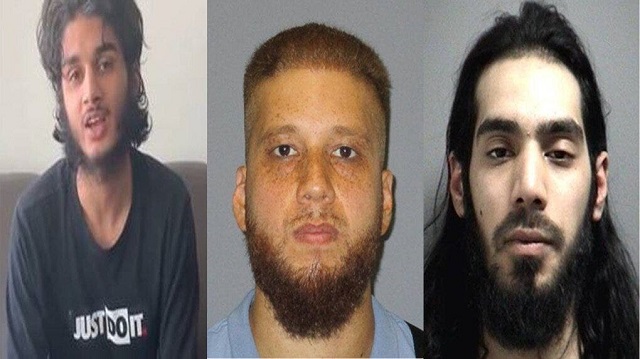
Three assailants await sentencing in the Chicken Land shooting |
|
It was a murder trial like no other. During the trial, a suspected Islamic terrorist who according to testimony pledged loyalty to ISIS, sat next to me. The crime-scene photos were X-rated, the text messages between suspects obscene, and the police work so superb that nearly every move of the defendants was accounted for. |
|
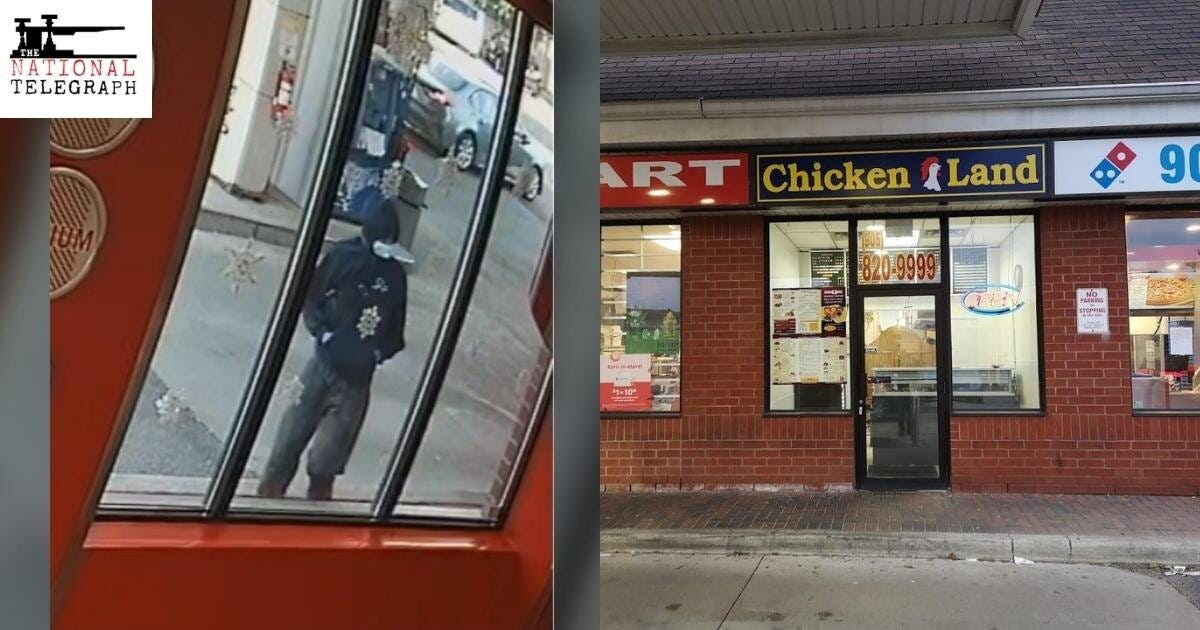
In the end, the jury found all three men guilty in a shooting spree meant to eliminate an entire family at their takeout restaurant, Chicken Land, in Mississauga just outside Toronto. One young man died on the spot. The others survived, including one man shot through the neck and another in the chest. |
|
It was an unprecedented crime in Canada, an entire family targeted for execution at their workplace, but the trial was also extraordinary for something else. On the opening day, Crown prosecutor David D’Iorio rose to say that the three men — with others — had established a home-grown terrorist cell affiliated with ISIS, the Islamic State. One of the Chicken Land family members had learned about it and had mused that he might tell the police. In ISIS logic, that meant he and his family had to go. |
“An extreme crime with an extremist motive,” co-prosecutor Brian McGuire called it. Of the other terrorist cell members, said to number between 10 and 12, all that was mentioned was that the RCMP is pursuing an ongoing investigation, another astonishing detail presumably meaning they still walk among us. Well, not presumably. At one point in the trial, text messages from one of the defendants showed that he sent money to his brother in Pakistan for jihad — Islamic terrorism. The brother, now back in Canada, sometimes sat next to me in court. The three convicted killers are: Naqash Abbasi, 34, the organizer; Suliman Raza, 28, the getaway driver; and Anand Nath, 23, the shooter. All were found equally guilty of first-degree murder and five counts of attempted murder. 
They were running a business near Toronto’s Pearson International Airport that involved a warehouse that doubled as a mosque and dawa centre, a place for inviting non-Muslims to Islam. The shooter was a convert. The young family member killed at Chicken Land, Naim Akl, had gone to work for the men and had also converted. When Akl discovered the ISIS connection, he left Islam and returned to the family restaurant. The trial imparted details I thought would never come to light. Three years had passed since the shootings, a long time. I suspected a plea bargain was being negotiated to avoid police and prosecutors being labelled “Islamophobic,” a made-up notion pushed internationally by the Muslim Brotherhood and nationally by the National Council of Canadian Muslims (NCCM). The police and prosecutors would also have had other reasons not to push ahead. The accused men were clearly dangerous, willing to wipe out a family to try to keep a secret. The Crown’s star witness, who knew the three men, asked for and received witness protection, likely including relocation and a new identity. Two bodyguards escorted him to and from court on the days he testified. Courageously and brilliantly, however, the prosecutors brought the case to trial, and the lead investigators from Peel Regional Police sat with them every day in open court. The question now is whether, with their terrorism case, the RCMP will do the same. The date for sentencing the three killers has yet to be set, but first-degree murder carries a mandatory life sentence with no possibility of parole for 25 years. I am writing a book with the working title, The Chicken Land Shootings: A Crime Within a Crime.
|



From the Daily Caller News Foundation
A woman who survived the Hanukkah terrorist attack at Bondi Beach in Australia said on Monday that police officers seemed less concerned about stopping the attack than they were about keeping her from fighting back.
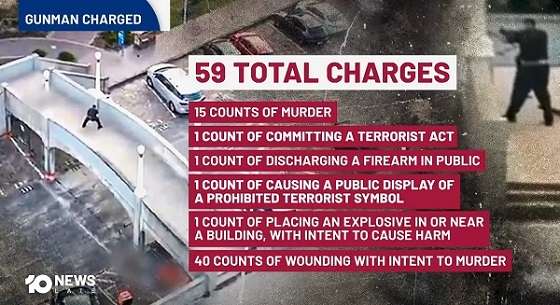
A father and son of Pakistani descent opened fire on a Hanukkah celebration Sunday, killing at least 15 people and wounding 40, with one being slain on the scene by police and the other wounded and taken into custody. Vanessa Miller told Erin Molan about being separated from her three-year-old daughter during Monday’s episode of the “Erin Molan Show.”
“I tried to grab one of their guns,” Miller said. “Another one grabbed me and said ‘no.’ These men, these police officers, they know who I am. I hope they are hearing this. You are weak. You could have saved so many more people’s lives. They were just standing there, listening and watching this all happen, holding me back.”
Dear Readers:
As a nonprofit, we are dependent on the generosity of our readers.
Please consider making a small donation of any amount here.
Thank you!
WATCH:
“Two police officers,” Miller continued. “Where were the others? Not there. Nobody was there.”
New South Wales Minister of Police Yasmin Catley did not immediately respond to a request for comment from the Daily Caller News Foundation about Miller’s comments.
Australian Prime Minister Anthony Albanese vowed to enact further restrictions on guns in response to the attack at Bondi Beach, according to the Associated Press. The new restrictions would include a limit on how many firearms a person could own, more review of gun licenses, limiting the licenses to Australian citizens and “additional use of criminal intelligence” to determine if a license to own a firearm should be granted.
Sajid Akram, 50, and Naveed Akram, 24, reportedly went to the Philippines, where they received training prior to carrying out the Sunday attack, according to the Australian Broadcasting Corporation. Naveed Akram’s vehicle reportedly had homemade ISIS flags inside it.
Australia passed legislation that required owners of semi-automatic firearms and certain pump-action firearms to surrender them in a mandatory “buyback” following a 1996 mass shooting in Port Arthur, Tasmania, that killed 35 people and wounded 23 others. Despite the legislation, one of the gunmen who carried out the attack appeared to use a pump-action shotgun with an extended magazine.
Crime
The Uncomfortable Demographics of Islamist Bloodshed—and Why “Islamophobia” Deflection Increases the Threat

Addressing realities directly is the only path toward protecting communities, confronting extremism, and preventing further loss of life, Canadian national security expert argues.
After attacks by Islamic extremists, a familiar pattern follows. Debate erupts. Commentary and interviews flood the media. Op-eds, narratives, talking points, and competing interpretations proliferate in the immediate aftermath of bloodshed. The brief interval since the Bondi beach attack is no exception.
Many of these responses condemn the violence and call for solidarity between Muslims and non-Muslims, as well as for broader societal unity. Their core message is commendable, and I support it: extremist violence is horrific, societies must stand united, and communities most commonly targeted by Islamic extremists—Jews, Christians, non-Muslim minorities, and moderate Muslims—deserve to live in safety and be protected.
Yet many of these info-space engagements miss the mark or cater to a narrow audience of wonks. A recurring concern is that, at some point, many of these engagements suggest, infer, or outright insinuate that non-Muslims, or predominantly non-Muslim societies, are somehow expected or obligated to interpret these attacks through an Islamic or Muslim-impact lens. This framing is frequently reinforced by a familiar “not a true Muslim” narrative regarding the perpetrators, alongside warnings about the risks of Islamophobia.
These misaligned expectations collide with a number of uncomfortable but unavoidable truths. Extremist groups such as ISIS, Al-Qaeda, Hamas, Hezbollah, and decentralized attackers with no formal affiliations have repeatedly and explicitly justified their violence through interpretations of Islamic texts and Islamic history. While most Muslims reject these interpretations, it remains equally true that large, dynamic groups of Muslims worldwide do not—and that these groups are well prepared to, and regularly do, use violence to advance their version of Islam.
Islamic extremist movements do not, and did not, emerge in a vacuum. They draw from the broader Islamic context. This fact is observable, persistent, and cannot be wished or washed away, no matter how hard some may try or many may wish otherwise.
Given this reality, it follows that for most non-Muslims—many of whom do not have detailed knowledge of Islam, its internal theological debates, historical divisions, or political evolution—and for a considerable number of Muslims as well, Islamic extremist violence is perceived as connected to Islam as it manifests globally. This perception persists regardless of nuance, disclaimers, or internal distinctions within the faith and among its followers.
THE COST OF DENIAL AND DEFLECTION
Denying or deflecting from these observable connections prevents society from addressing the central issues following an Islamic extremist attack in a Western country: the fatalities and injuries, how the violence is perceived and experienced by surviving victims, how it is experienced and understood by the majority non-Muslim population, how it is interpreted by non-Muslim governments responsible for public safety, and how it is received by allied nations. Worse, refusing to confront these difficult truths—or branding legitimate concerns as Islamophobia—creates a vacuum, one readily filled by extremist voices and adversarial actors eager to poison and pollute the discussion.
Following such attacks, in addition to thinking first of the direct victims, I sympathize with my Muslim family, friends, colleagues, moderate Muslims worldwide, and Muslim victims of Islamic extremism, particularly given that anti-Muslim bigotry is a real problem they face. For Muslim victims of Islamic extremism, that bigotry constitutes a second blow they must endure. Personal sympathy, however, does not translate into an obligation to center Muslim communal concerns when they were not the targets of the attack. Nor does it impose a public obligation or override how societies can, do, or should process and respond to violence directed at them by Islamic extremists.
As it applies to the general public in Western nations, the principle is simple: there should be no expectation that non-Muslims consider Islam, inter-Islamic identity conflicts, internal theological disputes, or the broader impact on the global Muslim community, when responding to attacks carried out by Islamic extremists. That is, unless Muslims were the victims, in which case some consideration is appropriate.
Quite bluntly, non-Muslims are not required to do so and are entitled to reject and push back against any suggestion that they must or should. Pointedly, they are not Muslims, a fact far too many now seem to overlook.
The arguments presented here will be uncomfortable for many and will likely provoke polarizing discussion. Nonetheless, they articulate an important, human-centered position regarding how Islamic extremist attacks in Western nations are commonly interpreted and understood by non-Muslim majority populations.
Non-Muslims are free to give no consideration to Muslim interests at any time, particularly following an Islamic extremist attack against non-Muslims in a non-Muslim country. The sole exception is that governments retain an obligation to ensure the safety and protection of their Muslim citizens, who face real and heightened threats during these periods. This does not suggest that non-Muslims cannot consider Muslim community members; it simply affirms that they are under no obligation to do so.
The impulse for Muslims to distance moderate Muslims and Islam from extremist attacks—such as the targeting of Jews in Australia or foiled Christmas market plots in Poland and Germany—is understandable.
Muslims do so to protect their own interests, the interests of fellow Muslims, and the reputation of Islam itself. Yet this impulse frequently collapses into the “No True Scotsman” fallacy, pointing to peaceful Muslims as the baseline while asserting that the attackers were not “true Muslims.”
Such claims oversimplify the reality of Islam as it manifests globally and fail to address the legitimate political and social consequences that follow Islamic extremist attacks in predominantly non-Muslim Western societies. These deflections frequently produce unintended effects, such as strengthening anti-Muslim extremist sentiments and movements and undermining efforts to diminish them.
The central issue for public discourse after an Islamic extremist attack is not debating whether the perpetrators were “true” or “false” Muslims, nor assessing downstream impacts on Muslim communities—unless they were the targets.
It is a societal effort to understand why radical ideologies continue to emerge from varying—yet often overlapping—interpretations of Islam, how political struggles within the Muslim world contribute to these ideologies, and how non-Muslim-majority Western countries can realistically and effectively confront and mitigate threats related to Islamic extremism before the next attack occurs and more non-Muslim and Muslim lives are lost.
Addressing these realities directly is the only path toward protecting communities, confronting extremism, and preventing further loss of life.
Ian Bradbury, a global security specialist with over 25 years experience, transitioned from Defence and NatSec roles to found Terra Nova Strategic Management (2009) and 1NAEF (2014). A TEDx, UN, NATO, and Parliament speaker, he focuses on terrorism, hybrid warfare, conflict aid, stability operations, and geo-strategy.
The Bureau is a reader-supported publication.
To receive new posts and support my work, consider becoming a free or paid subscriber.


Western Campuses Help Build China’s Digital Dragnet With U.S. Tax Funds, Study Warns
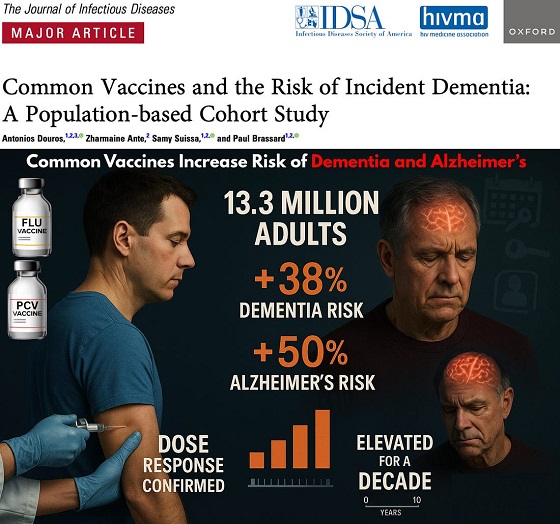
Common Vaccines Linked to 38-50% Increased Risk of Dementia and Alzheimer’s

Trump DOJ seeks to quash Pfizer whistleblower’s lawsuit over COVID shots

Alberta introducing three “all-season resort areas” to provide more summer activities in Alberta’s mountain parks
-
 Community2 days ago
Charitable giving on the decline in Canada
-
 Business1 day ago
Canada’s recent economic growth performance has been awful
-
 Alberta1 day ago
Canada’s New Green Deal
-
 armed forces1 day ago
Ottawa’s Newly Released Defence Plan Crosses a Dangerous Line
-
 Alberta1 day ago
Alberta’s huge oil sands reserves dwarf U.S. shale
-
 Health1 day ago
Saskatchewan woman approved for euthanasia urged to seek medical help in Canada rather than US
-
 Business1 day ago
COP30 finally admits what resource workers already knew: prosperity and lower emissions must go hand in hand
-
 Health1 day ago
Canadian gov’t considers sharing census data on gender-confused children