
Frontier Centre for Public Policy
The Worrisome Wave of Politicized Prosecutions

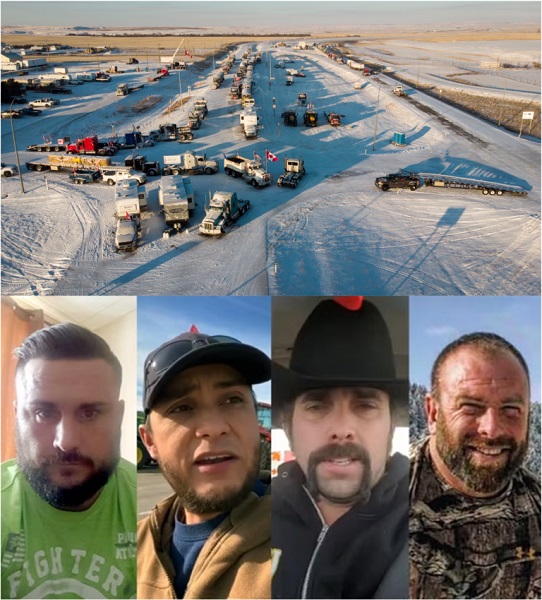

Unusual punishment: The 2022 truckers’ protest at the Coutts, Alberta border crossing (top) led to charges against four men (bottom left to right), Chris Carbert, Tony Olienick, Jerry Morin and Chris Lysak; Morin and Lysak were held in custody for almost two years while the other two are still in prison. (Sources of photos: (top) The Canadian Press/Jeff Mcintosh; (bottom) CBC)
From the C2C Journal
By Gwyn Morgan
Shaping criminal charges, bail decisions or prison sentences around an accused person’s political or religious beliefs is utterly odious – a hallmark of tinpot tyrannies and totalitarian hellholes. Such practices have no place in any constitutional nation, let alone a mature democracy that presents itself as a model to the world. But that is increasingly the situation in Canada, writes Gwyn Morgan. Comparing the treatment of protesters accused of minor infractions to those of incorrigible criminals who maim and kill, Morgan finds a yawning mismatch that suggests political motivations are increasingly a factor in today’s criminal justice system.
On January 29, 2022, a small convoy of trucks headed down to the U.S. border crossing at Coutts, Alberta to join in the nationwide protests against the Covid-19 vaccine mandate that the Justin Trudeau government had recently imposed on cross-border truckers – the very people Trudeau had previously described as “heroes” for delivering food and other essentials in the depths of the pandemic. Joined by many locals in pickup trucks and farm machinery, the truckers’ border protest turned into a full-scale blockade that would last 17 days. Just as it appeared to be settling into an extended stalemate, heavily armed police tactical teams swooped down upon several locations and arrested 14 protesters, charging four with the ominous crimes of conspiracy to commit murder (of police officers), mischief, a raft of weapons offences and uttering threats. These were bewildering accusations given the overall context of the event.

As the blockade almost instantly dissolved given that none of the protesters wanted to be linked to potentially violent offenders, the four men – Chris Lysak, Jerry Morin, Chris Carbert and Tony Olienick – were locked away. Lysak and Morin spent 723 days – nearly two years – in pre-trial custody, 74 of which Morin was kept in solitary confinement. Finally, after their new lawyer, Daniel Song, filed a Charter of Rights and Freedoms application demanding that the courts re-examine the case, the Crown suddenly accepted a plea deal on much lesser firearms charges. One month ago – on February 6 – Morin and Lysak were abruptly released. But they had already served the equivalent of a typical sentence for a serious crime in Canada – manslaughter or assault, say. Hard-working tradesmen with young families, Morin and Lysak will never get those two years back. Carbert and Olienick remain in prison and still face the full raft of charges; their trial is to begin in May.
Contrast this with the recent case of a mother and daughter – Carolann Robillard and Sara Miller, 11 – who were fatally stabbed in a horrific random attack outside an Edmonton school. Their accused killer, Muorater Arkangelo Mashar, had a long criminal record of assaults, assault with a weapon and robbery; he had been released from custody 18 days prior to the murders. Such events are no longer exceptions in Canada’s criminal justice system. They’re not cases of someone “falling through the cracks” – getting out due to a glitch or individual act of incompetence. They are routine. This is how things are now done in Canada. Vancouver police, for example, catch and release the same criminal offenders over and over, sometimes close to 100 times, because they always make bail.
By contrast, the four Coutts protesters were repeatedly denied bail despite having no criminal records. For this reason, social media users raised the possibility that they were, in effect, political prisoners being persecuted for having stood up so defiantly against the vaccine mandate and embarrassing Trudeau. Just a week or so following their arrests, over 3,000 km away on Parliament Hill, the Trudeau government moved against a peaceful protest that was breaking no significant laws other than, possibly, some municipal noise ordnances and parking bylaws. Police arrested and incarcerated four prominent protesters whom there was no credible basis to imprison and hold without bail. Of the four, Chris Barber was released within a day. Pat King and George Billings, however, were denied bail despite facing only minor mischief charges; they would spend months in jail. Billings eventually pled guilty to one charge and was released, while King’s trial has yet to begin.

Political prisoners: At the Freedom Convoy protest in Ottawa (top), police arrested (bottom left to right) Chris Barber, Pat King and George Billings; Barber was released but King and Billings were denied bail despite facing only minor mischief charges. (Sources of photos: (top) Maksim Sokolov (Maxergon), licensed under CC BY-SA 4.0; (bottom left) Public Order Emergency Commission; (bottom middle) Calgary Herald; (bottom right) The South Peace News)
Section 515 of the Criminal Code of Canada covers Judicial Interim Release – the formal term for bail – and states in part: “…the justice shall, unless a plea of guilty by the accused is accepted, make a release order in respect of that offence, without conditions, unless the prosecutor, having been given a reasonable opportunity to do so, shows cause, in respect of that offence, why the detention of the accused in custody is justified or why an order under any other provision of this section should be made.” The Criminal Code also specifies that bail should be granted with the fewest conditions possible and should consider the person’s background, criminal record and any threat their release might pose to the public.
Lich spent two weeks in jail and was then released under strict and stifling bail conditions that went beyond what is typically imposed even on accused bank robbers or murderers, including a prohibition against using social media and orders not to communicate with anyone associated with the convoy. That summer, the Justice Centre for Constitutional Freedoms selected Lich as the 2022 recipient of its annual George Jonas Freedom Award “in recognition of her outstanding dedication to the cause of freedom.” At the awards ceremony in Toronto, Lich was photographed with another person associated with the convoy. She was then rearrested in Alberta, handcuffed and shackled, and flown back to Ottawa. She spent another 30 days in prison before again being released on bail after a different judge ruled that there had been “no significant interaction” at the awards ceremony – though the judge did not strike any of the oppressive bail conditions themselves.

Convoy organizer Tamara Lich, a Métis grandmother from Alberta, was put in solitary confinement on charges of mischief and “intimidation” then released with draconian bail restrictions; she was later re-arrested after a gala in Toronto (right) and sent back to jail for 30 days. (Sources of photos: (left) X; (right) Facebook/Stacey Kauder)
Around the same time, Randall McKenzie, a habitual offender charged with weapons violations and assaulting a police officer, was set free with no conditions other than periodically reporting to his parole officer. On December 27, 2022, Ontario Provincial Police Constable Greg Pierzchala was murdered in an ambush-style attack; McKenzie and his girlfriend stand accused of the horrific crime. Again, such events now occur with sickening regularity. Just three months previously, habitual violent offender Myles Sanderson went on one of Canada’s worse-ever rampages, stabbing 10 people to death, including his own brother, and wounding another 18 on the James Smith Cree Nation in Saskatchewan. Over the years Sanderson had racked up the impossible-sounding total of 125 criminal charges plus numerous parole violations, but had been again let out because a parole board member deemed he “will not present an undue risk to society.”

In stark contrast to the treatment of freedom protesters, hardened criminals such as (left to right) Muorater Arkangelo Mashar, Randall McKenzie and Myles Sanderson have been routinely set free with no enforcement of their bail conditions, and then go on to commit more horrific crimes. (Sources of photos: (left to right) Global News; The Hamilton Spectator; CBC)
Whether or not there has been direct political interference, Canada’s justice system is no longer entirely trustworthy. Just two months after the forcible takedown of the Ottawa protests, no less a figure than Richard Wagner, Chief Justice of the Supreme Court of Canada, described the Freedom Convoy protest as “the beginning of anarchy where some people have decided to take other citizens hostage.” It was a grotesque exaggeration, but it wasn’t all that Canada’s highest-ranked impartial jurist had to say. “Forced blows against the state, justice and democratic institutions like the one delivered by protesters,” he declared, “should be denounced with force by all figures of power in the country.” Who outside a dictatorship even talks that way?

Supreme Court Chief Justice Richard Wagner speaks during a welcoming ceremony, Thursday, October 28, 2021 in Ottawa. THE CANADIAN PRESS/Adrian Wyld
Lich’s trial, together with that of convoy co-organizer Barber, finally began last September in the Ontario Court of Justice. It was expected to finish by mid-October but has been taking much longer. After adjourning in December, it resumed in January but was interrupted again after one day. Further hearings are to be held this week. The completion date is uncertain due to limited court time and the tenacious, tireless defence by the formidable Lawrence Greenspon, which appears to have rattled the prosecution.
Tamara Lich, Pat King, George Billings, Chris Lysak, Jerry Morin, Chris Carbert and Tony Olienick have spent a cumulative total of more than 3,200 days in jail – nearly 9 years – and this total will climb further because two of them remain in prison awaiting trial. Meanwhile, Canada’s bail laws continue to allow violent habitual offenders loose after just a few days in custody, while the parole system leaks like a poisonous sieve.
One of the cornerstones separating a democracy from a dictatorship is the prohibition of government interference in the judicial process. But in 2013, the then-aspiring political leader Justin Trudeau stated, “There is a level of admiration I actually have for China[’s]…basic dictatorship.” Even worse, Trudeau named China as the government he admired most in the world. Since then, Canadians have been given reason to believe he meant this literally.


Frontier Centre for Public Policy
Canada Lets Child-Porn Offenders Off Easy While Targeting Bible Believers

From the Fr0ntier Centre for Public Policy
By Lee Harding
Judges struck down one-year minimum prison sentences for child pornography possession. Meanwhile, the chair of the Parliamentary Human Rights Committee publicly stated that religious scriptures condemning homosexuality are “hateful.” Lee Harding says the 1982 Charter has led to an inversion of Canadian values.
Light sentences for child-porn possession collide with federal signals that biblical texts could be prosecuted as hate
Was Canada’s 1982 Charter meant to condemn the Bible as hate literature or to weaken sentencing for child pornography? Like it or not, that is the direction post-Charter Canada is moving.
For Halloween, the black-robed justices at the Supreme Court of Canada ruled that a one-year mandatory sentence for accessing or possessing child sexual abuse materials amounted to “cruel and unusual punishment.” The judgment upheld a similar ruling from the Quebec Court of Appeal.
A narrow 5-4 majority leaned on a hypothetical. If an 18-year-old received a sexually explicit image from a 17-year-old girlfriend, that image would technically be child porn. If prosecuted, the recipient could face a one-year minimum sentence. On that basis, the judges rejected the entire minimum sentence law.
But the real case before them was far more disturbing. Two Quebec men possessed images and videos that were clearly the result of abuse. One had 317 unique images of child porn, with 90 per cent showing girls aged three to six years old forced into penetration and sodomy by adults or other minors. The other had 531 images and 274 videos of girls aged five to 10 engaged in sexual acts, including anal and vaginal penetration and, in some cases, multiple children.
The sentences were light. The first offender received 90 days of intermittent imprisonment, served concurrently, plus 24 months of probation. The second received nine months of imprisonment and the same probation period. How is this acceptable?
The judgment did not emerge without warning. Daniel A. Lang, a Liberal campaign chair appointed to the Senate by Lester B. Pearson, saw this coming more than 40 years ago. On April 23, 1981, he expressed concerns that the new Constitution could be used to erode basic decency laws. He pointed to the U.S. experience and predicted that Canada could face a wave of cases challenging laws on “obscenity, pornography and freedom of speech,” leading to the “negation of federal or provincial legislation.”
His warning has come true. If Parliament wants to restore mandatory minimum sentences, it can do so by passing a new law that removes the obscure scenario judges used to strike them down. Section 33, the notwithstanding clause, gives elected officials the power to override court rulings for up to five years at a time.
This reflects Canada’s own system. In the British tradition Canada inherited, Parliament—not the courts—is the ultimate authority. British common law developed over centuries through conventions and precedents shaped by elected lawmakers. Section 33 protects that balance by ensuring Parliament can still act when judges disagree.
There is a democratic check as well. If a government uses Section 33 and voters believe it made the wrong call, they can remove that government at the next election. A new government can then follow the judges’ views or let the old law expire after five years. That accountability is precisely why Section 33 strengthens democracy rather than weakening it.
Yet today, Ottawa is working to limit that safeguard. In September, the Carney Liberals asked the Supreme Court to rule on new limits to how legislatures can use Section 33. Five premiers wrote to Carney to oppose the move. Former Newfoundland and Labrador premier Brian Peckford, the last living signatory to the agreement that produced the 1982 Constitution Act, has also condemned the attempt as wrongful.
The judges will likely approve the new limits. Why would they refuse a chance to narrow the one tool elected governments have to get around their rulings? For decades, the Supreme Court has made a habit of striking down laws, telling Parliament it is wrong and forcing political change.
And while minimum sentences for child-porn offenders fall, the Carney cabinet is focused on something else entirely: prosecuting Bible believers for alleged hate.
The quiet part was said out loud by Montreal lawyer Marc Miller, former minister of immigration and citizenship and chair of the Parliamentary Human Rights Committee. On Oct. 30, he told the committee, “In Leviticus, Deuteronomy, Romans, there’s other passages, there’s clear hatred towards, for example, homosexuals.”
The former minister added, “There should perhaps be discretion for prosecutors to press charges … [T]here are clearly passages in religious texts that are clearly hateful.”
That is the former minister’s view. Instead of Bible thumpers, we now have Charter thumpers who use their “sacred” document to justify whatever interpretation suits their cause and wield it against their ideological opponents. When wokeness hardens into dogma, disagreement becomes heresy. And we know what happens to heretics.
A country that lets child-porn offenders off easy while it hunts down Bible believers for fines and possible prison has lost its way. Most Canadians would reject this trade-off, but their rulers do not, whether in cabinet or on the judges’ bench. A dark shadow is settling over the country.
Lee Harding is a research fellow for the Frontier Centre for Public Policy

From the Frontier Centre for Public Policy
New script, same budget playbook. Nothing in the Carney budget breaks from the Trudeau years
Prime Minister Mark Carney’s first budget talks reform but delivers the same failed spending habits that defined the Trudeau years.
While speaking in the language of productivity, infrastructure and capital formation, the diction of grown-up economics, it still follows the same spending path that has driven federal budgets for years. The message sounds new, but the behaviour is unchanged.
Time will tell, to be fair, but it feels like more rhetoric, and we have seen this rhetoric lead to nothing before.
The government insists it has found a new path, one where public investment leads private growth. That sounds bold. However, it is more a rebranding than a reform. It is a shift in vocabulary, not in discipline. The government’s assumptions demand trust, not proof, and the budget offers little of the latter.
Former prime ministers Jean Chrétien and Paul Martin did not flirt with restraint; they executed it. Their budget cuts were deep, restored credibility, and revived Canada’s fiscal health when it was most needed. Ottawa shrank so the country could grow. Budget 2025 tries to invoke their spirit but not their actions. The contrast shows how far this budget falls short of real reform.
Former prime minister Stephen Harper, by contrast, treated balanced budgets as policy and principle. Even during the global financial crisis, his government used stimulus as a bridge, not a way of life. It cut taxes widely and consistently, limited public service growth and placed the long-term burden on restraint rather than rhetoric. Carney’s budget nods toward Harper’s focus on productivity and capital assets, yet it rejects the tax relief and spending controls that made his budgets coherent.
Then there is Justin Trudeau, the high tide of redistribution, vacuous identity politics and deficit-as-virtue posturing. Ottawa expanded into an ideological planner for everything, including housing, climate, childcare, inclusion portfolios and every new identity category.
The federal government’s latest budget is the first hint of retreat from that style. The identity program fireworks are dimmer, though they have not disappeared. The social policy boosterism is quieter. Perhaps fiscal gravity has begun to whisper in the prime minister’s ear.
However, one cannot confuse tone for transformation.
Spending still rises at a pace the government cannot justify. Deficits have grown. The new fiscal anchor, which measures only day-to-day spending and omits capital projects and interest costs, allows Ottawa to present a balanced budget while still adding to the deficit. The budget relies on the hopeful assumption that Ottawa’s capital spending will attract private investment on a scale economists politely describe as ambitious.
The housing file illustrates the contradiction. New funding for the construction of purpose-built rentals and a larger federal role in modular and subsidized housing builds announced in the budget is presented as a productivity measure, yet continues the Trudeau-era instinct to centralize housing policy rather than fix the levers that matter. Permitting delays, zoning rigidity, municipal approvals and labour shortages continue to slow actual construction. These barriers fall under provincial and municipal control, meaning federal spending cannot accelerate construction unless those governments change their rules. The example shows how federal spending avoids the real obstacles to growth.
Defence spending tells the same story. Budget 2025 offers incremental funding and some procurement gestures, but it avoids the core problem: Canada’s procurement system is broken. Delays stretch across decades. Projects become obsolete before contracts are signed. The system cannot buy a ship, an aircraft or an armoured vehicle without cost overruns and missed timelines. The money flows, but the forces do not get the equipment they need.
Most importantly, the structural problems remain untouched: no regulatory reform for major projects, no tax-competitiveness agenda and no strategy for shrinking a federal bureaucracy that has grown faster than the economy it governs. Ottawa presides over a low-productivity country but insists that a new accounting framework will solve what decades of overregulation and policy clutter have created. The budget avoids the hard decisions that make countries more productive.
From an Alberta vantage, the pivot is welcome but inadequate. The economy that pays for Confederation receives more rhetorical respect, yet the same regulatory thicket that blocks pipelines and mines remains intact. The government praises capital formation but still undermines the key sectors that generate it.
Budget 2025 tries to walk like Chrétien and talk like Harper while spending like Trudeau. That is not a transformation. It is a costume change. The country needed a budget that prioritized growth rooted in tangible assets and real productivity. What it got instead is a rhetorical turn without the courage to cut, streamline or reform.
Canada does not require a new budgeting vocabulary. It requires a government willing to govern in the country’s best interests.
Marco Navarro-Genie is vice-president of research at the Frontier Centre for Public Policy and co-author with Barry Cooper of Canada’s COVID: The Story of a Pandemic Moral Panic (2023).


Death by a thousand clicks – government censorship of Canada’s internet

Chinese Billionaire Tried To Build US-Born Baby Empire As Overseas Elites Turn To American Surrogates

Politicians should be honest about environmental pros and cons of electric vehicles

Viral TikTok video shows 7-year-old cuddling great-grandfather before he’s euthanized
-
Censorship Industrial Complex1 day ago
Death by a thousand clicks – government censorship of Canada’s internet
-
Daily Caller1 day ago
Chinese Billionaire Tried To Build US-Born Baby Empire As Overseas Elites Turn To American Surrogates
-
Great Reset1 day ago
Viral TikTok video shows 7-year-old cuddling great-grandfather before he’s euthanized
-
Automotive1 day ago
Politicians should be honest about environmental pros and cons of electric vehicles
-
 Digital ID24 hours ago
Canada releases new digital ID app for personal documents despite privacy concerns
-
 Alberta1 day ago
Schools should go back to basics to mitigate effects of AI
-
 Community21 hours ago
Charitable giving on the decline in Canada
-
 Bruce Dowbiggin23 hours ago
NFL Ice Bowls Turn Down The Thermostat on Climate Change Hysteria