
Alberta
NATO reps say U.S., Canada oil and gas critical for energy security

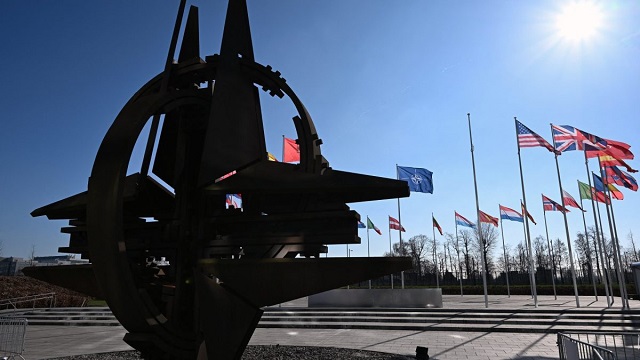

Outside NATO headquarters ahead of a flag-raising ceremony for Sweden’s accession to NATO, in Brussels on February 27, 2024. Getty Images photo
From the Canadian Energy Centre
‘The traditional energy system will not disappear in a day’
Canada and the United States now produce more oil and gas than anywhere else on Earth, including the Middle East, according to a new report by S&P Global.
This blanket of energy security extends beyond borders and is “a powerful card to play” in increasingly unstable times, researchers wrote.
They found that without oil and gas produced in the U.S. and Canada – which has more than doubled since 2008 – North America, Europe and the rest of the world would have been “notably more vulnerable” following Russia’s invasion of Ukraine in 2022.
The ‘massive social impact’ of energy insecurity
Energy insecurity is all too familiar for Lithuanian Juljius Grubliauskas, who works for the North Atlantic Treaty Alliance (NATO).
Growing up, he was on hand when the Soviet Union weaponized energy in an attempt to topple Lithuania’s fledgling independence.
“I remember clearly from my childhood in 1990 when the Russians cut off energy supplies to try to break the resolve of the Lithuanians, [and] that affected the daily lives of every citizen,” Grubliauskas told a recent webinar hosted by the Toronto-based Institute for Peace and Diplomacy.
“Having a lack of energy has a massive social impact and massive cascading effects like prices immediately jumping, massive inflation and such,” he said.
“Today obviously many things have changed and the energy landscape looks much different, but the principle that energy is closely linked to national security and the independence of nations to make their decisions still remains true.”
North America’s role in NATO energy supply
Formed following the second world war, NATO represents 31 nations in Europe and North America in shared collective defense where an attack on one is seen as an attack on all.
NATO is finalizing a strategic plan for its energy future as the world seeks to reduce emissions, focusing primarily on secure access for military forces, Grubliauskas said.
Oil and gas from North America play a critical role, said Brussels-based NATO energy security policy expert Can Ögütcü.
“We need to be sure that we’re going to have security of supply of production in the U.S. and in Canada,” he said.

“We have last one import supplier, the Russians, [and] we are in the transition to perhaps also lose another big supplier, the Middle East Gulf countries, as maritime routes become more and more insecure.”
Critical North American energy integration
While Canadian oil and gas exports currently go almost exclusively to the U.S., once they enter the integrated pipeline system, they can become so-called “re-exports” from U.S. Gulf Coast to overseas markets.
At the end last year, the U.S. imported more oil from Canada than ever before, according to the U.S. Energy Information.
At the same time, America exported a record 11.5 million barrels per day of oil and petroleum products, and a record 709 billion cubic feet of natural gas.
“North American energy integration, things like the Enbridge Line 3 pipeline and the Keystone pipeline are absolutely crucial pieces of infrastructure, not just for the energy security of North America but also increasingly for the energy security of NATO allies,” said Joseph Calnan, energy security analyst with the Canadian Global Affairs Institute.
“The traditional energy system will not disappear in a day. Climate change of course makes it imperative that we do reduce our emissions globally but the role of Canada in the short term and medium term, I believe, is to firm up this traditional energy system.
“While Canada has a major role to play in future energy technologies, the current energy technologies are in my opinion, the priority.”
Canada can do more
Canada has not done enough to improve world energy security, said Heather Exner-Pirot, a senior fellow with the Macdonald-Laurier Institute.
“In the wake of Russia’s invasion, Canada has not stepped up and there is risk on all sides from depending too much on OPEC, or Qatar or Russia, but also too much on the United States,” she said, referencing the U.S. decision to pause approvals of new liquefied natural gas (LNG) export projects.
“We can do much more shipping on the East Coast. There are projects that were in the pipeline that have been rejected by the federal government and by provincial governments that could be going to Europe. Obviously on the West Coast is more promising.”
Major projects slated to start up soon like the Trans Mountain expansion and LNG Canada terminal will grow global access to Canadian oil and gas, primarily in the Indo Pacific region, Calnan noted.
“I think we’ll see that Canada has a much larger role to play in the total global market, which will have a stepwise influence on the situation in Europe,” he said.

From Melissa Lantsman
Turns out the anti-development wing of the Liberal Party never stopped running the show.
Today, we’ll see if the Liberals vote for the pipeline they just finished bragging about.
Spoiler: they won’t. Because with the Liberals, the announcements are real, but the results never are.
Alberta
Premier Smith: Canadians support agreement between Alberta and Ottawa and the major economic opportunities it could unlock for the benefit of all

From Energy Now
By Premier Danielle Smith
Get the Latest Canadian Focused Energy News Delivered to You! It’s FREE: Quick Sign-Up Here
If Canada wants to lead global energy security efforts, build out sovereign AI infrastructure, increase funding to social programs and national defence and expand trade to new markets, we must unleash the full potential of our vast natural resources and embrace our role as a global energy superpower.
The Alberta-Ottawa Energy agreement is the first step in accomplishing all of these critical objectives.
Recent polling shows that a majority of Canadians are supportive of this agreement and the major economic opportunities it could unlock for the benefit of all Canadians.
As a nation we must embrace two important realities: First, global demand for oil is increasing and second, Canada needs to generate more revenue to address its fiscal challenges.
Nations around the world — including Korea, Japan, India, Taiwan and China in Asia as well as various European nations — continue to ask for Canadian energy. We are perfectly positioned to meet those needs and lead global energy security efforts.
Our heavy oil is not only abundant, it’s responsibly developed, geopolitically stable and backed by decades of proven supply.
If we want to pay down our debt, increase funding to social programs and meet our NATO defence spending commitments, then we need to generate more revenue. And the best way to do so is to leverage our vast natural resources.
At today’s prices, Alberta’s proven oil and gas reserves represent trillions in value.
It’s not just a number; it’s a generational opportunity for Alberta and Canada to secure prosperity and invest in the future of our communities. But to unlock the full potential of this resource, we need the infrastructure to match our ambition.
There is one nation-building project that stands above all others in its ability to deliver economic benefits to Canada — a new bitumen pipeline to Asian markets.
The energy agreement signed on Nov. 27 includes a clear path to the construction of a one-million-plus barrel-per-day bitumen pipeline, with Indigenous co-ownership, that can ensure our province and country are no longer dependent on just one customer to buy our most valuable resource.
Indigenous co-ownership also provide millions in revenue to communities along the route of the project to the northwest coast, contributing toward long-lasting prosperity for their people.
The agreement also recognizes that we can increase oil and gas production while reducing our emissions.
The removal of the oil and gas emissions cap will allow our energy producers to grow and thrive again and the suspension of the federal net-zero power regulations in Alberta will open to doors to major AI data-centre investment.
It also means that Alberta will be a world leader in the development and implementation of emissions-reduction infrastructure — particularly in carbon capture utilization and storage.
The agreement will see Alberta work together with our federal partners and the Pathways companies to commence and complete the world’s largest carbon capture, utilization and storage infrastructure project.
This would make Alberta heavy oil the lowest intensity barrel on the market and displace millions of barrels of heavier-emitting fuels around the globe.
We’re sending a clear message to investors across the world: Alberta and Canada are leaders, not just in oil and gas, but in the innovation and technologies that are cutting per barrel emissions even as we ramp up production.
Where we are going — and where we intend to go with more frequency — is east, west, north and south, across oceans and around the globe. We have the energy other countries need, and will continue to need, for decades to come.
However, this agreement is just the first step in this journey. There is much hard work ahead of us. Trust must be built and earned in this partnership as we move through the next steps of this process.
But it’s very encouraging that Prime Minister Mark Carney has made it clear he is willing to work with Alberta’s government to accomplish our shared goal of making Canada an energy superpower.
That is something we have not seen from a Canadian prime minister in more than a decade.
Together, in good faith, Alberta and Ottawa have taken the first step towards making Canada a global energy superpower for benefit of all Canadians.
Danielle Smith is the Premier of Alberta


Media bound to pay the price for selling their freedom to (selectively) offend

Sometimes An Ingrate Nation Pt. 2: The Great One Makes His Choice

Recent price declines don’t solve Toronto’s housing affordability crisis

From Exception to Routine. Why Canada’s State-Assisted Suicide Regime Demands a Human-Rights Review
-
 COVID-192 days ago
University of Colorado will pay $10 million to staff, students for trying to force them to take COVID shots
-
 Bruce Dowbiggin2 days ago
Integration Or Indignation: Whose Strategy Worked Best Against Trump?
-
 espionage2 days ago
Western Campuses Help Build China’s Digital Dragnet With U.S. Tax Funds, Study Warns
-
 Bruce Dowbiggin2 days ago
Wayne Gretzky’s Terrible, Awful Week.. And Soccer/ Football.
-
 Agriculture2 days ago
Canada’s air quality among the best in the world
-
 Business1 day ago
Canada invests $34 million in Chinese drones now considered to be ‘high security risks’
-
 Health2 days ago
CDC Vaccine Panel Votes to End Universal Hep B Vaccine for Newborns
-
 Business2 days ago
The EU Insists Its X Fine Isn’t About Censorship. Here’s Why It Is.