
armed forces
Trudeau government has spent $10 million promoting DEI in the military as recruitment flounders

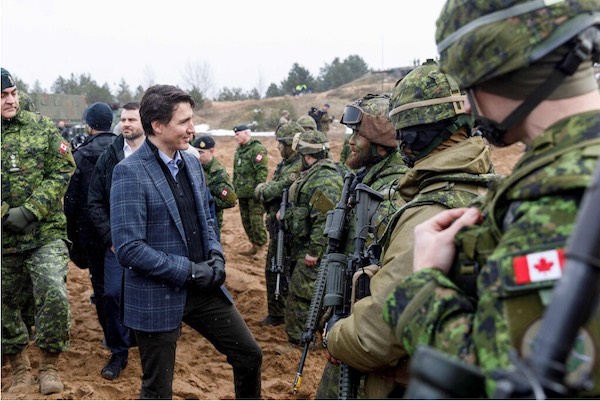
From LifeSiteNews
“These are not Canadian values of freedom and democracy. These are cancel culture values of censorship, of authoritarianism, of radical ideologies that are alien to our culture.”
Canada’s Department of National Defence has spent nearly $10 million on so-called diversity, equity and inclusion programs since Prime Minister Justin Trudeau took office in 2015.
According to records released May 7 by Blacklock’s Reporter, the Department of National Defence has paid consultants and contractors $9,510,247 to promote “equity and inclusion” within the military.
“It is clear a lack of diversity in the Canadian Armed Forces is just one of the issues confronting this government,” a 2021 briefing note claimed. “National Defence is committed to building an inclusive and modern defence team that reflects Canada’s diversity, values and culture.”
The spending was disclosed in the House of Commons in response to Conservative MP Cheryl Gallant’s question: “What is the total value of contracts relating to diversity, equity and inclusion services in the Department of National Defence since 2015?”
According to the records, Canadians’ tax dollars were spent on polls, guest speakers, presentations, workshops, and LGBT flags. The workshops covered topics including ” the gendered nature of security,” while one talk discussed “integrating gender and diversity perspectives.”
In 2021, the defence department revealed that they have two separate committees and eight programs which worked to appoint gay advisors to “innovate” religious instruction and gender-neutral uniforms.
Since Trudeau took office, the Canadian military has become increasingly woke and has been forcing LGBT ideology on its personnel. Interestingly, at the same time, military recruitment has plummeted.
In June, the Canadian military was criticized for “raising the pride flag” in honor of the “2SLGBTQI+ communities.”
That same month, Canadian troops in Latvia were forced to purchase their own helmets and food when the Trudeau government failed to provide proper supplies. Weeks later, Trudeau lectured the same troops on “climate change” and disinformation.
In November, officials admitted that the nation’s military is shrinking to dangerously low numbers as Trudeau continues to push the LGBT agenda on Canadian soldiers. In addition to low recruitment, the military is struggling to retain soldiers.
A Canadian Armed Force member previously told LifeSiteNews that between the COVID vaccine mandates and pushing the LGBT agenda, Canadians soldiers have lost confidence in the military.
“And it’s not stopping with the gender ideology; it’s going to include medical assistance in dying,” he added. “There’s something fundamentally changing. And for most people, it doesn’t sit well with them.”
He explained that the new ideologies are driving away new recruits, as the primary source of recruitment for the military is Saskatchewan farm boys who want to serve Canada – not radical left-wing ideologies.
“That farm boy looks at the army and with the blue hair and the face, piercings and ideologies and all that stuff,” he said. “And it doesn’t have the same pull because it doesn’t represent the farm boy’s values.”
“This is not the Canada that we signed up to defend. It’s an alien ideology that people don’t resonate with,” he continued. “These are not Canadian values of freedom and democracy. These are cancel culture values of censorship, of authoritarianism, of radical ideologies that are alien to our culture.”
In January, a Commanding Officer of the 4th Canadian Division Support Group (CDSG) of the Greater Toronto Area Detachment threatened soldiers who dared to throw out tampon dispensers which had been placed in men’s bathrooms as part of the military’s new “inclusion” policy.


And we all pay when the dancing ends
How to explain Mark Carney’s obsession with Europe and his lack of attention to Canada’s economy and an actual budget?
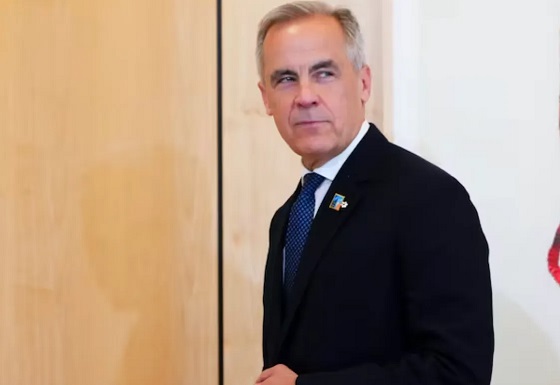
Carney’s pirouette through NATO meetings, always in his custom-tailored navy blue power suits, carries the desperate whiff of an insecure, small-town outsider who has made it big but will always yearn for old-money credibility. Canada is too young a country, too dynamic and at times a bit too vulgar to claim equal status with Europe’s formerly magnificent and ancient cultures — now failed under the yoke of globalism.
Hysterical foreign policy, unchecked immigration, burgeoning censorship and massive income disparity have conquered much of the continent that many of us used to admire and were even somewhat intimidated by. But we’ve moved on. And yet Carney seems stuck, seeking approval and direction from modern Europe — a place where, for most countries, the glory days are long gone.
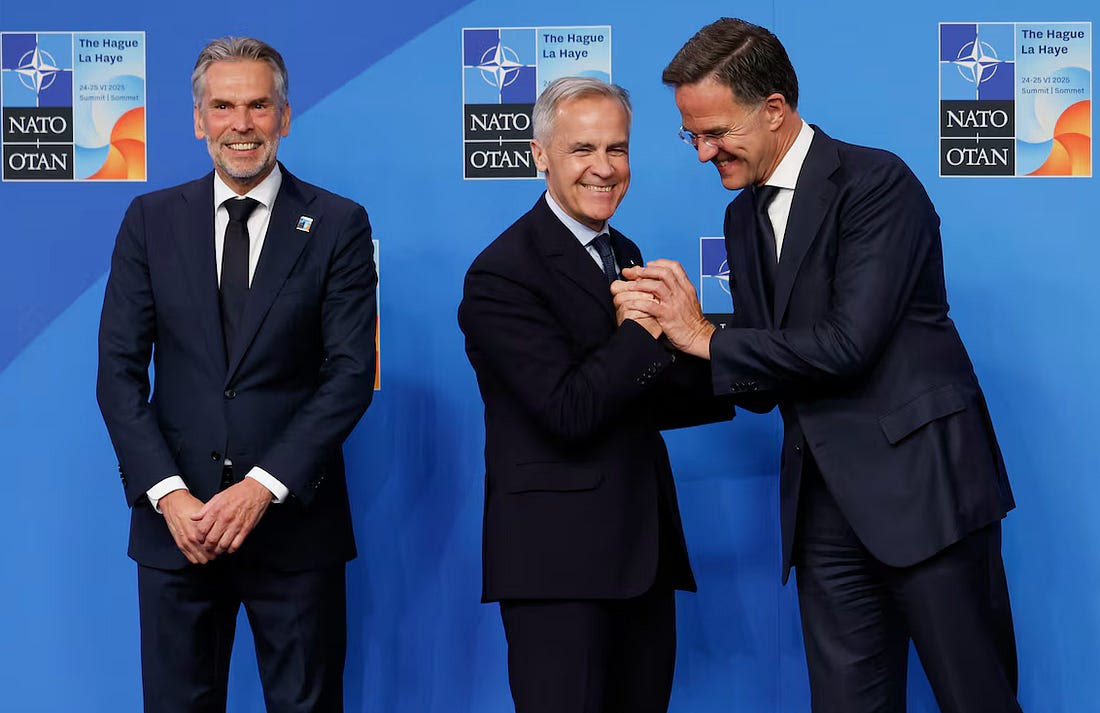
Carney’s irresponsible financial commitment to NATO is a reckless and unnecessary expenditure, given that many Canadians are hurting. But it allowed Carney to pick up another photo of himself glad-handing global elites to whom he just sold out his struggling citizens.
 |
From the Globe and Mail
“Prime Minister Mark Carney has committed Canada to the biggest increase in military spending since the Second World War, part of a NATO pledge designed to address the threat of Russian expansionism and to keep Donald Trump from quitting the Western alliance.
Mr. Carney and the leaders of the 31 other member countries issued a joint statement Wednesday at The Hague saying they would raise defence-related spending to the equivalent of 5 per cent of their gross domestic product by 2035.
NATO Secretary-General Mark Rutte said the commitment means “European allies and Canada will do more of the heavy lifting” and take “greater responsibility for our shared security.”
For Canada, this will require spending an additional $50-billion to $90-billion a year – more than doubling the existing defence budget to between $110-billion and $150-billion by 2035, depending on how much the economy grows. This year Ottawa’s defence-related spending is due to top $62-billion.”
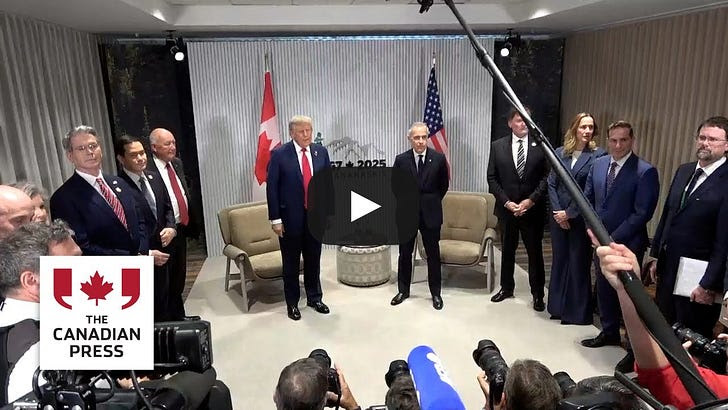
You’ll note that spending money we don’t have in order to keep President Trump happy is hardly an elbows up moment, especially given that the pledge followed Carney’s embarrassing interactions with Trump at the G7. I’m all for diplomacy but sick to my teeth of Carney’s two-faced approach to everything. There is no objective truth to anything our prime minister touches. Watch the first few minutes of the video below.
The portents are bad. This from the Globe:
We are poorer than we think. Canadians running their retirement numbers are shining light in the dark corners of household finances in this country. The sums leave many “anxious, fearful and sad about their finances,” according to a Healthcare of Ontario Pension Plan survey recently reported in these pages.
Fifty-two per cent of us worry a lot about our personal finances. Fifty per cent feel frustrated, 47 per cent feel emotionally drained and 43 per cent feel depressed. There is not one survey indicator to suggest Canadians have made financial progress in 2025 compared with 2024.
The video below is a basic “F”- you to Canadians from a Prime Minister who smirks and roles his eyes when questioned about his inept money management.
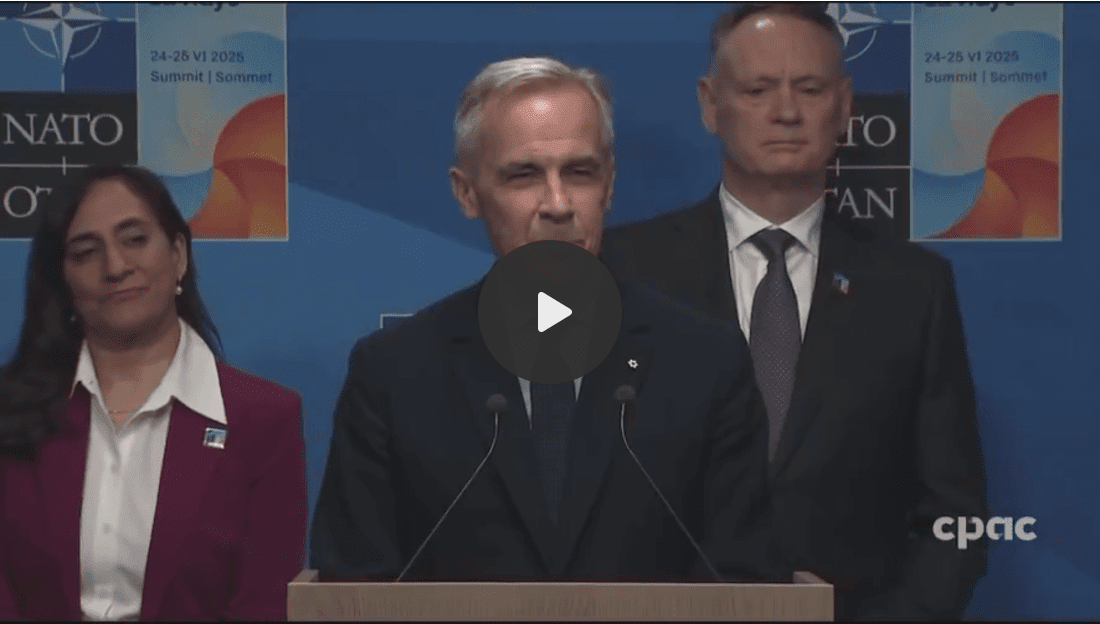
He did spill the beans to CNN with this unsettling revelation about the staggering numbers we are talking about:
Signing on to NATO’s new defence spending target could cost the federal treasury up to $150 billion a year, Prime Minister Mark Carney said Tuesday in advance of the Western military alliance’s annual summit.
The prime minister made the comments in an interview with CNN International.
“It is a lot of money,” Carney said.
This guy was a banker?
We are witnessing the political equivalent of a vain woman who blows her entire paycheque to look good for an aspirational event even though she can’t afford food or rent. Yes, she sparkled for a moment, but in reality her domaine is crumbling. All she has left are the photographs of her glittery night. Our Prime Minister is collecting his own album of power-proximity photos he can use to wallpaper over his failures as our economy collapses.
The glass slipper doesn’t fit.
Trish Wood is Critical is a reader-supported publication.
To receive new posts and support my work, consider becoming a free or paid subscriber.
Invite your friends and earn rewards
From the Fraser Institute
By Jake Fuss and Grady Munro
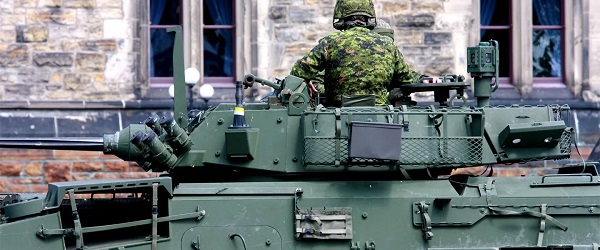
To reach 2 per cent of GDP this year, the federal government is committing an additional $9.3 billion towards the military budget. Moreover, to reach 3.5 per cent of GDP by 2035, it’s estimated the government will need to raise yearly spending by an additional $50 billion—effectively doubling the annual defence budget from $62.7 billion to approximately $110 billion.
As part of this year’s NATO summit, Canada and its allies committed to increase annual military spending to reach 5 per cent of gross domestic product (GDP) by 2035. While this commitment—and the government’s recent push to meet the previous spending target of 2 per cent of GDP—are important steps in fulfilling Canada’s obligations to the alliance, there are major challenges the federal government will need to overcome to execute these plans.
Since 2014, members of the North Atlantic Treaty Organization (NATO) have committed to spend at least 2 per cent of GDP (a measure of overall economic output) on national defence. Canada had long-failed to fulfill this commitment, to the ire of our allies, until the Carney government recently announced a $9.3 billion boost to defence spending (up to a total of $62.7 billion) that will get us to 2 per cent of GDP during the 2025/26 fiscal year.
However, just as Canada reached the old target, the goal posts have now moved. As part of the 2025 NATO summit, alliance members (including Canada) committed to reach an increased spending target of 5 per cent of GDP in 10 years. The new target is made up of two components: core military spending equivalent to 3.5 per cent of GDP, and another 1.5 per cent of GDP for other defence-related spending.
National defence is a core function of the federal government and the Carney government deserves credit for prioritizing its NATO commitments given that past governments of different political stripes have failed to do so. Moreover, the government is ensuring that Canada remains in step with its allies in an increasingly dangerous world.
However, there are major challenges that arise once you consider how the government will execute these commitments.
First, both the announcement that Canada will reach 2 per cent of GDP in military spending this fiscal year, and the future commitment to spend up to 3.5 per cent of GDP on defence by 2035, represent major fiscal commitments that Canada’s budget cannot simply absorb in its current state.
To reach 2 per cent of GDP this year, the federal government is committing an additional $9.3 billion towards the military budget. Moreover, to reach 3.5 per cent of GDP by 2035, it’s estimated the government will need to raise yearly spending by an additional $50 billion—effectively doubling the annual defence budget from $62.7 billion to approximately $110 billion. However, based on the last official federal fiscal update, the federal government already plans to run an annual deficit this year—meaning it spends more than it collects in revenue—numbering in the tens of billions, and will continue running large deficits for the foreseeable future.
Given this poor state of finances, the government is left with three main options to fund increased military spending: raise taxes, borrow the money, or cut spending in other areas.
The first two options are non-starters. Canadian families already struggle under a tax burden that sees them spend more on taxes than on food, shelter, and clothing combined. Moreover, raising taxes inhibits economic growth and the prosperity of Canadians by reducing the incentives to work, save, invest, or start a business.
Borrowing the money to fund this new defence spending will put future generations of Canadians in a precarious situation. When governments borrow money and accumulate debt (total federal debt is expected to reach $2.3 trillion in 2025-26), the burden of this debt falls squarely on the backs of Canadians—likely in the form of higher taxes in the future. Put differently, each dollar we borrow today must be paid back by more than a dollar in higher taxes tomorrow.
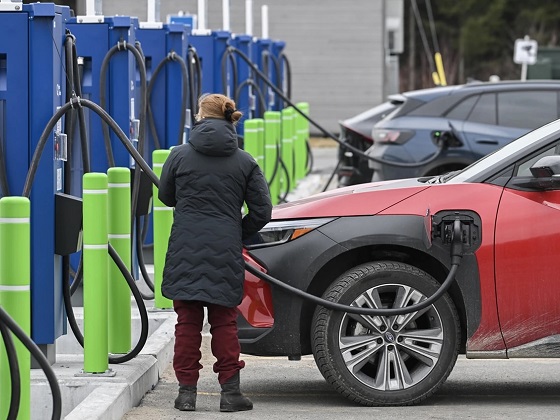
This leaves cutting spending elsewhere as the best option, but one that requires the government to substantially readjusts its priorities. The federal government devotes considerable spending towards areas that are not within its core responsibilities and which shouldn’t have federal involvement in the first place. For instance, the previous government launched three major initiatives to provide national dental care, national pharmacare and national daycare, despite the fact that all three areas fall squarely under provincial jurisdiction. Instead of continuing to fund federal overreach, the Carney government should divert spending back to the core function of national defence. Further savings can be found by reducing the number of bureaucrats, eliminating corporate welfare, dropping electric vehicle subsidies, and many other mechanisms.
There is a fourth option by which the government could fund increased defence spending, which is to increase the economic growth rate within Canada and enjoy higher overall revenues. The problem is Canada has long-suffered a weak economy that will remain stagnant unless the government fundamentally changes its approach to tax and regulatory policy.
Even if the Carney government is able to successfully adjust spending priorities to account for new military funding, there are further issues that may inhibit money from being spent effectively.
It is a well-documented problem that military spending in Canada is often poorly executed. A series of reports from the auditor general in recent years have highlighted issues with the readiness of Canada’s fighter force, delays in supplying the military with necessary materials (e.g. spare parts, uniforms, or rations), as well as delays in delivering combat and non-combat ships needed to fulfill domestic and international obligations. All three of these cases represent instances in which poor planning and issues with procurement and supply chains) are preventing government funding from translating into timely and effective military outcomes.
The Carney government has recently made major commitments to increase military funding to fulfill Canada’s NATO obligations. While this is a step in the right direction, it’s not enough to simply make the commitments, the government must execute them as well.

Jake Fuss
Director, Fiscal Studies, Fraser Institute

Grady Munro
Policy Analyst, Fraser Institute
Repeal the EV mandate, Mr. Carney
The Oil Price Spike That Didn’t Happen
Quebec bans gender-confused inmates from requesting prison of their choice
World Economic Forum Aims to Repair Relations with Schwab
Carney’s Digital Tax Debacle: How Ottawa Triggered a Trade Fallout with Washington
Israeli media report claims Netanyahu and Trump agreed to end Gaza hostilities
Carney’s Bill C-5 will likely make things worse—not better
-
 International2 days ago
CBS settles with Trump over doctored 60 Minutes Harris interview
-
 Crime1 day ago
Bryan Kohberger avoids death penalty in brutal killing of four Idaho students
-
 Business2 days ago
Why it’s time to repeal the oil tanker ban on B.C.’s north coast
-
 Energy1 day ago
If Canada Wants to be the World’s Energy Partner, We Need to Act Like It
-
 Alberta1 day ago
Pierre Poilievre – Per Capita, Hardisty, Alberta Is the Most Important Little Town In Canada
-
 MxM News1 day ago
UPenn strips Lia Thomas of women’s swimming titles after Title IX investigation
-
 Business2 days ago
Latest shakedown attempt by Canada Post underscores need for privatization
-
 COVID-191 day ago
Top COVID doctor given one of Canada’s highest honors