
armed forces
State of federal finances make NATO spending target very challenging

From the Fraser Institute
By Jake Fuss and Grady Munro
Defence Minister Bill Blair recently claimed the federal government could “absolutely” achieve the North Atlantic Treaty Organization (NATO) defence spending target of 2.0 per cent of gross domestic product (GDP—a measure of the size of the economy) by 2027. However, the dismal state of Canada’s finances makes this accelerated timeline very costly to Canadians.
First, some background. In 2014, Canada (along with the other NATO members) formally pledged to increase spending on defence up to a target of 2.0 per cent of GDP by 2024. At the time, Canada spent 1.01 per cent of GDP on defence. A decade has passed and Canada has failed to fulfill that pledge. Indeed, based on the current defence spending plan and the latest GDP projections, Canada’s defence spending is expected to reach just 1.34 per cent of GDP ($41.0 billion) in 2024/25.
Based on the latest spending estimates from NATO, Canada is one of only eight NATO members (out of 31 in total) to spend less than 2.0 per cent of GDP on defence. As the large majority of the alliance has now met the spending target, and President Donald Trump has called for the target to be raised even further to 5 per cent of GDP, Canada will have to dramatically increase defence spending (lest we be at complete odds with our allies).
However, meeting the NATO 2.0 per cent target by 2027/28 would require billions more in annual federal spending (see the following figure).Over the next three years, according to the Parliamentary Budget Officer (PBO), the federal government will increase defence spending from a projected $41.0 billion in 2024/25 to $53.5 billion in 2027/28—with the majority of this increase occurring in the first year. This means, based on the current plan, Canada’s defence spending would only reach 1.55 per cent of GDP by 2027/28.

To reach 2.0 per cent of GDP in 2027/28, the government would need to spend $68.8 billion on defence during that fiscal year. Assuming the initial jump remains the same, this implies the government would need to increase annual defence spending by $16.5 billion from 2025/26 to 2027/28—$15.3 billion more than currently planned.
The federal government plans to run four consecutive budget deficits from 2024/25 to 2027/28 that add up to $151.9 billion in expected borrowing. In other words, the government already plans to spend more than it collects in revenues. Assuming the government adopts the spending plan shown in the above figure, reaching the NATO target by 2027/28 would require an additional $22.7 billion in borrowing.
Increasing the amount borrowed will impose substantial costs on Canadians. In the near-term it results in higher debt interest payments. Government must pay interest on its debt—same as a family with a mortgage—and rising interest costs leave less money available for programs and services. For perspective, largely due to past borrowing under the Trudeau government, federal debt interest payments are expected to equal all Goods and Services Tax (GST) revenues (and then some) in 2024/25. Longer-term, an increase in borrowed money will also burden future generations of taxpayers who will likely face higher taxes to pay for today’s spending.
Clearly, borrowing money to fund higher defence spending will only worsen the state of federal finances, meaning Canada is in a lose-lose situation when it comes to meeting the NATO 2.0 per cent target—risk the consequences of further disappointing our allies or take on billions more in debt.
Instead, Ottawa should identify and cut wasteful spending and use those savings for national defence. Simply put, smaller and smarter government spending could help get Canada out of this lose-lose situation.

Jake Fuss
Director, Fiscal Studies, Fraser Institute

Grady Munro
Policy Analyst, Fraser Institute


From the Frontier Centre for Public Policy
By Lt. Gen. (Ret.) Michel Maisonneuve
Canada’s military is broken, and unless Ottawa backs its spending with real reform, we’re just playing politics with national security
Prime Minister Mark Carney’s surprise pledge to meet NATO’s defence spending target is long overdue, but without real reform, leadership and a shift away from bureaucracy and social experimentation, it risks falling short of what the moment demands.
Canada committed in 2014 to spend two per cent of its gross national product on defence—a NATO target meant to ensure collective security and more equitable burden-sharing. We never made it past 1.37 per cent, drawing criticism from allies and, in my view, breaching our obligation. Now, the prime minister says we’ll hit the target by the end of fiscal year 2025-26. That’s welcome news, but it comes with serious challenges.
Reaching the two per cent was always possible. It just required political courage. The announced $9 billion in new defence spending shows intent, and Carney’s remarks about protecting Canadians are encouraging. But the reality is our military readiness is at a breaking point. With global instability rising—including conflicts in Ukraine and the Middle East—Canada’s ability to defend its territory or contribute meaningfully to NATO is under scrutiny. Less than half of our army vehicles, ships and aircraft are currently operational.
I’m told the Treasury Board has already approved the new funds, making this more than just political spin. Much of the money appears to be going where it’s most needed: personnel. Pay and benefit increases for serving members should help with retention, and bonuses for re-enlistment are reportedly being considered. Recruiting and civilian staffing will also get a boost, though I question adding more to an already bloated public service. Reserves and cadet programs weren’t mentioned but they also need attention.
Equipment upgrades are just as urgent. A new procurement agency is planned, overseen by a secretary of state—hopefully with members in uniform involved. In the meantime, accelerating existing projects is a good way to ensure the money flows quickly. Restocking ammunition is a priority. Buying Canadian and diversifying suppliers makes sense. The Business Council of Canada has signalled its support for a national defence industrial strategy. That’s encouraging, but none of it will matter without follow-through.
Infrastructure is also in dire shape. Bases, housing, training facilities and armouries are in disrepair. Rebuilding these will not only help operations but also improve recruitment and retention. So will improved training, including more sea days, flying hours and field operations.
All of this looks promising on paper, but if the Department of National Defence can’t spend funds effectively, it won’t matter. Around $1 billion a year typically lapses due to missing project staff and excessive bureaucracy. As one colleague warned, “implementation [of the program] … must occur as a whole-of-government activity, with trust-based partnerships across industry and academe, or else it will fail.”
The defence budget also remains discretionary. Unlike health transfers or old age security, which are legally entrenched, defence funding can be cut at will. That creates instability for military suppliers and risks turning long-term procurement into a political football. The new funds must be protected from short-term fiscal pressure and partisan meddling.
One more concern: culture. If Canada is serious about rebuilding its military, we must move past performative diversity policies and return to a warrior ethos. That means recruiting the best men and women based on merit, instilling discipline and honour, and giving them the tools to fight and, if necessary, make the ultimate sacrifice. The military must reflect Canadian values, but it is not a place for social experimentation or reduced standards.
Finally, the announcement came without a federal budget or fiscal roadmap. Canada’s deficits continue to grow. Taxpayers deserve transparency. What trade-offs will be required to fund this? If this plan is just a last-minute attempt to appease U.S. President Donald Trump ahead of the G7 or our NATO allies at next month’s summit, it won’t stand the test of time.
Canada has the resources, talent and standing to be a serious middle power. But only action—not announcements—will prove whether we truly intend to be one.
The NATO summit is over, and Canada was barely at the table. With global threats rising, Lt. Gen. (Ret.) Michel Maisonneuve joins David Leis to ask: How do we rebuild our national defence—and why does it matter to every Canadian? Because this isn’t just about security. It’s about our economy, our identity, and whether Canada remains sovereign—or becomes the 51st state.
Michel Maisonneuve is a retired lieutenant-general who served 45 years in uniform. He is a senior fellow at the Frontier Centre for Public Policy and author of In Defence of Canada: Reflections of a Patriot (2024).

And we all pay when the dancing ends
How to explain Mark Carney’s obsession with Europe and his lack of attention to Canada’s economy and an actual budget?
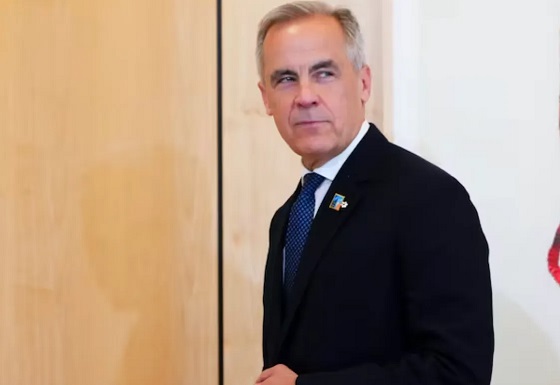
Carney’s pirouette through NATO meetings, always in his custom-tailored navy blue power suits, carries the desperate whiff of an insecure, small-town outsider who has made it big but will always yearn for old-money credibility. Canada is too young a country, too dynamic and at times a bit too vulgar to claim equal status with Europe’s formerly magnificent and ancient cultures — now failed under the yoke of globalism.
Hysterical foreign policy, unchecked immigration, burgeoning censorship and massive income disparity have conquered much of the continent that many of us used to admire and were even somewhat intimidated by. But we’ve moved on. And yet Carney seems stuck, seeking approval and direction from modern Europe — a place where, for most countries, the glory days are long gone.
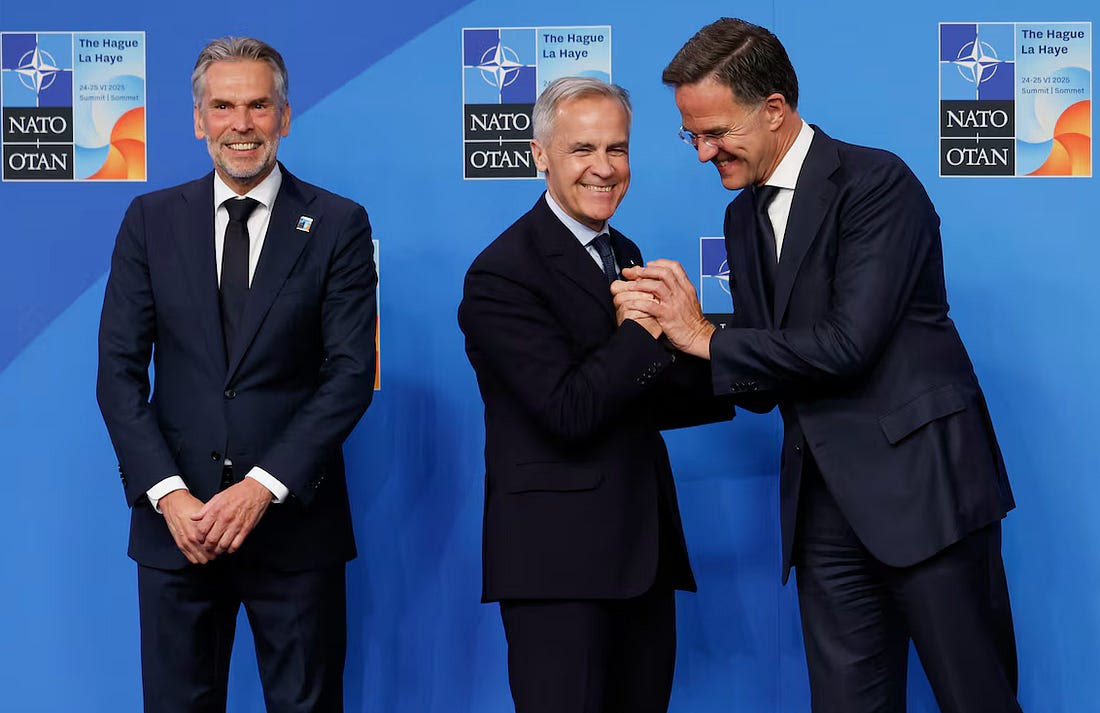
Carney’s irresponsible financial commitment to NATO is a reckless and unnecessary expenditure, given that many Canadians are hurting. But it allowed Carney to pick up another photo of himself glad-handing global elites to whom he just sold out his struggling citizens.
 |
From the Globe and Mail
“Prime Minister Mark Carney has committed Canada to the biggest increase in military spending since the Second World War, part of a NATO pledge designed to address the threat of Russian expansionism and to keep Donald Trump from quitting the Western alliance.
Mr. Carney and the leaders of the 31 other member countries issued a joint statement Wednesday at The Hague saying they would raise defence-related spending to the equivalent of 5 per cent of their gross domestic product by 2035.
NATO Secretary-General Mark Rutte said the commitment means “European allies and Canada will do more of the heavy lifting” and take “greater responsibility for our shared security.”
For Canada, this will require spending an additional $50-billion to $90-billion a year – more than doubling the existing defence budget to between $110-billion and $150-billion by 2035, depending on how much the economy grows. This year Ottawa’s defence-related spending is due to top $62-billion.”
You’ll note that spending money we don’t have in order to keep President Trump happy is hardly an elbows up moment, especially given that the pledge followed Carney’s embarrassing interactions with Trump at the G7. I’m all for diplomacy but sick to my teeth of Carney’s two-faced approach to everything. There is no objective truth to anything our prime minister touches. Watch the first few minutes of the video below.
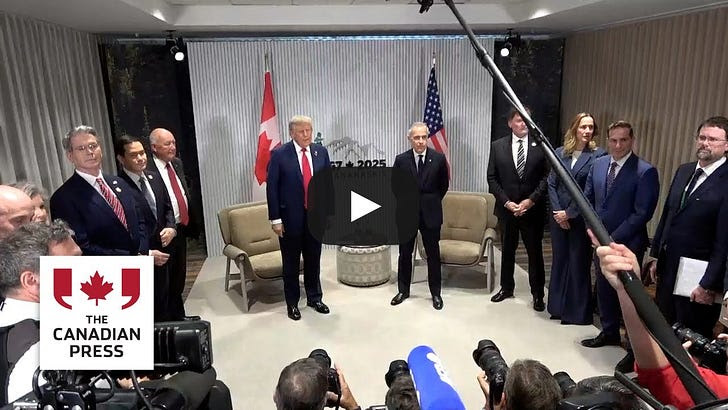
The portents are bad. This from the Globe:
We are poorer than we think. Canadians running their retirement numbers are shining light in the dark corners of household finances in this country. The sums leave many “anxious, fearful and sad about their finances,” according to a Healthcare of Ontario Pension Plan survey recently reported in these pages.
Fifty-two per cent of us worry a lot about our personal finances. Fifty per cent feel frustrated, 47 per cent feel emotionally drained and 43 per cent feel depressed. There is not one survey indicator to suggest Canadians have made financial progress in 2025 compared with 2024.
The video below is a basic “F”- you to Canadians from a Prime Minister who smirks and roles his eyes when questioned about his inept money management.
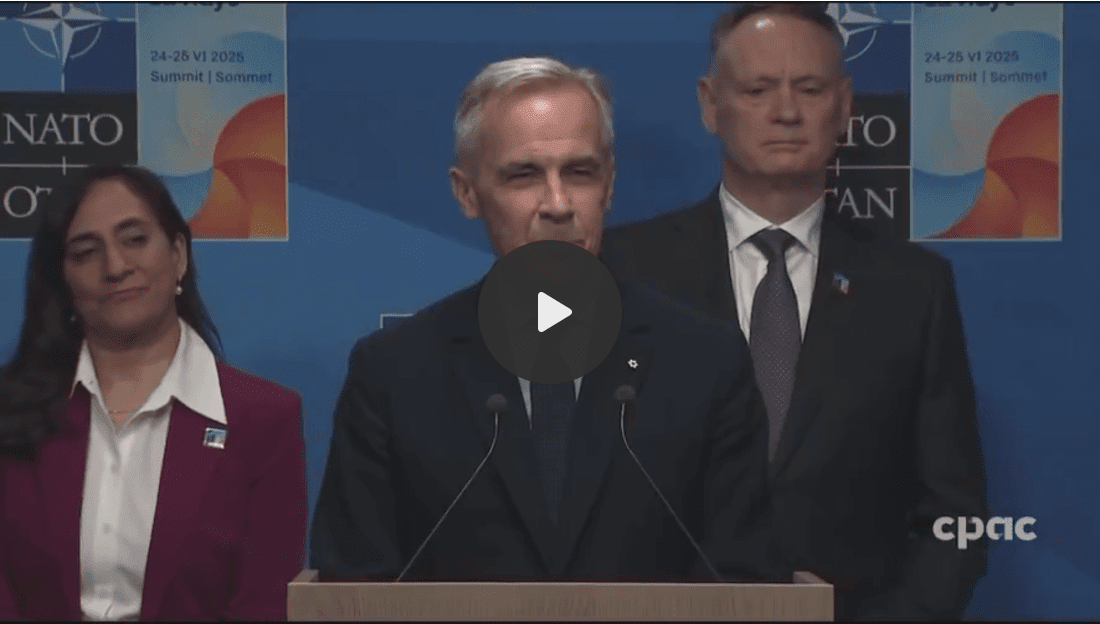
He did spill the beans to CNN with this unsettling revelation about the staggering numbers we are talking about:
Signing on to NATO’s new defence spending target could cost the federal treasury up to $150 billion a year, Prime Minister Mark Carney said Tuesday in advance of the Western military alliance’s annual summit.
The prime minister made the comments in an interview with CNN International.
“It is a lot of money,” Carney said.
This guy was a banker?
We are witnessing the political equivalent of a vain woman who blows her entire paycheque to look good for an aspirational event even though she can’t afford food or rent. Yes, she sparkled for a moment, but in reality her domaine is crumbling. All she has left are the photographs of her glittery night. Our Prime Minister is collecting his own album of power-proximity photos he can use to wallpaper over his failures as our economy collapses.
The glass slipper doesn’t fit.
Trish Wood is Critical is a reader-supported publication.
To receive new posts and support my work, consider becoming a free or paid subscriber.
Invite your friends and earn rewards
Power Struggle: Electric vehicles and reality
Elon Musk slams Trump’s ‘Big Beautiful Bill,’ calls for new political party

Alberta judge sides with LGBT activists, allows ‘gender transitions’ for kids to continue
China undermining American energy independence, report says
National Health Care Fraud Takedown Results in 324 Defendants Charged in Connection with Over $14.6 Billion in Alleged Fraud
Trump on Canada tariff deadline: ‘We can do whatever we want’

RFK Jr. Unloads Disturbing Vaccine Secrets on Tucker—And Surprises Everyone on Trump
-
armed forces1 day ago
Canada’s Military Can’t Be Fixed With Cash Alone
-
 Alberta1 day ago
COVID mandates protester in Canada released on bail after over 2 years in jail
-
 International1 day ago
Trump transportation secretary tells governors to remove ‘rainbow crosswalks’
-
 Business1 day ago
Canada’s loyalty to globalism is bleeding our economy dry
-
 Business1 day ago
Carney’s spending makes Trudeau look like a cheapskate
-
 Alberta1 day ago
Alberta Next: Alberta Pension Plan
-
 C2C Journal23 hours ago
Canada Desperately Needs a Baby Bump
-
 Alberta2 days ago
Alberta uncorks new rules for liquor and cannabis