
COVID-19
Court to hear Charter challenge to $5,000 ArriveCAN ticket


From the Justice Centre for Constitutional Freedoms
The Justice Centre for Constitutional Freedoms announces that a Notice of Constitutional Question has been filed in the ticket case of Elim Sly-Hooten. Mr. Sly-Hooten’s lawyers, provided by the Justice Centre, have requested a judicial pre-trial to schedule new times, and to agree on witnesses and procedures needed to make Charter arguments. The matter is scheduled to be heard on March 1, 2024, at 3:00 p.m. ET in Courtroom M4, 950 Burnhamthorpe Road West, Mississauga, Ontario. Mr. Sly-Hooten, who lives in British Columbia, returned to Canada from the Netherlands on July 30, 2022. He landed at Toronto’s Pearson International Airport. Once on the ground, he did not use the ArriveCAN app to disclose his Covid vaccination status. It is Mr. Sly-Hooten’s personal belief that this medical information should remain private. While overseas, Mr. Sly-Hooten tested positive for Covid. At Pearson International Airport, he provided Public Health Agency of Canada (PHAC) agents a certificate of recovery given to him by the Government of the Netherlands, proving he had natural immunity to Covid. Because he did not use the ArriveCAN app to disclose his vaccination status, however, Peel Regional Police and Public Health Agency of Canada (PHAC) personnel detained him. In custody, under pressure and without counsel, Mr. Sly-Hooten broke down and revealed his vaccination status. He received a $5,000 ticket for violating the Quarantine Act and was ordered to quarantine in his home for 14 days. At issue in the upcoming trial is whether the federal government can demand personal health information from someone just because they are at the border. Also, the relevance of vaccination status is questionable since it has been shown that vaccination does not affect infections or transmission; the vaccinated and unvaccinated transmit Covid at the same rate. Another issue is whether authorities can arbitrarily order people into detention. In his defense, Mr. Sly-Hooten cites his Charter section 7 right to liberty, his section 8 right to be protected from unreasonable search and seizure, his section 9 right to be free from arbitrary arrest and detention, and his section 10(b) right to counsel after arrest and detention. Mr. Sly-Hooten’s Notice of Constitutional Question follows the withdrawal of all charges in a similar ticket case. Scott Bennett received an ArriveCAN ticket for not using the app at the Pearson International Airport around the time Mr. Sly-Hooten received his, on July 12, 2022. Mr. Bennett joined with ten others who had been fined or ordered into quarantine for not using the ArriveCAN app to launch a legal challenge on August 24, 2022, commenced by lawyers provided by the Justice Centre. They wanted their tickets and detention declared unconstitutional. On September 30, 2022, a few weeks after the Justice Centre’s lawyers sued the federal government over the mandatory use of this app, the government discontinued the ArriveCAN app. The court then decided that the constitutional challenge, known as Yates v. Attorney General of Canada, was “moot” (no longer relevant). The court would not hear the case based on its view that, since the app had been discontinued, there was nothing for the court to decide. The court disregarded the fact that the government could bring back the policy at any time. The Federal Court upheld that decision on July 19, 2023, though the Court acknowledged that each person ticketed could raise Charter challenges when fighting their fines. In fact, the federal government itself suggested at the first court hearing that the proper place for a constitutional challenge was when individuals contested their tickets. Based on this, Mr. Bennett, with lawyers provided by the Justice Centre, filed a Notice of Constitutional Question in his case. But when his day in court came, on January 16, 2024, the federal government’s witness failed to appear, and the charges against Mr. Bennett were withdrawn.It is possible that Mr. Sly-Hooten’s trial could meet with a similar fate. Chris Fleury, lawyer for Mr. Sly-Hooten, stated, “The requirement for unvaccinated Canadians to lock themselves in their houses for 14 days following international travel was the height of the federal government’s unscientific and irrational response to Covid. By the summer of 2022, it was widely understood that the vaccines did not stop the spread of Covid, even among vaccinated individuals. Mr. Sly-Hooton’s detention in his own house was entirely arbitrary where it provided no public health or other benefit.”


From LifeSiteNews
A judge ruled that the Ontario Court of Justice is already ‘satisfied’ with Chris Barber’s sentence and taking away his very livelihood would be ‘disproportionate.’
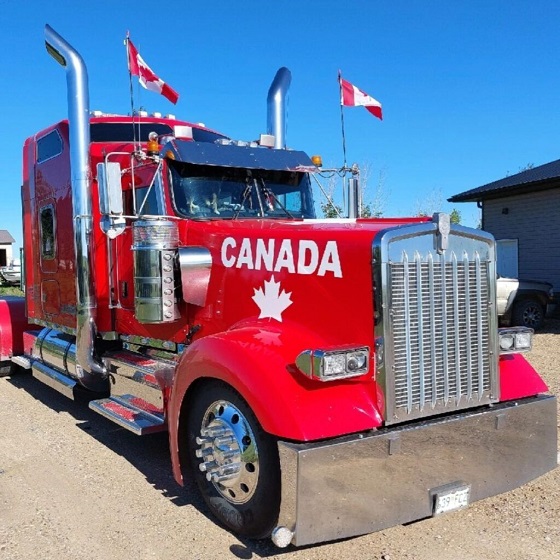
A Canadian judge has dismissed a demand from Canadian government lawyers to seize Freedom Convoy leader Chris Barber’s “Big Red” semi-truck.
On Friday, Ontario Court of Justice Judge Heather Perkins-McVey denied the Crown’s application seeking to forfeit Barber’s truck.
She ruled that the court is already “satisfied” with Barber’s sentence and taking away his very livelihood would be “disproportionate.”
“This truck is my livelihood,” said Barber in a press release sent to LifeSiteNews.
“Trying to permanently seize it for peacefully protesting was wrong, and I’m relieved the court refused to allow that to happen,” he added.
Criminal defense lawyer Marwa Racha Younes was welcoming of the ruling as well, stating, “We find it was the right decision in the circumstances and are happy with the outcome.”
John Carpay, president of the Justice Centre for Constitutional Freedoms (JCCF), said the decision is “good news for all Canadians who cherish their Charter freedom to assemble peacefully.”
READ: Freedom Convoy protester appeals after judge dismissed challenge to frozen bank accounts
“Asset forfeiture is an extraordinary power, and it must not be used to punish Canadians for participating in peaceful protest,” he added in the press release.
As reported recently by LifeSiteNews, the Canadian government claimed that Barber’s truck is an “offence-related property” relating to his involvement in the 2022 protests against Canada’s COVID mandates.
At this time, the court ruling ends any forfeiture proceedings for the time being, however Barber will continue to try and appeal his criminal conviction and house arrest sentence.
Barber’s truck, a 2004 Kenworth long-haul he uses for business, was a focal point in the 2022 protests. He drove it to Ottawa, where it was parked for an extended period of time, but he complied when officials asked him to move it.
On October 7, 2025, after a long trial, Ontario Court Justice Perkins-McVey sentenced Barber and Tamara Lich, the other Freedom Convoy leader, to 18 months’ house arrest. They had been declared guilty of mischief for their roles as leaders of the 2022 protest against COVID mandates, and as social media influencers.
Lich and Barber have filed appeals of their own against their house arrest sentences, arguing that the trial judge did not correctly apply the law on their mischief charges.
Government lawyers for the Crown have filed an appeal of the acquittals of Lich and Barber on intimidation charges.
The pair’s convictions came after a nearly two-year trial despite the nonviolent nature of the popular movement.

From LifeSiteNews
Protestor Evan Blackman’s legal team argues Trudeau’s Emergencies Act-based bank account freezes were punitive state action tied directly to protest participation.
A Freedom Convoy protester whose bank accounts were frozen by the Canadian government says a judge erred after his ruling did not consider the fact that the funds were frozen under the Emergencies Act, as grounds for a stay of proceedings.
In a press release sent out earlier this week, the Justice Centre for Constitutional Freedoms (JCCF) said that Freedom Convoy protestor Evan Blackman will challenge a court ruling in his criminal case via an appeal with the Ontario Superior Court of Justice.
“This case raises serious questions about how peaceful protest is treated in Canada and about the lasting consequences of the federal government’s unlawful use of the Emergencies Act,” noted constitutional lawyer Chris Fleury. “The freezing of protestors’ bank accounts was part of a coordinated effort to suppress dissent, and courts ought to be willing to scrutinize that conduct.”
Blackman was arrested on February 18, 2022, during the police crackdown on Freedom Convoy protests against COVID restrictions, which was authorized by the Emergencies Act (EA). The EA was put in place by former Prime Minister Justin Trudeau’s Liberal government, which claimed the protests were violent, despite no evidence that this was the case.
Blackman’s three bank accounts with TD Bank were frozen due to his participation in the Freedom Convoy, following a directive ordered by Trudeau.
As reported by LifeSiteNews, in November of this year, Blackman was convicted at his retrial even though he had been acquitted at his original trial. In 2023, Blackman’s “mischief” and “obstructing police” charges were dismissed by a judge due to lack of evidence and the “poor memory of a cop regarding key details of the alleged criminal offences.”
His retrial resulted in Blackman getting a conditional discharge along with 12 months’ probation and 122 hours of community service, along with a $200 victim fine surcharge.
After this, Blackman’s application for a stay of proceedings was dismissed by the court. He had hoped to have his stay of proceedings, under section 24(1) of the Charter of Rights and Freedoms, allowed. However, the judge ruled that the freezing of his bank accounts was legally not related to his arrest, and because of this, the stay of proceedings lacked standing.
The JCCF disagreed with this ruling, noting, it “stands in contrast to a Federal Court decision finding that the government’s invocation of the Emergencies Act was unreasonable and violated Canadians’ Charter rights, including those targeted by the financial measures used against Freedom Convoy protestors.”
As of press time, a hearing date has not been scheduled.
In 2024, Federal Court Justice Richard Mosley ruled that Trudeau was “not justified” in invoking the Emergencies Act.
In early 2022, the Freedom Convoy saw thousands of Canadians from coast to coast come to Ottawa to demand an end to COVID mandates in all forms. Despite the peaceful nature of the protest, Trudeau’s federal government enacted the EA in mid-February.
After the protesters were cleared out, which was achieved through the freezing of bank accounts of those involved without a court order as well as the physical removal and arrest of demonstrators, Trudeau revoked the EA on February 23, 2022.


Canada’s sudden rediscovery of energy ambition has been greeted with a familiar charge: hypocrisy

Paris Climate Deal Now Decade-Old Disaster

Chinese Billionaire Tried To Build US-Born Baby Empire As Overseas Elites Turn To American Surrogates

Canada Hits the Brakes on Population

Canadian gov’t considers sharing census data on gender-confused children
Brown University shooter dead of apparent self-inflicted gunshot wound
Major tax changes in 2026: Report
-
 Business2 days ago
Geopolitics no longer drives oil prices the way it used to
-
 Business2 days ago
Argentina’s Milei delivers results free-market critics said wouldn’t work
-
 Business2 days ago
Deadlocked Jury Zeroes In on Alleged US$40 Million PPE Fraud in Linda Sun PRC Influence Case
-
 Business1 day ago
Taxing food is like slapping a surcharge on hunger. It needs to end
-
 espionage1 day ago
Carney Floor Crossing Raises Counterintelligence Questions aimed at China, Former Senior Mountie Argues
-
 Energy1 day ago
75 per cent of Canadians support the construction of new pipelines to the East Coast and British Columbia
-
COVID-191 day ago
Judge denies Canadian gov’t request to take away Freedom Convoy leader’s truck
-
 International1 day ago
Ottawa is still dodging the China interference threat