
Addictions
Claims about ‘safer supply’ diversion aren’t disinformation


News release from Break The Needle
This month, police in London, Ont., admitted to what critics have said all along: safer supply diversion is happening at alarming levels
Last spring, Canada’s minister of mental health and addictions claimed critics’ concerns about “safer supply” diversion — the illegal selling and trading of taxpayer-funded addictive drugs — were based on lies.
“For Pierre Poilievre to state untrue information about safer supply, and try to create barriers to accessing harm reduction services that are saving lives amid this ongoing crisis, is incredibly irresponsible and dehumanizing to people who use drugs,” read a statement by then-minister Carolyn Bennett’s office.
Fast forward a year, and it’s clear which side was telling the truth.
This month, police in London, Ont., admitted to what critics said all along: diversion of pharmaceutically supplied opioids to the streets is happening at alarming levels. London is home to Canada’s longest-running safer supply program, which dates back to 2016 and was significantly expanded in 2020.
The London Police Service released data that shows a staggering 3,000 per cent increase in the seizure of hydromorphone tablets — the opioid predominantly given out by safer supply programs — over the last five years. In 2019, London police seized just under 1,000 tablets. By 2020, that number had tripled. In 2023, they seized 30,000 hydromorphone tablets.
For context, hydromorphone is as potent as heroin and just two or three of these pills, if snorted, can cause an overdose in an inexperienced opioid user.
Earlier this month, the city’s deputy police chief, Paul Bastien, told CBC’s London Morning, “We recognize the value that safe supply plays as part of that harm reduction piece, but diversion is an important issue that is affecting community safety. I won’t say that everyone’s doing it, but some of the tablets from safe supply are being diverted for that purpose.”
“Criminal groups are fairly adept at exploiting policy changes that are well intended. But unforeseen consequences sometimes arise and this appears to be, at least in part, one of them,” he continued.
A reasonable person may assume that, given this alarming new evidence, proponents of safer supply would change their tune about widespread diversion being “fake news.” Unfortunately, they haven’t.
Some activists are now claiming on social media that London’s spike in hydromorphone seizures was not caused by safer supply, but rather by a high-profile theft of 245,000 hydromorphone tablets from an Ontario pharmacy. Yet the spike in seizures began years before this theft and, according to multiple addiction physicians, the street price of hydromorphone collapsed in the city well before 2023, suggesting an earlier influx of diverted supply.
However, these mental contortions aren’t surprising. As more and more evidence of widespread diversion emerged over the past year, accusations of disinformation and misinformation haven’t stopped –– they have simply evolved. The narrative changed from “Diversion doesn’t exist” to “Fine, it exists, but only on a small scale” to, now, “Fine, diversion exists at scale, but imagine the alternative?”
This is the angle already emerging in British Columbia, where the province’s top doctor, Bonnie Henry, authored a damning report that acknowledges the regularity and harms of safer supply diversion, yet still concludes safer supply is “ethically defensible” and advocates for its expansion.
Like many safer supply activists, Henry often argues diversion isn’t a significant concern because most opioid deaths are caused by fentanyl.
While it’s true that most opioid deaths are attributable to fentanyl, hydromorphone is still incredibly dangerous. When diverted into the black market, it creates new addictions, often among young people, which culminate in fentanyl use.
Moreover, data indicate hydromorphone is implicated in an increasing share of drug-related deaths in young people in B.C. In 2019, there were no reported deaths involving hydromorphone. By 2022, that number jumped to 22 per cent. Similarly, a recent report by the Centre for Addiction and Mental Health in Ontario found the number of youth in the province who self-reported using prescription opioids for “non-medical” reasons jumped 71 per cent between 2021 and 2023.
Still, safer supply activists continue to insist, despite overwhelming evidence to the contrary, that widespread diversion isn’t happening.
In 2017, Collins Dictionary declared “fake news” the word of the year. Since then, the term –– along with sister terms “misinformation” and “disinformation” –– have taken on a disturbing new life.
While fake news, misinformation and disinformation are very real democratic threats, some politicians and activists realized they could delegitimize opponents’ arguments and unflattering media stories by simply proclaiming them fake. Now, we’re in the dizzyingly ironic position of real news, and real facts, being dismissed as misinfo and disinfo by self-declared guardians of the truth.
This is the exact problem journalists and concerned medical professionals continue to face when raising the alarm on so-called “safer supply.” Despite the abundance of solid reporting, emerging data, whistleblower warnings and first-hand accounts of widespread diversion, harm reduction activists and their allies in government don’t just recklessly dismiss the problem, they weaponize the language of fake news to discredit a reality they don’t like.
Communities across Canada, and addicts themselves, deserve better.
 |
A guest post by
|


News release from Alberta RCMP
Virtual Opioid Dependency Program serves vulnerable population in Red Deer
Since April 2024, your Alberta RCMP’s Community Safety and Well-being Branch (CSWB) has been piloting the Virtual Opioid Dependency Program (VODP) program in Red Deer to assist those facing opioid dependency with initial-stage intervention services. VODP is a collaboration with the Government of Alberta, Recovery Alberta, and the Alberta RCMP, and was created to help address opioid addiction across the province.
Red Deer’s VODP consists of two teams, each consisting of a police officer and a paramedic. These teams cover the communities of Red Deer, Innisfail, Blackfalds and Sylvan Lake. The goal of the program is to have frontline points of contact that can assist opioid users by getting them access to treatment, counselling, and life-saving medication.
The Alberta RCMP’s role in VODP:
- Conducting outreach in the community, on foot, by vehicle, and even UTV, and interacting with vulnerable persons and talking with them about treatment options and making VODP referrals.
- Attending calls for service in which opioid use may be a factor, such as drug poisonings, open drug use in public, social diversion calls, etc.
- Administering medication such as Suboxone and Sublocade to opioid users who are arrested and lodged in RCMP cells and voluntarily wish to participate in VODP; these medications help with withdrawal symptoms and are the primary method for treating opioid addiction. Individuals may be provided ongoing treatment while in police custody or incarceration.
- Collaborating with agencies in the treatment and addiction space to work together on client care. Red Deer’s VODP chairs a quarterly Vulnerable Populations Working Group meeting consisting of a number of local stakeholders who come together to address both client and community needs.
While accountability for criminal actions is necessary, the Alberta RCMP recognizes that opioid addiction is part of larger social and health issues that require long-term supports. Often people facing addictions are among offenders who land in a cycle of criminality. As first responders, our officers are frequently in contact with these individuals. We are ideally placed to help connect those individuals with the VODP. The Alberta RCMP helps those individuals who wish to participate in the VODP by ensuring that they have access to necessary resources and receive the medical care they need, even while they are in police custody.
Since its start, the Red Deer program has made nearly 2,500 referrals and touchpoints with individuals, discussing VODP participation and treatment options. Some successes of the program include:
- In October 2024, Red Deer VODP assessed a 35-year-old male who was arrested and in police custody. The individual was put in contact with medical care and was prescribed and administered Suboxone. The team members did not have any contact with the male again until April 2025 when the individual visited the detachment to thank the team for treating him with care and dignity while in cells, and for getting him access to treatment. The individual stated he had been sober since, saying the treatment saved his life.
- In May 2025, the VODP team worked with a 14-year-old female who was arrested on warrants and lodged in RCMP cells. She had run away from home and was located downtown using opioids. The team spoke to the girl about treatment, was referred to VODP, and was administered Sublocade to treat her addiction. During follow-up, the team received positive feedback from both the family and the attending care providers.
The VODP provides same-day medication starts, opioid treatment transition services, and ongoing opioid dependency care to people anywhere in Alberta who are living with opioid addiction. Visit vodp.ca to learn more.
“This collaboration between Alberta’s Government, Recovery Alberta and the RCMP is a powerful example of how partnerships between health and public safety can change lives. The Virtual Opioid Dependency Program can be the first step in a person’s journey to recovery,” says Alberta’s Minister of Mental Health and Addiction Rick Wilson. “By connecting people to treatment when and where they need it most, we are helping build more paths to recovery and to a healthier Alberta.”
“Part of the Alberta RCMP’s CSWB mandate is the enhancement of public safety through community partnerships,” says Supt. Holly Glassford, Detachment Commander of Red Deer RCMP. “Through VODP, we are committed to building upon community partnerships with social and health agencies, so that we can increase accessibility to supports in our city and reduce crime in Red Deer. Together we are creating a stronger, safer Alberta.”
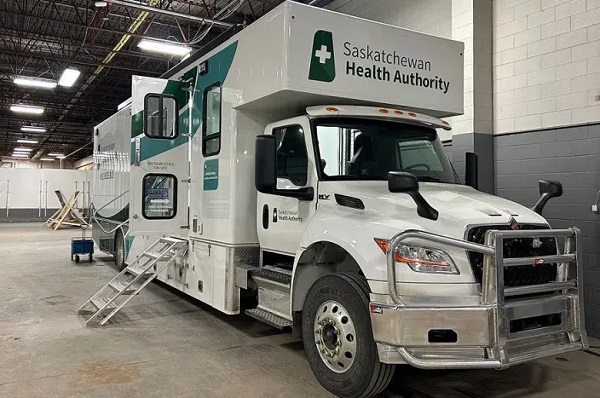

By Alexandra Keeler
Across Canada, mobile health models are increasingly being used to offer care to rural and underserved communities
Saskatchewan has launched a small fleet of mobile wellness buses to improve access to primary health care, mental health and addiction services in the province.
The first bus began operating in Regina on Feb. 12. Another followed in Prince Albert on March 21. Saskatoon’s bus was unveiled publicly on April 9. All three are former coach buses that have been retrofitted to provide health care to communities facing barriers to access.
“Mobile health units are proven to improve outcomes for people facing barriers to healthcare,” Kayla DeMong, the executive director of addiction treatment centre Prairie Harm Reduction, told Canadian Affairs in an email.
“We fully support this innovative approach and are excited to work alongside the health bus teams to ensure the people we support receive the care they need, when and where they need it.”
Wellness buses
Like all provinces, Saskatchewan has been grappling with the opioid crisis.
In 2023, an estimated 457 individuals died from overdoses in the province. In 2024, that number fell to 346. But the province continues to struggle with fatal and non-fatal overdoses.
In late February, Saskatoon firefighters responded to more than 25 overdoses in a single 24-hour period. Just over a week later, they responded to 37 overdoses within another 24-hour window.
Saskatchewan’s wellness buses are part of the province’s plan to address these problems. In April 2025, the province announced $2.4 million to purchase and retrofit three coach buses, plus $1.5 million in annual operating funds.
The buses operate on fixed schedules at designated locations around each city. Each bus is staffed with a nurse practitioner, nurse and assessor coordinator who offer services such as overdose reversal kits, addiction medicine and mental health referrals.
“By bringing services directly to where people are, the health buses foster safer, more welcoming spaces and help build trusting relationships between community members and care providers,” said DeMong, executive director of Prairie Harm Reduction.
Saskatoon-based Prairie Harm Reduction is one of the local organizations that partners with the buses to provide additional support services. Prairie Harm Reduction provides a range of family, youth and community supports, and also houses the province’s only fixed supervised consumption site.
The mobile model
Saskatchewan is not the only province using wellness buses. Across Canada, mobile health models are increasingly being used to expand access to care in rural and underserved communities.
In Kingston, Ont., the Street Health Centre operates a retrofitted RV called PORCH (Portable Outreach Care Hub) that serves individuals struggling with homelessness and addiction.
“Our outreach services are extremely popular with our clients and community partners,” Donna Glasspoole, manager at Street Health Centre, said in an emailed statement.
“PORCH hits the road two to three days/week and offers a variety of services, which are dependent on the health care providers and community partners aboard.”
Street Health Centre also has a shuttle service that picks up clients in shelters and brings them to medical clinics or addiction medicine clinics.
The PORCH vehicles are not supported by provincial funding, but instead rely on support from the United Way and other grants. Glasspoole says the centre’s permanent location — which does receive government funding — is more cost-effective to operate.
“The vehicles are expensive to operate and our RV is not great in winter months and requires indoor parking,” she said.

Politically palatable
Many mobile health models currently do not provide controversial services such as supervised drug consumption.
The Saskatchewan Health Authority told Canadian Affairs the province’s new wellness buses will not offer supervised consumption services or safer supply, where drug users are given prescribed opioids as an alternative to toxic street drugs.
“There are no plans to provide supervised consumption services from the wellness buses,” Saskatchewan Health Authority spokesperson Courtney Markewich told Canadian Affairs in a phone call.
This limited scope may make mobile services more politically palatable in provinces that have resisted harm reduction measures.
In Ontario, some harm reduction programs have shifted to mobile models following Premier Doug Ford’s decision to suspend supervised consumption services located within 200 metres of schools and daycares.
In April, Toronto Public Health ended operations at its Victoria Street fixed consumption site, replacing it with street outreach and mobile vans.
The Ontario government’s decision to close the sites is part of a broader pivot away from harm reduction. The province is investing $378 million to transition suspended sites into 19 new “HART Hubs” that offer primary care, mental health, addictions treatment and other supports.
Glasspoole says that what matters most is not whether services are provided at fixed or mobile locations, but how care is delivered.
Models that “reduce barriers to care, [are] non-judgemental, and [are staffed by] trauma-informed providers” are what lead more people toward treatment and recovery, she said in her email.
In Saskatchewan, DeMong hopes the province’s new wellness buses help address persistent service gaps and build trust with underserved communities.
“This initiative is a vital step toward filling long-standing gaps in the continuum of care by providing low-barrier, community-based access to health-care services,” she said.
This article was produced through the Breaking Needles Fellowship Program, which provided a grant to Canadian Affairs, a digital media outlet, to fund journalism exploring addiction and crime in Canada. Articles produced through the Fellowship are co-published by Break The Needle and Canadian Affairs.
Subscribe to Break The Needle

Elon Musk slams Trump’s ‘Big Beautiful Bill,’ calls for new political party

RFK Jr. says Hep B vaccine is linked to 1,135% higher autism rate
RFK Jr. Unloads Disturbing Vaccine Secrets on Tucker—And Surprises Everyone on Trump

CBS settles with Trump over doctored 60 Minutes Harris interview

Why it’s time to repeal the oil tanker ban on B.C.’s north coast
National Health Care Fraud Takedown Results in 324 Defendants Charged in Connection with Over $14.6 Billion in Alleged Fraud
Alberta Provincial Police – New chief of Independent Agency Police Service
-
 Alberta1 day ago
Alberta Next: Immigration
-
 Business2 days ago
The Digital Services Tax Q&A: “It was going to be complicated and messy”
-
 International2 days ago
Elon Musk forms America Party after split with Trump
-
 Crime15 hours ago
News Jeffrey Epstein did not have a client list, nor did he kill himself, Trump DOJ, FBI claim
-
 COVID-1913 hours ago
FDA requires new warning on mRNA COVID shots due to heart damage in young men
-
 Alberta Sports Hall of Fame and Museum24 hours ago
Alberta Sports Hall of Fame 2025 Inductee Profiles – Para Nordic Skiing – Brian and Robin McKeever
-
 Indigenous11 hours ago
Internal emails show Canadian gov’t doubted ‘mass graves’ narrative but went along with it
-
 Business10 hours ago
Carney’s new agenda faces old Canadian problems