
Business
Carbon Tax poll reveals what we already knew

 Written By Dan McTeague of Canadians for Affordable Energy
The chickens are coming home to roost for the Trudeau government.
Last month (August 6th) Nanos Research released a new poll showing that two thirds of Canadians think that now is a bad time to increase the Carbon Tax. This is not exactly a shocking revelation. It really didn’t take a poll to determine what everyday Canadians already know. Adding a Carbon Tax to a struggling economy is a bad idea.
Anyone who has gone to the grocery store lately, or has filled up their vehicle, knows that the cost of living has skyrocketed. Social media is flooded with Canadians sharing their stories of how they are at the breaking point with the cost of living. It doesn’t take an economist to know that higher consumption taxes have the immediate effect of increasing the cost of everything. That has not stopped the green Agenda driven Trudeau government that seems determined to make life unaffordable for Canadians.
But back to that Nanos poll –
Let’s break this down a bit more to understand what this poll is really saying about how Canadians feel about Carbon Taxes.
First, it is evident that Nanos is approaching this poll with a clear bias in favor of Carbon Taxes. Participants were asked three (3) questions: 1) Do you think a carbon tax on things like gas is an effective, somewhat effective, somewhat ineffective, or ineffective way to encourage people to use less fuel? 2) Is now a very good, good, average, poor or very poor time to increase carbon taxes on things like gas? 3) On a scale from 0 to 10 where 0 is not at all effective and 10 is extremely effective, how effective do you think the federal government’s Carbon Pollution Pricing system, often called the carbon tax, is to combat climate change?
Notice the poll did not ask Canadians whether or not they think Carbon Taxes are a good idea or whether they want them at all.
The assumption is that Canadians buy into the narrative that climate change is real, and a “real problem” that requires government action, that “using less carbon” such as fuel is a key, if not the key, to reducing “carbon consumption”.
We know not every Canadian believes this; but the Nanos poll didn’t even ask.
That said, looking at the results of what they did ask, two thirds of Canadians say that now is a bad time to increase carbon taxes.
In the prairie provinces, this number was 79% and in Atlantic Canada 73% of respondents said the timing is “poor” or “very poor”.
Of even greater political significance: in Ontario, where the next federal election will likely be decided, a whopping 68.7% of respondents said that now is a bad time to increase the Carbon Tax. And yet Justin Trudeau keeps increasing this most hated tax.
In terms of effectiveness, 64.3% in Ontario think that a new carbon tax is not effective at encouraging people to use less fuel. This comes as no surprise. A majority of Canadians rely on their vehicles to get to work, the grocery store, kids practices, and family vacations. Normal daily activities for life in Canada. In most cases not driving is not an option. It only means that getting there is more expensive, and other items in the budget need to be sacrificed instead.
And as we know the Carbon Tax is one of the culprits for higher prices.
Conservative MP Kyle Seeback articulated it well in the House of Commons when he explained to Trudeau’s Environment Minister Stephen Guilbeault how the Carbon Tax is driving up inflation. “Mr. Speaker, it is incredible, he actually does not know how food ends up on his plate. The farmer pays a carbon tax, the truck that picks up the farmer’s food pays a carbon tax to take it to the processor, the processor pays a carbon tax, the truck that picks it up from the processor to take it to the grocery store pays a carbon tax, the grocery store pays a carbon tax and then Canadians cannot pay for food.”
Canadians for Affordable Energy has been advocating for affordability since 2017 and have known that Carbon Taxes are a threat to affordable energy in Canada and will drive up the cost of everything. And that is exactly what is happening. Fuel prices are skyrocketing, food prices are at record highs, and Canadians are struggling to make ends meet. Energy affordability is the key to success in Canada and therefore it is the view of CAE that there is never a good time to implement a Carbon Tax. Full stop.
Canadians are finally starting to connect the dots on a path that leads directly back to bad energy and environmental policies. Policies that have stifled our resource economy and punished working Canadians. Policies that are hitting Canadians’ pocketbooks really hard, especially when trying to fill up their vehicles and feed their families. Policies that won’t even help the environment.
Pierre Poilievre and his Conservative government have committed to scrapping the carbon tax. Let’s hope they follow through on this promise if they come into power in the next election. Because not all Canadians buy the narrative that Carbon Taxes are a good thing.

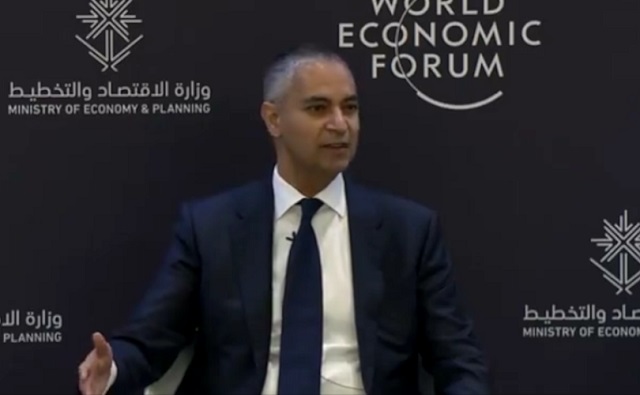
Central Bank of Bahrain governor Khalid Humaidan
From LifeSiteNews
When asked how he would convince people that CBDCs would be a trusted medium of exchange, Bahrain’s central bank governor said that COVID made the digital transformation ‘something of a requirement’ that had ‘very little resistance.’
Central bank digital currencies (CBDCs) will hopefully replace physical cash and become fully digital, a central banker tells the World Economic Forum (WEF).
Speaking at the WEF Special Meeting on Global Collaboration, Growth and Energy Development on Sunday, Central Bank of Bahrain governor Khalid Humaidan told the panel “Open Forum: The Digital Currencies’ Opportunity in the Middle East” that one of the goals of CBDC was to replace cash, at least in Bahrain, and to go “one hundred percent digital.”
Humaidan likened physical cash to being an antiquated “analogue” technology and that CBDC was the digital solution that would hopefully replace cash:
"We're probably going to stop calling it central bank digital currency [CBDC]. It's going to be a digital form of cash, and at some point in time hopefully we will be able to be 100% digital": Central Bank of Bahrain Governor Khalid Humaidan to the WEF https://t.co/Pspr0M1Uuq pic.twitter.com/N5aOkCpzh1
— Tim Hinchliffe (@TimHinchliffe) April 29, 2024
“I thank this panel and this opportunity. It forced me to refine my thoughts and opinions where I’m at a place comfortably now that I’m ready to verbalize what I think about CBDC,” said Humaidan.
If we think cash is the analogue and digital currency is the form of digital – CBDC is the digital form of cash – today, clearly we’re in a hybrid situation; we’re using both.
We know in the past when it comes to cash, central bankers were very much in control with all aspects of cash, and now we’re comfortable to the point where the private sector plays a big role in the printing of the cash, in the distribution of the cash, and with the private sector we use interest rates to manage the supply of cash.
The same thing is likely to happen with CBDC. Yes, the central bank will have a role, but at some point in time – the same way we don’t call it ‘central bank cash’ – we’re probably going to stop calling it central bank digital currency.
“It’s going to be a digital form of the cash, and at some point in time hopefully we will be able to be one hundred percent digital,” he added.
When asked how he would convince people that CBDC would be a trusted medium of exchange, Bahrain’s central bank governor said that people were already used to it and that COVID made the digital transformation “necessary” and “something of a requirement” that had “very little resistance.”
"There's less use of cash […] The transition to fully digital is not going to be a stretch […] People are used to it […] Its adoption rates increased because of COVID […] There is very little resistance": Central Bank of Bahrain Governor Khalid Humaidan to the WEF on CBDC pic.twitter.com/zB7nJAi48G
— Tim Hinchliffe (@TimHinchliffe) April 29, 2024
“Right now, many of our payments are digital. The truth is, I said that we’re in a hybrid model; there’s less and less use of cash,” said Humaidan.
I think from predominantly digital with a little physical, I think the transition to fully digital is not going to be a stretch.
People are used to it, people have engaged in it and certain circumstances did help. Its adoption rates increased because of COVID.
“This is where contactless started to become something of a necessity, something of safety, something of a requirement, and because of that there is very little resistance; trust is already there,” he added.
"Is it [digital euro] going to be as private as cash? No. A digital currency will never be as anonymous and as protecting of privacy in many respects as cash, which is why cash will always be around": Christine Lagarde, BIS Innovation Summit, March 2023 #CBDC pic.twitter.com/BLMVOPax6a
— Tim Hinchliffe (@TimHinchliffe) April 11, 2023
Meanwhile, European Central Bank president Christine Lagarde has been going around the world telling people that the digital euro CBDC would not eliminate cash, and that cash would always be an option.
Speaking at the Bank for International Settlements (BIS) Innovation Summit in March 2023, Lagarde said that a digital currency will never be as anonymous as cash, and for that reason, cash will always be around.
“Is it [digital euro] going to be as private as cash? No,” she said.
A digital currency will never be as anonymous and as protecting of privacy in many respects as cash, which is why cash will always be around.
If people want to use cash in some countries or in some transactions, cash should be available.
“A digital currency is an alternative, is another means of payment and will not provide exactly the same level of privacy and anonymity as cash, but will be pretty close in terms of complete neutrality in relation to the data,” she added.
A WEF Agenda blog post from September, 2017, lists the “gradual obsolescence of paper currency” as being “characteristic of a well-designed CBDC.”
"You could have a potentially […] darker world where the government decides that [CBDC] can be used to purchase some things, but not other things that it deems less desirable like say ammunition, or drugs, or pornography, or something of the sort": Eswar Prasad, WEF #AMNC23 pic.twitter.com/KkWgaEWAR5
— Tim Hinchliffe (@TimHinchliffe) June 28, 2023
Last year at the WEF’s 14th Annual Meeting of the New Champions, aka “Summer Davos,” in Tianjing, China, Cornell University professor Eswar Prasad said that “we are at the cusp of physical currency essentially disappearing,” and that programmable CBDCs could take us to either a better or much darker place.
“If you think about the benefits of digital money, there are huge potential gains,” said Prasad, adding, “It’s not just about digital forms of digital currency; you can have programmability – units of central bank currency with expiry dates.
You could have […] a potentially better – or some people might say a darker world – where the government decides that units of central bank money can be used to purchase some things, but not other things that it deems less desirable like say ammunition, or drugs, or pornography, or something of the sort, and that is very powerful in terms of the use of a CBDC, and I think also extremely dangerous to central banks.
The WEF’s Special Meeting on Global Collaboration, Growth and Energy Development took place from April 27-29 in Riyadh, Saudi Arabia.
“Saudi Arabia’s absolute monarchy restricts almost all political rights and civil liberties,” according to D.C.-based NGO Freedom House.
In the kingdom, “No officials at the national level are elected,” and “the regime relies on pervasive surveillance, the criminalization of dissent, appeals to sectarianism and ethnicity, and public spending supported by oil revenues to maintain power.”
Reprinted with permission from The Sociable.
From the Canadian Taxpayers Federation
Author: Franco Terrazzano
“Every penny collected from the GST will now go to cover interest charges on the Trudeau government’s credit card”
The Canadian Taxpayers Federation is calling on the federal government to cut spending and balance the budget following today’s Parliamentary Budget Officer report forecasting higher deficits.
“Budget 2024 was bad, but the PBO report forecasts the Trudeau government will be running even bigger deficits,” said Franco Terrazzano, CTF Federal Director. “This PBO report should be a wake-up call for Prime Minister Justin Trudeau: get a hold of your spending or interest charges will keep ballooning.”
The PBO projects a $46-billion deficit this year. Budget 2024 projected a $40-billion deficit.
“PBO’s projected budgetary deficits are $5.3 billion higher annually, on average, over 2023-24 to 2028-29,” according to the report.
In Budget 2023, Finance Minister Chrystia Freeland said the government would find “savings of $15.4 billion over the next five years.”
However, “in Budget 2024, the government announced $61.2 billion in new spending,” according to the PBO. “Since Budget 2021, the government has announced a total of $251.6 billion in new spending measures.”
Interest charges on the debt are expected to cost taxpayers $54 billion this year, according to Budget 2024.
“Every penny collected from the GST will now go to cover interest charges on the Trudeau government’s credit card,” Terrazzano said. “Trudeau must balance the budget, cut spending and stop wasting more than $1 billion every week on interest charges.”


“The Numbers Favour Our Side”

Don’t be fooled by high-speed rail
Canadian interest in electric vehicles falls for second year in a row: survey

UN plastics plans are unscientific and unrealistic
Taxpayers criticize Trudeau and Ford for Honda deal

Making Alberta a geothermal energy leader
Honda deal latest episode of corporate welfare in Ontario

-
Uncategorized2 days ago
Making Alberta a geothermal energy leader
-
 Alberta2 days ago
Three Calgary massage parlours linked to human trafficking investigation
-
 Alberta2 days ago
Alberta’s vision for passenger rail
-
 COVID-192 days ago
States move to oppose WHO’s ‘pandemic treaty,’ assert states’ rights
-
Business2 days ago
Parliamentary Budget Officer forecasts bigger deficits for years to come
-
 Addictions2 days ago
Must Watch: Addiction worker estimates 90% of “safer supply” drugs resold on black market
-
 conflict1 day ago
Columbia on Lockdown After pro-Palestinian Protesters Take Over Building, Hold Janitors Hostage
-
 Canadian Energy Centre1 day ago
North America LNG project cost competitiveness