
Fraser Institute
Canada can solve its productivity ‘emergency’—we just need politicians on board


From the Fraser Institute
By Jake Fuss

Policymakers are slowly acknowledging the problem, but their proposed solutions are troubling.
According to Carolyn Rogers, senior deputy governor of the Bank of Canada, it’s time to “break the glass” and respond to Canada’s productivity “emergency.” Unfortunately, the country is unlikely to solve this issue any time soon as politicians are doubling down on the policy status quo rather than making sorely needed reforms.
Worker productivity—the level of output in the economy per hour worked—is a crucial indicator of a country’s underlying economic performance. When productivity increases, we not only increase our output and efficiency, but worker wages typically rise as well.
According to Statistics Canada, the country’s productivity dropped for six consecutive quarters before eking out a small gain in the final quarter of 2023. Rogers is right, this is an emergency, and it’s unsurprising that living standards for Canadians are falling alongside our productivity. Since the second quarter of 2022 (when it peaked post-COVID), inflation-adjusted per-person GDP (a common indicator of living standards) declined from $60,178 to $58,111 by the end of 2023—and declined during five of those six quarters, now sitting below where it was at the end of 2014.
Policymakers are slowly acknowledging the problem, but their proposed solutions are troubling. Federal Finance Minister Chrystia Freeland, for instance, recently emphasized the importance of making “investments in productivity and growth.” Yet, the federal government increased taxes on capital gains in its recent budget, which will disincentivize investment in Canada. Usually, when a politician says the word “investment” this is a fancy way of saying we need more government spending.
And in fact, more government spending appears to be the popular solution to every problem for most governments in Canada these days. Canadian premiers and the prime minister already support this approach in health care even though it’s been tried for decades. The result? In 2023, the longest wait times for health care on record despite having the most expensive system (as a share of GDP) among high-income universal health-care countries.
And now, these same policymakers are advocating for the same approach to boost productivity—that is, throw taxpayer money at the problem and hope it will somehow go away.
But there’s hope—governments have other options. For starters, governments from coast to coast could eliminate interprovincial trade barriers, which limit productivity improvements by (among other things) shielding inefficient local businesses from competition from businesses in other provinces. Governments also effectively prohibit the entry of foreign-owned competitors in crucial industries such as telecommunications and air travel. There’s less incentive for Canadian firms to innovate or improve when there’s no threat to shake things up.
Moreover, if governments reduced regulatory red tape and subsequent compliance costs, firms could allocate more resources towards training their workers, investing in equipment, and producing new and better products. And if governments reduced tax rates on families and businesses, they could make Canada more attractive to productive businesses, high-skilled workers and investors. Our current relatively high tax rates on capital gains, personal income and businesses income discourage capital investment and scare away the best and brightest scientists, engineers, doctors and entrepreneurs.
The Trudeau government, and other governments in Canada, seemingly want to spend their way out of our productivity emergency. While some level of government spending can help improve productivity, continued spending increases reallocate resources from the private sector to the government sector, which is by nature less productive. Governments should impose credible restraints (i.e. fiscal rules) on the growth of government spending to prevent this crowding out of private-sector investment.
There are plenty of ways Canada can boost productivity. We just need policymakers to be on board.
Author:



From the Fraser Institute
By Jason Clemens and Elmira Aliakbari
The challenge of GHG emissions in 2050 is not in the industrial world but rather in the developing world, where there is still significant basic energy consumption using timber and biomass.
The new Memorandum of Understanding (MOU) between the federal and Alberta governments lays the groundwork for substantial energy projects and infrastructure development over the next two-and-a-half decades. It is by all accounts a step forward, though, there’s debate about how large and meaningful that step actually is. There is, however, a fundamental flaw in the foundation of the agreement: it’s commitment to net zero in Canada by 2050.
The first point of agreement in the MOU on the first page of text states: “Canada and Alberta remain committed to achieving net zero greenhouse gas emissions by 2050.” In practice, it’s incredibly difficult to offset emissions with tree planting or other projects that reduce “net” emissions, so the effect of committing to “net zero” by 2050 means that both governments agree that Canada should produce very close to zero actual greenhouse gas (GHG) emissions. Consider the massive changes in energy production, home heating, transportation and agriculture that would be needed to achieve this goal.
So, what’s wrong with Canada’s net zero 2050 and the larger United Nations’ global goal for the same?
Let’s first understand the global context of GHG reductions based on a recent study by internationally-recognized scholar Vaclav Smil. Two key insights from the study. First, despite trillions being spent plus international agreements and regulatory measures starting back in 1997 with the original Kyoto agreement, global fossil fuel consumption between then and 2023 increased by 55 per cent.
Second, fossil fuels as a share of total global energy declined from 86 per cent in 1997 to 82 per cent in 2022, again, despite trillions of dollars in spending plus regulatory requirements to force a transition away from fossil fuels to zero emission energies. The idea that globally we can achieve zero emissions over the next two-and-a-half decades is pure fantasy. Even if there is an historic technological breakthrough, it will take decades to actually transition to a new energy source(s).
Let’s now understand the Canada-specific context. A recent study examined all the measures introduced over the last decade as part of the national plan to reduce emissions to achieve net zero by 2050. The study concluded that significant economic costs would be imposed on Canadians by these measures: inflation-adjusted GDP would be 7 per cent lower, income per worker would be more than $8,000 lower and approximately 250,000 jobs would be lost. Moreover, these costs would not get Canada to net zero. The study concluded that only 70 per cent of the net zero emissions goal would be achieved despite these significant costs, which means even greater costs would be imposed on Canadians to fully achieve net zero.
It’s important to return to a global picture to fully understand why net zero makes no sense for Canada within a worldwide context. Using projections from the International Energy Agency (IEA) in its latest World Energy Outlook, the current expectation is that in 2050, advanced countries including Canada and the other G7 countries will represent less than 25 per cent of global emissions. The developing world, which includes China, India, the entirety of Africa and much of South America, is estimated to represent at least 70 per cent of global emissions in 2050.
Simply put, the challenge of GHG emissions in 2050 is not in the industrial world but rather in the developing world, where there is still significant basic energy consumption using timber and biomass. A globally-coordinated effort, which is really what the U.N. should be doing rather than fantasizing about net zero, would see industrial countries like Canada that are capable of increasing their energy production exporting more to these developing countries so that high-emitting energy sources are replaced by lower-emitting energy sources. This would actually reduce global GHGs while simultaneously stimulating economic growth.
Consider a recent study that calculated the implications of doubling natural gas production in Canada and exporting it to China to replace coal-fired power. The conclusion was that there would be a massive reduction in global GHGs equivalent to almost 90 per cent of Canada’s total annual emissions. In these types of substitution arrangements, the GHGs would increase in energy-producing countries like Canada but global GHGs would be reduced, which is the ultimate goal of not only the U.N. but also the Carney and Smith governments as per the MOU.
Finally, the agreement ignores a basic law of economics. The first lesson in the very first class of any economics program is that resources are limited. At any given point in time, we only have so much labour, raw materials, time, etc. In other words, when we choose to do one project, the real cost is foregoing the other projects that could have been undertaken. Economics is mostly about trying to understand how to maximize the use of limited resources.
The MOU requires massive, literally hundreds of billions of dollars to be used to create nuclear power, other zero-emitting power sources and transmission systems all in the name of being able to produce low or even zero-emitting oil and gas while also moving to towards net zero.
These resources cannot be used for other purposes and it’s impossible to imagine what alternative companies or industries would have been invested in. What we do know is that workers, entrepreneurs, businessowners and investors are not making these decisions. Rather, politicians and bureaucrats in Ottawa and Edmonton are making these decisions but they won’t pay any price if they’re wrong. Canadians pay the price. Just consider the financial fiasco unfolding now with Ottawa, Ontario and Quebec’s subsidies (i.e. corporate welfare) for electric vehicle batteries.
Understanding the fundamentally flawed commitment to Canadian net zero rather than understanding a larger global context of GHG emissions lays at the heart of the recent MOU and unfortunately for Canadians will continue to guide flawed and expensive policies. Until we get the net zero policies right, we’re going to continue to spend enormous resources on projects with limited returns, costing all Canadians.

Jason Clemens
Executive Vice President, Fraser Institute

Elmira Aliakbari

From the Fraser Institute
By Tegan Hill
According to this week’s fiscal update, amid falling oil prices, the Alberta government will run a projected $6.4 billion budget deficit in 2025/26—higher than the $5.2 billion deficit projected earlier this year and a massive swing from the $8.3 billion surplus recorded in 2024/25.
Overall, that’s a $14.8 billion deterioration in Alberta’s budgetary balance year over year. Resource revenue, including oil and gas royalties, comprises 44.5 per cent of that decline, falling by a projected $6.6 billion.
Albertans shouldn’t be surprised—the good times never last forever. It’s all part of the boom-and-bust cycle where the Alberta government enjoys budget surpluses when resource revenue is high, but inevitably falls back into deficits when resource revenue declines. Indeed, if resource revenue was at the same level as last year, Alberta’s budget would be balanced.
Instead, the Alberta government will return to a period of debt accumulation with projected net debt (total debt minus financial assets) reaching $42.0 billion this fiscal year. That comes with real costs for Albertans in the form of high debt interest payments ($3.0 billion) and potentially higher taxes in the future. That’s why Albertans need a new path forward. The key? Saving during good times to prepare for the bad.
The Smith government has made some strides in this direction by saving a share of budget surpluses, recorded over the last few years, in the Heritage Fund (Alberta’s long-term savings fund). But long-term savings is different than a designated rainy-day account to deal with short-term volatility.
Here’s how it’d work. The provincial government should determine a stable amount of resource revenue to be included in the budget annually. Any resource revenue above that amount would be automatically deposited in the rainy-day account to be withdrawn to support the budget (i.e. maintain that stable amount) in years when resource revenue falls below that set amount.
It wouldn’t be Alberta’s first rainy-day account. Back in 2003, the province established the Alberta Sustainability Fund (ASF), which was intended to operate this way. Unfortunately, it was based in statutory law, which meant the Alberta government could unilaterally change the rules governing the fund. Consequently, by 2007 nearly all resource revenue was used for annual spending. The rainy-day account was eventually drained and eliminated entirely in 2013. This time, the government should make the fund’s rules constitutional, which would make them much more difficult to change or ignore in the future.
According to this week’s fiscal update, the Alberta government’s resource revenue rollercoaster has turned from boom to bust. A rainy-day account would improve predictability and stability in the future by mitigating the impact of volatile resource revenue on the budget.

Tegan Hill
Director, Alberta Policy, Fraser Institute


From Underdog to Top Broodmare
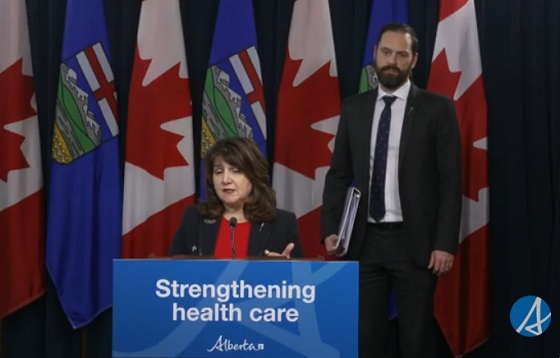
Alberta introducing dual practice health care model to increase options and shorten wait times while promising protection for publicly funded services
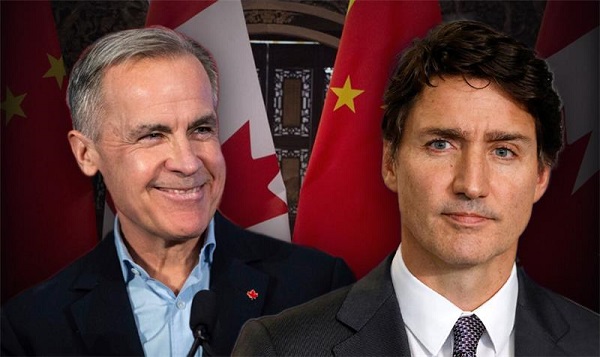
Beijing’s blueprint for breaking Canada-U.S. unity

More than 200 children will receive dangerous puberty blockers for new UK study
US Supreme Court may end ‘emergency’ tariffs, but that won’t stop the President

Boris Johnson Urges Ukraine to Continue War

Elbows Down For The Not-So-Magnificent Seven: Canada’s Wilting NHL Septet
-
 National2 days ago
Alleged Liberal vote-buying scandal lays bare election vulnerabilities Canada refuses to fix
-
Alberta21 hours ago
Net Zero goal is a fundamental flaw in the Ottawa-Alberta MOU
-
 Food20 hours ago
Canada Still Serves Up Food Dyes The FDA Has Banned
-
 Addictions2 days ago
The Death We Manage, the Life We Forget
-
 Daily Caller2 days ago
John Kerry Lurches Back Onto Global Stage For One Final Gasp
-
 National1 day ago
Eco-radical Canadian Cabinet minister resigns after oil deal approved
-
 Crime2 days ago
Vancouver police seize fentanyl and grenade launcher in opioid-overdose crisis zone
-
 Addictions20 hours ago
Manitoba Is Doubling Down On A Failed Drug Policy