
Crime
Calgary has a 50% higher property crime rate than Phoenix

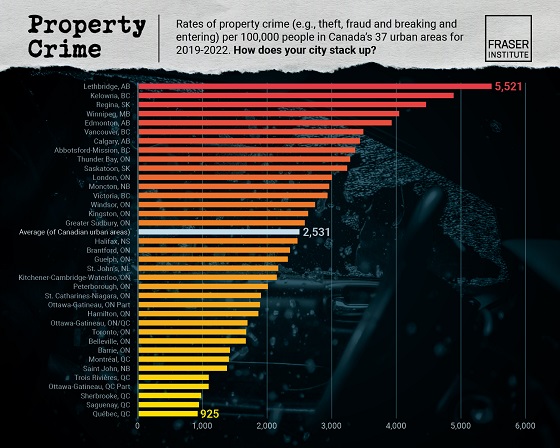

From the Fraser Institute

The rate of property crimes per person in Calgary is 50 per cent higher than in Phoenix, and Lethbridge has the highest rate of property crime of any large urban area in Canada, finds a new study published today by the Fraser Institute, an independent, non-partisan Canadian public policy think-tank.
“Albertans are no doubt aware that the rate of property crimes in the province’s biggest cities is on the rise, but they might not know how bad it’s become relative to American cities to the south,” said Livio Di Matteo, senior fellow at the Fraser Institute and author of Comparing Recent Crime Trends in Canada and the US.
The study examines crime rates of large urban areas with 100,000 people or more, known as Census Metropolitan Areas in Canada and Metropolitan Statistical Areas in the U.S.
Using the maximum annual crime rate from 2019 to 2022 (the most recent years of comparable date), Lethbridge had the highest rate of property crimes (e.g., burglary, theft, motor vehicle theft) of all Canadian cities while Kelowna, BC ranked 2nd.
Both Lethbridge and Calgary ranked higher than Las Vegas for property crime, while Lethbridge also ranked higher than Denver, Salt Lake City, Utah, and Los Angeles, California.
Winnipeg, Manitoba is Canada’s most-violent city with the highest per person rate of violent crimes (murder, robbery, and assault with a weapon) of all Canadian urban areas. Crucially, Winnipeg ranked 18th out of all 334 urban areas in Canada and the U.S.
“Crime rates in Alberta’s largest cities, while still historically low, are on the rise and should be of greater concern for both citizens and policymakers,” Di Matteo said.


Comparing Recent Crime Trends in Canada and the United States
- This study examines total property and total violent crimes, adjusted for population, across 36 Canadian Census Metropolitan Areas (CMAs) and over 300 U.S. Metropolitan Statistical Areas (MSAs). The data reported covers the 2019 to 2022 period.
- In general, after decades of decline, recent years have seen increases in crime rates in both Canada and the United States, though by historic standards rates remain low.
- For violent crimes, the top (worst) ranked city was Memphis, TN (1,311 per 100,000) while the top ranked Canadian city was Winnipeg, which ranked 18th overall at 675 per 100,000.
- Twenty-five percent of Canadian CMAs are in the top half of Canada-U.S. violent crime rankings with the remaining 75 percent in the bottom half.
- For property crime, the top (worst) ranked city was Lethbridge, AB at 5,521 per 100,000. Kelowna, BC ranked second highest (4,932 per 100,000). Pueblo, CO at 4,911 per 100,000 ranked third overall and was the highest (worst) ranked U.S. city.
- While Canadian CMAs make up roughly 10 percent of the CMAs and MSAs used in this ranking, when it comes to property crime rates, they account for 24 percent of the top (worst) 10 percent of the property crime rankings whereas in the case of violent crimes they accounted for only 3 percent of the cities in the top 10 percent.
- There is a distinct east-west divide in the data in that eastern Canadian cities, particularly in Quebec, tend to have lower rates (adjusted for population) of both violent and property crime compared to the west. A similar east-west trend holds in the United States.

Livio Di Matteo
Professor of Economics, Lakehead University



From the Daily Caller News Foundation
A woman who survived the Hanukkah terrorist attack at Bondi Beach in Australia said on Monday that police officers seemed less concerned about stopping the attack than they were about keeping her from fighting back.
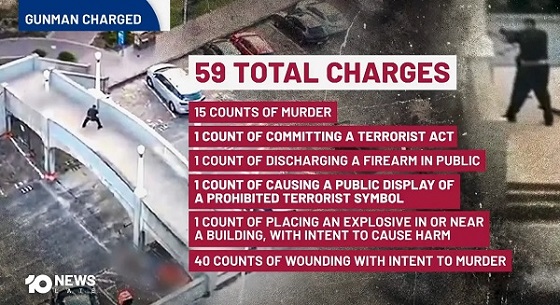
A father and son of Pakistani descent opened fire on a Hanukkah celebration Sunday, killing at least 15 people and wounding 40, with one being slain on the scene by police and the other wounded and taken into custody. Vanessa Miller told Erin Molan about being separated from her three-year-old daughter during Monday’s episode of the “Erin Molan Show.”
“I tried to grab one of their guns,” Miller said. “Another one grabbed me and said ‘no.’ These men, these police officers, they know who I am. I hope they are hearing this. You are weak. You could have saved so many more people’s lives. They were just standing there, listening and watching this all happen, holding me back.”
Dear Readers:
As a nonprofit, we are dependent on the generosity of our readers.
Please consider making a small donation of any amount here.
Thank you!
WATCH:
“Two police officers,” Miller continued. “Where were the others? Not there. Nobody was there.”
New South Wales Minister of Police Yasmin Catley did not immediately respond to a request for comment from the Daily Caller News Foundation about Miller’s comments.
Australian Prime Minister Anthony Albanese vowed to enact further restrictions on guns in response to the attack at Bondi Beach, according to the Associated Press. The new restrictions would include a limit on how many firearms a person could own, more review of gun licenses, limiting the licenses to Australian citizens and “additional use of criminal intelligence” to determine if a license to own a firearm should be granted.
Sajid Akram, 50, and Naveed Akram, 24, reportedly went to the Philippines, where they received training prior to carrying out the Sunday attack, according to the Australian Broadcasting Corporation. Naveed Akram’s vehicle reportedly had homemade ISIS flags inside it.
Australia passed legislation that required owners of semi-automatic firearms and certain pump-action firearms to surrender them in a mandatory “buyback” following a 1996 mass shooting in Port Arthur, Tasmania, that killed 35 people and wounded 23 others. Despite the legislation, one of the gunmen who carried out the attack appeared to use a pump-action shotgun with an extended magazine.
Crime
The Uncomfortable Demographics of Islamist Bloodshed—and Why “Islamophobia” Deflection Increases the Threat

Addressing realities directly is the only path toward protecting communities, confronting extremism, and preventing further loss of life, Canadian national security expert argues.
After attacks by Islamic extremists, a familiar pattern follows. Debate erupts. Commentary and interviews flood the media. Op-eds, narratives, talking points, and competing interpretations proliferate in the immediate aftermath of bloodshed. The brief interval since the Bondi beach attack is no exception.
Many of these responses condemn the violence and call for solidarity between Muslims and non-Muslims, as well as for broader societal unity. Their core message is commendable, and I support it: extremist violence is horrific, societies must stand united, and communities most commonly targeted by Islamic extremists—Jews, Christians, non-Muslim minorities, and moderate Muslims—deserve to live in safety and be protected.
Yet many of these info-space engagements miss the mark or cater to a narrow audience of wonks. A recurring concern is that, at some point, many of these engagements suggest, infer, or outright insinuate that non-Muslims, or predominantly non-Muslim societies, are somehow expected or obligated to interpret these attacks through an Islamic or Muslim-impact lens. This framing is frequently reinforced by a familiar “not a true Muslim” narrative regarding the perpetrators, alongside warnings about the risks of Islamophobia.
These misaligned expectations collide with a number of uncomfortable but unavoidable truths. Extremist groups such as ISIS, Al-Qaeda, Hamas, Hezbollah, and decentralized attackers with no formal affiliations have repeatedly and explicitly justified their violence through interpretations of Islamic texts and Islamic history. While most Muslims reject these interpretations, it remains equally true that large, dynamic groups of Muslims worldwide do not—and that these groups are well prepared to, and regularly do, use violence to advance their version of Islam.
Islamic extremist movements do not, and did not, emerge in a vacuum. They draw from the broader Islamic context. This fact is observable, persistent, and cannot be wished or washed away, no matter how hard some may try or many may wish otherwise.
Given this reality, it follows that for most non-Muslims—many of whom do not have detailed knowledge of Islam, its internal theological debates, historical divisions, or political evolution—and for a considerable number of Muslims as well, Islamic extremist violence is perceived as connected to Islam as it manifests globally. This perception persists regardless of nuance, disclaimers, or internal distinctions within the faith and among its followers.
THE COST OF DENIAL AND DEFLECTION
Denying or deflecting from these observable connections prevents society from addressing the central issues following an Islamic extremist attack in a Western country: the fatalities and injuries, how the violence is perceived and experienced by surviving victims, how it is experienced and understood by the majority non-Muslim population, how it is interpreted by non-Muslim governments responsible for public safety, and how it is received by allied nations. Worse, refusing to confront these difficult truths—or branding legitimate concerns as Islamophobia—creates a vacuum, one readily filled by extremist voices and adversarial actors eager to poison and pollute the discussion.
Following such attacks, in addition to thinking first of the direct victims, I sympathize with my Muslim family, friends, colleagues, moderate Muslims worldwide, and Muslim victims of Islamic extremism, particularly given that anti-Muslim bigotry is a real problem they face. For Muslim victims of Islamic extremism, that bigotry constitutes a second blow they must endure. Personal sympathy, however, does not translate into an obligation to center Muslim communal concerns when they were not the targets of the attack. Nor does it impose a public obligation or override how societies can, do, or should process and respond to violence directed at them by Islamic extremists.
As it applies to the general public in Western nations, the principle is simple: there should be no expectation that non-Muslims consider Islam, inter-Islamic identity conflicts, internal theological disputes, or the broader impact on the global Muslim community, when responding to attacks carried out by Islamic extremists. That is, unless Muslims were the victims, in which case some consideration is appropriate.
Quite bluntly, non-Muslims are not required to do so and are entitled to reject and push back against any suggestion that they must or should. Pointedly, they are not Muslims, a fact far too many now seem to overlook.
The arguments presented here will be uncomfortable for many and will likely provoke polarizing discussion. Nonetheless, they articulate an important, human-centered position regarding how Islamic extremist attacks in Western nations are commonly interpreted and understood by non-Muslim majority populations.
Non-Muslims are free to give no consideration to Muslim interests at any time, particularly following an Islamic extremist attack against non-Muslims in a non-Muslim country. The sole exception is that governments retain an obligation to ensure the safety and protection of their Muslim citizens, who face real and heightened threats during these periods. This does not suggest that non-Muslims cannot consider Muslim community members; it simply affirms that they are under no obligation to do so.
The impulse for Muslims to distance moderate Muslims and Islam from extremist attacks—such as the targeting of Jews in Australia or foiled Christmas market plots in Poland and Germany—is understandable.
Muslims do so to protect their own interests, the interests of fellow Muslims, and the reputation of Islam itself. Yet this impulse frequently collapses into the “No True Scotsman” fallacy, pointing to peaceful Muslims as the baseline while asserting that the attackers were not “true Muslims.”
Such claims oversimplify the reality of Islam as it manifests globally and fail to address the legitimate political and social consequences that follow Islamic extremist attacks in predominantly non-Muslim Western societies. These deflections frequently produce unintended effects, such as strengthening anti-Muslim extremist sentiments and movements and undermining efforts to diminish them.
The central issue for public discourse after an Islamic extremist attack is not debating whether the perpetrators were “true” or “false” Muslims, nor assessing downstream impacts on Muslim communities—unless they were the targets.
It is a societal effort to understand why radical ideologies continue to emerge from varying—yet often overlapping—interpretations of Islam, how political struggles within the Muslim world contribute to these ideologies, and how non-Muslim-majority Western countries can realistically and effectively confront and mitigate threats related to Islamic extremism before the next attack occurs and more non-Muslim and Muslim lives are lost.
Addressing these realities directly is the only path toward protecting communities, confronting extremism, and preventing further loss of life.
Ian Bradbury, a global security specialist with over 25 years experience, transitioned from Defence and NatSec roles to found Terra Nova Strategic Management (2009) and 1NAEF (2014). A TEDx, UN, NATO, and Parliament speaker, he focuses on terrorism, hybrid warfare, conflict aid, stability operations, and geo-strategy.
The Bureau is a reader-supported publication.
To receive new posts and support my work, consider becoming a free or paid subscriber.

The Recall Trap: 21 Alberta MLA’s face recall petitions

Taxpayers Federation calls on politicians to reject funding for new Ottawa Senators arena
Canada’s free speech record is cracking under pressure

Albertans give most on average but Canadian generosity hits lowest point in 20 years

100 Catholic schoolchildren rescued, Nigeria promises release of remaining hostages

Canada considers creating national ID system using digital passports for domestic use
Claims about ‘unmarked graves’ don’t withstand scrutiny
-
 Daily Caller1 day ago
Paris Climate Deal Now Decade-Old Disaster
-
 armed forces1 day ago
Ottawa’s Newly Released Defence Plan Crosses a Dangerous Line
-
 Alberta1 day ago
Alberta’s huge oil sands reserves dwarf U.S. shale
-
 Business16 hours ago
Ottawa Pretends To Pivot But Keeps Spending Like Trudeau
-
 Energy16 hours ago
Liberals Twisted Themselves Into Pretzels Over Their Own Pipeline MOU
-
 Censorship Industrial Complex14 hours ago
How Wikipedia Got Captured: Leftist Editors & Foreign Influence On Internet’s Biggest Source of Info
-
 International1 day ago
FBI didn’t think it had cause to raid Trump but DOJ did it anyway
-
 Community2 days ago
Charitable giving on the decline in Canada