
Censorship Industrial Complex
Biden Agencies Have Resumed Censorship Collaboration With Big Tech, Dem Senate Intel Chair Says


 From the Daily Caller News Foundation
By JASON COHEN

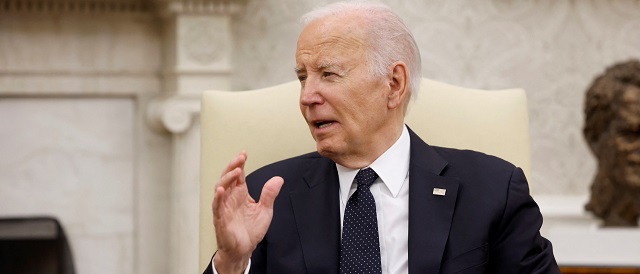
Agencies in President Joe Biden’s administration have resumed their perceived disinformation censorship collaboration with social media companies, Senate Intelligence Committee Chairman Mark Warner told reporters at a recent security conference, Nextgov/FCW reported.
The administration stopped “misinformation” censorship collaboration with social media platforms after a July Missouri v. Biden ruling to prevent federal agencies from coordinating with social media companies, but recently restarted this work, Warner # reporters, according to Nextgov. He said the cooperation resumed as the Supreme Court heard oral arguments in the case, now called Murthy v. Missouri, in March, where multiple justices indicated they supported the Biden administration’s viewpoint that it has the right to work with platforms to combat what it believes is harmful content.
Democrat Senator Mark Warner says there’s a “voluntary agreement about disinformation and misinformation in elections” between “all 20 of the major social media companies” pic.twitter.com/YmIyAuJBrw
— RNC Research (@RNCResearch) April 21, 2024
“There seemed to be a lot of sympathy that the government ought to have at least voluntary communications with [the companies],” Warner said, according to Nextgoc. He also reportedly called on the Biden administration to take strong action against any foreign countries that try to interfere in the 2024 election.
The agencies include the Department of Homeland Security’s Cybersecurity and Infrastructure Security Agency (CISA) and the Federal Bureau of Investigation (FBI), according to NextGov.
“If the bad guy started to launch AI-driven tools that would threaten election officials in key communities, that clearly falls into the foreign interference category,” he added.
A district court judge issued an injunction in July preventing certain officials in agencies from the Department of Health and Human Services (HHS) to the FBI from communicating with social media platforms to censor speech, characterizing the government conduct exposed by the plaintiffs in the case as arguably “the most massive attack against free speech in United States’ history.”
Justices Sonia Sotomayor, Elena Kagan and Ketanji Brown Jackson, expressed concern during March oral arguments about restricting the government’s ability to persuade companies to take action when necessary, such as when terrorists disseminate speech on a platform.
The justices also questioned whether the plaintiffs could prove their platforms censored their speech as a direct result of the government.
Facebook executives believed they were engaged in a “knife fight” with Biden’s White House on COVID-19 censorship, according to a recent House Judiciary Committee report. Biden accused the platform of “killing people” in July 2021 for not censoring so-called COVID-19 misinformation, and unearthed WhatsApp messages between Facebook executives revealed that they were unhappy about the president’s remarks.
Warner, the White House and the FBI did not immediately respond to the Daily Caller News Foundation’s request for comment. CISA declined to comment, but notified the DCNF about an Election Security hearing in the coming weeks with the agency’s Director, Jen Easterly.

Censorship Industrial Complex
US Under Secretary of State Slams UK and EU Over Online Speech Regulation, Announces Release of Files on Past Censorship Efforts

Sarah Rogers’ comments draw a new line in the sand between America’s First Amendment and Europe’s tightening grip on online speech.
|
|
Censorship Industrial Complex
Canadian university censors free speech advocate who spoke out against Indigenous ‘mass grave’ hoax
From LifeSiteNews
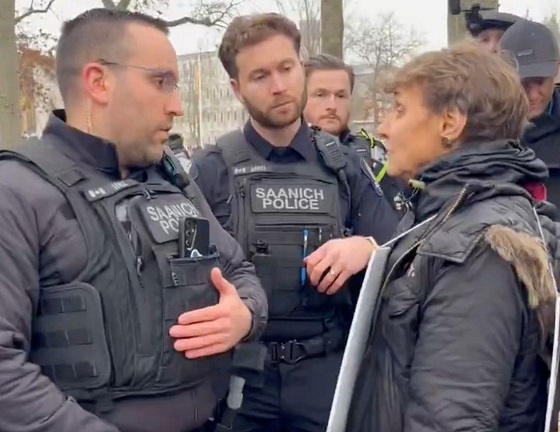
Dr. Frances Widdowson was arrested and given a ticket at the University of Victoria campus after trying to engage in conversation about ‘the disputed claims of unmarked graves in Kamloops.’
A Canadian academic who spoke out against claims there are mass unmarked graves of kids on former Indigenous residential schools, and who was arrested on a university campus as a result for trespassing, is fighting back with the help of a top constitutional group.
Dr. Frances Widdowson was arrested and given a ticket on December 2, 2025, at the University of Victoria (UVic) campus after trying to engage in conversation about “the disputed claims of unmarked graves in Kamloops,” noted the Justice Centre for Constitutional Freedoms (JCCF) in a recent news release.
According to the JCCF, Widdowson was trying to initiate a “good faith” conversation with people on campus, along with the leader of OneBC provincial party, Dallas Brodi.
“My arrest at the University of Victoria is an indication of an institution that is completely unmoored from its academic purpose,” said Widdowson in a statement made available to LifeSiteNews.
She added that the “institution” has been “perpetuating the falsehood” of the remains of 215 children “being confirmed at Kamloops since 2021, and is intent on censoring any correction of this claim.”
“This should be of concern for everyone who believes that universities should be places of open inquiry and critical thinking, not propaganda and indoctrination,” she added.
UVic had the day before Widdowson’s arrest warned on its website that those in favor of free speech were “not permitted to attend UVic property for the purpose of speaking publicly.”
Despite the warning, Widdowson, when she came to campus, was met with some “100 aggressive protesters assembled where she intended to speak at Petch Fountain,” noted the JCCF.
The protesters consisted of self-identified Communists, along with Antifa-aligned people and Hamas supporters.
When Widdowson was confronted by university security, along with local police, she was served with a trespass notice.
“When she declined to leave, she was arrested, detained for about two hours, and charged under British Columbia’s Trespass Act—an offence punishable by fines up to $2,000 or up to six months’ imprisonment,” said the JCCF.
According to Constitutional lawyer Glenn Blackett, UVic actions are shameful, as it “receives hundreds of millions of taxpayer dollars annually while it facilitates the arrest of Canadians attempting to engage in free inquiry on campus.”
Widdowson’s legal team, with the help of the JCCF, will be defending her ticket to protect her “Charter-protected freedoms of expression and peaceful assembly.”
Widdowson served as a tenured professor at Mount Royal University in Calgary, Alberta, before she was fired over criticism of her views on identity politics and Indigenous policy, notes the JCCF. She was vindicated, however, as an arbitrator later found her termination was wrongful.
In 2021 and 2022, the mainstream media ran with inflammatory and dubious claims that hundreds of children were buried and disregarded by Catholic priests and nuns who ran some Canadian residential schools. The reality is, after four years, there have been no mass graves discovered at residential schools.
However, as the claims went unfounded, over 120 churches, most of them Catholic and many of them on Indigenous lands that serve the local population, have been burned to the ground, vandalized, or defiled in Canada since the spring of 2021.
Last year, retired Manitoba judge Brian Giesbrecht said Canadians are being “deliberately deceived by their own government” after blasting the former Trudeau government for “actively pursuing” a policy that blames the Catholic Church for the unfounded “deaths and secret burials” of Indigenous children.
As reported by LifeSiteNews, new private members’ Bill C-254, “An Act To Amend The Criminal Code” introduced by New Democrat MP Leah Gazan, looks to give jail time to people who engage in so-called “Denialism.” The bill would look to jail those who question the media and government narrative surrounding Canada’s “Indian Residential School system” that there are mass graves despite no evidence to support this claim.

The “Disruptor-in-Chief” places Canada in the crosshairs
Canada’s EV gamble is starting to backfire

End Supply Management—For the Sake of Canadian Consumers

UK Police Pilot AI System to Track “Suspicious” Driver Journeys

Judge Declares Mistrial in Landmark New York PRC Foreign-Agent Case

Canadian government launches trial version of digital ID for certain licenses, permits
Alberta Next Panel calls to reform how Canada works
-
 Business2 days ago
Largest fraud in US history? Independent Journalist visits numerous daycare centres with no children, revealing massive scam
-
 Haultain Research22 hours ago
Sweden Fixed What Canada Won’t Even Name
-
 Business2 days ago
“Magnitude cannot be overstated”: Minnesota aid scam may reach $9 billion
-
Censorship Industrial Complex2 days ago
US Under Secretary of State Slams UK and EU Over Online Speech Regulation, Announces Release of Files on Past Censorship Efforts
-
 Business21 hours ago
What Do Loyalty Rewards Programs Cost Us?
-
 Business9 hours ago
Land use will be British Columbia’s biggest issue in 2026
-
 Energy10 hours ago
Why Japan wants Western Canadian LNG
-
 Business7 hours ago
Mainstream media missing in action as YouTuber blows lid off massive taxpayer fraud