
MacDonald Laurier Institute
Barriers to care persist but access to MAiD keeps expanding



From the Macdonald Laurier Institute
By Ramona Coelho

Our government has allowed the incredible power of certain lobby groups to control the public discourse and policies around MAiD and its expansion, prioritizing access to MAiD over the safety of Canadians.
My family medicine practice serves predominantly low-income and marginalized patients, including refugees, those who have been in our prison system or are facing charges, and many with disabilities and mental health issues. My patients experience high barriers to care and support and face social isolation and all kinds of discrimination. Observing the impacts of this has left me deeply concerned about our government’s priorities.
When the federal government introduced MAiD (a medical procedure that causes death) to those not at imminent risk of dying, I was appalled to learn that my patients, who are frequently blocked from care as a result of hurdles created by our government and systems, could potentially be offered an expedient death provided by the government.
In 2016, assisted suicide and euthanasia were first legalized in Canada and the term medical assistance in dying (MAiD) was created. Originally MAiD was presented as an exceptional lethal procedure for ending the lives of consenting adults who were experiencing intolerable suffering and were near death. The legislation required that patients meet certain criteria, including having a “grievous and irremediable” medical condition, such as organ failure or cancer, and a “reasonably foreseeable natural death.”
But the Canadian discourse around MAiD rapidly shifted to facilitating access and there has been a broadening of the number and criteria of those who qualify for MAiD. In 2021, Bill C-7 came into effect and removed some of the safeguards within the original pathway, now called Track 1, and created a new, second track, Track 2, for adults with physical disabilities[1] who are not dying. Furthermore, there is a planned expansion, though the timing is currently being debated in Parliament, for patients whose only medical condition is mental illness. Parliamentary recommendations in 2023 included future expansion to children and to incapable adults who signed advance directives for euthanasia.
Currently, those in Track 1 with a “reasonably foreseeable natural death” can potentially have their life ended the same day as the initial request if all the criteria are met and practitioners are available.
For those in Track 2, those not dying, death by lethal injection is set at a minimum of 90 days after the completion of the first MAiD assessment. To qualify for this track, a patient must also have a “grievous and irremediable” condition and experience intolerable psychological or physical suffering. Suffering is treated as purely subjective with no requirement for further validation. There is also no legal requirement for standard treatment options to be accessible or tried, only that a patient be informed that they exist. This means that a patient who says they are suffering intolerably could access MAiD having declined treatments that would remediate their condition. This could be because the treatment is inaccessible, or unaffordable, or if the patient declines therapy.
The Canadian Association of MAiD Assessors and Providers (CAMAP) has received 3.3 million dollars in funding from Health Canada to educate clinicians assessing and providing for those who have requested the service. So although the existing Track 1 and Track 2 pathways have different safeguards, in aiming to allow those near death to have access to MAiD quickly and with no barriers, CAMAP has created a guidance document that suggests clinicians can be flexible as to whether someone fits Track 1’s reasonably foreseeable natural death, since the law does not require that the person be terminally ill or likely to die within 6 or 12 months. It also states that a person may meet the reasonably foreseeable criterion if they’ve demonstrated a clear and serious intent to take steps to “make their natural death happen soon, or to cause their death to be predictable.” This could come about from a refusal to take antibiotics for an infection, stopping oxygen therapy, or refusing to eat and drink.
This means that people with disabilities can state their intention to or make themselves sick enough to qualify as having a reasonably foreseeable natural death, as is currently happening with adults who are not dying and yet are having their lives ended within days of their first MAiD assessment. In one case, a man had a mild stroke and received MAiD shortly after, even though he wasn’t terminally ill. The reason? He was approved for track 1 as he was temporarily eating less. This was due to following a cautious meal plan ordered by the treating team which was intended to prevent choking and aspiration risks.
Currently, some places in Canada have MAiD rates that are the highest in the world. By the end of 2022, there had been almost 45,000 MAiD deaths across Canada since legalization—more than 13,000 of which took place in 2022 with 463 of those individuals accessing MAiD through Track 2. Estimates based on provincial reporting approximate 16,000 deaths in 2023. Health Canada and MAiD expansionists have tried to reassure the public that the overwhelming number of MAiD deaths have been mostly Track 1 deaths (implying they were dying anyway) but we do not know how many of those persons were “fast-tracked” and may have had many decades of life left to live and the potential to recover with time and care.
The CAMAP guidance document that seems to circumvent Track 2 safeguards is just the beginning of many serious problems with MAiD legislation and practice in Canada.
Patient safeguards for MAiD are lacking
Other jurisdictions in the world where MAiD practices are legalized, such as New Zealand and Victoria, Australia, frown on or prohibit raising death as a treatment option. This is due to the power imbalance that exists between physician and patient, coupled with the patients’ assumption that the provider will only suggest the best options for their health. Raising MAiD unsolicited could cause undue pressure to choose death. Yet Health Canada’s 2023 Model Practice Standard for Medical Assistance in Dying recommends that MAiD should be raised to all who might qualify if the practitioner suspects it aligns with a patient’s values and preferences.
The model practice standard’s approach to “conscientious objection” is equally troubling. Health care providers who object to providing MAiD, even in specific cases, are considered conscientious objectors. A physician who is concerned that MAiD is not a patient’s best option is supposed to ignore their conscience or professional opinion and simply refer the patient on so they can seek access to a MAiD death.
This is further echoed in a CAMAP video training session where experts explain that patients might be driven to MAiD by unmet psycho-social needs. The expert leading the session responds to a trainee’s concerns: “If withdrawing is about protecting your conscience, you have [an] absolute right to do so.” But he adds: “You’ll then have to refer the person on to somebody else, who may hopefully fulfill the request in the end.” This demonstrates precisely how effective referrals can funnel patients toward death despite legitimate professional concerns and obligations that should have instead led to the process being stopped or paused.
In response to this legislation, many from the disability community have advocated for safe spaces where MAiD can’t pose a risk to their lives. The Disability Filibuster, a national grassroots disability community, stated in an open letter that its members have raised fears about seeking health care where death could be offered to them and if at their lowest, they might agree.
The disability community is not being alarmist in this concern. Health care providers often rate the quality of life of those with disabilities as poor despite those patients rating their own quality of life as the same as aged-matched healthy individuals. Put differently, many physicians might consider that patients with disabilities are better off dead, consciously or unconsciously, which might lead them to suggest MAiD.
Besides the problems of mandatory referral and raising MAiD unsolicited, there is another important factor to consider. Persons with physical disabilities systemically lack much of the essential care they need to live and consequently suffer higher rates of isolation, poverty, and marginalization, all of which can make death their most accessible option. The Canadian government commissioned a University of Guelph study, published in 2021, in which the researchers noted that some persons with disabilities were encouraged to explore the MAiD option—even though they had not been contemplating doing so—because of a lack of resources that would enable them to live. Those with disabilities can be approved for MAiD based on their disability, but it is their psycho-social suffering that can drive their requests.
The United Nations Special Rapporteur on the rights of persons with disabilities, the Independent Expert on the enjoyment of all human rights by older persons, and the Special Rapporteur on extreme poverty and human rights have all warned the Canadian government that the current MAiD framework could lead to human rights violations. Their concerns are validated by the numerous fact-checked stories about MAiD abuses that are emerging in Canada. These should give us pause. For example, Sathya Dhara Kovac, 44, ended her life through the MAiD program. She lived with a degenerative disease and her condition was worsening, but she wanted to live but lacked the home care resources to do so. “Ultimately it was not a genetic disease that took me out, it was a system,” Kovac wrote in an obituary to loved ones. All Canadians have a right to humane living conditions, to be treated with respect and dignity, and to receive appropriate timely medical care. Considering the living conditions and lack of care that as a society we allow persons with disabilities to have, choices to die might be understandable for those like Sathya. But we should ask ourselves if choices, made under inhumane conditions, are made freely if driven by structural coercion.
Disturbingly, there are MAiD assessors and providers who seem to be ok with proving MAiD under such inhumane conditions. One such provider testified at a parliamentary committee on MAiD that if someone had to wait a long time for a service that would remediate their suffering, she would still consider that waiting to be irremediable suffering and grant them MAiD in the interim. Therefore, it is not surprising that patients with unaddressed psycho-social suffering are being given MAiD by assessors like her.
When it was considering Bill C-7, the federal government asked the Parliamentary Budget Officer to estimate cost savings to our health care system of the legalization of MAiD. The office did this by looking at the comparative cost savings of MAiD versus palliative care at the end of life. Through this impoverished lens of valuation, it is clear that the cost savings will be even greater when, by many years, we prematurely end the lives of people who have higher care needs, especially when we factor in social services, disability benefits, equipment, and other costs on top of the direct savings to health care budgets. But this is not how we should create budgets or measure outcomes. Our socialized health care system is meant to serve those with disabilities, not consider them a cost to the system.
The Canadian government is currently deciding on the timing for its further roll-out of MAiD, this time for mental illness and with no legislative changes to the current safeguards. This expansion is alarming given what we know is happening already to disabled Canadians under the existing MAiD regime. The Canadian Association of Chairs of Psychiatry wrote a letter in 2022—and some testified more recently in Parliament—that we are not ready for this development. They have warned that there is no evidence to guide decisions about who with mental illness would not get better. The evidence suggests that for every 5 people whose lives would be ended based on the sole medical condition of mental illness, 2 or 3 would have recovered. We expect to have much higher numbers qualifying for MAiD on the grounds of mental illness in Canada than in other jurisdictions that allow assisted death for this reason, since barriers to care and unmitigated psycho-social suffering do not have to be rectified in this country (as they do elsewhere) before being granted MAiD.
Our government has allowed the incredible power and influence of certain lobby groups and their members to control the public discourse and policies around MAiD and its expansion, prioritizing access to MAiD over the safety of Canadians. Besides the current discussion about when to legalize MAiD for mental illness, the parliamentary committee has also recommended expansion to children and MAiD by advance directives. With eligibility for MAiD continuing to broaden, we are not giving priority to serving those most in need, but instead seem intent on rapidly expanding a path to end their lives.
[1] Disabilities is an umbrella term that includes impairment, chronic illness and/or other conditions.
Dr. Ramona Coelho is a family physician in London, Ontario. Her practice largely serves marginalized patients.


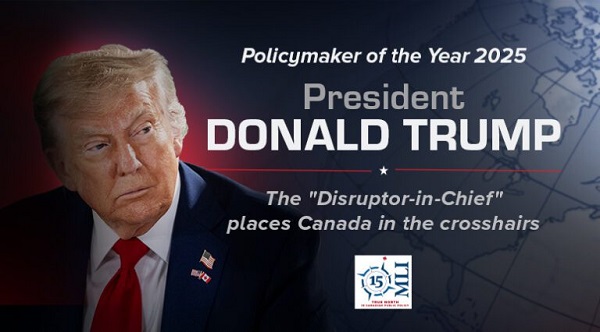

Not for the first time, the Macdonald-Laurier Institute’s Policymaker of the Year is not a Canadian.
In 2019, our laureate was Xi Jinping, leader of the People’s Republic of China, whose long arm reached far into many aspects of policymaking in our nation’s capital.
That helps to underline our intention in conferring this recognition. Policy influence can be used to Canada’s benefit or detriment. In naming our annual Policymaker of the Year, MLI does not endorse their policies; instead, we seek to draw to the attention of Canadians those people who have had the most influence on public policy in this country – for good or ill – in the past year.
And in 2025, who can deny that US President Donald Trump, the Disruptor-in-Chief, has exercised an outsized influence on Canadians – on their hopes and fears, on their political preferences, and, most importantly for our purposes, on the policies pursued by the Canadian government?
How has Donald Trump spurred policy change in Canada? Let us count the ways:
First, set aside for the moment any focus on specific policy areas and just think about the President’s style and strategy. Anyone who has read The Art of the Deal knows that Trump is quite straightforward in avowing that his dealmaking strategy sets out to frighten and intimidate the other party with a degree of unpredictability, bravado, and unwillingness to be bound by past assumptions that is sometimes just breathtaking to contemplate.
On the other hand, what on the surface appears to his opponents as simply irrational is in fact nothing of the sort. He sets out to frighten and intimidate, but he also sets out to get deals done, which cannot happen with negotiating partners paralyzed by fear. And in fact, the list of deals he has done in less than a year in office is impressive: NATO members have made big commitments to increase defence spending, the war in Gaza is paused by a (shaky) ceasefire of his design, trade deals have been struck with many partners, including the EU, the UK, Mexico, and even China … though notably, not with Canada.
Here at home, Trump has riled Canadians with his comments about annexation and disputed borders, laid a heavy finger on the 2025 electoral scales, and met repeatedly with Prime Minister Mark Carney – but equally repeatedly sent him on his way with little to show for the Prime Minister’s efforts as supplicant. Policies that seemed settled, like our purchase of the F-35 fighter jet, our deep integration with the US economy, and our feeble attempts at even-handedness in the conflict in the Middle East, all seem to have fallen victim to Ottawa’s ill-advised urge to stick a finger in Donald Trump’s eye, whatever the cost.
Like it or not, Trump has reminded Canadians in no uncertain terms that America is the elephant and we are, if not exactly a mouse, certainly a beast whose wellbeing depends on American forbearance and good will. The question of whether we can calm the rampaging elephant and charm him into a better humour or fall back on much less profitable relations with other countries far away is THE question that will preoccupy policymakers in Ottawa this year and for several years to come.
It is against this backdrop that several major dimensions of Canada-US relations have been thrust into the spotlight – none more dramatically than trade.
Weaponized Tariffs and Fractured Trade
Tim Sargent
For many Canadians, Donald Trump’s re-election on November 5, 2024, while not a cause for celebration, was also not an existential threat to our economy. After all, when Trump was first elected in 2016, his threats to tear up the North American Free Trade Agreement (NAFTA) ultimately came to nothing, and the new version of NAFTA that was negotiated by the US, Canada, and Mexico (we call it CUSMA, the Americans call it USMCA), was broadly similar to its predecessor, with almost all Canadian goods able to enter the US market tariff-free.
That complacency was almost immediately shattered when the President, even before his inauguration, announced his intent to slap a tariff of 25 per cent on Canadian (and Mexican exports), supposedly in response to Canada’s failure to stop fentanyl from crossing over the US border. The shock was rapid, and the implications unmistakable.
Once in office, Trump made good on his threat and imposed the 25 per cent tariff on all Canadian exports except energy, which was subject to “only” a 10 per cent tariff. The sheer interconnectedness of the North American economy forced Trump to partially back down and exempt CUSMA-compliant goods from the tariffs. However, because they raised input costs for US manufacturers, Trump opened another front by slapping tariffs on steel, aluminum, autos, copper, lumber, and furniture in the name of national security, overriding the CUSMA treaty that he had signed. While these tariffs apply to all countries, these are all commodities for which Canadian exporters are very dependent on the US market, and which are very important for the Canadian economy.
While trade disputes with the US have not been unknown since the signing of the original Canada-US Free Trade Agreement in 1988 – softwood lumber is the most obvious example – no one expected Trump to take aim at the whole Canada–US trading relationship, which accounts for almost a quarter of our GDP. This escalation marks a break not just with economic norms but with decades of strategic restraint.
None of this augers well for the negotiations for the renewal of CUSMA, which are supposed to conclude in the summer of 2026, or the broader Canada-US trading relationship. Indeed, it is not clear that the renewal document will be worth the paper it is written on, given that Trump has shown no compunction in violating the terms of the original agreement. Perhaps even more fundamentally, the President, reflecting a broader strand of America-first nationalism, simply does not see trade as a mutually beneficial activity; rather, it is a zero-sum game in which the only way for the US to win is for others to lose. The fact that basic economics says the opposite seems to be neither here nor there.
All this leaves Canadian policymakers with some unpleasant alternatives. While the Carney government originally attempted to retaliate by imposing tariffs of its own, the reality is that these are pinpricks to the US, for which Canadian exports are only a few percentage points of GDP. Furthermore, tariffs hurt Canadian consumers. The other alternative, which the government is now pursuing, is to diversify Canada’s trade away from the US. However, Canadian governments have been trying to reduce their reliance on the United States since at least the 1970s, with little success. Geography and economic gravity continue to dominate: the US will always be the most obvious market for our exports, even with tariffs.
Perhaps the most that Canadians can hope for is that Americans will, as has happened in the past, come to realize that a close and stable trading relationship with Canada is in their national interest just as much as it is in ours.
Trade Tensions Fuel Canadian Oil Revival
Heather Exner-Pirot
Donald Trump’s tariffs and threat to the Canadian economy have meaningfully shifted both the public understanding and attitude towards oil and gas. Perhaps in the past it could be seen simply as something Alberta produced, an embarrassing source of global emissions. After 2025, it became clear how essential oil production is both to our economic health and our global standing.
Oil is Canada’s largest export, and most of it goes to the United States. When Trump declared in January 2025 that “we don’t need their oil and gas. We have more than anybody,” it was a tell. Canadian oil and gas is precisely the thing we produce that the United States needs more than anything else. In fact, that same month the US imported a record amount of Canadian crude oil: 4.27 million barrels; the most any country has ever imported from another in the history of the world.
This newfound appreciation of oil and its geopolitical importance brought a long-dead idea back to life: an oil pipeline to the northwest coast of British Columbia, the value of which has always been in diversifying our market for heavy oil from the US to Asia. The source of hard fought culture wars in the 2010s before being approved in 2014, rejected by Trudeau in 2018, and handed the final indignity of a tanker ban in 2019, a Northern Gateway-type pipeline is now not only possible, but even likely. In every public opinion poll in 2025, such a pipeline has enjoyed majority support. It is the centrepiece of the landmark MOU between the federal and Alberta government that has as an explicit goal increasing oil and gas production.
Canada has always had the resources of an energy superpower. Trump’s threats have done more to give us the ambition of one than anyone or anything before him.
“Elbows up” and the New Anti-American Nationalism
Mark Reid
Donald Trump’s return to the White House drastically altered the course of Canadian politics. The ensuing fallout – fuelled by threats of tariffs and incendiary “51st state” rhetoric – became the key catalyst that propelled Mark Carney’s Liberals to victory on an “elbows up” platform.
This resurgent Canadian nationalism was defined by a sharp strain of anti-Americanism in general, and a profound dislike of Trump in particular.
As Trump slapped tariffs on Canada (and mused about annexing Greenland), the Prime Minister and provincial leaders promised a “Team Canada” approach to counter the President’s aggression. Canadian politicians from coast to coast earnestly vowed to remove interprovincial trade barriers, back major national projects, and present a common front.
That unity quickly faded.
Faced with new rounds of tariff threats, Carney’s government shifted to diplomatic conciliation, rolling back the Digital Sales Tax and offering border security concessions to avert economic disaster. Supporters called it pragmatism; critics called it a surrender.
Meanwhile, the Team Canada vision turned out to be a mirage. Interprovincial squabbles over a bitumen pipeline to tidewater in BC persists, while a multi-million-dollar Ontario anti-tariff ad, which aired on US television, infuriated Trump.
These internal divisions underscore a dangerous reality: Canada’s very sovereignty may be at risk. The US President’s recent “Trump Corollary” to the Monroe Doctrine clearly articulates his vision of American hegemony over the Americas, with Canada, presumably, as a sort of vassal state. The federal government now faces an impossible task – buying time in the hope that the US political climate shifts, while protecting Canadian autonomy from an American president who sees it as negotiable.
Smashing the Overton Window on social policy
Peter Copeland
Donald Trump is polarizing for good reason. He is rude, crude, lewd, and norm-breaking to an extraordinary degree: a former Manhattan Democrat and social liberal whose transgressiveness and contempt for precedent embody many of the very cultural tendencies the left has long celebrated. His impulsiveness seems to threaten alliances and raise geopolitical risks by the day – yet he now leads the most effective conservative movement in decades.
He also possesses unusual strengths. His entrepreneurial instinct has allowed him to see the gap created by an oblivious, or unwilling, left- and right- establishment political class on trade, immigration, cultural and social decline – and to seize the opportunity. His unfiltered political style contrasts sharply with the scripted, risk-averse habits of career politicians and the professional-managerial class. He seeks no validation from the Davos set or the media-academic establishment, making him unafraid to challenge orthodoxy. Trump’s rise is a sharp indictment of liberal elites on both sides of the political spectrum, who proved incapable of addressing the deep social and economic issues that he foregrounded from the outset of his presidency.
On issues like gender identity, DEI, and mass migration, rooted in an extreme open-society ideology of hyper-individualism and autonomy, establishment leaders had long been unwilling even to acknowledge the problems. Then Trump came along and threw open the Overton window on just about every issue.
For Canada, Trump’s impact is mixed. He expanded the envelope of the politically possible on topics thought untouchable just years ago, but his abrasive style has made Canadian elites – whose defining characteristic is anti-Americanism – more reluctant to pursue parallel reforms. On immigration, borders and defence, Ottawa is now moving; on gender, DEI, and education, it is retreating behind “Trump did it, so we won’t.”
Shredding Canada’s US security blanket
Richard Shimooka
President Trump’s successful upending of American foreign policy in 2025 has had profound and potentially long-term consequences, but few are as acutely felt as the changes he has forced upon the Canada-US security relationship. Trump’s actions have effectively ended the decades-long expectation that the United States would forever underwrite Canada’s defence and security, forcing a sea-change in Ottawa’s strategic calculus.
Since the Second World War, the foundation of the Canada-US security and economic relationship has been an interlocking system of security guarantees through alliances and free trade blocs. This synergistic mix, which bound states like Canada to a rules and values based international order conceived in Washington, allowed Canada to maintain a relatively small defence footprint, relying instead on overwhelming American firepower to deter its enemies.
However, Trump’s skepticism towards this foundation, evident since his first term, consolidated into decisive policy changes in his second term. By launching a devastatingly counterproductive trade war against Canada and other major trading partners and directly questioning the value of major alliances like NATO, he effectively declared America’s security commitments are no longer unconditional.
For Canada, this has meant a new urgency to foot a larger portion of the bill for continental security, a renewed focus on securing both the Canada-US border and the Arctic, and for finally meeting long-standing pledges to spend two per cent of GDP on NATO.
Ironically, while Trump’s pressure tactics have succeeding in pushing Canada (and other allies like Japan and Germany) to increase defence spending and become more self-sufficient, it comes at the cost of America’s ability to lead like-minded states. As US leverage wanes, Trump’s strategy may end up pushing America’s allies into the arms of strategic rivals like China.
Without American global leadership, states may prioritize a narrower brand of self-interest – one that is counterproductive to America’s overall strategic ends. Observe how Canada is now looking to rebuild its economic relationship with the People’s Republic of China, not merely for trade, but as a deliberate economic counterweight to its highly integrated trade relationship with the United States.
This impulse will likely be shared by many US allies. Indeed, allied nations in Southeast Asia may begin to doubt Washington’s commitment to the current geopolitical alignment and seek to balance their relationship with China. Some may even fall further into Beijing’s grasp, becoming the 21st-century equivalent of tributary states.
“Trump the Peacemaker” and the Politics of Force
Casey Babb
Donald Trump’s bold and fearless foreign policy decisions – especially regarding Israel’s war in Gaza and the broader Middle East – make him one of the most consequential and transformative political leaders in a generation. His combination of disruption, recalibration, and strategic risk-taking sought to redirect the trajectory of the Middle East in ways few leaders have attempted.
Some of these changes began during Trump’s first administration. The Abraham Accords, which normalized relations between Israel and several Arab states, reflected a shift toward open regional co-operation against shared security concerns. His decisions, like recognizing Jerusalem as Israel’s capital and cutting aid to Palestinian institutions, were commonsense corrections to what he viewed as unnecessary diplomatic ambiguities.
However, his most transformative actions in the Middle East happened in the aftermath of the October 7, 2023, Hamas terror attacks on Israel. From his 20-point plan for peace in Gaza and his efforts to bring home hostages, to the “12 Day War” between Israel and Iran, Trump made it clear that America’s support for Israel remains unwavering – signalling that Washington is willing to take decisive action in the Middle East to protect US and allied security.
Beyond the Middle East, Trump’s approach to China marked a sharp departure from previous presidents. Replacing engagement tactics with tariffs, export controls, and the framing of China as a key rival, Trump pushed for a shift in US policy that continues in his second term in office.
In Europe, Trump’s record on the Russia-Ukraine war is mixed. The President has pressured NATO allies to carry a greater load in terms of supporting Ukraine, and the US has continued to provide Kyiv with lethal military aid. However, critics worry about Trump’s personal relationship with Russian President Vladimir Putin: as the peace negotiations continue, will Ukraine eventually be sacrificed for American expediency?
Conclusion
Trump’s legacy remains unwritten. It may destabilize Western institutions, or it may be the jolt needed to shake a complacent boomer establishment out of its decadent, dogmatic slumbers.
Trump has clearly shifted the geopolitical landscape in both Canada and around the world – in ways no conventional figure could have. It is worth asking: would Europe have increased defence spending without American pressure? Would Canada have taken border security, immigration, defence, or energy policy seriously?
Even conservative governments – often differing little from liberal ones in practice – have lacked the capital or resolve to confront entrenched bureaucracies, and it remains doubtful whether any old-school Canadian libertarian-oriented fusionist, or a typical Wall Street Republican in the US, would have had what it took to win, yet alone enact the needed the reforms.
Trump was, and is, very much the man for the moment. Whether this shift leads to renewal or decline, only time will tell. Those same disruptive instincts have defined his approach to the world stage as well, reshaping geopolitics in ways Canadians cannot ignore.
Brian Lee Crowley is managing director of the Macdonald-Laurier Institute.
Tim Sargent is a senior fellow and the director of Domestic Policy at MLI.
Heather Exner-Pirot is a senior fellow and MLI’s director of Energy, Natural Resources, and the Environment.
Mark Reid is the senior editor at MLI.
Peter Copeland is the deputy director of Domestic Policy at MLI.
Richard Shimooka is a senior fellow at MLI.
Casey Babb is the director of MLI’s The Promised Land program.

Indigenous
Residential school burials controversy continues to fuel wave of church arsons, new data suggests


By Edgardo Sepulveda for Inside Policy
Church arsons surged again in 2024 according to new data released by Statistics Canada—continuing a disturbing trend first uncovered by a Macdonald-Laurier Institute investigation published last year.
Scorched Earth: A quantitative analysis of arson at Canadian religious institutions and its threat to reconciliation, which I published last April, warned that the arson wave – almost certainly spurred by ongoing anger over potential unmarked burials of children at residential schools –would not disappear without concerted government policy intervention.
Unfortunately, my prediction is proving accurate.
Newly available custom data from Statistics Canada confirms that arsons in 2024 continued at nearly double the baseline level established from 2011–17.
This persistent elevation is particularly concerning given that arson is a dangerous crime with significant financial costs and, in the case of religious institutions, broader implications for Canadian society and political discourse. Most importantly for those committed to Indigenous reconciliation, the apparent lack of effective policy response risks undermining public support for reconciliation efforts—suggesting these crimes are not being treated with the seriousness they deserve, particularly because many targets are Catholic churches associated with residential school legacies.
Scorched Earth developed specific terms and a conceptual framework to analyze arsons at religious institutions. First, I refer to “potential unmarked burials” rather than other terminology, including “mass graves” – language suggesting verified remains and, potentially, the site of clandestine burials. Neither has been established. No remains have been verified at any of the 21 announced sites. The Tk’emlúps te Secwépemc First Nation revised its own characterization of the Kamloops, BC, announcements in May 2024 to “probable unmarked burial sites,” a significant shift from its initial May 2021 announcement of “remains of 215 children.” This precipitated announcement, together with some of the initial media coverage in Canada and elsewhere, likely contributed to the intensity of the arson response.
Second, the conceptual framework, updated with the latest Statistics Canada data, separates “baseline” from “excess” arson associated with specific shocks, such as the announcements. It shows that arsons at religious institutions have remained elevated since the initial spike in 2021. Based on careful geographic statistical analysis presented in Scorched Earth, I demonstrated that the most likely explanation for elevated arsons was a criminal response prompted by the 17 announcements of potential unmarked burials at former residential schools, beginning in Kamloops, B.C., in May 2021. Four additional announcements occurred in 2024, bringing the total to 21. While data through 2023 showed no detectable increase in arsons related to the Israel-Gaza conflict, analysis of 2024 data suggests this changed: arsons in response to that conflict now constitute a minority of the increase above baseline levels, with the majority remaining those related to announcements of potential unmarked burials.
Investigation and Prosecution Rates Remain Insufficient for Effective Deterrence
Statistics Canada’s newly released custom clearance data for arson at religious institutions provides the first comprehensive official view of law enforcement effectiveness in these cases, superseding the preliminary compilation included in Scorched Earth.
Crimes in Canada are considered “solved” when police identify a suspect with sufficient evidence to support charges. Cases are then classified as “cleared” through two mechanisms: laying charges (“cleared by charge”) or alternative processes such as diversion programs (“cleared otherwise”).
As Figure 2 illustrates, the cleared-by-charge rate for all arson averaged 13.1 per cent over the 2011–24 period. For religious institutions, the yearly average reached 14.4 per cent—marginally higher but still concerning. The clearance rate for religious institutions shows significant year-over-year variability, reflecting the smaller statistical base compared to all arsons. The “cleared otherwise” category adds an average of 4.7 per cent for both arson types.
While these low clearance rates align with those for other property crimes, the continuing elevated arson rate suggests they provide insufficient deterrence for either first-time or serial arsonists. Evidence from Scorched Earth indicates that sustained clearance rates in the mid-30 per cent range—achieved by the National Church Arson Task Force (NCATF) in the United States during the 1990s—effectively reduced church arsons targeting predominantly Black congregations in the American South.
While my statistical analysis indicates that announcements of potential unmarked burials likely motivated many incidents, this remains circumstantial evidence. Direct evidence would require confessions or explicit statements of rationale from arrested arsonists, or credible claims of responsibility from organized groups. Out of the 306 arsons at religious institutions over the 2021-24 period, 53 resulted in charges and 13 were cleared through alternative processes, totaling 64 cleared incidents—an overall clearance rate of 21 per cent.
A clearance rate at this level, while insufficient for effective deterrence, makes it unlikely that most arsons during this period resulted from organized political, ideological, or anti-religious campaigns. A coordinated campaign would likely be visible to investigators even at this clearance level. Since police identify suspects in far more cases than they prosecute, investigators develop a broader perspective on potential culprits than clearance rates alone suggest. Law enforcement officials have not provided any indication of such organized campaigns.
Federal and Provincial Funding Addresses Searches But Ignores Consequences
Neither federal nor provincial governments have introduced policy initiatives addressing elevated arson rates at religious institutions, despite substantial new funding for related matters.
Following the Kamloops announcement, the federal government launched the Residential Schools Missing Children Community Support program, providing $246 million to hundreds of communities, including for research and field investigations. Separately, British Columbia, Alberta, Ontario, and other provinces have committed hundreds of millions in additional dollars, including programs to address mental health effects from the search process and announcements.
This funding inventory highlights a significant policy gap: substantial resources address the cause—announcements of potential unmarked burials—while none target the effect: arsons at religious institutions.
Even viewed narrowly as a crime issue, recent government responses to other property crimes demonstrate available policy tools. When auto theft peaked in 2023, the federal government announced $121 million in federal support, convened a national summit with all levels of government and law enforcement, and released a National Action Plan by May 2024.
Policy Gaps and a Call to Action
The NCATF, created in response to arsons targeting Black churches in the 1990s United States, achieved clearance rates sufficient to reduce incidents. Canada possesses the same policy tools but has not deployed them for residential school-related arsons.
This is not a matter of capacity or institutional precedent. Recent government responses to other serious property crimes, such as auto theft, demonstrate that Canada can mobilize coordinated federal-provincial action when it chooses to. The apparent policy inaction since 2021 for residential school-related arsons must end.
Canada is not powerless to stop the arsonists. The policy recommendations set out in Scorched Earth continue to be valid:
- Create a national or regional integrated police/fire investigations unit focused specifically on arson at religious institutions. This integrated unit would investigate arsons at all religious institutions—Christian, Muslim, Jewish, and others.
- Improve Indigenous police and fire protection services, including to ensure full Indigenous participation in the integrated unit.
- Complete the long-running project of building and maintaining a comprehensive and timely national and on-reserve database of fire statistics.
Law enforcement officials must thoroughly investigate and prosecute the arsonists. The attacks threaten reconciliation and full Indigenous equality—and they must be condemned by all Canadians.
Economist Edgardo Sepulveda has more than 30 years of experience advising clients in more than forty countries. He has written for Jacobin magazine, TVO Today, and the Alberta Federation of Labour, and has been lead author of three peer-reviewed academic articles in the last five years. He received his BA (Hon) from the University of British Columbia and his MA from Queen’s University, both in Economics. He established Sepulveda Consulting Inc. in 2006.


Rulings could affect energy prices everywhere: Climate activists v. the energy industry in 2026

China Stages Massive Live-Fire Encirclement Drill Around Taiwan as Washington and Japan Fortify

Why Japan wants Western Canadian LNG

Land use will be British Columbia’s biggest issue in 2026

Mainstream media missing in action as YouTuber blows lid off massive taxpayer fraud
The Canadian Energy Centre’s biggest stories of 2025

The Global Push for Government Mandated Digital IDs And Why You Should Worry
-
 Business1 day ago
Vacant Somali Daycares In Viral Videos Are Also Linked To $300 Million ‘Feeding Our Future’ Fraud
-
 Energy1 day ago
The U.S. Just Removed a Dictator and Canada is Collateral Damage
-
 Haultain Research1 day ago
Trying to Defend Maduro’s Legitimacy
-
 International1 day ago
“Captured and flown out”: Trump announces dramatic capture of Maduro
-
International1 day ago
Trump Says U.S. Strike Captured Nicolás Maduro and Wife Cilia Flores; Bondi Says Couple Possessed Machine Guns
-
 International1 day ago
U.S. Claims Western Hemispheric Domination, Denies Russia Security Interests On Its Own Border
-
International1 day ago
US Justice Department Accusing Maduro’s Inner Circle of a Narco-State Conspiracy
-
International1 day ago
“It’s Not Freedom — It’s the First Step Toward Freedom”