
Opinion
Are Penny Pinching Politicians Passe?


We all support fiscal responsibility, but only if it is done fairly. It is becoming more obvious everyday that it is not being done fairly.
Our Prime Minister is spending almost a million dollars to rub shoulders at the World Economic Forum and defends it by saying he is promoting Canada. The same goes with his many trips to other countries around the world.
There are news stories about cuts in tax deductions for low income earners, people with disabilities and parents with sick children.
The last few years, maybe decades, all politicians campaign on being fiscally responsible but that is getting to be a bit tiresome.
My taxes at all levels, keeps going up, and my services keep going down, yet my politicians seem to be living the high life. Tweets from galas, junkets, and meetings all over the country and the world but my concerns get ignored.
The cost of fixing a pot hole on my street would get more scrutiny, than a new promenade downtown, or the next big sporting event. I have trees growing in my street and my sidewalk continue to crumble after decades of neglect but we have other neighbourhoods with new streets, firehall, bus service and a high school with nary a house built.
I am not saying, do not have 77 million dollar sporting events, do not spend millions lobbying Senators in Washington for the oil companies, do not spend hundreds of millions on General Motors or Bombardier, I am not saying that. What I am asking, is why not fix my street, expand our hospital, or buy that pump for a diabetic child.
How many insulin pumps could be bought, for the price of this junket to the World Economic Forum? Just asking.


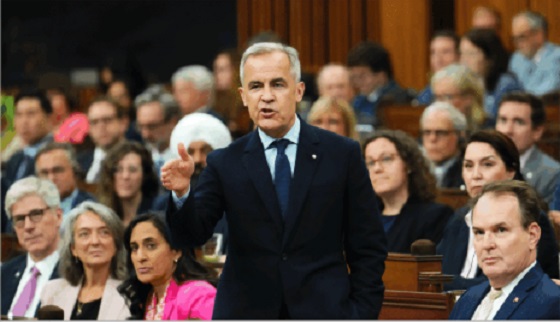

By Gwyn Morgan
Mark Carney was supposed to be the adult in the room. After nearly a decade of runaway spending under Justin Trudeau, the former central banker was presented to Canadians as a steady hand – someone who could responsibly manage the economy and restore fiscal discipline.
Instead, Carney has taken Trudeau’s recklessness and dialled it up. His government’s recently released spending plan shows an increase of 8.5 percent this fiscal year to $437.8 billion. Add in “non-budgetary spending” such as EI payouts, plus at least $49 billion just to service the burgeoning national debt and total spending in Carney’s first year in office will hit $554.5 billion.
Even if tax revenues were to remain level with last year – and they almost certainly won’t given the tariff wars ravaging Canadian industry – we are hurtling toward a deficit that could easily exceed 3 percent of GDP, and thus dwarf our meagre annual economic growth. It will only get worse. The Parliamentary Budget Officer estimates debt interest alone will consume $70 billion annually by 2029. Fitch Ratings recently warned of Canada’s “rapid and steep fiscal deterioration”, noting that if the Liberal program is implemented total federal, provincial and local debt would rise to 90 percent of GDP.
This was already a fiscal powder keg. But then Carney casually tossed in a lit match. At June’s NATO summit, he pledged to raise defence spending to 2 percent of GDP this fiscal year – to roughly $62 billion. Days later, he stunned even his own caucus by promising to match NATO’s new 5 percent target. If he and his Liberal colleagues follow through, Canada’s defence spending will balloon to the current annual equivalent of $155 billion per year. There is no plan to pay for this. It will all go on the national credit card.
This is not “responsible government.” It is economic madness.
And it’s happening amid broader economic decline. Business investment per worker – a key driver of productivity and living standards – has been shrinking since 2015. The C.D. Howe Institute warns that Canadian workers are increasingly “underequipped compared to their peers abroad,” making us less competitive and less prosperous.
The problem isn’t a lack of money; it’s a lack of discipline and vision. We’ve created a business climate that punishes investment: high taxes, sluggish regulatory processes, and politically motivated uncertainty. Carney has done nothing to reverse this. If anything, he’s making the situation worse.
Recall the 2008 global financial meltdown. Carney loves to highlight his role as Bank of Canada Governor during that time but the true credit for steering the country through the crisis belongs to then-prime minister Stephen Harper and his finance minister, Jim Flaherty. Facing the pressures of a minority Parliament, they made the tough decisions that safeguarded Canada’s fiscal foundation. Their disciplined governance is something Carney would do well to emulate.
Instead, he’s tearing down that legacy. His recent $4.3 billion aid pledge to Ukraine, made without parliamentary approval, exemplifies his careless approach. And his self-proclaimed image as the experienced technocrat who could go eyeball-to-eyeball against Trump is starting to crack. Instead of respecting Carney, Trump is almost toying with him, announcing in June, for example that the U.S. would pull out of the much-ballyhooed bilateral trade talks launched at the G7 Summit less than two weeks earlier.
Ordinary Canadians will foot the bill for Carney’s fiscal mess. The dollar has weakened. Young Canadians – already priced out of the housing market – will inherit a mountain of debt. This is not stewardship. It’s generational theft.
Some still believe Carney will pivot – that he will eventually govern sensibly. But nothing in his actions supports that hope. A leader serious about economic renewal would cancel wasteful Trudeau-era programs, streamline approvals for energy and resource projects, and offer incentives for capital investment. Instead, we’re getting more borrowing and ideological showmanship.
It’s no longer credible to say Carney is better than Trudeau. He’s worse. Trudeau at least pretended deficits were temporary. Carney has made them permanent – and more dangerous.
This is a betrayal of the fiscal stability Canadians were promised. If we care about our credit rating, our standard of living, or the future we are leaving our children, we must change course.
That begins by removing a government unwilling – or unable – to do the job.
Canada once set an economic example for others. Those days are gone. The warning signs – soaring debt, declining productivity, and diminished global standing – are everywhere. Carney’s defenders may still hope he can grow into the job. Canada cannot afford to wait and find out.
The original, full-length version of this article was recently published in C2C Journal.
Gwyn Morgan is a retired business leader who was a director of five global corporations.


Over the past few years, I’ve had canvassers coming to my home in Toronto on behalf of a wide range of non-profits – including hospitals and mental health and homeless support organizations. The fundraisers all “wear” a noticeable post secondary student vibe. That’s hardly news.
But curiously, no matter what they’re collecting for, every last one of them uses the exact same methodology. That is, they refuse to take a one-time donation, instead insisting I sign up for six (not seven, and definitely not five) monthly payments. They don’t want me donating online through the organization’s website (explaining that they wouldn’t get credit for that). They do expect me to enter my basic information on a high-end tablet they’re carrying. When that’s done, they’ll use their smartphones to make a call to a remote agent who would take my financial information.
I only completed the process once – for the Hospital for Sick Children (SickKids) in Toronto. But that was mostly because, at the time, they were in the middle of quite literally saving my granddaughter’s life. I couldn’t very well say no.
Because of the paranoia that comes with my background in IT systems administration, I generally don’t participate, explaining that I never share financial information on a call I didn’t initiate. At the same time, these campaigns are not fraudulent and, with the possible exception of UNICEF, they all represent legitimate organizations. Nevertheless, they all come with the clear fingerprints of a third-party, for-profit company. Which makes me curious.
After a little digging, it became clear that a company called Globalfaces Direct was the most likely employer of the face-to-face (F2F) canvassers I’m seeing. It’s also obvious that those canvassers are paid at least partially through revenue-based commissions.
Estimating how much of your donations are actually used for charitable work can be difficult. For once thing, in the case of SickKids, it’s not even clear which organization the money is going to. There at least three related non-profit accounts registered with CRA: The Hospital for Sick Children, The Hospital for Sick Children Foundation, and the SickKids Charitable Giving Fund.
But even where there isn’t such ambiguity we have only limited visibility into an organization’s finances. Covenant House, for instance, issued receipts for $26 million in donations for 2024, but there’s no way to know how much of that came through Globalfaces Direct F2F campaigns. And there’s certainly no public record indicating how much of that $26 million was spent on commissions and overhead. CRA filings for Covenant House do report fundraising costs of $9.4 million in 2024, which was 22 percent of their total spending and 32 percent of all donations.
It’s likely that their $9.4 million in fundraising costs includes Globalfaces Direct’s canvasser commissions and overhead costs. But those are only some of the costs – which likely include events, direct mail, and other in-house efforts. In fact, it’s not unreasonable to assume that only 20-30 percent of each dollar raised through F2F canvassing is actually spent on charity work.
From the perspective of the non-profit, hiring F2F companies can generate new sources of stable, long-term income that would have been otherwise unattainable. Especially if the F2F agreement specifies withholding a percentage of what’s collected rather than charging a flat fee, then a non-profit has nothing to lose. Why wouldn’t SickKids or Covenant House sign up for that?
Of course, a lot of that will depend on how you think about the numbers. Taken as a whole, an organization that spends just 32 percent of their donations on fundraising activities is well within CRA guidelines: “Fundraising is acceptable unless it is a purpose of the charity (a collateral non-charitable purpose).” But if we just looked at the money raised through a F2F campaign, that percentage would likely be a lot higher.
Similarly, CRA also expects that: “Fundraising is acceptable unless it delivers a more than incidental private benefit.” In other words, if a private company like Globalfaces Direct were to realize financial gain that’s “more than incidental”, it might fail to meet CRA guidelines.
Unfortunately, there’s no easy way for donors to assess the numbers on those terms. So regular people who prefer to direct as much of their donation as possible to the actual cause will generally be far better off donating through an institution’s website or, even better, through a single CRA-friendly aggregator like CanadaHelps.org.
But it would be nice if CRA reporting rules clearly broke those numbers down so we could judge for ourselves.
WEF-linked Linda Yaccarino to step down as CEO of X
Eyebrows Raise as Karoline Leavitt Answers Tough Questions About Epstein
“This is a total fucking disaster”
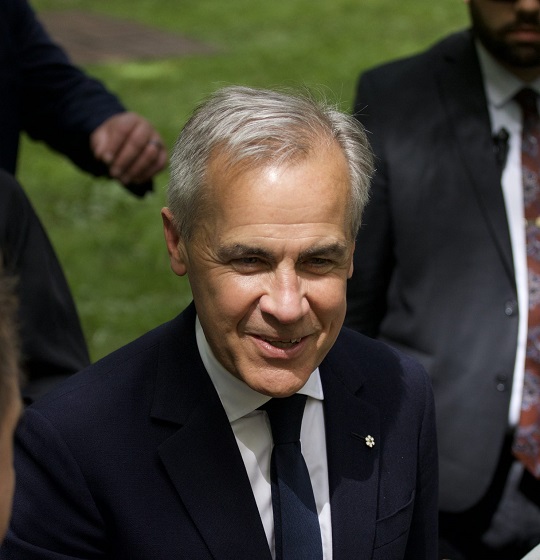
The stars are aligning for a new pipeline to the West Coast

Prime minister can make good on campaign promise by reforming Canada Health Act

Federal government should swiftly axe foolish EV mandate
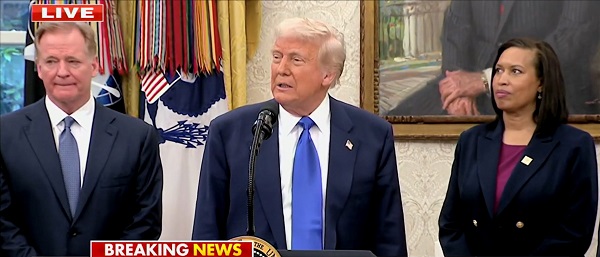
Trump Issues Order To End Green Energy Gravy Train, Cites National Security
-
 Uncategorized14 hours ago
CNN’s Shock Climate Polling Data Reinforces Trump’s Energy Agenda
-
 illegal immigration2 days ago
ICE raids California pot farm, uncovers illegal aliens and child labor
-
 Opinion6 hours ago
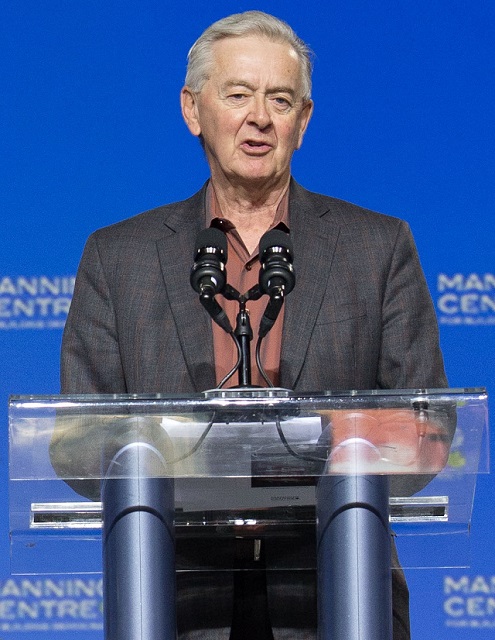
Preston Manning: Three Wise Men from the East, Again
-
 Addictions6 hours ago
Why B.C.’s new witnessed dosing guidelines are built to fail
-
 Business4 hours ago
Carney Liberals quietly award Pfizer, Moderna nearly $400 million for new COVID shot contracts
-
 Business1 day ago
Trump to impose 30% tariff on EU, Mexico
-
 Energy1 day ago
LNG Export Marks Beginning Of Canadian Energy Independence
-
 Business1 day ago
Carney government should apply lessons from 1990s in spending review