
International
Years Of Media Misdirection Over Biden Mental State Are Unraveling Before Our Eyes


 From the Daily Caller News Foundation
By JASON COHEN

Corporate media’s years-long effort to sweep questions about President Joe Biden’s mental fitness under the rug took a devastating blow after his debate with former President Donald Trump.
Voters have long been concerned about Biden’s mental fitness being insufficient to be president, and Republicans have repeatedly raised doubts about his cognitive competence, including during the 2020 campaign as he made numerous gaffes. Despite concerns from Americans, legacy media outlets have consistently downplayed their legitimacy and criticized those who voiced them, even suggesting the narrative of incompetence stems from Russia.
WATCH:
Joe Scarborough, March:
“I’m gonna tell you the truth, and f* you if you can’t handle the truth: This version of Biden is the best Biden ever” pic.twitter.com/RWij2c4Zfg— Philip Reichert (@PhilipReichert) June 28, 2024
CNN published an analysis in August 2021, concluding that concerns about Biden’s cognitive capabilities were mostly a “moot” issue. The analysis suggested it was primarily Republicans who were pushing the narrative that Biden is diminished.
“This is the sort of gross, lowest-common-denominator politics that drive people away from public life,” the analysis by former CNN editor-at-large Chris Cillizza stated. “If Republicans have some sort of proof that Biden is declining, they should bring it forward. If they don’t, they should stop doing what they’re doing. Immediately.”
The NYT published an opinion piece in November 2020 titled “Stop Worrying About Biden’s Age. We Need His Wisdom Right Now” that stated, “I can’t be bothered with the despicable Sleepy-Joe canard that the right is peddling, except to say that if this is what dementia looks like, I don’t know what to call my own flashes of forgetfulness, in which words, keys and hair scrunchies regularly desert me.”
Moreover, The Hill published a piece in November 2019 suggesting Biden’s frequent gaffes are due to a stutter he has had since he was a child rather than cognitive decline.
“Some have been quick to question Biden’s mental fitness, hinting at a possible age-related cognitive decline (he just turned 77 years old), but it’s important to consider that many of those missteps could have been caused by his lifelong struggle with a speech impediment,” The Hill stated.
Special counsel Robert Hur published a report in February finding Biden mismanaged classified documents, but he opted not to seek charges against the president because of the improbability of obtaining a conviction based on the likelihood a jury may perceive the president as “a sympathetic, well-meaning, elderly man with a poor memory.” Corporate media defended Biden’s lucidity and attacked Hur as partisan and deceptive after a transcript of their interview was published, revealing memory lapses, such as appearing to forget when he began and ended his vice presidency and the date of his late son Beau’s death.
For instance, the NYT reported that “Biden appeared clearheaded most of the time” and that he “went into great detail about many matters,” while The Washington Post noted that “Biden doesn’t come across as absent-minded as Hur has made him out to be.”
NBC News acknowledged Biden’s “memory lapses” during the interview, but highlighted the “detailed exchanges” that took place in its headline.
Several clips about Biden in June amassed attention for underscoring the 81-year-old’s diminished fitness and increased gaffes, including the president freezing and wandering off. The White House, in the month leading up to the debate, characterized concerning videos of Biden as “cheap fakes,” and the media picked up on the narrative.
“‘Cheapfake’ Biden videos enrapture right-wing media, but deeply mislead,” a headline by The Washington Post on June 14 read.
“The use of these clips is an especially pernicious couple of examples of manipulated video… because it’s intended to create a false narrative that doesn’t reflect the event as it occurred,” the outlet asserted, stating that the style of editing made them misleading. The NYT published an article titled “How Misleading Videos Are Trailing Biden as He Battles Age Doubts” on June 21, similarly claiming the cropping of the videos makes them deceptive.
The latest panic about Biden’s age and fitness has led to the president facing growing high-profile calls to drop out of the race, such as from a prominent columnist and a Democratic representative. Five significant media publications, including the NYT, called for Biden to withdraw, and two urged him to at least consider it, The Hill reported on Sunday.
“There’s ample speculation online about what the news media did and didn’t do with respect to covering the president’s age,” NYT executive editor Joe Kahn said in a note to NYT journalists on Wednesday that the outlet shared with the Daily Caller News Foundation. “What I’ve seen and what our readers have experienced from our team is steadfast, fact-based reporting on the subject that began a couple of years ago as we documented Biden’s age-related challenges in multiple, industry-leading articles. We have stayed on that story at every turn, always with nuance and context, through today’s outstanding report.”
The coverage of Biden’s competence should have been more intense, some reporters who cover the White House told CNN anonymously on Tuesday. One reporter told the outlet they erred by not probing more after Hur’s report.
“The right-wing media was calling him senile from day one, and that wasn’t true,” the reporter told CNN. “Then whenever you report on the age you were in some ways solidifying, giving credence to some people that were actually of bad faith.”
MSNBC’s “Morning Joe” host Joe Scarborough said in March that the current “version of Biden — intellectually, analytically — is the best Biden ever. Not a close second and I’ve known him for years… If it weren’t the truth, I wouldn’t say it.”
Scarborough asked on Friday, after the debate, if Biden should withdraw from the race, raising concerns about his capability to run the country and beat Trump.
The Washington Post, NBC and The Hill did not respond to the DCNF’s request for comment.


 MxM News
The Small Business Administration is moving to freeze grant money flowing into Minnesota after explosive allegations of large-scale fraud tied to state oversight failures, with SBA Administrator Kelly Loeffler signaling an immediate crackdown following recent independent reporting.
In a series of comments shared publicly by conservative commentator Benny Johnson, Loeffler said the agency is “cutting off and clawing back” SBA grants to the state while investigators dig deeper into what she described as a rapidly expanding fraud network.
Johnson wrote that Loeffler told him she was “disgusted and sickened” after reviewing footage from YouTuber Nick Shirley, whose on-the-ground reporting in Minnesota highlighted what he said were sham daycare and learning centers collecting millions in public funds despite showing little or no sign of legitimate operations.
According to Johnson, Loeffler blamed the situation on Democrat Gov. Tim Walz, accusing his administration of refusing to enforce basic rules governing small businesses and allowing fraud to flourish unchecked.
Johnson said Loeffler told him SBA investigators were able to identify roughly half a billion dollars in suspected fraud within days of focusing on Minnesota, calling the operation an “industrial-scale crime ring” that ripped off American taxpayers.
“Pending further review, SBA is freezing all grant funding to the state in order to stop the rampant waste of taxpayer dollars and uncover the full depth of fraud,” Loeffler said, according to Johnson’s account, adding that the total scope of the scheme remains unknown and could reach into the billions.
The controversy gained national traction after Shirley posted video of himself visiting multiple facilities, including a South Minneapolis site known as the Quality Learning Center, which he reported was approved for federal aid for up to 99 children but appeared inactive during normal business hours.
The center’s sign, Shirley noted, even misspelled the word “learning” as “learing.”
In the footage, a woman inside the building is heard shouting “Don’t open up,” falsely claiming Shirley and his colleague were Immigration and Customs Enforcement agents.
After the video circulated, Rep. Tom Emmer, a Republican, publicly demanded answers from Walz, questioning how such facilities were approved for millions in taxpayer funding.
Shirley’s reporting followed earlier investigations, including a November report by City Journal alleging that members of Minnesota’s Somali community had sent millions of dollars in stolen taxpayer funds overseas, with some of that money reportedly ending up in the hands of Al-Shabaab, a U.S.-designated terrorist organization.
While Walz’s administration has insisted it takes fraud seriously, the SBA’s decision to halt grant funding marks one of the most aggressive federal responses yet, underscoring how rapidly a local scandal has escalated into a national reckoning over oversight, enforcement, and accountability in Minnesota.


From StosselTV
Countries all over the world are imposing digital IDs. They tie your identity to everything you do. Spain’s Prime Minister wants “An end to anonymity online!”
Tech privacy expert Naomi Brockwell @NaomiBrockwellTV warns that’s dangerous. “Privacy is not about hiding,” she tells Stossel TV producer Kristin Tokarev. “It’s about an individual’s right to decide for themselves who gets access to their data. A Digital ID… will strip individuals of that choice.”
The new government mandated digital IDs aren’t just a digital version of your driver’s license or passport. “It connects everything,” Brockwell explains. “Your financial decisions, to your social media posts, your likes, the things that you’re watching, places that you’re going… Everything you say will be tied back to who you are.”
And once everything runs through a single government ID, access to services becomes something you need permission for. That’s already a reality in China where citizens are tracked, scored, and punished for “bad” behavior.
Brockwell warns the western world is “skyrocketing in that direction.” She says Americans need to push back now.
———
To make sure you receive the weekly video from Stossel TV, sign up here: https://www.johnstossel.com/#subscrib...
———

The “Disruptor-in-Chief” places Canada in the crosshairs

UK Police Pilot AI System to Track “Suspicious” Driver Journeys

Judge Declares Mistrial in Landmark New York PRC Foreign-Agent Case

Canadian government launches trial version of digital ID for certain licenses, permits

World-leading biochemist debunks evolutionary theory

Ottawa-Alberta agreement may produce oligopoly in the oilsands

Warning Canada: China’s Economic Miracle Was Built on Mass Displacement
-
 Haultain Research1 day ago
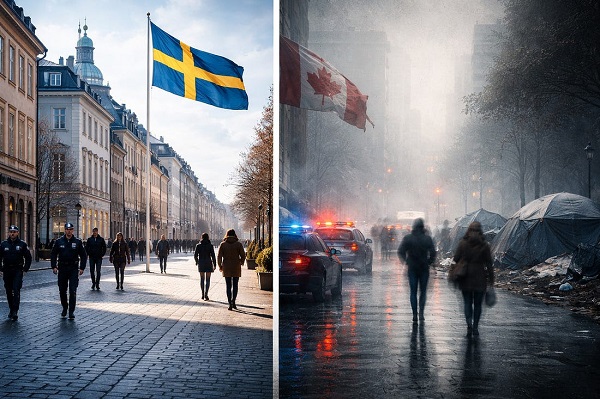
Sweden Fixed What Canada Won’t Even Name
-
 Business1 day ago
What Do Loyalty Rewards Programs Cost Us?
-
 Business18 hours ago
Land use will be British Columbia’s biggest issue in 2026
-
 Energy19 hours ago
Why Japan wants Western Canadian LNG
-
 Business16 hours ago
Mainstream media missing in action as YouTuber blows lid off massive taxpayer fraud
-
 Business15 hours ago
Stripped and shipped: Patel pushes denaturalization, deportation in Minnesota fraud
-
 Energy7 hours ago
Rulings could affect energy prices everywhere: Climate activists v. the energy industry in 2026
-
Digital ID5 hours ago
The Global Push for Government Mandated Digital IDs And Why You Should Worry