Connect with us
[the_ad id="89560"]

Crime

Why is Trump threatening Canada? The situation is far worse than you think!

Published

12 minute read

From LifeSiteNews

By Frank Wright

Multiple reports are proving that Donald Trump’s claims that Canada’s lax approach to fentanyl poses a grave threat is even worse than the U.S. president has stated.

(LifeSiteNews) — A report from the Dana Cambole Show gives a sensational explanation on why U.S. President Donald Trump seems to have Canada in his sights. Her guest on the ITM Trading Channel is the Canadian investigative journalist Samuel Cooper, who says: “Canada has become a node of Chinese infiltration and organized crime activity – especially in Vancouver.”

His bold claim buttresses the accusations made by Trump that the U.S. faces a crisis on its northern border. On February 1, Trump issued an executive order titled, “Imposing Duties to Arrest the Flow of Illicit Drugs Across Our Northern Border” 

In it, Trump said his measures to impose punishing trade tariffs were to address the “challenges” presented by the “Gang members, smugglers, human traffickers, and illicit drugs of all kinds [which] have poured across our borders and into our communities.” 

He said the Canadian government had failed in its duty to address these issues. 

“Canada has played a central role in these challenges, including by failing to devote sufficient attention and resources or meaningfully coordinate with United States law enforcement partners to effectively stem the tide of illicit drugs.” 

Is Trump ‘invading’ Canada?

These bold claims have been interpreted as a means of dictating to – or even “annexing” Canada. This has “soured relations” with Canadians, as the Chinese Toronto-based journalist Kevin Jiang reports. 

Some critics argue Trump is not serious about fentanyl or crime, and is simply undermining Canadian sovereignty and even threatening to “invade” Canada.   

So, is what Trump says about Canada’s crime and border problem true?

Canada has become a Chinese drug production hub

Called “Wilful blindness: how a network of narcos tycoons and CCP agents have infiltrated the West,” its cover illustrates what Cooper sees as the center of a network of Chinese corruption and crime.   

“The cover shows a graphic photo of Vancouver on a world map with fentanyl pills exploding out of Vancouver going around the world.”  

“Vancouver has become a production hub for China and a trans-shipment hub for fentanyl precursors.”

Cooper says that whilst he is “not pleased with Donald Trump’s rhetoric,” he maintains, “This gets to what Donald Trump is saying.”

“It’s hard for many people to believe that Canada could be put in the same category as Mexico in terms of endangering the United States with fentanyl, illegal immigration and human trafficking,” Cooper says, before adding “…but my research has showed that indeed this is the fear and concern of the U.S. intelligence Community, military and law enforcement.”

Decades of Canadian weakness

How has this happened? Cooper says the problem has been brewing for years.  

“For decades Canada’s weak enforcement against transnational crime weak, and control of borders has allowed international organized crime with linkages to hostile States – most specifically China but also Iran.”

His claims seem astonishing, and yet recent news reports all support his – and Trump’s – conclusions. 

The biggest fentanyl superlab in the world

The top story on the Vancouver Sun today is the discovery of the biggest fentanyl factory in Canadian history. The owner, who is Canadian, did not name the tenants who used his property to build “Canada’s largest ever fentanyl superlab.”

“The Abbotsford man who owns the Falkland property where Canada’s largest-ever fentanyl superlab was discovered in October says he was just the landlord and unaware of what was going on there.”  

David Asher, senior fellow at the Hudson Institute, said it was in fact the largest fentanyl production site in the world, and was certainly linked to “Chinese organized crime.”

Speaking to Rosemary Barton on the Canadian Broadcasting Corporation, Asher explained on February 9, “I think they are sitting on a big scandal here. How many other labs do you think they have going?” 

Asher, who has advised the U.S. State department on countering money laundering and terrorism financing, claimed “there’s very little border enforcement going on” in Canada, dismissing claims by the Canadian media that Canada’s cross-border drug trafficking into the U.S. was insignificant compared to that of Mexican cartels on the U.S. southern border. 

Asher further claims that Mexican cartels are in fact transporting drugs by ship to Canada to be trafficked into the U.S., because “you have almost no port enforcement with police.”

In response to allegations made by the Trump administration that there is a security crisis on the northern border of the U.S., Canada has appointed a “fentanyl Czar,” promised to share more intelligence with the U.S., and said it is stepping up police checks and border controls.  

These measures led to the 30 day “pause” of the threatened tariffs on Canadian trade with the U.S. 

Canadian law is ‘crazy’

So what’s the U.S. government’s problem with Canada?  

Asher praises the federal Royal Canadian Mounted Police (RCMP) but says the problem is Canadian law. Specifically, “The Stinchcombe Law” – a landmark ruling which Asher says means the Canadian police have to inform criminals they are watching them.  

“Basically every time we try to go up on a phone number in Canada almost all the money laundering network is tied to China – and 90% percent of all the money laundering in the United States is tied to Canada.”

“So when we try to go up on those numbers with your police they have to inform the person that we are targeting that we are targeting their number. That’s crazy. How can we run an undercover police operation with your country?”  

Asher explains why claims in the media that low seizure rates of fentanyl from Canada do not give the real story. 

“Which is why we don’t run them. Which is why the seizure statistics are so low. We don’t even try to work with Canada because your laws are distorted.” 

Asher recommends the passing of a RICO act – which he says “I think you’re going to do,” adding this will “solve these problems” in permitting law enforcement to correctly designate these networks as “criminal and racketeering operations” – and as a form of “terrorism.” Asher, together with Cooper, says Iran is also involved in drug trafficking in Canada. 

When asked whether fentanyl and money laundering are the “real reason” for Trump’s threats, Asher said, “yes,” concluding: “Our countries are getting killed by fentanyl. We gotta protect ourselves.”

The Supreme Court of Canada appears to agree, ruling last December that constitutional privacy can be violated to address the national “opioid crisis.”

Massive money laundering operation

Is there any basis in reality for Asher’s claims on the scale of money laundering from Canada? Reports on the actions of the second biggest bank in Canada would suggest there is.  

Last May Canada’s Toronto Dominion (TD) Bank was hit with the largest fine in history for money laundering, initially being ordered to pay around 9 million dollars. 

In October 2024, following an investigation of its U.S. operations, TD Bank agreed to pay 3 billion dollars in fines. It had been found in one case to have “…facilitated over $400 million in transactions to launder funds on behalf of people selling fentanyl and other deadly drugs.”

Reuters reported the bank had “…failed to monitor over $18 trillion in customer activity for about a decade, enabling three money laundering networks to transfer illicit funds through accounts at the bank.” Employees had “openly joked” about the “lack of compliance “on multiple occasions.” 

The Wall Street Journal reported on May 3, 2024 that the U.S. Department of Justice (DOJ) was conducting an “investigation into TD Bank’s internal controls” which “focuses on how Chinese crime groups and drug traffickers used the Canadian lender to launder money from U.S. fentanyl sales.”

Reuters added how TD Bank’s “internal controls” had came under investigation, “since agents discovered a Chinese criminal operation bribed employees and brought large bags of cash into branches to launder millions of dollars in fentanyl sales through TD branches in New York and New Jersey.”  

The charges against Canada are supported by facts presented by people who support and do not support Donald Trump, and the actions of Chinese billionaires and their comfortable relationship with Canadian law have been reported for years.   

Though Trump’s habit of making headline-grabbing threats to secure agreement may be shocking, what is perhaps most shocking of all is to find out the facts behind the headlines are more damning than his description of the problem. Trump’s solution, as Asher outlines, appears not to be “annexation” but the restoration of law and order and the exposure of corruption.

Crime

Inside the Fortified Sinaloa-Linked Compound Canada Still Can’t Seize After 12 Years of Legal War

Published on

Exclusive analysis shows how a fortified Surrey mansion tied in court filings to the Sinaloa Cartel’s leader has become the core of a stalled civil forfeiture fight, exposing Canada’s weak laws.

A British Columbia government lawsuit seeks to merge almost a decade of litigation into a single, high-stakes test of whether the province can finally seize a fortified mansion near the U.S. border that was first swept up in a 2014 fentanyl investigation, raided in 2016, and is now at the center of a new synthetic-opioid case alleging its occupants contracted with the leader of Mexico’s Sinaloa Cartel to flood narcotics into Canada.

In a notice of application filed in November 2025, the Director of Civil Forfeiture argues that all of the files revolve around one owner — James Sydney Sclater — and his flagship property on 77th Avenue, a multi-million-dollar house about twenty minutes’ drive from the Peace Arch crossing.

The property became newly notorious this spring when the latest effort to seize it pulled back the curtain on a 2024 RCMP raid. Officers say they entered a mansion ringed by compound fencing, steel gates and razor wire, wired with Chinese-made Hikvision surveillance cameras and hardened doors.

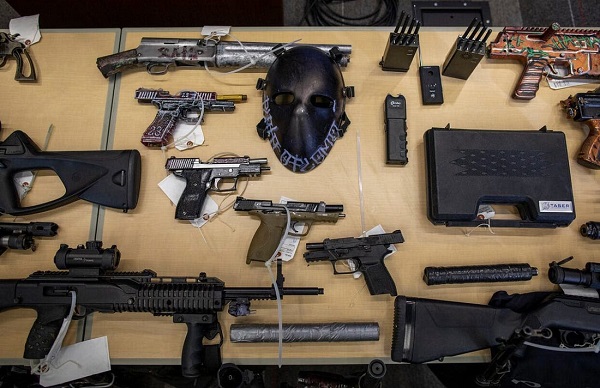
Inside, they reported finding hidden compartments in bedrooms and a basement bathroom packed with counterfeit pills and kilograms of raw synthetic opioids — including fentanyl — while assault-style rifles with screw-on suppressors, thousands of bullets and other firearms and body armour were stored in ways that suggested the residents were prepared for urban warfare. Investigators later alleged the targets had “connections to virtually every criminal gang in British Columbia.”

They also seized travel documents, including Mexican visas, before tracing the operation to alleged negotiations with Ismael “El Mayo” Zambada García, the reputed head of the Sinaloa Cartel, which Ottawa has now listed as a terrorist entity.

But for Canadian anti-mafia units, the address tracks the history of fentanyl’s deadly sweep across British Columbia, among the hardest-hit opioid death zones in North America. Their interest in the Surrey mansion stretches back to the first wave of lethal fentanyl trafficking that surged from Vancouver’s Downtown Eastside to Victoria and Vancouver Island around 2013 — making this single property a through-line in the North American opioid crisis, one that now runs through senior offices in Washington, Mexico City, Beijing and Ottawa.

Behind the hundreds of pages of civil filings reviewed by The Bureau lies a failure of governance as urgent as the unchecked advance of Latin cartels into Canadian cities — and as lethal as the synthetic opioids tied to the Surrey home.

British Columbia has been chasing the same house, and the same alleged transnational traffickers, through raids, affidavits and Charter of Rights battles since before fentanyl became a household word — and still has not managed to take the keys away.

The case documents explicitly point to a criminal-defence-friendly Supreme Court of Canada ruling — Stinchcombe, notoriously cited by police leaders — and to its role in undermining numerous major prosecutions involving networks tied to alleged narcoterror suspect Ryan Wedding and modern Canadian fentanyl-lab operators. One of those networks is the Wolfpack, a hybrid of Mexican cartels, Middle Eastern threat networks and biker gangs said to be supplied by Chinese Communist Party–linked criminal organizations and other Latin American cartel interests.

For the Director, the newest chapter begins in earnest with an RCMP raid on September 23, 2024. By then, investigators say, the Surrey mansion was no longer a domestic drug base, but the Canadian end of a supply line reaching into Sinaloa itself. Notably, 38 days later, on October 31, the RCMP announced a separate raid on what U.S. sources describe as the largest fentanyl lab ever discovered in the world, in rugged Falkland, B.C., roughly halfway between Vancouver and Calgary.

“The combined fentanyl and precursors seized at this facility could have amounted to over 95,500,000 potentially lethal doses of fentanyl, which have been prevented from entering our communities, or exported abroad,” the Mounties said.

But Sinaloa does not appear out of nowhere in the Surrey compound. The older case that the Director now wants consolidated onto the same track reaches back to a different phase of the crisis — and sketches an earlier incarnation of the Surrey house as a node in a Lower Mainland fentanyl network.

According to a 2019 notice of civil claim filed in the Victoria registry, the RCMP’s Project E-Probang began in November 2014, targeting a chemical narcotics distribution network that operated across the Lower Mainland and Vancouver Island. At the centre of that probe, police say, was Nicholas Lucier and his associates. The Director alleges that Sclater supplied Lucier’s network with controlled substances, while his father-in-law Gary Van Buuren lived with him at the 77th Avenue property and “assisted him in trafficking of controlled substances.”

The narrative that follows reads like a blueprint for mid-2010s fentanyl tradecraft. In October 2016, Lucier associate Yevgeniy Nagornyy-Kryvonos allegedly drove to the Surrey mansion to receive fentanyl from Sclater. Two days later, Nagornyy-Kryvonos met Daemon Gariepy; Gariepy was arrested shortly after that meeting, with one kilogram of fentanyl in his possession. On November 6, 2016, Sclater and Van Buuren visited the Surrey home of another associate, Azam Abdul. Van Buuren was picked up soon afterwards, allegedly carrying a kilogram of methamphetamine, a kilogram of fentanyl and two cellphones.

That same day, RCMP officers moved in on 16767 77th Avenue with a warrant. Inside, according to the pleadings, they found the kind of infrastructure that exists to supply major drug lines: long guns and improvised weapons scattered through the house, from conventional shotguns and rifles to a deactivated grenade, brass knuckles and a small armoury of knives, batons and throwing stars. There was a money counter parked near vacuum-sealing equipment; shelves of drug-packaging and currency-bundling materials; a body armour vest; and a banknote stash of roughly $20,000 in twenties, bundled with elastic bands and tucked into vacuum-sealed bags.

Fentanyl-containing pills and scoresheets documenting transactions sat alongside a multi-monitor surveillance system and a wiretap-detection kit. In a separate corner, tax records in Sclater’s name showed his declared income stepping down from more than $77,000 in 2010 to just over $11,000 by 2014 — data points that undermined his ability to carry mortgages on two Surrey properties.

The days that followed widened the picture.

A search at Abdul’s residence turned up scales, fentanyl and the tools of drug production and processing. Raids at Lucier’s home and two rentals he allegedly used produced what the Director describes as a haul worth a serious cartel’s attention: weapons and ammunition, more than $2-million in cash, and “thousands of grams” of fentanyl, cocaine, methamphetamine, a heroin-fentanyl mixture, fentanyl “oxy” tablets and MDMA, along with the scoresheets and processing gear that underpin a wholesale operation.

On Vancouver Island, an arrest search of Lucier allegedly produced tens of thousands of dollars in cash and multiple phones.

Lucier had been on Canadian police radar since at least the mid-2000s, and his story intertwines with the murder of B.C. cocaine broker Tom Gisby in Mexico — a killing that, according to a Canadian police source interviewed by The Bureau, formed part of a bloody consolidation of Mexican cartel power over Vancouver’s drug markets.

Lucier’s notoriety stretches back to October 2009, when Victoria police announced what they described as the city’s largest-ever cocaine bust. After a three-month undercover probe triggered by a shooting near Beacon Hill Park, nearly 100 officers carried out pre-dawn raids on five locations around the capital region, seizing roughly 22.5 kilograms of cocaine, four high-powered handguns, two vehicles and about $420,000 in cash. Lucier, then 41 and already on parole from a 2007 trafficking sentence involving multi-kilogram quantities of cocaine and heroin, was the lone suspect to slip away; a Canada-wide warrant was issued for his arrest.

In 2012, police in Mexico’s Nayarit state announced they had arrested Lucier in the Pacific resort city of Nuevo Vallarta on the outstanding Canadian warrant — the same town where Gisby, a longtime player in British Columbia’s cocaine trade, had been shot dead days earlier while ordering coffee at a Starbucks. Mexican authorities said Lucier had been living under an assumed name and socializing with other Canadian expatriates in the Puerto Vallarta area, including people who knew Gisby, although his arrest was not believed to be directly tied to the murder.

For investigators, the episode underscored how Canadian traffickers were deeply embedded in Mexican resort corridors from Mazatlán to Cancún that doubled as hubs for cartel-linked players from the north. In the years that followed, it would be former Canadian snowboarder Ryan Wedding — tightly associated with the Wolfpack networks tied to Western Canada’s fentanyl superlabs — who, according to U.S. government sources, rose above other Canadian narcos in those resort towns to become perhaps the single conduit for Latin American–supplied narcotics imported into Canada for both domestic consumption and onward transshipment.

The Bureau is a reader-supported publication.

To receive new posts and support my work, consider becoming a free or paid subscriber.

No Charges on Fentanyl Network

E-Probang era investigations underpin the 2019 civil claim that seeks forfeiture of both the 77th Avenue mansion and a second property at 15797 92nd Avenue. The Director’s position is that the homes were purchased and maintained with money that cannot be reconciled with Sclater’s reported earnings and should be treated as the proceeds of crime.

According to an amended notice of civil claim filed in May 2025, Sclater shared the 77th Avenue house with Hector Armando Chavez-Anchondo and John Brian Whalen, while Whalen’s father, John Edwin Whalen, and Brittany Anne Horvey are drawn into the case through their alleged roles in what the Director calls a drug trafficking organization, or DTO. The court filings describe not a loose circle of dealers, but a structured group that trafficked ketamine, methamphetamine, counterfeit Xanax, oxycodone, MDMA and fentanyl, and that “since June 2021 at the latest” had been working to import bulk cocaine from Mexico.

As the Director tells it, those efforts led straight to Sinaloa itself. The Surrey group is alleged to have agreed to purchase cocaine from senior cartel suppliers — operating at such scale, sophistication and power within Canada that they ultimately negotiated directly with alleged cartel boss Ismael “El Mayo” Zambada García.

When U.S. authorities arrested El Mayo on July 25, 2024, the Surrey operation is said to have lurched sideways, searching for “other parties” to keep the cocaine pipeline alive. In early September, Sclater, Chavez-Anchondo and Whalen Jr. allegedly pooled money to secure a shipment, then drove out to a rendezvous where they expected to collect their imported cocaine. According to the filings, their transport contact never materialized, and they returned to Surrey empty-handed.

Eleven days later, the RCMP arrived with a search warrant. Inside the mansion, officers reported walking into what looked more like a mid-level cartel outpost than a suburban home: firearms racked and stashed in multiple rooms, including assault-style rifles with screw-on suppressors and piles of ammunition, suggesting residents lived with the expectation of raids or perhaps clashes with some of the six other Mexican cartel networks aside from Sinaloa that have been identified in Canada by federal police.

Hidden compartments had been carved into bedrooms and a basement bathroom, where police say they found kilogram-scale quantities of ketamine and methamphetamine, counterfeit alprazolam tablets pressed to resemble Xanax, hundreds of oxycodone pills, a smaller but potent stash of fentanyl, and bundles of Canadian cash tucked away in a manner seasoned investigators instantly recognized — elastic-bound bricks, some vacuum-sealed, packed tightly enough to hint at far more money moving through the house than Sclater’s tax returns would ever show.

Downstairs, a kitchen freezer allegedly doubled as a storage vault for nearly a kilogram of MDMA; elsewhere, RCMP catalogued an Azure pleasure boat, a stable of trucks and custom motorcycles, gold jewellery and two Hikvision digital-video recorders that formed the core of a security system surveying the compound. The Director’s case is that neither Sclater nor his co-defendants had legitimate income capable of supporting that lifestyle, and that the house was both the proceeds and instrument of unlawful activity.

The timing was not incidental. Ottawa formally listed the Sinaloa Cartel as a terrorist entity on February 20, 2025, as one of seven Latin American criminal organizations added to Canada’s Criminal Code list in response to the fentanyl crisis and mounting U.S. pressure.

The Director’s pleadings lean into that backdrop, explicitly calling Sinaloa a terrorist entity and portraying 16767 77th Avenue as part of the infrastructure of a cartel now placed at the centre of a transnational security crisis.

While the alleged facts of police raids against the Surrey mansion seem to move steadily, the apparent lack of criminal charges against any of the targets — let alone a racketeering-style case against the network itself, which is effectively impossible to mount in Canada, where there is no U.S.-style RICO statute — reveals a litigation record that can fairly be described as broken and ineffectual, except from the perspective of criminal-defence lawyers and their clients.

The Director’s Victoria-based action was filed on May 22, 2019.

Sclater responded months later, disputing the forfeiture. In December 2019, the province produced its list of documents. Sclater replied in January 2020 with a list that named no documents at all. Over the next two years, Crown counsel sent a steady stream of letters — in March 2020, August 2021, and repeatedly between October 2021 and March 2022 — demanding a proper list and the financial and property records that would show how Sclater funded his holdings.

In a 2022 application, the Director’s frustration spilled onto the record. The submission notes that under the Civil Forfeiture Act, the core question is whether the Surrey properties are proceeds or instruments of unlawful activity — and that without basic financial disclosure, there is no way to test Sclater’s claim that they were acquired lawfully. The Director points out that documents showing income sources, mortgage servicing, and the acquisition and storage of weapons “are critical to a determination of the action on its merits,” and accuses Sclater of refusing or neglecting, for almost three years, to meet even the baseline disclosure duties imposed by the civil-procedure rules.

To head off what it casts as an attempt to turn the case into a criminal-style disclosure standoff, the Director leans on British Columbia v. PacNet Services Ltd., where the court rejected defence arguments that tried to graft the Supreme Court’s Stinchcombe-era criminal disclosure standards onto civil forfeiture proceedings. R. v. Stinchcombe — the 1991 Supreme Court of Canada decision that imposed a broad duty on the Crown to disclose all potentially relevant information so an accused can make full answer and defence under section 7 of the Charter — is firmly rooted in criminal procedure. Echoing that line of authority, the Director argues that there is “no justification” for Sclater to shelter behind Stinchcombe to avoid producing his own financial and property records, and tells the court it is “time to move [the case] forward,” with full document production or a lawful explanation for the default.

The Bureau is a reader-supported publication.

To receive new posts and support my work, consider becoming a free or paid subscriber.

Constitutional Test

The newer Sinaloa-linked file adds another layer of complexity. Four of the five named defendants — Chavez-Anchondo, the two Whalens and Horvey — have not filed responses. In a separate notice of application, the Director now asks the court to treat the core allegations against them as admitted by default: that they were members of a drug trafficking organization; that they used or threatened violence; that they trafficked a catalogue of synthetic drugs and opioids; that they negotiated with Sinaloa; and that the weapons, cash and assets found in the 2024 raid are instruments and proceeds of crime.

For his part, Sclater is trying to turn the Surrey files into a constitutional test case. In his latest defence, he claims a lawful ownership interest in the 77th Avenue property, certain vehicles, cash, jewellery and electronic devices, and denies every allegation that he joined a criminal organization, conspired to import cocaine from Mexico, or negotiated with El Mayo. He acknowledges having a criminal record but disputes the particulars, and insists he had sufficient legitimate income to fund his properties and toys.

More ambitiously, he argues that the Civil Forfeiture Act itself is unconstitutional. By using allegations that he failed to declare taxable income as part of the proceeds-of-crime theory, he says, the province is encroaching on the federal government’s exclusive power over taxation under the Constitution Act, 1867. Assessing taxes owed, he points out, is the business of the Minister of National Revenue and the Tax Court of Canada. Civil forfeiture, in his view, cannot be used as a kind of shadow tax audit. He also asserts that the case “has arisen solely” from breaches of his Charter rights by RCMP officers and other state actors, arguing that the Director — “also an agent of the state” — is improperly relying on those breaches in seeking forfeiture.

It is, in effect, a bid to turn a forfeiture trial about a Surrey mansion into a referendum on how far provincial authorities can go in dismantling alleged drug networks without turning civil litigation into a criminal prosecution by another name.

All of this is unfolding against a national and continental backdrop that makes the Surrey house look less like an isolated problem than a symbol of a wider national failure.

Under National Fentanyl Sprint 2.0, Canadian police and partner agencies seized 386 kilograms of fentanyl and analogues between May 20 and October 31, 2025, with Ontario and British Columbia accounting for more than 90 per cent of that total. British Columbia reported 88 kilograms of seized fentanyl during the sprint. Yet those numbers miss some of the most alarming data points. Just days before the sprint window opened, Canada Border Services Agency officers at the Tsawwassen container facility in Delta intercepted more than 4,300 litres of chemicals from China, including 500 litres of propionyl chloride — a direct fentanyl precursor — and other substances capable of feeding clandestine labs in the Canadian wilderness for years. That shipment was destined for Calgary, and conservative estimates suggest it could have yielded enough fentanyl for billions of potentially lethal doses.

The Carney government continues to insist that Canada is primarily an end market, not a major exporter, and CBSA officials emphasize that only “small, personal doses” of finished fentanyl are being found heading south.

Seen from that angle, the fight over one Surrey mansion and the man who owns it becomes more than a story of Mexican cartels embedding in British Columbia’s wealthy suburbs.

It is a test of whether Canada’s patchwork of civil forfeiture laws, criminal prosecutions and Charter-driven disclosure rules can keep pace with transnational networks that blend Chinese chemical suppliers, Mexican cartels and domestic labs into a single system. For now, many Canadian police experts acknowledge in private — and some senior leaders flag in cautious public statements — that this test is being failed, and failed egregiously.

The Bureau is a reader-supported publication.

To receive new posts and support my work, consider becoming a free or paid subscriber.

Continue Reading

Crime

Vancouver police seize fentanyl and grenade launcher in opioid-overdose crisis zone

Published on

Sam Cooper's avatar Sam Cooper

Vancouver police say they have seized a grenade launcher, four guns, and nearly 500 grams of fentanyl and other hard drugs from a fortified Downtown Eastside rooming house that was allegedly feeding a synthetic opioid supply line through the city’s most drug-ravaged blocks.

“Task Force Barrage has come to an end, but our work to curb violence and disrupt organized crime in the Downtown Eastside continues,” Sergeant Steve Addison said, adding “the proliferation of violence and weapons in some residential buildings continues to put the neighbourhood at risk.”

The latest investigation began November 13, when a 42-year-old man suffered serious injuries in an assault near Carrall Street and East Cordova and was taken to hospital. Officers followed leads to a rooming house at 50 East Cordova Street, in the heart of a street-level open drug market that has become notorious in photos and news clips around the world.

On November 18, police say they uncovered a stockpile of illicit drugs, guns and weapons in three rooms of the East Cordova building. According to Addison, there are signs that parts of the property, which is supposed to house low-income residents, were repurposed as a hub to store weapons and distribute contraband throughout the neighbourhood, with some areas “fortified with countersurveillance measures to avoid detection from law enforcement.”

Items seized include four firearms, two imitation guns, a grenade launcher, a firearm suppressor, seven machetes, four flare guns, bullwhips, baseball bats, body armour, handcuffs and ammunition. Officers also seized 486 grams of fentanyl, cannabis, Dilaudid pills and methamphetamine – a quantity police say represents more than 2,500 single doses.

Meanwhile, in a separate update posted November 26 — the day before VPD announced the Cordova Street raid — Vancouver Fire Rescue Services said that on Tuesday, November 21, firefighters responded to 54 overdoses, the highest single-day total in the department’s history. The service said it averaged about 16 overdose calls per day in May, but that figure has surged in recent weeks, and during the most recent income-assistance week, firefighters were averaging roughly 45 overdose responses per day.

While police have not publicly linked the East Cordova seizure to any specific cartel, the mix of fentanyl, fortified real estate and a small armoury of weapons closely tracks the profile of a separate, high-profile British Columbia case in which provincial authorities say a Sinaloa Cartel–aligned cell embedded itself just south of Vancouver.

In that case, a civil forfeiture lawsuit alleged a Sinaloa Cartel–linked fentanyl and cocaine trafficking group set up in a multi-million-dollar mansion near the U.S. border, capable of negotiating major cocaine import deals with Ismael Garcia—known as “El Mayo”—the reputed Sinaloa Cartel chief. According to the filings, the Canada-based syndicate involved at least three men, and belonged to a violent drug trafficking organization that “used and continues to use violence, or threats of violence, to achieve its aims.”

Investigators alleged the Surrey-based group trafficked ketamine, methamphetamine, Xanax, oxycodone, MDMA and fentanyl. “As part of these efforts, the drug trafficking organization has agreed to, and made arrangements to, purchase cocaine from the Cártel de Sinaloa in Mexico,” the filings stated. They added: “the Sinaloa Cartel is a terrorist entity, and the government of Canada listed it as such on February 20, 2025.”

RCMP said they uncovered a substantial cache of weapons and narcotics during a search of the Surrey property on 77th Avenue on September 23, 2024. Opioids seized from the mansion included 400 grams of counterfeit Xanax, 810 oxycodone pills, 5.5 grams of fentanyl and nearly a kilogram of Ecstasy. The province is now seeking forfeiture of the house, which sits about 20 minutes from the Peace Arch border crossing north of Seattle.

Court submissions detailed an arsenal of 23 weapons – ten handguns, two sawed-off shotguns, two hunting rifles, seven assault rifles (two reportedly fitted with screw-on suppressors), and a speargun – alongside about 3.5 kilograms of ketamine and methamphetamine hidden in a compartment in one suspect’s room, hundreds of counterfeit alprazolam pills, a stash of oxycodone, and nearly CAD 15,000 in bundled cash “not consistent with standard banking practices.”

Viewed together, the Downtown Eastside raid and the Surrey mansion case sketch out different ends of what appears to be the same continuum, ultimately pointing to senior criminal leaders in Mexico and China.

The Bureau is a reader-supported publication.

To receive new posts and support my work, consider becoming a free or paid subscriber.

Continue Reading

Trending

X