
Frontier Centre for Public Policy
Why is Trudeau sticking to the unmarked graves falsehood?


From the Frontier Centre for Public Policy

There is simply no possibility that Trudeau didn’t know on June 17th, 2024 that he was spreading misinformation when he said that unmarked graves were found. In plain English — he knew he was lying.
The claim made by Chief Rosanne Casimir on May 27th, 2021, that the remains of 215 children, former students of the Kamloops Indian Residential School (KIRS) had been found in unmarked graves on the school grounds, was false.
Only soil anomalies were detected by a radar device. Those anomalies could be tree roots, previous excavations, or almost anything. In fact, research since that time makes it clear that the anomalies were almost certainly the trenches of a former septic field installed in 1924 to dispose of the school’s sewage.
No “unmarked graves”, “human remains”, “bodies” or “mass graves” were found.
Chief Casimir finally confessed to making that false claim three years after making it. She admitted what was known to most of all along: no graves, human remains, or bodies were found — only 215 “anomalies”.
So, everyone in Canada now knows that the May 27th, 2021 claim of unmarked graves containing human remains found at Kamloops was false. Everybody except the prime minister it seems, and his former Indigenous Affairs Minister, Marc Miller.
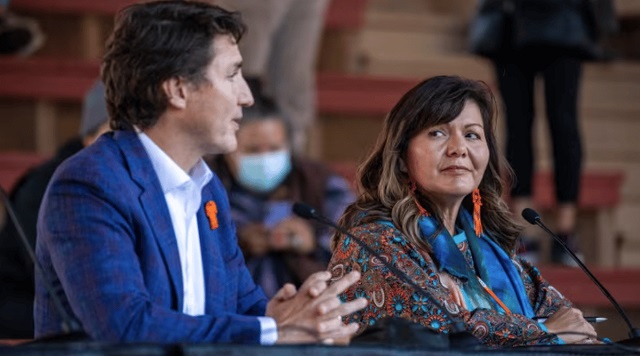
However on June 17th, 2024, Prime Minister Trudeau — instead of taking the opportunity to set the record straight — repeated at an indigenous event the whopper that “unmarked graves” have been found. He has been spreading that misinformation for three years.
One would think that now that the person who originally made the false claim has admitted that no graves were found — only anomalies — that Trudeau would take the opportunity to clear up the confusion and go with the truth, instead of repeating the original lie.
There is simply no possibility that Trudeau didn’t know on June 17th, 2024 that he was spreading misinformation when he said that unmarked graves were found. In plain English — he knew he was lying.
So, why would he do such a thing? Doesn’t a prime minister have a duty to refrain from deliberately lying to Canadian citizens? After all, the great majority of Canadians know by now that no graves were found at Kamloops.
The only answer that makes sense is that the Prime Minister was not speaking to all Canadians on June 17th, 2024. He was speaking only to indigenous Canadians when he falsely stated that unmarked graves had been found at Kamloops. He was repeating a lie they believed. They believed that lie in large part because he and Marc Miller were doing their best to keep the lie alive.
Everything that he and his colleagues have done since May 27, 2021 — lowering flags, kneeling with a teddy bear in an ordinary community cemetery, lavishing money on indigenous communities to search for missing children he knows were never “missing” — has been done to pander to an indigenous community that largely believes those false stories about evil priests and secret burials. I repeat — believes that anti- Catholic bilge in large part because the Trudeau Liberals have encouraged them to believe it.
What has come to be known as the “Kamloops Graves Hoax” is now known to most Canadians for what it is — a false claim. However, we have a prime minister who, for his own reasons, seems intent on keeping the hoax going within the indigenous community. The deception being practiced by the prime minister will have serious consequences in the years ahead. And those consequences are all negative.
Prime ministers come and go. Some remain popular throughout their term, but some become increasingly unpopular. For example, the late Brian Mulroney was so unpopular with Canadians toward the end of his term that the Conservatives, led by his successor, Kim Campbell, were virtually wiped in the election following his retirement.
Trudeau’s fate remains to be seen.
However, that is just politics. But what Trudeau is doing, in deliberately lying to an already marginalized demographic that has a history of being lied to by indigenous and non-indigenous politicians, is not just politics. It is reprehensible conduct. Those people are going to be very angry when they realize that they have been deceived.
Under Trudeau’s watch, we have already seen churches burn, statues topple, and other mayhem as a result of a claim that the PMO knows is false.
Exactly why he is practicing this deception we do not know. We do know with certainty that Indigenous Affairs Minister Marc Miller spoke with Chief Rosanne Casimir on the evening of May 27, 2021, immediately after she made her false claim that the remains of 215 children, who were students at KIRS, had been found. Here’s what he said about his May 27, 2021 telephone conversation with Casimir, according to Hansard:
“On Thursday evening, I spoke to Chief Casimir and assured her of my steadfast support for the grieving and reconciliation process over the coming weeks. We have been in contact since then as well. We will be there with them as they lead this initiative, and we will help meet their needs in the coming weeks and months.”
Unless Chief Casimir told Miller that “remains” had been found, and not the truth — that only anomalies had been detected — the Trudeau government and the Kamloops band together, for reasons unknown, created the false narrative that the remains of 215 children had been found, knowing that their claim was false. Why did this happen?
The prime minister is now keeping this false narrative alive, knowing that it was, and is, false. Why is he doing this?.
And why are the CBC and our mainstream media not even trying to find out?
Something is very wrong here.
Brian Giesbrecht, retired judge, is a Senior Fellow at the Frontier Centre for Public Policy

From the Frontier Centre for Public Policy
By Collin May
Targeting comedians is a sign of political insecurity
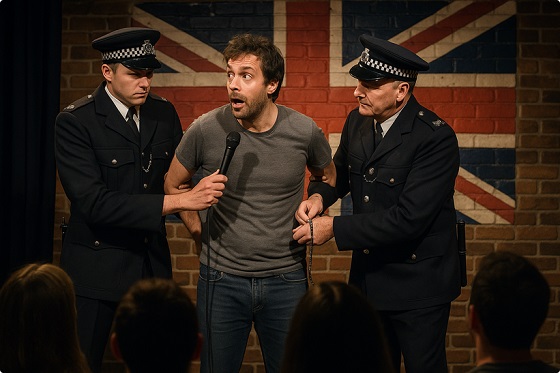
A democracy that fears its comedians is a democracy in trouble. That truth landed hard when Graham Linehan, the Irish writer behind Father Ted and The IT Crowd, stepped off a plane at Heathrow on Sept. 1, 2025, and was met by five London Metropolitan Police officers ready to arrest him for three posts on X.
Returning to the UK from Arizona, he was taken into custody on the charge of “suspicion of inciting violence”, an allegation levelled with increasing ease in an age wary of offence. His actual “crime” amounted to three posts, the most contentious being a joke about trans-identified men in exclusively female spaces and a suggestion that violated women respond with a swift blow to a very sensitive part of the male’s not-yet-physically-transitioned anatomy.
The reaction to Linehan’s arrest, from J.K. Rowling to a wide array of commentators, was unqualified condemnation. Many wondered whether free speech had become a museum piece in the UK. Asked about the incident, British Prime Minister Keir Starmer defended his country’s reputation for free expression but declined to address the arrest itself.
Canada has faced its own pressures on comedic expression. In 2022, comedian Mike Ward saw a 12-year legal saga end when the Supreme Court of Canada ruled five-to-four that the Quebec Human Rights Commission had no jurisdiction to hear a complaint about comments Ward made regarding a disabled Quebec boy. The ruling confirmed that human rights bodies cannot police artistic expression when no discrimination in services or employment has occurred. In that case, comic licence survived narrowly.
These cases reveal a broader trend. Governments and institutions increasingly frame comedy as a risk rather than a social pressure valve. In an environment fixated on avoiding perceived harm, humour becomes an easy and symbolic target. Linehan’s arrest underscores the fragility of free speech, especially in comedic form, in countries that claim to value democratic openness.
Comedy has long occupied an unusual place in public life. One of its earliest literary appearances is in Homer’s Iliad. A common soldier, Thersites, is ugly, sharp-tongued and irreverent. He speaks with a freedom others will not risk, mocking Agamemnon and voicing the frustrations of rank-and-file soldiers. He represents the instinct to puncture pretension. In this sense, comedy and philosophy share a willingness to speak uncomfortable truths that power prefers to avoid.
Aristotle, in his Poetics, noted that tragedy imitates noble actions and depicts people who are to be taken seriously. Comedy, by contrast, imitates those who appear inferior. Yet this lowly status is precisely what gives comedy its political usefulness. It allows performers to say what respectable voices cannot, revealing hypocrisies that formal discourse leaves untouched.
In the Iliad, Thersites does not escape punishment. Odysseus, striving to restore order, strikes him with Agamemnon’s staff, and the soldiers laugh as Thersites is silenced. The scene captures a familiar dynamic. Comedy can expose authority’s flaws, but authority often responds by asserting its dominance. The details shift across history, but the pattern endures.
Modern democracies are showing similar impatience. Comedy provides a way to question conventions without inviting formal conflict. When governments treat jokes as misconduct, they are not protecting the public from harm. They are signalling discomfort with scrutiny. Confident systems do not fear irreverence; insecure ones do.
The growing targeting of comedians matters because it reflects a shift toward institutions that view dissent, even in comedic form, as a liability. Such an approach narrows the space for open dialogue and misunderstands comedy’s role in democratic life. A society confident in itself tolerates mockery because it trusts its citizens to distinguish humour from harm.
In October, the British Crown Prosecution Service announced it would not pursue charges against Linehan. The London Metropolitan Police Service also said it would stop recording “non-crime hate incidents”, a controversial category used to document allegations of hateful behaviour even when no law has been broken. These reversals are welcome, but they do not erase the deeper unease that allowed the arrest to happen.
Comedy survives, but its environment is shifting. In an era where leaders are quick to adopt moral language while avoiding meaningful accountability, humour becomes more necessary, not less. It remains one of the few public tools capable of exposing the distance between political rhetoric and reality.
The danger is that in places where Agamemnon’s folly, leadership driven by pride and insecurity, takes root, those who speak uncomfortable truths may find themselves facing not symbolic correction but formal sanctions. A democracy that begins by targeting its jesters rarely stops there.
Collin May is a Senior Fellow with the Frontier Centre for Public Policy, a lawyer, and Adjunct Lecturer in Community Health Sciences at the University of Calgary, with degrees in law (Dalhousie University), a Masters in Theological Studies (Harvard) and a Diplome d’etudes approfondies (Ecole des hautes etudes, Paris).

From the Frontier Centre for Public Policy
By Lee Harding
Canada is falling behind on food safety by continuing to allow seven synthetic food dyes that the United States and several other jurisdictions are banning due to clear health risks.
The United States is banning nine synthetic food dyes linked to health risks, but Canada is keeping them on store shelves. That’s a mistake.
On April 22, 2025, the U.S. Department of Health and Human Services and the Food and Drug Administration (FDA) announced they would ban nine petroleum-based dyes, artificial colourings that give candies, soft drinks and snack foods their bright colours, from U.S. foods before 2028.
The agencies’ directors said the additives presented health risks and offered no nutritional value. In August, the FDA targeted Orange B and Citrus Red No. 2 for even quicker removal.
The good news for Canada is that Orange B was banned here long ago, in 1980, while Citrus Red No. 2 is barely used at all. It is allowed at two parts per million in orange skins. Also, Canada reduced the maximum permitted level for other synthetic dyes following a review in 2016.
The bad news for Canadians is that regulators will keep allowing seven dyes that the U.S. plans to ban, with one possible exception. Health Canada will review Erythrosine (called Red 3 in the U.S.) next year. The FDA banned the substance from cosmetics and drugs applied to the skin in 1990 but waited decades to do the same for food.
All nine dyes targeted by the FDA have shown evidence of tumours in animal studies, often at doses achievable through diet. Over 20 years of meta-analyses also show each dye increases the risk of attention deficit hyperactivity disorder in eight to 10 per cent of children, with a greater risk in mixtures.
At least seven dyes demonstrate broad-spectrum toxicity, especially affecting the liver and kidneys. Several have been found to show estrogenic endocrine effects, triggering female hormones and causing unwanted risks for both males and females. Six dyes have clinical proof of causing DNA damage, while five show microbiome disruption in the gut. One to two per cent of the population is allergic to them, some severely so.
The dyes also carry a risk of dose dependency, or addiction, especially when multiple dyes are combined, a common occurrence in processed foods.
U.S. research suggests the average child consumes 20 to 50 milligrams of synthetic dyes per day, translating to 7.3 to 18.25 kilograms (16.1 to 40.2 pounds) per year. It might be less for Canadian kids now, but eating even a “mere” 20 pounds of synthetic dyes per year doesn’t sound healthy.
It’s debatable how to properly regulate these dyes. Regulators don’t dispute that scientists have found tumours and other problems in rats given large amounts of the dyes. What’s less clear are the implications for humans with typical diets. With so much evidence piling up, some countries have already taken decisive action.
Allura Red (Red 40), slated for removal in the U.S., was previously banned in Denmark, Belgium, France, Switzerland, Sweden and Norway. However, these countries were forced to accept the dye in 2009 when the European Union harmonized its regulations across member countries.
Nevertheless, the E.U. has done what Canada has not and banned Citrus Red No. 2 and Fast Green FCF (Green 3), as have the U.K. and Australia. Unlike Canada, these countries have also restricted the use of Erythrosine (Red 3). And whereas product labels in the E.U. warn that the dyes risk triggering hyperactivity in children, Canadians receive no such warning.
Canadian regulators could defend the status quo, but there’s a strong case for emulating the E.U. in its labelling and bans. Health Canada should expand its review to include the dyes banned by the E.U. and those the U.S. is targeting. Alignment with peers would be good for health and trade, ensuring Canadian manufacturers don’t face export barriers or costly reformulations when selling abroad.
It’s true that natural alternatives present challenges. Dr. Sylvain Charlebois, a food policy expert and professor at Dalhousie University, wrote that while natural alternatives, such as curcumin, carotenes, paprika extract, anthocyanins and beet juice, can replace synthetic dyes, “they come with trade-offs: less vibrancy, greater sensitivity to heat and light, and higher costs.”
Regardless, that option may soon look better. The FDA is fast-tracking a review of calcium phosphate, galdieria blue extract, gardenia blue, butterfly pea flower extract and other natural alternatives to synthetic food dyes. Canada should consider doing the same, not only for safety reasons but to add value to its agri-food sector.
Ultimately, we don’t need colour additives in our food at all. They’re an unnecessary cosmetic that disguises what food really is.
Yes, it’s more fun to have a coloured candy or cupcake than not.What’s less fun is cancer, cognitive disorders, leaky gut and hormonal disruptions. Canada must choose.
Lee Harding is a research fellow for the Frontier Centre for Public Policy.


From Underdog to Top Broodmare
Federal major projects list raises questions

Google denies scanning users’ email and attachments with its AI software

Crown seeks to punish peaceful protestor Chris Barber by confiscating his family work truck “Big Red”
Alberta and Ottawa ink landmark energy agreement

Poilievre says West Coast Pipeline MOU is no guarantee

Health Canada indefinitely pauses plan to sell unlabeled cloned meat after massive public backlash
-
 Artificial Intelligence2 days ago
‘Trouble in Toyland’ report sounds alarm on AI toys
-
 Daily Caller2 days ago
Tom Homan Predicts Deportation Of Most Third World Migrants Over Risks From Screening Docs
-
 Energy2 days ago
Canadians will soon be versed in massive West Coast LPG mega-project
-
 National1 day ago
Media bound to pay the price for selling their freedom to (selectively) offend
-
 Business7 hours ago
Canada’s future prosperity runs through the northwest coast
-
Censorship Industrial Complex46 mins ago
A Democracy That Can’t Take A Joke Won’t Tolerate Dissent
-
 armed forces1 day ago
Global Military Industrial Complex Has Never Had It So Good, New Report Finds
-
 Alberta1 day ago
Emissions Reduction Alberta offering financial boost for the next transformative drilling idea