
Crime
While Illegal Aliens Kill and Rape, Bogus Crime ‘Studies’ Ideology Still Blunt Solutions

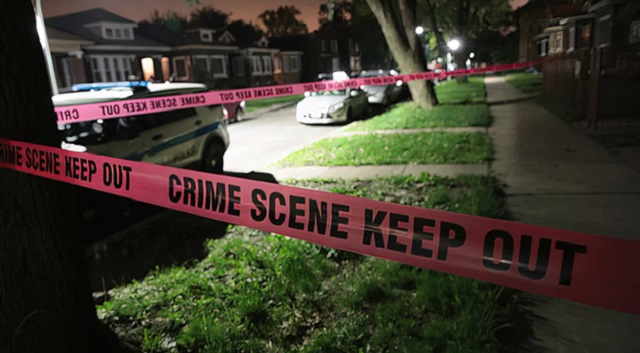

From ToddBensman.com
By Todd Bensman

Time for border enforcement hawks to disengage with this intellectually fraudulent sham debate and find this new approach
Advocates of a borderless United States – those who will do or say anything to unleash and maintain a torrent of unimpeded illegal mass border migration – demand that Americans deny an especially resonate outcome: illegal border crossers who murder, kill with drunk driving, rape, rob and beat their hosts.
In their arguments for unmitigated releases into the country of illegal border-crossing strangers, libertarian and progressive liberal pro-illegal immigration, anti-border enforcement activists always point to “studies” that compare illegal alien criminality to U.S. citizen criminality and then conclude that Americans commit as much or more than the illegal immigrants.
Media writers and pundits on the open-borders side parrot the “studies” to deflect detention and deportation proposals that would reduce illegal alien crime on grounds that the main danger to address are U.S. citizen criminals and, while you’re at that, let the border flows continue unimpeded since that population is less worrisome.
“No, Illegal Migrants Aren’t Fueling a Crime Wave,” reads the June 26 headline of a Bloomberg column by Justin Fox in a typical argument against illegal immigration enforcement.
“Migrant Crime Wave Not Supported by Data, Despite High-Profile Cases,” the headline of a February 15 New York Times report states in another one undermining recent demands for border enforcement.
“Ironically, studies indicate that immigrants commit less crime than U.S.-born individuals, and advocates have been pushing for less detention for years,” wrote Michael Lukens, Executive Director at the Capital Area Immigrants’ Rights Coalition, in a February 20 letter to the editor in The Washington Post. “Instead of alarmist tactics, ICE [U.S. Immigration and Customs Enforcement] should be looking at the devastating impacts of detention and releasing immigrants because it is the right thing to do.”
As complicit in this redirection are Republican border hawks and many on the right who abhor unimpeded illegal border immigration because they frequently engage the citizens-versus-illegal-aliens comparison, ever trying to challenge, counter, and undermine the crime comparison studies.
But what opponents of unmitigated mass migration must finally be made to realize, especially now that illegal alien crime is figuring largely for the November 5 presidential election, is that the door their adversaries opened for them leads up a fake stairwell.
The citizen-illegal alien comparison is invalid at the jump and, because it is once again often cited, a different approach is necessary.
An invalid apples-to-rocks comparison
The notion that policy thinkers and media pundits must compare the measured crime rates of citizens and illegal aliens – it’s unclear who initially devised it – has no foundation in academic science because the two compared groups are not similar enough.
Here is why: Illegal immigrants – and not ever American citizens and legal residents – are uniquely subject to an elaborate, expansive, and lawful government deportation and detention apparatus that Congress built to block and remove them from the country, in some part, so that they are not present to commit crimes. The same apparatus, of course, cannot touch American citizens who will commit crimes.
To restate the seemingly obvious, illegal aliens blocked at the border or who are quickly removed from the country cannot inflict any harm on American inhabitants because they are not present. That means every single crime committed by an illegally present immigrant should never have happened, was avoidable, preventable, and unnecessary whereas the Department of Homeland Security detention and removal machine cannot prevent a single American citizen crime. The United States, unfortunately, has no such choice but to contend with its criminal citizens before, during and after every crime they commit.
What this means is that all crimes committed by illegal aliens amount to a 100-percent net-gain burden on American society and its criminal justice system that was always largely preventable and unnecessary.
These differences between the two groups amount to an insurmountable Grand Canyon for purposes of comparison, apples-to-rocks, thus invalid for any academic study at the jump.
The libertarian and progressive liberals who created and purveyed the citizen-versus-illegal immigrant crime rate comparison debate should be called out for their campaign of misdirection or, if you will “gas-lighting.”
The misdirection campaign has always neutralized deserved political backlash against the highly resonate problem of 100 percent unnecessary extra crime that illegal aliens commit in the United States and stunted political momentum for policy remedies that would reduce both. By design, the mass illegal immigration and its associated 100 percent extra crime victimization continue while those who either favor or disfavor illegal immigration fruitlessly wage battles over a totally invalid proposition.
A different approach is long overdue.
The comparison stands discredited anyway but…
Border enforcement hawks have done much to discredit the studies that conclude American citizens commit more crime than illegal aliens. For instance, the Center for Immigration Studies has found that the activist-academics who favor unimpeded illegal immigration have misused data to undercount criminal alien crime. (See Misuse of Texas Data Understates Illegal Immigrant Crime and Continued Misuse of Texas Crime Data)
But as this 2024 presidential campaign period shows, efforts to engage the comparison debate have done little to suppress its continued impact of nullifying momentum for policy change. Mass media outlets still default to the original ruse at a time when a new approach to this discussion is most needed at this key time in the American political cycle, presenting an opportunity for the polity to rise up on good information and demand a halt to the mass border incursions that fuel 100-percent unnecessary net increases illegal alien crime.
Even though they have done a laudable job at discrediting the original studies, border enforcement advocates should disengage from further such distracting attempts and call out the comparison studies as the mendacious intellectual sham they are, on grounds that the two groups are too different to be compared. They must parry every citation of the studies and re-direct to the correct policy discussion, which is the extent to which current American leadership uses existing border enforcement law to block, detain, and deport. They must argue that all illegal alien crime is a 100 percent net addition to America’s crime problem, no matter what the rates per alien are, and that American citizen crime rates are irrelevant to the discussion of a solution to that.
They must only ever argue that blocking, detaining and deporting illegal aliens are the main levers that enable or prevent illegal alien crime in the United States. Most Americans will instinctively understand that this objective truth is on their side.
No one on either side of this policy issue should ever again engage in this immoral sham, but border enforcement hawks should parry and thrust elsewhere.
Graves that need never have been dug
Having said all of this, the comparison “studies” ruse was useful in one important regard; it surfaced rare data that establishes a rare and important measure of this preventable illegal immigrant crime. The data used in them comes from the only U.S. state that has tracked its unnecessary, all-net-gain illegal immigrant crime for years: Texas.
Border enforcement advocates should use this rare data set, not to compare the incomparable but, rather, to emphasize that it was entirely a net total – preventable – addition to overall U.S. crime. The Texas data should be used to emphasize a need for the United States to protect its citizens by exercising existing deportation and detention requirements embodied in the Immigration and Naturalization Act.
America may never know the extent to which alien crime that will result from the three-plus years of the Biden border crisis, which has ushered into the country at least seven million strangers as of this writing. Most local, state and federal agencies will not log immigration status of criminals.
But the Texas Department of Public Safety tracks the immigration status of suspects who are booked into local jails through a program that submits fingerprints to the FBI for criminal history and warrant checks, and to DHS. The agencies return immigration status information on those whose fingerprints were already on file (which is not all of them).
From the resulting Texas statistics, we catch a sound partial glimpse at the vaster sea of nationwide blood and carnage that was up to 100 percent preventable and unnecessary, of murder, rape, child abuse, burglary, felony theft, drug trafficking, alien smuggling and drunken driving manslaughter.
Between June 1, 2011 and June 30, 2024, these 437,000 criminal aliens (308,000 classified as illegal) were charged with more than 533,000 unnecessary extra criminal offenses that should never have happened.
Those included 997 homicide charges (resulting in 498 convictions as of June 2024), 1,245 kidnapping charges (resulting in 354 convictions), 6,744 sexual assault charges (resulting in 3,537 convictions), 7,763 sexual offense charges (resulting in 3,537 sexual offense convictions), and 6,560 weapons charges (resulting in 2,138 weapons convictions). Texas includes another category called “All Other Offenses,” which tallies 298,912 (and 103,265 convictions).
The Texas data reveals hundreds of dead people who should be alive, thousands of sexual assault and sexual offense victims who should never have suffered the trauma, and tens of thousands of assault charges involving victims who would not have been hurt.
The Texas data shows that criminal aliens took up police time and clogged up the American justice system that could have been more dedicated to American criminals. Thousands of drugs, burglary, robbery and weapons charges need not have jammed the Texas criminal justice systems at taxpayer cost.
In all, more than 32,000 people identified by DHS as living in the country illegally were imprisoned in Texas.
But the number of criminal illegal aliens appears to be a highly undercounted one even when a state like Texas is working hard at the tally. We know this because the Texas program found that another 10,748 illegal aliens since 2011, whose immigration status hadn’t been federally determined at the time of their arrests, were only later determined to be illegally present when they were sent to Texas state prisons. There must be far more.
Among them were prisoners serving time for 134 more unnecessary, preventable homicides.
The graves of all their dozens of dead victims are real even as nary any of them have drawn national media attention like a mere few have lately.
The bamboozlers bear responsibility for tragedies that deportation would have prevented. Far too often, the preventable violence is exceptionally brutal, scenes from the most extreme horror movies in volumes far too numerous to catalogue here.
The huge scale of seven or ten million foreign national strangers allowed to enter the United States in three years means the size of the criminal class among them must be historically large as well. All their crime will be 100 percent extra on top of U.S. citizen crime and potentially reducible by up to 100 percent in with the exercise of lawful detention and deportation.
Far fewer bad things will happen if Americans finally slam closed the wrong door with its fake stairwell.




Vancouver police say they have seized a grenade launcher, four guns, and nearly 500 grams of fentanyl and other hard drugs from a fortified Downtown Eastside rooming house that was allegedly feeding a synthetic opioid supply line through the city’s most drug-ravaged blocks.
“Task Force Barrage has come to an end, but our work to curb violence and disrupt organized crime in the Downtown Eastside continues,” Sergeant Steve Addison said, adding “the proliferation of violence and weapons in some residential buildings continues to put the neighbourhood at risk.”
The latest investigation began November 13, when a 42-year-old man suffered serious injuries in an assault near Carrall Street and East Cordova and was taken to hospital. Officers followed leads to a rooming house at 50 East Cordova Street, in the heart of a street-level open drug market that has become notorious in photos and news clips around the world.
On November 18, police say they uncovered a stockpile of illicit drugs, guns and weapons in three rooms of the East Cordova building. According to Addison, there are signs that parts of the property, which is supposed to house low-income residents, were repurposed as a hub to store weapons and distribute contraband throughout the neighbourhood, with some areas “fortified with countersurveillance measures to avoid detection from law enforcement.”
Items seized include four firearms, two imitation guns, a grenade launcher, a firearm suppressor, seven machetes, four flare guns, bullwhips, baseball bats, body armour, handcuffs and ammunition. Officers also seized 486 grams of fentanyl, cannabis, Dilaudid pills and methamphetamine – a quantity police say represents more than 2,500 single doses.
Meanwhile, in a separate update posted November 26 — the day before VPD announced the Cordova Street raid — Vancouver Fire Rescue Services said that on Tuesday, November 21, firefighters responded to 54 overdoses, the highest single-day total in the department’s history. The service said it averaged about 16 overdose calls per day in May, but that figure has surged in recent weeks, and during the most recent income-assistance week, firefighters were averaging roughly 45 overdose responses per day.
While police have not publicly linked the East Cordova seizure to any specific cartel, the mix of fentanyl, fortified real estate and a small armoury of weapons closely tracks the profile of a separate, high-profile British Columbia case in which provincial authorities say a Sinaloa Cartel–aligned cell embedded itself just south of Vancouver.
In that case, a civil forfeiture lawsuit alleged a Sinaloa Cartel–linked fentanyl and cocaine trafficking group set up in a multi-million-dollar mansion near the U.S. border, capable of negotiating major cocaine import deals with Ismael Garcia—known as “El Mayo”—the reputed Sinaloa Cartel chief. According to the filings, the Canada-based syndicate involved at least three men, and belonged to a violent drug trafficking organization that “used and continues to use violence, or threats of violence, to achieve its aims.”
Investigators alleged the Surrey-based group trafficked ketamine, methamphetamine, Xanax, oxycodone, MDMA and fentanyl. “As part of these efforts, the drug trafficking organization has agreed to, and made arrangements to, purchase cocaine from the Cártel de Sinaloa in Mexico,” the filings stated. They added: “the Sinaloa Cartel is a terrorist entity, and the government of Canada listed it as such on February 20, 2025.”
RCMP said they uncovered a substantial cache of weapons and narcotics during a search of the Surrey property on 77th Avenue on September 23, 2024. Opioids seized from the mansion included 400 grams of counterfeit Xanax, 810 oxycodone pills, 5.5 grams of fentanyl and nearly a kilogram of Ecstasy. The province is now seeking forfeiture of the house, which sits about 20 minutes from the Peace Arch border crossing north of Seattle.
Court submissions detailed an arsenal of 23 weapons – ten handguns, two sawed-off shotguns, two hunting rifles, seven assault rifles (two reportedly fitted with screw-on suppressors), and a speargun – alongside about 3.5 kilograms of ketamine and methamphetamine hidden in a compartment in one suspect’s room, hundreds of counterfeit alprazolam pills, a stash of oxycodone, and nearly CAD 15,000 in bundled cash “not consistent with standard banking practices.”
Viewed together, the Downtown Eastside raid and the Surrey mansion case sketch out different ends of what appears to be the same continuum, ultimately pointing to senior criminal leaders in Mexico and China.
The Bureau is a reader-supported publication.
To receive new posts and support my work, consider becoming a free or paid subscriber.
Crime
B.C.’s First Money-Laundering Sentence in a Decade Exposes Gaps in Global Hub for Chinese Drug Cash
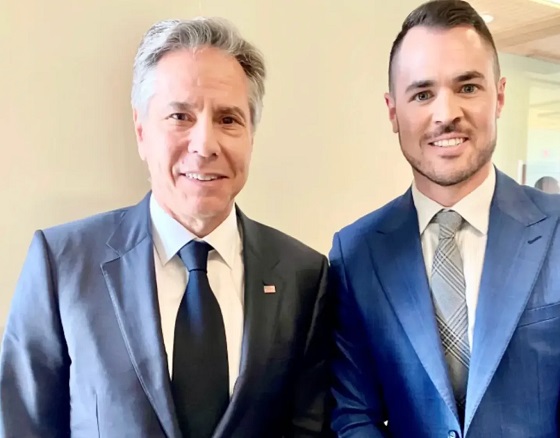
Port Coquitlam Mayor Brad West met with Biden Secretary of State Antony Blinken in 2023, to discuss Canada’s enforcement gap on fentanyl money laundering.
Chinese underground-banking conviction is a baby step in a jurisdiction that some experts see as North America’s center of gravity for transnational crime.
In a milestone that is staggering for its rarity in a jurisdiction regarded as a global nexus of Chinese transnational money laundering that facilitates fentanyl trafficking for Mexican and Iranian gangs, British Columbia’s anti-gang unit has finally secured its first money laundering sentencing in a decade.
On Monday, a B.C. Supreme Court judge sentenced 37-year-old Richmond resident Alexandra Joie Chow to 18 months in jail for laundering the proceeds of crime, following a six-year investigation that targeted illegal Chinese underground casinos and unlicensed money transfer businesses in Metro Vancouver. The court also ordered the forfeiture of cash and bank drafts seized during the probe, the Combined Forces Special Enforcement Unit of B.C. (CFSEU) says.
Chow’s case marks the first time in roughly ten years that a money-laundering investigation in British Columbia has actually resulted in a sentencing — a remarkable data point in a province where hundreds of billions have washed through casinos, banks and real estate, according to The Bureau’s estimates, yet almost no one has been successfully prosecuted for the underlying financial crime.
While Chow’s case in itself is relatively small in dollar terms, it followed the catastrophic collapse of the RCMP’s E-Pirate probe into a Richmond underground bank called Silver International, which was alleged to have laundered over $1 billion through a network of Chinese Triad leaders known as “Sam Gor” or “The Company” — a scheme that moved drug cash collected in Chinese diasporas across North and Latin America, cycling the funds back to hundreds of accounts in China, in part through lending gang cash to Asian high-rollers who washed massive sums through B.C. government casinos.
The collapse of E-Pirate raised significant concerns in Washington around Canada’s capacity to prosecute fentanyl money laundering and trafficking. Vancouver-area Mayor Brad West has told The Bureau that the failure of Canadian authorities to secure convictions in that case was explicitly noted in 2023 by senior figures in the Biden administration, including Secretary of State Antony Blinken, in discussions about Canada’s role in North American drug trafficking.
Chow pleaded guilty in February 2025 to one count of laundering proceeds of crime after prosecutors alleged she was part of an underground loan-sharking and money-services scheme that operated in the Lower Mainland. Her plea came almost two years after B.C.’s Joint Illegal Gaming Investigation Team first announced charges.
The trail to that conviction began in August 2019, when B.C.’s Joint Illegal Gaming Investigation Team (JIGIT) quietly launched an investigation into the alleged loan-sharking and money-laundering activities of a man and a woman. Investigators believed the suspects were charging criminal interest rates and operating an unlicensed money services business.
Over the course of the probe, police say they developed evidence that the suspects allegedly laundered more than $828,000 in Canadian cash. On November 5, 2021, JIGIT executed a series of search warrants on properties in Richmond and Burnaby, as well as three vehicles associated to the investigation.
The searches resulted in the seizure of a number of items believed to be tied to money laundering and loan-sharking, including score sheets with client names and payment due dates, four cellular phones, two bank drafts totaling $50,000, and $10,680 in Canadian currency and three high-end vehicles.
Two years later, on November 1, 2023, the B.C. Prosecution Service approved four sets of charges against Chow: money laundering, possessing proceeds of crime, and entering into agreements to receive criminal-rate interest — classic loan-sharking. No other individuals were ultimately charged in the case.
As CFSEU-BC media officer Sgt. Sarbjit Sangha put it in the unit’s statement Monday, this is “the first time in a decade that a money laundering investigation in British Columbia has resulted in a sentencing,” and it “underscores the impact of collaborative investigative work” and JIGIT’s mandate to tackle illegal gaming tied to organized crime, loan-sharking and sophisticated bookmaking.
The scale of the enforcement gap this case exposes is critical to understanding current irritants between Washington and Ottawa, and the Trump administration’s leverage of tariffs on Canada. That campaign of economic pressure, some U.S. and Canadian officials have informed The Bureau, apparently extends from deep concerns in both the Biden and Trump administrations over Ottawa’s lack of meaningful action against massive money laundering through Canada’s financial system — including the TD Bank fentanyl money laundering case prosecuted in the Tri-State area, which exposed transactions similar to those revealed in the Chow investigation in Richmond.
The Cullen Commission into money laundering in B.C. found that by 2014, casinos in the province were accepting nearly $1.2 billion in cash transactions of $10,000 or more in a single year, many involving patrons who showed classic indicators of criminal cash — bricks of small bills delivered in bags by couriers closely watched by organized-crime investigators. JIGIT itself was created as part of the province’s response to that crisis. In a 2021 presentation to the Cullen Commission, then-Unit Commander Staff Sgt. Joel Hussey explained that JIGIT’s money-laundering and loan-sharking probes were focused on “top-tier” organized criminals exploiting casinos and banks, particularly at Richmond’s River Rock Casino Resort, Vancouver’s Parq Casino and Burnaby’s Grand Villa, where investigators saw the most entrenched high-roller criminal activity.
Yet the province’s record in actually getting such cases to the finish line has been abysmal. The most notorious example remains E-Pirate, the massive RCMP investigation that targeted Silver International, a Richmond underground bank alleged to be moving over $1 billion a year in drug and casino cash for Chinese and Mexican cartels and Middle Eastern networks. That case collapsed in 2018–2019 after federal prosecutors mistakenly exposed a confidential informant, leading to a stay of charges despite years of work and huge evidence seizures.
International bodies such as the Financial Action Task Force later used E-Pirate as a case study, describing a “professional” Richmond-hub laundering network that allegedly used B.C. casinos and real estate to clean and move drug proceeds on a global scale. Cullen’s final report, released in 2022, concluded that sophisticated money-laundering networks were moving “staggering amounts” of illicit funds through B.C., while law-enforcement and regulatory agencies failed to respond in a timely or coordinated way.
Whether Chow’s 18-month sentence becomes a template for future Vancouver Model prosecutions — or remains an isolated success in a province still struggling to hold money launderers to account — will be the next test for B.C.’s anti-gang and financial-crime enforcement regime.
Those questions are not just academic in Ottawa. As The Bureau has previously reported, senior officials in Washington — Democrats and Republicans alike — have for years warned that Canada’s failure to deliver sustained proceeds-of-crime prosecutions, and its lack of a RICO-style racketeering law, has turned the country into a structural weak point in North America’s fight against cartel-linked fentanyl networks.
As reported previously by The Bureau, in a high-level meeting in 2023, according to Vancouver-area Mayor Brad West, a longstanding critic of transnational drug networks in his province, Secretary of State Antony Blinken stressed that Washington believes Beijing is effectively weaponizing fentanyl against North Americans—and that Canada stands out as a worrisome weak link in the global supply chain.
West, reflecting on his encounter with Blinken, argued that only bold legislative change, coupled with a willingness to challenge entrenched legal barriers, can dispel the U.S. government’s unease over Canada’s approach. “Secretary Blinken specifically noted the lack of a RICO-style law in Canada,” West said. “He talked about how, in the United States, that law had been used to take down large portions of the mafia. Then he looked at us—one of America’s closest allies—and saw a very concerning weak link.”
According to West, Blinken pointed to China’s role in funneling precursor chemicals into fentanyl labs. He warned that China’s government, if inclined, could stem the flow but has little interest in doing so. “He was incredibly candid,” West recalled. “He confirmed the connection between the Chinese Communist Party, the triads, and the Mexican cartels, telling me these groups are working together—and it’s Canada where they’re finding a safe operating base.”
Blinken also conveyed to West that U.S. agencies had grown hesitant to share certain intelligence with their Canadian counterparts. “He told me that U.S. intelligence and law enforcement are withholding some evidence because they don’t believe we’ll act on it,” West explained. “They’ve lost confidence.”
West added that in ongoing communications, he had learned American officials are shocked that major figures in Asian organized crime “seem to have so much access to our political class. They’re basically saying, ‘What’s going on in Canada?’”
A major concern, according to West, is how known criminals manage to appear at political events or fundraisers with little oversight. “It’s not necessarily that politicians are complicit, but our political structures have weak guardrails,” West said. “The Americans see pictures of transnational criminals mingling at official gatherings and find it baffling.”
The Bureau is a reader-supported publication.
To receive new posts and support my work, consider becoming a free or paid subscriber.


From Underdog to Top Broodmare

Alberta and Ottawa ink landmark energy agreement

Poilievre says West Coast Pipeline MOU is no guarantee

Afghan Ex–CIA Partner Accused in D.C. National Guard Ambush

Man overboard as HMCS Carney lists to the right

Health Canada indefinitely pauses plan to sell unlabeled cloned meat after massive public backlash

Higher carbon taxes in pipeline MOU are a bad deal for taxpayers
-
 Business1 day ago
Recent price declines don’t solve Toronto’s housing affordability crisis
-
 C2C Journal2 days ago
Learning the Truth about “Children’s Graves” and Residential Schools is More Important than Ever
-
 Business2 days ago
Why Isn’t There a Cure for Alzheimer’s Disease?
-
 Brownstone Institute2 days ago
The Unmasking of Vaccine Science
-
 armed forces2 days ago
Global Military Industrial Complex Has Never Had It So Good, New Report Finds
-
 Alberta2 days ago
Emissions Reduction Alberta offering financial boost for the next transformative drilling idea
-
 Daily Caller1 day ago
Tech Mogul Gives $6 Billion To 25 Million Kids To Boost Trump Investment Accounts
-
 Censorship Industrial Complex20 hours ago
A Democracy That Can’t Take A Joke Won’t Tolerate Dissent