
Economy
What the Data Shows About the New Canada-Alberta Pipeline Opportunity


From Energy Now
By Canada Powered by Women

Canada has entered a new period of energy cooperation, marking one of the biggest shifts in federal–provincial alignment on energy priorities in years.
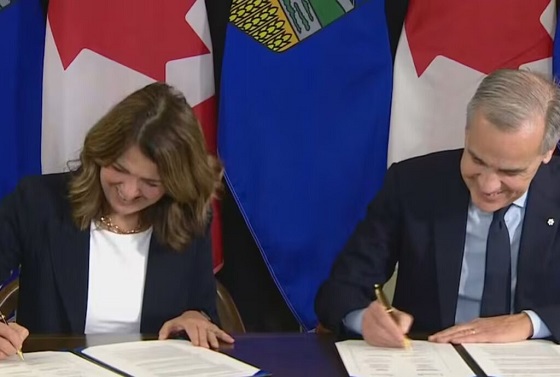
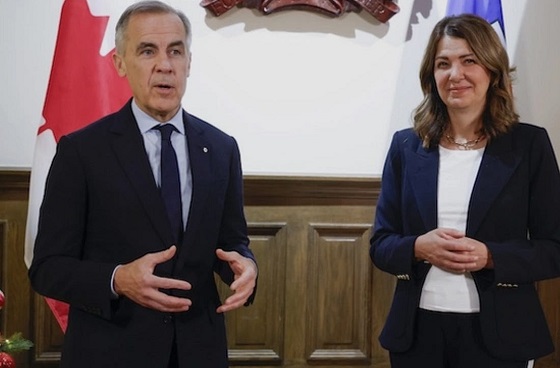
Last week as Prime Minister Mark Carney and Alberta Premier Danielle Smith signed a memorandum of understanding (MOU) that outlines how both governments will approach a potential pipeline to British Columbia’s coast.
The agreement, which has been described as a “new starting point” after years of tension, lays the groundwork for a privately financed pipeline while also linking this commitment to a broader set of infrastructure priorities across oil and gas, LNG, renewables, critical minerals and electricity transmission.
It also sets out how a privately financed project, moving roughly 300,000 to 400,000 barrels of oil to global markets each day, will be reviewed.
Now that the announcement is behind us, attention has turned to how (or if) a pipeline is going to get built.
Alberta has set out its ambitions, British Columbia has its conditions, and the federal government has its own expectations. Together, these positions are shaping what some are calling a “grand bargain” which will be made up of trade-offs.
Trade-offs are not a new concept for the engaged women that Canada Powered by Women (CPW) represents, as they’ve been showing up in our research for several years now. And anyone who reads us also knows we like to look at what the data says.
According to new polling from the Angus Reid Institute, a clear majority of Canadians support a pipeline, with national backing above 60 per cent. And there’s strong support for the pipeline among those in B.C. This aligns with other emerging data points that show Canadians are looking for practical solutions that strengthen affordability and long-term reliability.
By the numbers:
• 60 per cent of Canadians support the pipeline concept, while 25 per cent oppose it.
• 53 per cent of people support in British Columbia, compared to 37 percent opposed.
• 74 per cent of people in Alberta and Saskatchewan support the pipeline.

Our research shows the same trends.
A large majority (85 per cent) of engaged women agree that building pipelines and refining capacity within the country should be prioritized. They favour policies that will progress stability, affordability and long-term economic opportunity.
A key feature of the MOU is the expectation of Indigenous ownership and benefit sharing, which Alberta and B.C. governments identify as essential, and which aligns with public opinion. As of right now, Indigenous groups remain split on support for a pipeline.
The agreement also signals that changes to the federal Oil Tanker Moratorium Act may need to be considered. The moratorium, in place since 2019, is designed to limit large tanker traffic on the North Coast of B.C. because of navigation risks in narrow channels and the need to protect sensitive coastal ecosystems.
Those in favour of the pipeline point to this as a critical barrier to moving Canadian oil to international markets.
Polling from the Angus Reid Institute shows that 47 per cent of Canadians believe the moratorium could be modified or repealed if stronger safety measures are in place. Again, we come back to trade-offs.
The MOU is a starting point and does not replace consultation, environmental review or provincial alignment. These steps are still required before any project can advance. Taken together, the agreement and the data show broad support for strengthening Canada’s energy options.
This will be an issue that engaged women are no doubt going to watch, and the conversation is likely to move from ideas to discussing what trade-offs can be made to bring this opportunity to life.


From the Daily Caller News Foundation
During the latest marathon cabinet meeting on Dec. 2, Energy Secretary Chris Wright made news when he told President Donald Trump that “The biggest determinant of the price of energy is politicians, political leaders, and polices — that’s what drives energy prices.”
He’s right about that, and it is why the back-and-forth struggle over federal energy and climate policy plays such a key role in America’s economy and society. Just 10 months into this second Trump presidency, the administration’s policies are already having a profound impact, both at home and abroad.
While the rapid expansion of AI datacenters over the past year is currently being blamed by many for driving up electric costs, power bills were skyrocketing long before that big tech boom began, driven in large part by the policies of the Obama and Biden administration designed to regulate and subsidize an energy transition into reality. As I’ve pointed out here in the past, driving up the costs of all forms of energy to encourage conservation is a central objective of the climate alarm-driven transition, and that part of the green agenda has been highly effective.
Dear Readers:
As a nonprofit, we are dependent on the generosity of our readers.
Please consider making a small donation of any amount here.
Thank you!
President Trump, Wright, and other key appointees like Interior Secretary Doug Burgum and EPA Administrator Lee Zeldin have moved aggressively throughout 2025 to repeal much of that onerous regulatory agenda. The GOP congressional majorities succeeded in phasing out Biden’s costly green energy subsidies as part of the One Big Beautiful Bill Act, which Trump signed into law on July 4. As the federal regulatory structure eases and subsidy costs diminish, it is reasonable to expect a gradual easing of electricity and other energy prices.
This year’s fading out of public fear over climate change and its attendant fright narrative spells bad news for the climate alarm movement. The resulting cracks in the green facade have manifested rapidly in recent weeks.
Climate-focused conflict groups that rely on public fears to drive donations have fallen on hard times. According to a report in the New York Times, the Sierra Club has lost 60 percent of the membership it reported in 2019 and the group’s management team has fallen into infighting over elements of the group’s agenda. Greenpeace is struggling just to stay afloat after losing a huge court judgment for defaming pipeline company Energy Transfer during its efforts to stop the building of the Dakota Access Pipeline.
350.org, an advocacy group founded by Bill McKibben, shut down its U.S. operations in November amid funding woes that had forced planned 25 percent budget cuts for 2025 and 2026. Employees at EDF voted to form their own union after the group went through several rounds of budget cuts and layoffs in recent months.
The fading of climate fears in turn caused the ESG management and investing fad to also fall out of favor, leading to a flood of companies backtracking on green investments and climate commitments. The Net Zero Banking Alliance disbanded after most of America’s big banks – Goldman Sachs, J.P. Morgan Chase, Citigroup, Wells Fargo and others – chose to drop out of its membership.
The EV industry is also struggling. As the Trump White House moves to repeal Biden-era auto mileage requirements, Ford Motor Company is preparing to shut down production of its vaunted F-150 Lightning electric pickup, and Stellantis cancelled plans to roll out a full-size EV truck of its own. Overall EV sales in the U.S. collapsed in October and November following the repeal of the $7,500 per car IRA subsidy effective Sept 30.
The administration’s policy actions have already ended any new leasing for costly and unneeded offshore wind projects in federal waters and have forced the suspension or abandonment of several projects that were already moving ahead. Capital has continued to flow into the solar industry, but even that industry’s ability to expand seems likely to fade once the federal subsidies are fully repealed at the end of 2027.
Truly, public policy matters where energy is concerned. It drives corporate strategies, capital investments, resource development and movement, and ultimately influences the cost of energy in all its forms and products. The speed at which Trump and his key appointees have driven this principle home since Jan. 20 has been truly stunning.
David Blackmon is an energy writer and consultant based in Texas. He spent 40 years in the oil and gas business, where he specialized in public policy and communications.


““He knows nothing; and he thinks he knows everything. That points clearly to a political career.” George Bernard Shaw
In the days immediately following Donald Trump’s rude intervention into the 2025 Canadian federal election— suggesting Canada might best choose American statehood— two schools of thought emerged.
The first and most impactful school in the short term was the fainting-goat response of Canadian’s elites. Sensing an opening in which to erode Pierre Poilievre’s massive lead in the 2024 polls over Justin Trudeau, the Laurentian elite concocted Elbows Up, a self-pity response long on hurt feelings and short on addressing the issues Trump had cited in his trashing of the Canadian nation state.
In short order they fired Trudeau into oblivion, imported career banker Mark Carney as their new leader in a sham convention and convinced Canada’s Boomers that Trump had the tanks ready to go into Saskatchewan at a moment’s notice. The Elbows Up meme— citing Gordie Howe— clinched the group pout.

(In fact, Trump has said that America is the world’s greatest market, and if those who’ve used it for free in the past [Canada] want to keep special access they need to pay tariffs to the U.S. or drop protectionist charges on dairy and more against the U.S.)
The ruse worked out better than they could have ever imagined with Trump even saying he preferred to negotiate with Carney over Poilievre. In short order the Tories were shoved aside, the NDP kneecapped and the pet media anointed Carney the genius skewing Canada away from its largest trade partner to the Eurosphere. We remain in that bubble, although the fulsome promises of Carney’s first days are now coming due.
Which brings us to the second reaction. That was Alberta premier Danielle Smith bolting to Mar A Lago in the days following Trump’s comments. Her goal was to put pride aside and accept that a new world order was in play for Canada. She met with U.S. officials and, briefly, with Trump to remind them that Canada’s energy industry was integral to American prosperity and Canadian stability.
Needless to say, the fainting goats pitched a fit that not everyone was clutching pearls and rending garments in the wake of Trump’s dismissive assessment of his northern neighbours. Their solution to Trump was to join China in retaliatory tariffs— the only two nations to do so— and to boycott American products and travel. Like the ascetic monks they cut themselves off from real life. Trump has yet to get back to Carney the Magnificent

And Smith? She was a “traitor” or a “subversive” who should be keel hauled in the North Saskatchewan. For much of the intervening months she has been attacked at home in Alberta by the N-Deeps and in Ottawa by just about everyone on CBC, CTV, Global and the Globe & Mail. “How could she meet with the Cheeto?”
Nonetheless conservatives in the province moved toward a more independence within Canada. Smith articulated her demands for Alberta to prevent a referendum on whether to remain within Confederation. At the top of her list were pipelines and access to tidewater. Ergo, a no-go for BC’s squish premier David Eby who is the process of handing over his province to First Nations.
It became obvious that for all of Carney’s alleged diplomacy in Europe and Asia (is the man ever home?) he had a brewing disaster in the West with Alberta and Saskatchewan growing restless. In a striking move against the status quo, Nutrien announced it would ship its potash to tidewater via the U.S., thereby bypassing Vancouver’s strike-prone, outdated port and denying them billions.

Suddenly, Smith’s business approach began making eminent good sense if the goal is to keep Canada as one. So we saw last week’s “memorandum of understanding” between Alberta and Ottawa trading off carbon capture and carbon taxes for potential pipelines to tidewater on the B.C. coast. A little bit of something for everyone and a surrender on other things.
The most amazing feature of the Mark Carney/Danielle Smith MOU is that both politicians probably need the deal to fail. Carney can tell fossil-fuel enemy Quebec that he tried to reason with Smith, and Smith can say she tried to meet the federalists halfway. Failure suits their larger purposes. Which is for Carney to fold Canada into Euro climate insanity and Smith into a strong leverage against the pro-Canada petitioners in her province.
Soon enough, at the AFN Special Chiefs Assembly, FN Chief Cindy Woodhouse Nepinak told Carney that “Turtle Island” (the FN term for North America popularized by white hippy poet Gary Snyder) belongs to the FN people “from coast to coast to coast.” The pusillanimous Eby quickly piped up about tanker bans and the sanctity of B.C. waters etc.
Others pointed out the massive flaw in a plan to attract private interests to build a vital bitumen pipeline if the tankers it fills are not allowed to sail through the Dixon Entrance to get to Asia.
But then Eby got Nutrien’s message that his power-sharing with the indigenous might cause other provinces to bypass B.C. (imagine California telling Texas it can’t ship through its ports over moral objections to a product). He’s now saying he’s open to pipelines but not to lift the tanker ban along the coast. Whatever.
Meanwhile the kookaburras of isolation back east continue with virtue signalling on American booze— N.S. to sell off its remains stocks — while dreaming that Trump’s departure will lead to the good-old days of reliance on America’s generosity.
But Smith looks to be wining the race. B.C.’s population shrank 0.04 percent in the second quarter of 2025, the only jurisdiction in Canada to do so. Meanwhile, Alberta is heading toward five million people, with interprovincial migrants making up 21 percent of its growth.
But what did you expect from the Carney/ Eby Tantrum Tandem? They keep selling fear in place of GDP. As GBS observed, “You have learnt something. That always feels at first as if you have lost something.”
Bruce Dowbiggin @dowbboy is the editor of Not The Public Broadcaster A two-time winner of the Gemini Award as Canada’s top television sports broadcaster, his new book Deal With It: The Trades That Stunned The NHL And Changed hockey is now available on Amazon. Inexact Science: The Six Most Compelling Draft Years In NHL History, his previous book with his son Evan, was voted the seventh-best professional hockey book of all time by bookauthority.org . His 2004 book Money Players was voted sixth best on the same list, and is available via brucedowbigginbooks.ca.


From Underdog to Top Broodmare
READ IT HERE – Canada-Alberta Memorandum of Understanding – From the Prime Minister’s Office
IEA peak-oil reversal gives Alberta long-term leverage
Healthcare And Pipelines Are The Front Lines of Canada’s Struggle To Stay United

Net Zero goal is a fundamental flaw in the Ottawa-Alberta MOU

Falling resource revenue fuels Alberta government’s red ink

Alberta can’t fix its deficits with oil money: Lennie Kaplan
-
 Alberta2 days ago
Alberta Sports Hall of Fame Announces Class of 2026 Inductees
-
 Business2 days ago
Canada’s climate agenda hit business hard but barely cut emissions
-
 Business2 days ago
Carney government should privatize airports—then open airline industry to competition
-
 Business1 day ago
Carney’s Toronto cabinet meetings cost $530,000
-
 Business2 days ago
Is Carney Falling Into The Same Fiscal Traps As Trudeau?
-
 Alberta2 days ago
Carney’s pipeline deal hits a wall in B.C.
-
 Artificial Intelligence1 day ago
AI is accelerating the porn crisis as kids create, consume explicit deepfake images of classmates
-
 MAiD1 day ago
101-year-old woman chooses assisted suicide — press treats her death as a social good