
International
Trump signs executive order banning gender-confused men from women’s and girls’ sports


From LifeSiteNews

The new executive order declares it ‘the policy of the United States to rescind all funds from educational programs’ that allow gender-confused men to compete against women and girls and extends beyond schools to the Olympics.
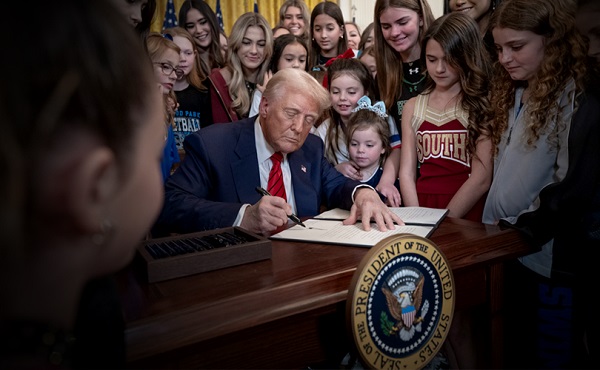
President Donald Trump signed an executive order banning men, including those who “identify” as female, from participating in women’s sports in order to “protect opportunities for women and girls to compete in safe and fair sports.”
“The war on women’s sports is over,” declared the president to the delight of the crowd.
“The war on women’s sports is over.” pic.twitter.com/32Z7Htwv8M
— Mike Lee (@BasedMikeLee) February 5, 2025
The scene in the White House East Room on Wednesday where the president was flanked by dozens of women and girl athletes who had been waiting for this moment presented a stark contrast with Joe Biden’s action on his first day in office, when he signed an executive order defending students’ ability to compete in sports based on their perceived “gender identity.”
Prominent in the crowd standing behind President Trump was former collegiate swimmer Riley Gaines who, as the president noted, has been on the forefront of the battle to keep men out of women’s school and professional athletics.
Gaines became a popular, outspoken activist after “losing” to a gender-confused male, William “Lia” Thomas, at a National Collegiate Athletic Association (NCAA) swimming championship in 2022.
Title IX’s original intent restored
“From now on, women’s sports will be only for women,” said Trump.
He warned educational institutions, “If you let men take over women’s sports teams or invade your locker rooms, you will be investigated for violations of Title IX and risk your federal funding.”
READ: ‘Transgender’ males are brutally injuring female athletes, and sports officials don’t care
Passed in 1972, Title IX was enacted in order to prohibit sex-based discrimination in schools that receive federal funding. In recent years, Democrats have contorted its original intent to include gender-confused males and females under its umbrella.
White House press secretary Karoline Leavitt explained that the order “upholds the promise of Title IX” and requires “immediate action, including enforcement actions, against schools and athletic associations” that currently permit gender-confused males to to participate in women’s sports and use locker rooms previously reserved for women and girls only.
‘Demeaning, unfair, and dangerous’ for female athletes, no more
“In recent years, many educational institutions and athletic associations have allowed men to compete in women’s sports,” notes the executive order, aptly titled “Keeping Men out of Women’s Sports.” “This is demeaning, unfair, and dangerous to women and girls, and denies women and girls the equal opportunity to participate and excel in competitive sports.”
“As some Federal courts have recognized, ‘ignoring fundamental biological truths between the two sexes deprives women and girls of meaningful access to educational facilities,’” it continues.
Therefore, it is the policy of the United States to rescind all funds from educational programs that deprive women and girls of fair athletic opportunities, which results in the endangerment, humiliation, and silencing of women and girls and deprives them of privacy.
It shall also be the policy of the United States to oppose male competitive participation in women’s sports more broadly, as a matter of safety, fairness, dignity, and truth.
Trump admin to Olympics: ‘America categorically rejects transgender lunacy’
The president’s directive extends beyond U.S. schools and sports leagues to the upcoming 2028 Summer Olympics to be held in Los Angeles.
Trump authorized Secretary of State Marco Rubio to inform the International Olympic Committee that “America categorically rejects transgender lunacy. We want them to change everything having to do with the Olympics and having to do with this absolutely ridiculous subject.”
He further directed Homeland Security head Kristi Noem to “deny any and all visa applications made by men attempting to fraudulently enter the United States while identifying themselves as women athletes to try and get into the Games.”
NCAA welcomes a ‘clear, national standard’
The NCAA (National Collegiate Athletic Association) seemed to welcome the president’s executive order, saying it provides a “clear, national standard.”
“The NCAA is an organization made up of 1,100 colleges and universities in all 50 states that collectively enroll more than 530,000 student-athletes,” noted a statement by NCAA President Charlie Baker. “We strongly believe that clear, consistent and uniform eligibility standards would best serve today’s student-athletes instead of a patchwork of conflicting state laws and court decisions. To that end, President Trump’s order provides a clear, national standard.”
“The NCAA Board of Governors is reviewing the executive order and will take necessary steps to align NCAA policy in the coming days, subject to further guidance from the administration,” continued Baker. “The Association will continue to help foster welcoming environments on campuses for all student-athletes. We stand ready to assist schools as they look for ways to support any student-athletes affected by changes in the policy.”
Soon after Trump added his signature to his latest executive order, Harvard University fell in line with the order, removing its “transgender inclusion” policy from its athletics website.
LGBT activist groups infuriated
GLAAD, an organization that identifies itself as “the world’s largest LGBTQ media advocacy organization,” was infuriated by the executive order, claiming that men confused about their sex should be recognized as “women” and allowed to compete against women “if they want.”
LGBTQ+ Washington, D.C., lobbying group, the Human Rights Campaign, also attacked the executive order, as did National Women’s Law Center president and CEO, Fatima Goss Graves.
Graves insisted that gender-confused students “do not pose threats to sports” or schools, despite numerous incidents of “transgender” males severely injuring women and girls in competitions, among other harms.

Daily Caller
Scathing Indictment Claims Nicolás Maduro Orchestrated Drug-Fueled ‘Culture Of Corruption’ Which Plagued Entire Region

From the Daily Caller News Foundation
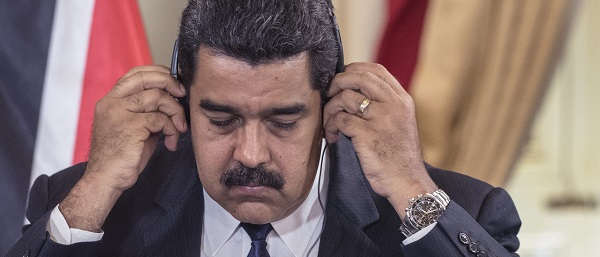
Ousted socialist Venezuelan dictator Nicolás Maduro was the mastermind of a pervasive drug-fueled “culture of corruption” which extended all the way to the U.S.’s backyard, according to the scathing indictment against him, his wife, his son, and others, released Saturday.
Hours after President Donald Trump announced Maduro’s capture and removal from power, Attorney General Pam Bondi confirmed the deposed despot and his wife, Cilia Flores, were indicted in the Southern District of New York on four charges, including narco-terrorism conspiracy, and “will soon face the full wrath of American justice” on U.S. soil. A grand jury found Maduro “and corrupt members of his regime enabled corruption fueled by drug trafficking throughout” the Latin American region, including in Mexico and Central America, and empowered notorious crime syndicates such as Tren de Aragua (TdA), according to the unsealed indictment.
Signed by Trump-appointed U.S. Attorney Jay Clayton, the 25-page indictment names six defendants, including the deposed Maduro, Flores, and Maduro’s 35-year-old son from his first marriage, Nicolás “Nicolasito” Maduro Guerra. It also names as defendants TdA leader Niño Guerrero and two high-profile members of Maduro’s United Socialist Party, Diosdado Cabello Rondón and Ramón Rodríguez Chacín.
Dear Readers:
As a nonprofit, we are dependent on the generosity of our readers.
Please consider making a small donation of any amount here.
Thank you!
Maduro, “like former President [Hugo] Chávez before him[,] participates in, perpetuates, and protects a culture of corruption in which powerful Venezuelan elites enrich themselves through drug trafficking and the protection of their partner drug traffickers,” the indictment alleges. “The profits of that illegal activity flow to corrupt rank-and-file civilian, military, and intelligence officials, who operate in a patronage system run by those at the top-referred to as the Cartel de Los Soles or Cartel of the Suns, a reference to the sun insignia affixed to the uniforms of high-ranking Venezuelan military officials.”
The Trump administration’s State Department announced it was designating the Cartel de Los Soles as a Foreign Terrorist Organization (FTO) in November 2025. Secretary of State Marco Rubio wrote in a statement at the time the cartel “is headed by Nicolás Maduro and other high-ranking individuals of the illegitimate Maduro regime who have corrupted Venezuela’s military, intelligence, legislature, and judiciary.”
The indictment also notes the South American nation “sits in a geographically valuable location for drug traffickers” and that, around the time Chávez came to power in 1999, “Venezuela became a safe haven” for them.
“In that environment, cocaine trafficking flourished,” the indictment continues, citing State Department estimates from arund 2020, with between 200 and 250 tons of the drug being trafficked through the country each year.
The charging document goes on to allege Maduro, his wife, son, and political allies had “partnered with narcotics traffickers and narco-terrorist groups, who dispatched processed cocaine from Venezuela to the United States via transshipment points in the Caribbean and Central America, such as Honduras, Guatemala, and Mexico.”
“Through this drug trafficking, [Maduro] and corrupt members of his regime enabled corruption fueled by drug trafficking throughout the region,” the indictment continues. “The transshipment points in Honduras, Guatemala, and Mexico similarly relied on a culture of corruption, in which cocaine traffickers operating in those countries paid a portion of their own profits to politicians who protected and aided them. In turn, these politicians used the cocaine-fueled payments to maintain and augment their political power.”
Maduro and his regime also “facilitated the empowerment and growth of violent narco-terrorist groups fueling their organizations with cocaine profits,” according to the indictment.
The charging document notably identifies organizations which collaborated with the Maduro regime: Colombian communist militant groups Revolutionary Armed Forces of Colombia (FARC) and National Liberation Army (ELN); Mexican syndicates the Sinaloa Cartel and Los Zetas; and Guerrero’s TdA.
The indictment also alleges Maduro Guerra, the captured dictator’s son, personally “worked to ship hundreds of kilograms of cocaine from Venezuela to Miami, Florida” around the year 2017. Maduro Guerra is a member of his father’s political party and served as a Deputy to the Venezuelan National Assembly since 2021.
“During this time, MADURO GUERRA spoke with his drug trafficking partners about, among other things, shipping low-quality cocaine to New York because it could not be sold in Miami, arranging a 500-kilogram shipment of cocaine to be unloaded from a cargo container near Miami, and using scrap metal containers to smuggle cocaine into the ports of New York,” the document reads.
From the Daily Caller News Foundation
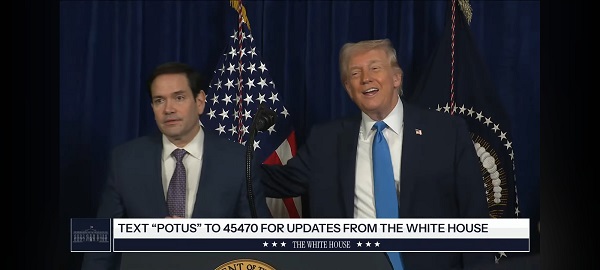
President Donald Trump said during a Saturday press conference that the United States would “run” Venezuela until a “judicious” transition could take place in the country.
Trump announced in a Saturday morning post to Truth Social that U.S. military forces carried out a law enforcement operation capturing Venezuelan President Nicolás Maduro and his wife in Caracas early Saturday morning. During his press conference later that day, Trump said that the United States would also seek to repair the infrastructure of Venezuela’s oil industry.
“We are going to run the country until such time as we can do a safe, proper and judicious transition. So, we don’t want to be involved with having somebody else get in and we have the same situation that we had for the last long period of years,” Trump said. “So, we are going to run the country until such time as we can do a safe, proper and judicious transition, and it has to be judicious because that’s what we’re all about.”
“We want peace, liberty and justice for the great people of Venezuela and that includes many from Venezuela that are now living in the United States and want to go back to their country. It’s their homeland,” Trump continued.
Many Congressional Democrats accused Trump of illegally engaging in a “regime change” operation. Trump said that Venezuela could be “making money” once its infrastructure was repaired.
“We’re there now, but we’re going to stay until such time as the proper transition can take place,” Trump said during the press conference. “We’re going to run it essentially until such time as a proper transition can take place.”
“As everyone knows the oil business in Venezuela has been a bust, a total bust for a long period of time. They were pumping almost nothing by comparison to what they could have been pumping and what could have taken place,” Trump continued. “We’re going to have our very large United States oil companies, the biggest anywhere in the world, go in, spend billions of dollars, fix the badly broken infrastructure, the oil infrastructure, and start making money for the country.”


Rulings could affect energy prices everywhere: Climate activists v. the energy industry in 2026

China Stages Massive Live-Fire Encirclement Drill Around Taiwan as Washington and Japan Fortify

Mainstream media missing in action as YouTuber blows lid off massive taxpayer fraud
The Canadian Energy Centre’s biggest stories of 2025

Why Japan wants Western Canadian LNG
Land use will be British Columbia’s biggest issue in 2026

The Global Push for Government Mandated Digital IDs And Why You Should Worry
-
 Energy22 hours ago
The U.S. Just Removed a Dictator and Canada is Collateral Damage
-
 Haultain Research20 hours ago
Trying to Defend Maduro’s Legitimacy
-
 Business1 day ago
Vacant Somali Daycares In Viral Videos Are Also Linked To $300 Million ‘Feeding Our Future’ Fraud
-
International1 day ago
Trump Says U.S. Strike Captured Nicolás Maduro and Wife Cilia Flores; Bondi Says Couple Possessed Machine Guns
-
 International22 hours ago
U.S. Claims Western Hemispheric Domination, Denies Russia Security Interests On Its Own Border
-
 International1 day ago
“Captured and flown out”: Trump announces dramatic capture of Maduro
-
International22 hours ago
US Justice Department Accusing Maduro’s Inner Circle of a Narco-State Conspiracy
-
International19 hours ago
“It’s Not Freedom — It’s the First Step Toward Freedom”