Connect with us
[the_ad id="89560"]

International

Trump rejects globalist Agenda 2030 and its climate emphasis as inconsistent with US sovereignty

Published

4 minute read

From LifeSiteNews

By Doug Mainwaring

According to Trump administration officials, the US president believes ‘the United Nations should refocus on its ‘founding purpose’ of preserving international peace and security.’

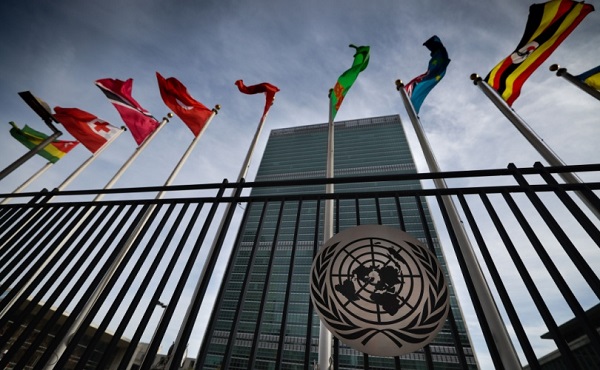
A Trump administration official informed the United Nations that the U.S. rejects the UN’s 2030 Agenda for Sustainable Development.

In a speech to the UN General Assembly, minister-counselor Edward Heartney of the U.S. mission to the UN said that its 2030 Agenda is “a program of soft global governance that is inconsistent with U.S. sovereignty and adverse to the rights and interests of Americans,” according to an Associated Press (AP) report.

Agenda 2030 has been touted as a “global partnership” and “shared blueprint for peace and prosperity” with 17 “Sustainable Development Goals (SDGs), which are an urgent call for action by all countries.”

The authors of the plan claim that “ending poverty and other deprivations must go hand-in-hand with strategies that improve health and education, reduce inequality, and spur economic growth,” emphasizing that this be done “while tackling climate change.”

Agenda 2030 was adopted by the UN in September 2015. Three months later, the Paris Agreement on Climate Change (PACC) was ratified. Both ambitious projects were welcomed by the Obama administration. President Donald Trump withdrew the U.S. from participation in the PACC early in his first term in the White House.

On Day One of his second term, Trump directed the U.S. Ambassador to the UN to:

  • Immediately submit written formal notification to the Secretary-General of the United Nations, or any relevant party, of the United States’ withdrawal from any agreement, pact, accord, or similar commitment made under the United Nations Framework Convention on Climate Change.
  • Immediately cease or revoke any purported financial commitment made by the United States under the United Nations Framework Convention on Climate Change.

His order also declared that the “U.S. International Climate Finance Plan is revoked and rescinded immediately. The Director of the Office of Management and Budget shall, within 10 days of this order, issue guidance for the rescission of all frozen funds.”

“In recent years, the United States has purported to join international agreements and initiatives that do not reflect our country’s values or our contributions to the pursuit of economic and environmental objectives,” the President wrote. “Moreover, these agreements steer American taxpayer dollars to countries that do not require, or merit, financial assistance in the interests of the American people.”

“Members of the Trump administration have said that U.S. President Donald Trump believes the United Nations should refocus on its ‘founding purpose’ of preserving international peace and security,” explained Richard Gowan, writing at Foreign Policy. The administration has announced “a full review of all U.S. multilateral commitments and treaties, which include the U.N. Charter. But Washington has offered little detail about what Trump’s vision of a peace-focused U.N. would look like.”

Great Reset

Surgery Denied. Death Approved.

Published on

Canada’s assisted-death regime has reached a point most people assumed was dystopian fiction and it’s doing so with bureaucratic calm. A woman in Saskatchewan, Jolene Van Alstine, suffering from a rare but treatable parathyroid disease, has applied for MAiD not because she is dying, but because she can’t access the surgery that would let her live.

Read that again. Not terminal. Not untreatable. Just abandoned by a system that has the audacity to call itself “universal.”

Kelsi Sheren is a reader-supported publication.

To receive new posts and support my work, consider becoming a free or paid subscriber.

Her assisted death is scheduled for January 7, 2026.

And the country shrugs. Van Alstine described spending years curled on a couch, nauseated, in agony, isolated, and pushed past endurance. The disease is brutal, but treatable a surgery here, a specialist there. The kind of medical intervention that in a functional system wouldn’t even make the news.

But in Saskatchewan? There are no endocrinologists accepting new patients. Without one, she can’t get referred. Without a referral, she can’t get surgery. Without surgery, she loses her life either slowly through suffering, or quickly through state-sanctioned death.

If you’ve ever lived through pain that warps time…
If you’ve ever had your mind hijacked by trauma…
If you’ve ever stared down suffering with no end in sight…

You know how thin the line can get between endurance and surrender.

And that’s why this story hits differently: it reveals how fragile people become when the system meant to protect them becomes an accomplice in their despair.

Canada frames MAiD as empowerment. As compassion. As choice.

But choice is only real when the alternatives are viable.
If your options are slow agony or assisted death, that’s not autonomy it’s coercion with a friendly tone.

Disability advocates, chronic-pain patients, the elderly, and low-income Canadians have been sounding the alarm for years: MAiD is expanding faster than support systems can catch up. Every expansion widens the chasm between the rhetoric of compassion and the lived experience of those who actually need help.

The Canadian Human Rights Commission itself warned that MAiD is being accessed because people cannot get the services required to live with dignity. And dignity matters. Anyone who has lived on the edge knows this: humans don’t just need survival, we need a reason to keep surviving.

When the healthcare system withholds that, death can look like mercy. This is the part polite society doesn’t want to confront.

Canada’s healthcare system is collapsing. Not strained. Not overburdened. Collapsing.

We have a growing list of citizens choosing death because medicine has become a lottery →
• a quadriplegic woman who applied for MAiD because she couldn’t secure basic home-care support
• veterans offered MAiD instead of trauma treatment
• homeless Canadians considering MAiD because they can’t survive winter

And now a woman denied a simple, lifesaving surgery.

At some point, we have to call this what it is: a nation outsourcing its failures to death. I’ve sat with veterans who couldn’t find themselves inside their own minds after war. I’ve watched people suffer silently because bureaucracy didn’t move fast enough to keep up with their pain.

I’ve coached clients who were one dropped ball, one missed appointment, one shut door away from losing the will to fight.

The lesson is the same every time. People don’t break because they’re weak. People break because they’re left alone with their suffering.

Van Alstine wasn’t offered community.
She wasn’t offered care.
She was offered an exit.

And she took it.

Not because she wanted to die but because Canada didn’t give her any path to live.

We need to stop pretending this is compassionate. Compassion is presence. Compassion is support. Compassion is a surgeon who actually exists, a referral that actually happens, a system that catches someone before they fall into the dark.

If MAiD is going to exist, it must be the last, quiet, grave option not the discounted aisle Canada sends you to when the cost of real care is too high.

A society reveals its soul by how it treats the people who can’t fight for themselves.
Right now, Canada is revealing something hollow.

People will debate the ethics of assisted dying forever. Fine. Debate it. But this is the wrong battleground. The real question is this →

What does it say about a country when death is easier to access than medical care?

Until Canada answers that honestly, we’re going to see more names on the calendar scheduled deaths, stamped and approved — for people who didn’t want to die. They just wanted someone to give them a chance to live.

Canada has failed every single citizen, and not a single person seems to care.

KELSI SHEREN

– – – – – – – – – – – –

SOURCE: https://righttolife.org.uk/news/canadian-woman-getting-assisted-death-because-she-cant-get-surgery

– – – – – – – – – – – –

One Time Donation! – Paypal – https://paypal.me/brassandunity

Buy me a coffee! – https://buymeacoffee.com/kelsisheren

Let’s connect!

Youtube – https://www.youtube.com/@thekelsisherenperspective

Instagram – https://www.instagram.com/thekelsisherenperspective?utm_source=ig_web_button_share_sheet&igsh=ZDNlZDc0MzIxNw%3D%3D

X: https://x.com/KelsiBurns

Substack: https://substack.com/@kelsisheren

TikTok – https://x.com/KelsiBurns

Continue Reading

Business

Canada invests $34 million in Chinese drones now considered to be ‘high security risks’

Published on

From LifeSiteNews

By Anthony Murdoch

Of the Royal Canadian Mounted Police’s fleet of 1,200 drones, 79% pose national security risks due to them being made in China

Canada’s top police force spent millions on now near-useless and compromised security drones, all because they were made in China, a nation firmly controlled by the Communist Chinese Party (CCP) government.

An internal report by the Royal Canadian Mounted Police (RCMP) to Canada’s Senate national security committee revealed that $34 million in taxpayer money was spent on a fleet of 973 Chinese-made drones.

Replacement drones are more than twice the cost of the Chinese-made ones between $31,000 and $35,000 per unit. In total, the RCMP has about 1,228 drones, meaning that 79 percent of its drone fleet poses national security risks due to them being made in China.

The RCMP said that Chinese suppliers are “currently identified as high security risks primarily due to their country of origin, data handling practices, supply chain integrity and potential vulnerability.”

In 2023, the RCMP put out a directive that restricted the use of the made-in-China drones, putting them on duty for “non-sensitive operations” only, however, with added extra steps for “offline data storage and processing.”

The report noted that the “Drones identified as having a high security risk are prohibited from use in emergency response team activities involving sensitive tactics or protected locations, VIP protective policing operations, or border integrity operations or investigations conducted in collaboration with U.S. federal agencies.”

The RCMP earlier this year said it was increasing its use of drones for border security.

Senator Claude Carignan had questioned the RCMP about what kind of precautions it uses in contract procurement.

“Can you reassure us about how national security considerations are taken into account in procurement, especially since tens of billions of dollars have been announced for procurement?” he asked.

The use of the drones by Canada’s top police force is puzzling, considering it has previously raised awareness of Communist Chinese interference in Canada.

Indeed, as reported by LifeSiteNews, earlier in the year, an RCMP internal briefing note warned that agents of the CCP are targeting Canadian universities to intimidate them and, in some instances, challenge them on their “political positions.”

The final report from the Foreign Interference Commission concluded that operatives from China may have helped elect a handful of MPs in both the 2019 and 2021 Canadian federal elections. It also concluded that China was the primary foreign interference threat to Canada.

Chinese influence in Canadian politics is unsurprising for many, especially given former Prime Minister Justin Trudeau’s past  admiration for China’s “basic dictatorship.”

As reported by LifeSiteNews, a Canadian senator appointed by Trudeau told Chinese officials directly that their nation is a “partner, not a rival.”

China has been accused of direct election meddling in Canada, as reported by LifeSiteNews.

As reported by LifeSiteNews, an exposé by investigative journalist Sam Cooper claims there is compelling evidence that Carney and Trudeau are strongly influenced by an “elite network” of foreign actors, including those with ties to China and the World Economic Forum. Despite Carney’s later claims that China poses a threat to Canada, he said in 2016 the Communist Chinese regime’s “perspective” on things is “one of its many strengths.”

Continue Reading

Trending

X