
International
Trump orders proof of citizenship to vote in federal elections


 MxM News
Quick Hit:

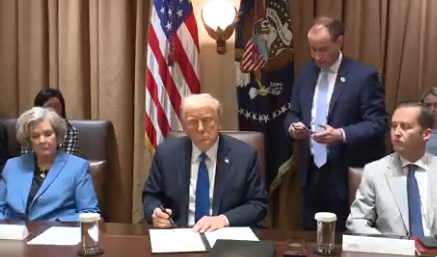
President Donald Trump on Tuesday signed an executive order aimed at restoring confidence in America’s elections by enforcing voter ID, cracking down on non-citizen voting, and ensuring compliance with existing federal election laws.
Key Details:
-
The executive order criticizes the United States for falling behind other nations in securing its elections, noting that while India and Brazil use biometric voter ID systems, many U.S. states rely on self-attestation.
-
Trump ordered the Election Assistance Commission to update the national voter registration form to require “documentary proof of United States citizenship,” including passports or REAL ID-compliant documents.
-
The order also instructs the Department of Justice to crack down on states that count ballots received after Election Day, stating that counting late ballots is akin to letting someone “vote in person at a former voting precinct” days after polls close.
Diving Deeper:
On Tuesday, President Trump signed a far-reaching executive order titled Preserving and Protecting the Integrity of American Elections, aiming to overhaul how federal and state governments enforce longstanding election laws.
In the order’s opening section, Trump drew comparisons to foreign democracies, arguing that “the United States now fails to enforce basic and necessary election protections employed by modern, developed nations.” He cited examples including India and Brazil’s biometric-linked voter ID systems and Germany and Canada’s paper ballot requirements, adding that “many American elections now feature mass voting by mail,” often accepting ballots “without postmarks or those received well after Election Day.”
Trump’s directive enforces federal laws already on the books, such as 2 U.S.C. § 7 and 3 U.S.C. § 1, which establish a uniform national Election Day. Referencing a 2024 Fifth Circuit ruling, the order states that ballots must be both cast and received by Election Day. “This is like allowing persons who arrive 3 days after Election Day, perhaps after a winner has been declared, to vote in person… which would be absurd,” the order reads.
A central element of the order is the crackdown on non-citizen voting. It mandates that the national voter registration form include “documentary proof of United States citizenship,” such as a passport, a REAL ID-compliant card, or a military ID indicating citizenship. The order also requires that state and local officials document the specific proof of citizenship used during registration.
To assist states in cleaning up voter rolls, Trump directed the Department of Homeland Security to provide access to immigration databases and mandated that the Social Security Administration share death and identity data. The Attorney General is instructed to “prioritize enforcement” of statutes that prohibit non-citizens from registering or voting and to coordinate with state officials to prosecute violations.
The order also targets election infrastructure and voting machines, requiring that all voting systems include “a voter-verifiable paper record” and banning systems that use barcodes or QR codes to contain vote data, except for accessibility needs. The Election Assistance Commission is instructed to decertify equipment that fails to meet new integrity standards within 180 days.
The executive order further aims to eliminate foreign interference by enforcing 52 U.S.C. § 30121, which bans foreign contributions to federal, state, or local elections. Trump highlighted the abuse of ballot initiative spending loopholes and committed federal enforcement resources to curtail this influence, declaring that “foreign nationals and non-governmental organizations have taken advantage of loopholes… undermining the franchise.”
Through information-sharing agreements, increased prosecution, and withholding of federal funds to uncooperative states, the order seeks to hold jurisdictions accountable for maintaining accurate voter rolls and enforcing citizenship requirements.
“In honest elections,” the order concludes, “voting methods must produce a voter-verifiable paper record… to protect against fraud or mistake.”


President Trump said Christmas night that he ordered U.S. forces to carry out airstrikes in northwest Nigeria, targeting ISIS-linked militants he blamed for a campaign of mass killings against Christians.
In announcing the operation, Trump said the United States delivered “powerful and deadly” blows against terrorists who have been “viciously killing, primarily, innocent Christians,” adding that he had warned them repeatedly that the slaughter would bring consequences. He credited precise U.S. strikes, said his administration would not allow radical Islamic terrorism to take root, and closed with a Christmas message blessing the military while signaling more action if the attacks continue.
.@POTUS “Tonight, at my direction as Commander in Chief, the United States launched a powerful and deadly strike against ISIS Terrorist Scum in Northwest Nigeria, who have been targeting and viciously killing, primarily, innocent Christians, at levels not seen for many years, and… pic.twitter.com/ct7rUW128t
— Department of War 🇺🇸 (@DeptofWar) December 26, 2025
The strike followed weeks of intensifying reports documenting targeted violence against Christian communities across northern and central Nigeria, violence that multiple journalists and religious freedom advocates have described as genocidal in nature.
Islamist factions including Boko Haram and allied jihadist militias have, for more than a decade, carried out coordinated assaults aimed at erasing Christian villages from the Middle Belt and the north. Those attacks have repeatedly spiked around Christian holidays, particularly Christmas and Easter.
During a December 16 briefing attended by reporters and advocates, speakers described the violence as a deliberate campaign of obliteration. Steven Kefas of the Observatory for Religious Freedom in Africa pointed to the timing of the attacks as evidence they are religiously motivated, noting that assaults frequently occur on Sundays and Christmas Eve. If the killings were random criminality, he asked, why are Muslim communities not attacked on Fridays or on the eve of their own celebrations?
Critics say the crisis has been compounded by denials from Abuja. President Bola Tinubu has consistently downplayed the religious nature of the violence, framing it instead as banditry or climate-related conflict, and pushed back on international scrutiny even after Trump designated Nigeria a Country of Particular Concern for religious freedom earlier this fall.
While the Nigerian government later declared a state of emergency and dismissed senior defense officials, watchdog groups report that Christians who survive the attacks — and journalists who document them — continue to face threats and intimidation.
According to Open Doors, Nigerian Christians now endure an average of eight violent attacks every day, a level of brutality critics say the government has long minimized or ignored.
The issue has also drawn attention beyond Washington. In a Christmas Eve message, Benjamin Netanyahu said Israel remains the only Middle Eastern nation where the Christian community is thriving and added that militant displacement and attacks against Christians in Nigeria “must end.”
Energy
While Western Nations Cling to Energy Transition, Pragmatic Nations Produce Energy and Wealth


From the Daily Caller News Foundation
History will likely remember 2025 as the year energy corporatists finally stopped pretending there is a climate crisis. For a decade, a bizarre theater of the absurd played out as titans of the oil and gas industry apologized for their core business while pledging allegiance to a “green transition” that existed mostly in the imaginations of Western bureaucrats. But the curtain has seemingly fallen.
ExxonMobil, one of the world’s largest energy producers, has slashed $10 billion from its low-carbon investment commitments through 2030. Simultaneously, the company announced that it expects $25 billion in earnings growth from 2024 to 2030 to be powered primarily by increases in oil and gas production, which will push daily output to 5.5 million barrels of oil equivalent by the end of the decade.
This is not a company abandoning climate responsibility but rather at last recognizing what has long been obvious: The path prescribed by the climate industrial complex is economically destructive and operationally impossible – even with massive government subsidies.
Dear Readers:
As a nonprofit, we are dependent on the generosity of our readers.
Please consider making a small donation of any amount here.
Thank you!
For years, the global energy strategy has been surreal. Companies that built the modern world on the back of energy-dense hydrocarbons indulged those celebrating the arrival of wind turbines and solar panels to power civilization. But reality, stubborn and unforgiving, has interrupted the psychedelic revelry.
ExxonMobil’s low-carbon investments will be paced to policy support and customer demand, says the company. That is corporate speak meaning that spending on green projects is paused unless the government – using our tax dollars – subsidizes the risk or until a market exists.
Megaprojects, once heralded as the future, are now in line for deferral. Why? Because without taxpayer handouts, the economics of trying to bury underground a plant food like carbon dioxide simply do not work – and defy common sense.
The energy sector is pivoting from a strategy of “grow clean at all costs” to “returns first, transition last.” “Green” projects are being relegated to a secondary capital bucket – a token for good PR instead of a core activity.
Europe’s Shell and Aker BP and Canada’s Enbridge have withdrawn from the Science Based Targets initiative to establish “science-based emissions reductions.” This was a retreat from what is described as a “credible, science-based net-zero framework” because there was neither credibility nor science. It was a political suicide pact. The energy giants looked at the cliff’s edge and refused to jump.
British multinational BP, having abandoned its promise to go “Beyond Petroleum,” has raised its oil and gas spending and softened its renewable targets.
ENEOS Holdings, a Japanese refiner, has discarded hydrogen production targets, with CEO Tomohide Miyata explaining that “the shift toward a carbon-neutral society appears to be slowing.”
These U-turns represent a renaissance in policy realism. Energy needs do not disappear because politicians make speeches at climate summits or corporations allocate funds to ESG programs or governments attempt to control consumption and choices of appliances and automobiles.
Second thoughts about an inevitably doomed “green” transition is a victory for the single mother in the U.S. trying to budget for winter heating and for the small business owner in the U.K. whose margins are crushed by one of the highest commercial electricity rates in the world. And for the billions of people in developing nations, this pivot could be salvation from generational poverty.
The question now is whether governments will recognize what corporations have made clear: that the energy transition was a fantasy infused with scientific language and draped in moralistic gingerbread. Or will they continue to increase subsidies and regulations?
Very likely, there will be a bifurcation: on the one hand, western bureaucracies, particularly in Europe, continuing an economic decline under mandates and taxes, and on the other, pragmatic governments, many of them in Asia, pursuing prosperity with fuels and technologies that work.
Vijay Jayaraj is a Science and Research Associate at the CO2 Coalition, Fairfax, Va. He holds an M.S. in environmental sciences from the University of East Anglia and a postgraduate degree in energy management from Robert Gordon University, both in the U.K., and a bachelor’s in engineering from Anna University, India. He served as a research associate with the Changing Oceans Research Unit at University of British Columbia, Canada.


Alberta’s new diagnostic policy appears to meet standard for Canada Health Act compliance
RFK Jr reversing Biden-era policies on gender transition care for minors
Geopolitics no longer drives oil prices the way it used to
Ex-FDA Commissioners Against Higher Vaccine Standards Took $6 Million From COVID Vaccine Makers

Canadian university censors free speech advocate who spoke out against Indigenous ‘mass grave’ hoax
Top constitutional lawyer warns against Liberal bills that could turn Canada into ‘police state’
There’s No Bias at CBC News, You Say? Well, OK…
-
 Alberta2 days ago
Ottawa-Alberta agreement may produce oligopoly in the oilsands
-
 Energy2 days ago
Western Canada’s supply chain for Santa Claus
-
 Energy2 days ago
The Top News Stories That Shaped Canadian Energy in 2025 and Will Continue to Shape Canadian Energy in 2026
-
 International2 days ago
$2.6 million raised for man who wrestled shotgun from Bondi Beach terrorist
-
 Frontier Centre for Public Policy16 hours ago
Tent Cities Were Rare Five Years Ago. Now They’re Everywhere
-
 armed forces17 hours ago
Remembering Afghanistan and the sacrifices of our military families
-
 Fraser Institute17 hours ago
How to talk about housing at the holiday dinner table
-
 Opinion17 hours ago
Pope Leo XIV’s Christmas night homily