
Economy
The stars are aligning for a new pipeline to the West Coast


From Resource Works

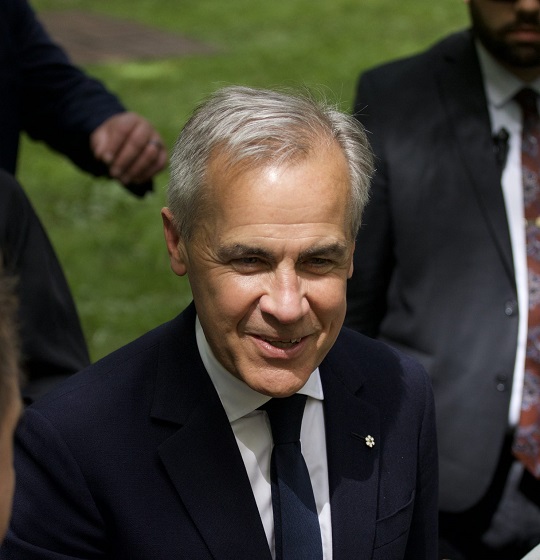
Mark Carney says another pipeline is “highly likely”, and that welcome news.
While attending this year’s Calgary Stampede, Prime Minister Mark Carney made it official that a new pipeline to Canada’s West Coast is “highly likely.”
While far from a guarantee, it is still great news for Canada and our energy industry. After years of projects being put on hold or cancelled, things are coming together at the perfect time for truly nation-building enterprises.
Carney’s comments at Stampede have been preceded by a number of other promising signs.
At a June meeting between Carney and the premiers in Saskatoon, Alberta Premier Danielle Smith proposed a “grand bargain” that would include a privately funded pipeline capable of moving a million barrels of oil a day, along with significant green investments.
Carney agreed with Smith’s plan, saying that Canada needed to balance economic growth with environmental responsibility.
Business and political leaders have been mostly united in calling for the federal government to speed up the building of pipelines, for economic and strategic reasons. As we know, it is very difficult to find consensus in Canada, with British Columbia Premier David Eby still reluctant to commit to another pipeline on the coast of the province.
Alberta has been actively encouraging support from the private sector to fund a new pipeline that would fulfil the goals of the Northern Gateway project, a pipeline proposed in 2008 but snuffed out by a hail of regulations under former Prime Minister Justin Trudeau.
We are in a new era, however, and we at Resource Works remarked that last month’s G7 meeting in Kananaskis could prove to be a pivotal moment in the history of Canadian energy. An Ipsos poll found that Canada was the most favoured nation for supplying oil in the G7, and our potential as an energy superpower has never been more important for the democratic world, given the instability caused by Russia and other autocratic energy powers.
Because of this shifting, uncertain global climate, Canadian oil and gas are more attractive than ever, and diversifying our exports beyond the United States has become a necessity in the wake of Donald Trump’s regime of tariffs on Canada and other friendly countries.
It has jolted Canadian political leaders into action, and the premiers are all on board with strengthening our economic independence and trade diversification, even if not all agree on what that should look like.
Two premiers who have found common ground are Danielle Smith and Ontario Premier Doug Ford. After meeting at Stampede, the pair signed two memorandums of understanding to collaborate on studying an energy corridor and other infrastructure to boost interprovincial trade. This included the possibility of an eastward-bound pipeline to Ontario ports for shipping abroad.
Ford explicitly said that “the days of relying on the United States 100 percent, those days are over.” That’s in line with Alberta’s push for new pipeline routes, especially to northwestern B.C., which are supported by Smith’s government.
On June 10, Resource Works founder and CEO Stewart Muir wrote that Canadian energy projects are a daunting endeavour, akin to a complicated jigsaw puzzle, but that getting discouraged by the complexity causes us to lose sight of the picture itself. He asserted that Canadians have to accept that messiness, not avoid it.
Prime Minister Carney has suggested he will make adjustments to existing regulations and controversial legislation like Bill C-69 and the emissions cap, all of which have slowed the development of new energy infrastructure.
This moment of alignment between Ottawa, the provinces, and other stakeholders cannot be wasted. The stars are aligning, and it will be a tragedy if we cannot take a great step into the future of our country.

Alberta
Premier Smith: Canadians support agreement between Alberta and Ottawa and the major economic opportunities it could unlock for the benefit of all
From Energy Now
By Premier Danielle Smith
Get the Latest Canadian Focused Energy News Delivered to You! It’s FREE: Quick Sign-Up Here
If Canada wants to lead global energy security efforts, build out sovereign AI infrastructure, increase funding to social programs and national defence and expand trade to new markets, we must unleash the full potential of our vast natural resources and embrace our role as a global energy superpower.
The Alberta-Ottawa Energy agreement is the first step in accomplishing all of these critical objectives.
Recent polling shows that a majority of Canadians are supportive of this agreement and the major economic opportunities it could unlock for the benefit of all Canadians.
As a nation we must embrace two important realities: First, global demand for oil is increasing and second, Canada needs to generate more revenue to address its fiscal challenges.
Nations around the world — including Korea, Japan, India, Taiwan and China in Asia as well as various European nations — continue to ask for Canadian energy. We are perfectly positioned to meet those needs and lead global energy security efforts.
Our heavy oil is not only abundant, it’s responsibly developed, geopolitically stable and backed by decades of proven supply.
If we want to pay down our debt, increase funding to social programs and meet our NATO defence spending commitments, then we need to generate more revenue. And the best way to do so is to leverage our vast natural resources.
At today’s prices, Alberta’s proven oil and gas reserves represent trillions in value.
It’s not just a number; it’s a generational opportunity for Alberta and Canada to secure prosperity and invest in the future of our communities. But to unlock the full potential of this resource, we need the infrastructure to match our ambition.
There is one nation-building project that stands above all others in its ability to deliver economic benefits to Canada — a new bitumen pipeline to Asian markets.
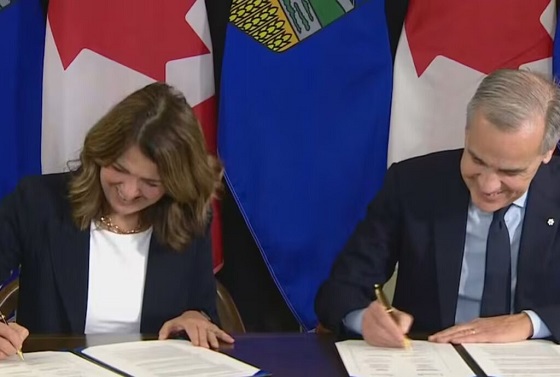
The energy agreement signed on Nov. 27 includes a clear path to the construction of a one-million-plus barrel-per-day bitumen pipeline, with Indigenous co-ownership, that can ensure our province and country are no longer dependent on just one customer to buy our most valuable resource.
Indigenous co-ownership also provide millions in revenue to communities along the route of the project to the northwest coast, contributing toward long-lasting prosperity for their people.
The agreement also recognizes that we can increase oil and gas production while reducing our emissions.
The removal of the oil and gas emissions cap will allow our energy producers to grow and thrive again and the suspension of the federal net-zero power regulations in Alberta will open to doors to major AI data-centre investment.
It also means that Alberta will be a world leader in the development and implementation of emissions-reduction infrastructure — particularly in carbon capture utilization and storage.
The agreement will see Alberta work together with our federal partners and the Pathways companies to commence and complete the world’s largest carbon capture, utilization and storage infrastructure project.
This would make Alberta heavy oil the lowest intensity barrel on the market and displace millions of barrels of heavier-emitting fuels around the globe.
We’re sending a clear message to investors across the world: Alberta and Canada are leaders, not just in oil and gas, but in the innovation and technologies that are cutting per barrel emissions even as we ramp up production.
Where we are going — and where we intend to go with more frequency — is east, west, north and south, across oceans and around the globe. We have the energy other countries need, and will continue to need, for decades to come.
However, this agreement is just the first step in this journey. There is much hard work ahead of us. Trust must be built and earned in this partnership as we move through the next steps of this process.
But it’s very encouraging that Prime Minister Mark Carney has made it clear he is willing to work with Alberta’s government to accomplish our shared goal of making Canada an energy superpower.
That is something we have not seen from a Canadian prime minister in more than a decade.
Together, in good faith, Alberta and Ottawa have taken the first step towards making Canada a global energy superpower for benefit of all Canadians.
Danielle Smith is the Premier of Alberta
From Energy Now
By Canada Powered by Women
Canada has entered a new period of energy cooperation, marking one of the biggest shifts in federal–provincial alignment on energy priorities in years.
Last week as Prime Minister Mark Carney and Alberta Premier Danielle Smith signed a memorandum of understanding (MOU) that outlines how both governments will approach a potential pipeline to British Columbia’s coast.
The agreement, which has been described as a “new starting point” after years of tension, lays the groundwork for a privately financed pipeline while also linking this commitment to a broader set of infrastructure priorities across oil and gas, LNG, renewables, critical minerals and electricity transmission.
It also sets out how a privately financed project, moving roughly 300,000 to 400,000 barrels of oil to global markets each day, will be reviewed.
Now that the announcement is behind us, attention has turned to how (or if) a pipeline is going to get built.
Alberta has set out its ambitions, British Columbia has its conditions, and the federal government has its own expectations. Together, these positions are shaping what some are calling a “grand bargain” which will be made up of trade-offs.
Trade-offs are not a new concept for the engaged women that Canada Powered by Women (CPW) represents, as they’ve been showing up in our research for several years now. And anyone who reads us also knows we like to look at what the data says.
According to new polling from the Angus Reid Institute, a clear majority of Canadians support a pipeline, with national backing above 60 per cent. And there’s strong support for the pipeline among those in B.C. This aligns with other emerging data points that show Canadians are looking for practical solutions that strengthen affordability and long-term reliability.
By the numbers:
• 60 per cent of Canadians support the pipeline concept, while 25 per cent oppose it.
• 53 per cent of people support in British Columbia, compared to 37 percent opposed.
• 74 per cent of people in Alberta and Saskatchewan support the pipeline.

Our research shows the same trends.
A large majority (85 per cent) of engaged women agree that building pipelines and refining capacity within the country should be prioritized. They favour policies that will progress stability, affordability and long-term economic opportunity.
A key feature of the MOU is the expectation of Indigenous ownership and benefit sharing, which Alberta and B.C. governments identify as essential, and which aligns with public opinion. As of right now, Indigenous groups remain split on support for a pipeline.
The agreement also signals that changes to the federal Oil Tanker Moratorium Act may need to be considered. The moratorium, in place since 2019, is designed to limit large tanker traffic on the North Coast of B.C. because of navigation risks in narrow channels and the need to protect sensitive coastal ecosystems.
Those in favour of the pipeline point to this as a critical barrier to moving Canadian oil to international markets.
Polling from the Angus Reid Institute shows that 47 per cent of Canadians believe the moratorium could be modified or repealed if stronger safety measures are in place. Again, we come back to trade-offs.
The MOU is a starting point and does not replace consultation, environmental review or provincial alignment. These steps are still required before any project can advance. Taken together, the agreement and the data show broad support for strengthening Canada’s energy options.
This will be an issue that engaged women are no doubt going to watch, and the conversation is likely to move from ideas to discussing what trade-offs can be made to bring this opportunity to life.


Net Zero goal is a fundamental flaw in the Ottawa-Alberta MOU

Eco-radical Canadian Cabinet minister resigns after oil deal approved

Learning the Truth about “Children’s Graves” and Residential Schools is More Important than Ever

Canadians will soon be versed in massive West Coast LPG mega-project

Recent price declines don’t solve Toronto’s housing affordability crisis

Manitoba Is Doubling Down On A Failed Drug Policy

Canada Still Serves Up Food Dyes The FDA Has Banned
-
 Censorship Industrial Complex1 day ago
Canadian bishops condemn Liberal ‘hate speech’ proposal that could criminalize quoting Scripture
-
 National2 days ago
Alberta will use provincial laws to stop Canadian gov’t from trying to confiscate legal firearms
-
 COVID-192 days ago
Canadian legislator introduces bill to establish ‘Freedom Convoy Recognition Day’ as a holiday
-
 Energy2 days ago
A look inside the ‘floatel’ housing B.C.’s LNG workforce
-
 Daily Caller18 hours ago
Trump Orders Review Of Why U.S. Childhood Vaccination Schedule Has More Shots Than Peer Countries
-
 Business2 days ago
US Energy Secretary says price of energy determined by politicians and policies
-
Economy1 day ago
What the Data Shows About the New Canada-Alberta Pipeline Opportunity
-
 illegal immigration1 day ago
While Trump has southern border secure, hundreds of thousands of illegal immigrants still flooding in from Canada