
Business
“The insanity is ending”: USDA cancels $600k grant to study transgender men’s menstruation



Quick Hit:
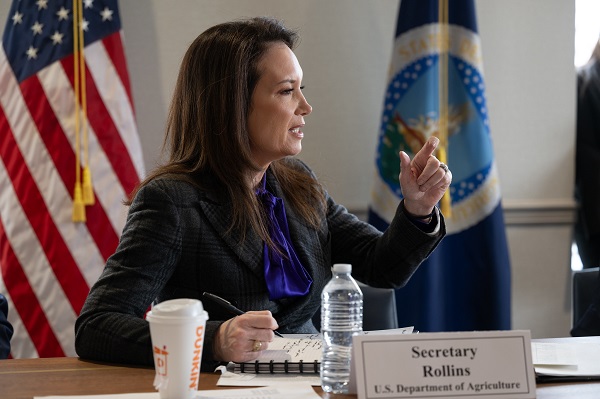
Agriculture Secretary Brooke Rollins announced Friday that the Department of Agriculture has canceled a $600,000 federal grant intended for a study on menstrual cycles in transgender men. Rollins declared the decision part of broader efforts to end what she called “insanity” and restore common sense in government spending.
Key Details:
-
The grant description outlined the study’s focus on menstruation, stating that most women experience around 450 menstrual cycles over their lifetime, while also emphasizing that “transgender men and people with masculine gender identities, intersex and non-binary persons may also menstruate.”
-
Researchers aimed to explore concerns related to menstruation, including the potential use of natural fibers, such as hemp, in feminine hygiene products.
-
The American Principles Project, a conservative nonprofit, first identified the study as part of a broader review of more than 340 federally funded grants during the Biden administration, which amounted to over $128 million.
🚨CANCELLED: $600,000 grant to study “menstrual cycles in transgender men”
Keep sending us tips. THANK YOU, @approject! The insanity is ending and the restoration of America is underway. 🇺🇸💪❤️ https://t.co/7S53WQ3CP3
— Secretary Brooke Rollins (@SecRollins) March 8, 2025
Diving Deeper:
The Department of Agriculture’s decision to revoke the $600,000 grant marks another rollback of Biden-era initiatives under the new administration. The study, awarded to Southern University Agricultural & Mechanical College, was originally slated to continue through April 2027, focusing on menstruation-related concerns, including the development of eco-friendly hygiene products.
A description of the study noted that menstruation typically begins around age 12 and continues until menopause, averaging around 450 cycles in a lifetime. The grant documentation also stated that menstruation is not limited to biological women, arguing that transgender men and other gender identities may also experience it.
Rollins took to social media platform X to confirm the cancellation, writing, “CANCELLED: $600,000 grant to study ‘menstrual cycles in transgender men.’” She credited the American Principles Project for uncovering the grant and added, “Keep sending us tips. THANK YOU, @approject! The insanity is ending and the restoration of America is underway.”


What Prime Minister Mark Carney gives with his left hand, he takes away with his right hand.
Canadians are already overtaxed and need serious tax cuts to make life more affordable and make our economy more competitive. But at best, the New Year will bring a mixed bag for Canadian taxpayers.
The federal government is cutting income taxes, but it’s hiking payroll taxes. The government cancelled the consumer carbon tax, but it’s hammering Canadian businesses with a higher industrial carbon tax.
The federal government cut the lowest income tax bracket from 15 to 14 per cent. That will save the average taxpayer $190 in 2026, according to the Parliamentary Budget Officer.
But the government is taking more money from Canadians’ paycheques with higher payroll taxes.
Workers earning $85,000 or more will pay $5,770 in federal payroll taxes in 2026. That’s a $262 payroll tax hike. Their employers will also be forced to pay $6,219.
So Canadians will save a couple hundred bucks from the income tax cut in the new year, but many Canadians will pay a couple hundred bucks more in payroll taxes.
It’s the same story with carbon taxes.
After massive backlash from ordinary Canadians, the federal government dropped its consumer carbon tax that cost average families hundreds of dollars every year and increased the price of gas by about 18 cents per litre.
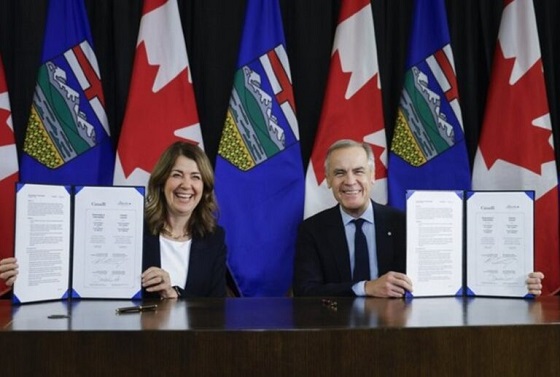
But Carney’s first budget shows he wants higher carbon taxes on Canadian businesses. Carney still hasn’t provided Canadians a clear answer on how much his business carbon tax will cost. He did, however, provide a hint during a press conference he held after signing a memorandum of understanding with the Alberta government.
“It means more than a six times increase in the industrial price on carbon,” Carney said.
Carney previously said that by “changing the carbon tax … We are making the large companies pay for everybody.”
Carney’s problem is that Canadians aren’t buying what he’s selling on carbon taxes.
Just 12 per cent of Canadians believe Carney that businesses will pay most of the cost of his carbon tax, according to a Leger poll. Nearly 70 per cent of Canadians say businesses will pass most or some of the cost to consumers.
Canadians understand that it doesn’t matter what type of lipstick politicians put on their carbon tax pig, all carbon taxes make life more expensive.
Carney is also continuing his predecessor’s tradition of automatically increasing booze taxes.
Ottawa will once again hike taxes on beer, wine and spirits in 2026 through its undemocratic alcohol tax escalator.
First passed in the 2017 federal budget, the alcohol escalator tax automatically increases federal taxes on beer, wine and spirits every year without a vote in Parliament.
Federal alcohol taxes are expected to increase by two per cent on April 1, and cost taxpayers $41 million in 2026. Since being imposed, the alcohol escalator tax has cost taxpayers about $1.6 billion, according to industry estimates.
Canadians are overtaxed and need the federal government to seriously lighten the load.
The biggest expense for the average Canadian family isn’t the home they live in, the food they eat or the clothes they buy. It’s the taxes they pay to all levels of government. More than 40 per cent of the average family’s budget goes to paying taxes, according to the Fraser Institute.
Politicians are taking too much money from Canadians. And their high taxes are driving away investment and jobs.
Canada ranks a dismal 27th out of 38 industrialized countries on individual tax competitiveness, according to the Tax Foundation. Canada ranks 22nd on business tax competitiveness. Canada is behind the United States on both measures.
A little bit of tax relief here and there isn’t going to cut it. Carney’s New Year’s resolution needs to be to embark on a massive tax cutting campaign.

Federal agents are now going “DOOR TO DOOR” in Minneapolis, launching what the Department of Homeland Security itself describes as an on-the-ground sweep of businesses and day-care centers tied to Minnesota’s exploding fraud scandal — a case that has already burned through at least $1 billion in taxpayer money and is rapidly closing in on Democrat Gov. Tim Walz and his administration.
ICE agents, working under the umbrella of the Department of Homeland Security, fanned out across the city this week, showing up unannounced at locations suspected of billing state and federal programs for services that never existed. One day-care worker told reporters Monday that masked agents arrived at her facility, demanded paperwork, and questioned staff about operations and enrollment.
“DHS is on the ground in Minneapolis, going DOOR TO DOOR at suspected fraud sites,” the agency posted on X. “The American people deserve answers on how their taxpayer money is being used and ARRESTS when abuse is found.”
DHS is on the ground in Minneapolis, going DOOR TO DOOR at suspected fraud sites.
The American people deserve answers on how their taxpayer money is being used and ARRESTS when abuse is found. Under the leadership of @Sec_Noem, DHS is working to deliver results. pic.twitter.com/7XtRflv36b
— Homeland Security (@DHSgov) December 29, 2025
Authorities say the confirmed fraud already totals roughly $300 million tied to fake food programs, $220 million linked to bogus autism services, and more than $300 million charged for housing assistance that never reached the people it was meant to help. Investigators from the FBI, Justice Department, and Department of Labor have now expanded their probes after a viral investigation exposed taxpayer-funded day cares that received more than $1 million each while allegedly serving few — or zero — children.
One of the most glaring examples, the Minneapolis-based Quality “Learing” Center — infamous for its misspelled sign — suddenly appeared busy Monday as national media arrived. Locals told reporters the center is typically empty and often looks permanently closed, despite receiving about $1.9 million in public funds. State inspection records show the facility has racked up 95 violations since 2019. Employees allegedly cursed at reporters while children were bused in during posted afternoon hours.
DHS officials say the “DOOR TO DOOR” operation is deliberate. In videos released online, agents are seen questioning nearby business owners about whether adjacent buildings ever had foot traffic, whether they appeared open, and whether operators used subcontractors or outside partners to pad billing. DHS Secretary Kristi Noem posted footage of agents pressing workers about business relationships and transportation services used by suspected fraud sites.
“This is a large-scale investigation,” DHS Assistant Secretary Tricia McLaughlin told the New York Post, confirming that Homeland Security Investigations and ICE are targeting fraudulent day-care and health-care centers as well as related financial schemes.
FBI Director Kash Patel warned that what investigators have uncovered so far is “just the tip of a very large iceberg.” He pointed to the bureau’s dismantling of a $250 million COVID-era food-aid scam tied to the Feeding Our Future network, a case that resulted in 78 indictments and 57 convictions. Patel has also made clear that denaturalization and deportation remain on the table for convicted fraudsters where the law allows.
Dozens of arrests have already been made across the broader scheme, many involving Somali immigrants, though federal officials stress the investigation targets criminal behavior — not communities. Some local residents say the scandal is hurting law-abiding families. One Somali Uber driver told reporters he works 16-hour days and is furious that “some people are taking advantage of the system,” making the entire community look bad.
Now, with federal agents going “DOOR TO DOOR” across Minneapolis, the era of polite indifference appears to be over. The message from Washington is blunt: the money trail is being followed, the paperwork is being checked, and the days of treating taxpayer-funded programs like an open vault are coming to an end.


Ottawa-Alberta agreement may produce oligopoly in the oilsands

Warning Canada: China’s Economic Miracle Was Built on Mass Displacement
The Top News Stories That Shaped Canadian Energy in 2025 and Will Continue to Shape Canadian Energy in 2026

The Climate Argument Against Livestock Doesn’t Add Up
What are the odds of a pipeline through the American Pacific Northwest

‘The electric story is over’

Calgary’s new city council votes to ban foreign flags at government buildings
-
 Haultain Research2 days ago
Sweden Fixed What Canada Won’t Even Name
-
 Business2 days ago
What Do Loyalty Rewards Programs Cost Us?
-
 Business1 day ago
Land use will be British Columbia’s biggest issue in 2026
-
 Bruce Dowbiggin3 hours ago
In Contentious Canada Reality Is Still Six Degrees Of Hockey
-
Business2 hours ago
Canada needs serious tax cuts in 2026
-
 Energy1 day ago
Why Japan wants Western Canadian LNG
-
 Business1 day ago
Mainstream media missing in action as YouTuber blows lid off massive taxpayer fraud
-
 Business1 day ago
Stripped and shipped: Patel pushes denaturalization, deportation in Minnesota fraud