
Opinion
Speed on Green?


Hey everyone,

As of August 11 the intersections in our city that currently have red light cameras will also now have the ability to issue tickets for speeding through them on green lights.
What do you think of this?
Could we frame this discussion as a speeders tax or a fee-to-speed? Perhaps.
But either way let’s not fool ourselves; these cameras are only marginally effective at making our roads safer. As soon as drivers learn where these cameras are they slow down temporarily and then they defiantly speed up again as soon as they’re out of range. So, yes, these cameras probably do make specific intersections safer. But on the other hand I suspect the gains might be lost if drivers are dangerously slamming on their brakes to avoid having their picture taken as soon as they catch a glimpse of the camera as they speed by. I suppose the data will bear out the fact of the matter. My mind will remain open.
Also, while the focus on catching speeders does give us a good feeling of accomplishment, the question remains; how do we address the other major factors such as distracted and impaired driving? I hear Police ride the bus in some cities and call in distracted drivers they see through the window as they cruise around the city. But that’s a whole other topic.
One thing that has worked well is installing timers at many intersections around our city. I really like how I can see from a distance that I have enough time to safely slow down and stop. So I’d like to put it forward that, if we must have speed-on-green cameras then we should use the money to pay for things like timers at intersections and other things that improve traffic safety.
I also wonder if we should be having the conversation about timing traffic lights better? “Red-Light-Deer” is a social media meme which is growing in popularity. So the bigger picture question here is how can we make traffic flow better in our city?
Lastly, another discussion that we should be having is how to improve safety in our school zones. Since we know that traffic cameras only temporarily slow drivers down and we also know that many drivers are unwilling to temporarily slow down near schools, it seems like there is an obvious solution to the problem, let’s put traffic cameras in school zones. Can we do that? Call it a cash grab, sure, just please don’t run my kids over. The scariest thing to a parent is a speeding car in school zone!
With all of that said, the reality is that we can’t legislate the sort of cultural change that needs to happen. I recently became a defensive driving instructor and this is something that I talk about a lot. People need to obey the rules of the road not because they’re afraid of getting a ticket but because they care about their own safety and respect the safety and well-being of everyone else in their community. This is the ultimate way to be proactive when it comes to road safety. It starts with you and the attitude that you choose to have when you get behind the wheel.
Cheers,




People criticize capitalism. A recent Axios-Generation poll says, “College students prefer socialism to capitalism.”
Why?
Because they believe absurd myths. Like the claim that the Soviet Union “wasn’t real socialism.”
Socialism guru Noam Chomsky tells students that. He says the Soviet Union “was about as remote from socialism as you could imagine.”
Give me a break.
The Soviets made private business illegal.
If that’s not socialism, I’m not sure what is.
“Socialism means abolishing private property and … replacing it with some form of collective ownership,” explains economist Ben Powell. “The Soviet Union had an abundance of that.”
Socialism always fails. Look at Venezuela, the richest country in Latin America about 40 years ago. Now people there face food shortages, poverty, misery and election outcomes the regime ignores.
But Al Jazeera claims Venezuela’s failure has “little to do with socialism, and a lot to do with poor governance … economic policies have failed to adjust to reality.”
“That’s the nature of socialism!” exclaims Powell. “Economic policies fail to adjust to reality. Economic reality evolves every day. Millions of decentralized entrepreneurs and consumers make fine tuning adjustments.”
Political leaders can’t keep up with that.
Still, pundits and politicians tell people, socialism does work — in Scandinavia.
“Mad Money’s Jim Cramer calls Norway “as socialist as they come!”
This too is nonsense.
“Sweden isn’t socialist,” says Powell. “Volvo is a private company. Restaurants, hotels, they’re privately owned.”
Norway, Denmark and Sweden are all free market economies.
Denmark’s former prime minister was so annoyed with economically ignorant Americans like Bernie Sanders calling Scandanavia “socialist,” he came to America to tell Harvard students that his country “is far from a socialist planned economy. Denmark is a market economy.”
Powell says young people “hear the preaching of socialism, about equality, but they don’t look on what it actually delivers: poverty, starvation, early death.”
For thousands of years, the world had almost no wealth creation. Then, some countries tried capitalism. That changed everything.
“In the last 20 years, we’ve seen more humans escape extreme poverty than any other time in human history, and that’s because of markets,” says Powell.
Capitalism makes poor people richer.
Former Rep. Jamaal Bowman (D-N.Y.) calls capitalism “slavery by another name.”
Rep. Alexandria Ocasio-Cortez (D-N.Y.) claims, “No one ever makes a billion dollars. You take a billion dollars.”
That’s another myth.
People think there’s a fixed amount of money. So when someone gets rich, others lose.
But it’s not true. In a free market, the only way entrepreneurs can get rich is by creating new wealth.
Yes, Steve Jobs pocketed billions, but by creating Apple, he gave the rest of us even more. He invented technology that makes all of us better off.
“I hope that we get 100 new super billionaires,” says economist Dan Mitchell, “because that means 100 new people figured out ways to make the rest of our lives better off.”
Former Labor Secretary Robert Reich advocates the opposite: “Let’s abolish billionaires,” he says.
He misses the most important fact about capitalism: it’s voluntary.
“I’m not giving Jeff Bezos any money unless he’s selling me something that I value more than that money,” says Mitchell.
It’s why under capitalism, the poor and middle class get richer, too.
“The economic pie grows,” says Mitchell. “We are much richer than our grandparents.”
When the media say the “middle class is in decline,” they’re technically right, but they don’t understand why it’s shrinking.
“It’s shrinking because more and more people are moving into upper income quintiles,” says Mitchell. “The rich get richer in a capitalist society. But guess what? The rest of us get richer as well.”
I cover more myths about socialism and capitalism in my new video.
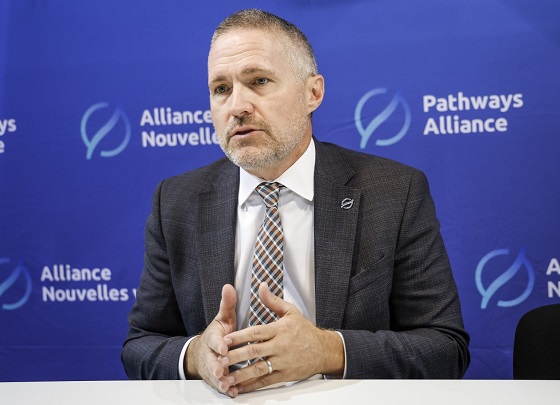
Pathways Alliance CEO Kendall Dilling is interviewed at the World Petroleum Congress in Calgary, Monday, Sept. 18, 2023.THE CANADIAN PRESS/Jeff McIntosh
From Resource Works
Carbon capture gives biggest bang for carbon tax buck CCS much cheaper than fuel switching: report
Canada’s climate change strategy is now joined at the hip to a pipeline. Two pipelines, actually — one for oil, one for carbon dioxide.
The MOU signed between Ottawa and Alberta two weeks ago ties a new oil pipeline to the Pathways Alliance, which includes what has been billed as the largest carbon capture proposal in the world.
One cannot proceed without the other. It’s quite possible neither will proceed.
The timing for multi-billion dollar carbon capture projects in general may be off, given the retreat we are now seeing from industry and government on decarbonization, especially in the U.S., our biggest energy customer and competitor.
But if the public, industry and our governments still think getting Canada’s GHG emissions down is a priority, decarbonizing Alberta oil, gas and heavy industry through CCS promises to be the most cost-effective technology approach.
New modelling by Clean Prosperity, a climate policy organization, finds large-scale carbon capture gets the biggest bang for the carbon tax buck.
Which makes sense. If oil and gas production in Alberta is Canada’s single largest emitter of CO2 and methane, it stands to reason that methane abatement and sequestering CO2 from oil and gas production is where the biggest gains are to be had.
A number of CCS projects are already in operation in Alberta, including Shell’s Quest project, which captures about 1 million tonnes of CO2 annually from the Scotford upgrader.
What is CO2 worth?
Clean Prosperity estimates industrial carbon pricing of $130 to $150 per tonne in Alberta and CCS could result in $90 billion in investment and 70 megatons (MT) annually of GHG abatement or sequestration. The lion’s share of that would come from CCS.
To put that in perspective, 70 MT is 10% of Canada’s total GHG emissions (694 MT).
The report cautions that these estimates are “hypothetical” and gives no timelines.
All of the main policy tools recommended by Clean Prosperity to achieve these GHG reductions are contained in the Ottawa-Alberta MOU.
One important policy in the MOU includes enhanced oil recovery (EOR), in which CO2 is injected into older conventional oil wells to increase output. While this increases oil production, it also sequesters large amounts of CO2.
Under Trudeau era policies, EOR was excluded from federal CCS tax credits. The MOU extends credits and other incentives to EOR, which improves the value proposition for carbon capture.
Under the MOU, Alberta agrees to raise its industrial carbon pricing from the current $95 per tonne to a minimum of $130 per tonne under its TIER system (Technology Innovation and Emission Reduction).
The biggest bang for the buck
Using a price of $130 to $150 per tonne, Clean Prosperity looked at two main pathways to GHG reductions: fuel switching in the power sector and CCS.
Fuel switching would involve replacing natural gas power generation with renewables, nuclear power, renewable natural gas or hydrogen.
“We calculated that fuel switching is more expensive,” Brendan Frank, director of policy and strategy for Clean Prosperity, told me.
Achieving the same GHG reductions through fuel switching would require industrial carbon prices of $300 to $1,000 per tonne, Frank said.
Clean Prosperity looked at five big sectoral emitters: oil and gas extraction, chemical manufacturing, pipeline transportation, petroleum refining, and cement manufacturing.
“We find that CCUS represents the largest opportunity for meaningful, cost-effective emissions reductions across five sectors,” the report states.

Fuel switching requires higher carbon prices than CCUS.
Measures like energy efficiency and methane abatement are included in Clean Prosperity’s calculations, but again CCS takes the biggest bite out of Alberta’s GHGs.
“Efficiency and (methane) abatement are a portion of it, but it’s a fairly small slice,” Frank said. “The overwhelming majority of it is in carbon capture.”

From left, Alberta Minister of Energy Marg McCuaig-Boyd, Shell Canada President Lorraine Mitchelmore, CEO of Royal Dutch Shell Ben van Beurden, Marathon Oil Executive Brian Maynard, Shell ER Manager, Stephen Velthuizen, and British High Commissioner to Canada Howard Drake open the valve to the Quest carbon capture and storage facility in Fort Saskatchewan Alta, on Friday November 6, 2015. Quest is designed to capture and safely store more than one million tonnes of CO2 each year an equivalent to the emissions from about 250,000 cars. THE CANADIAN PRESS/Jason Franson
Credit where credit is due
Setting an industrial carbon price is one thing. Putting it into effect through a workable carbon credit market is another.
“A high headline price is meaningless without higher credit prices,” the report states.
“TIER credit prices have declined steadily since 2023 and traded below $20 per tonne as of November 2025. With credit prices this low, the $95 per tonne headline price has a negligible effect on investment decisions and carbon markets will not drive CCUS deployment or fuel switching.”
Clean Prosperity recommends a kind of government-backstopped insurance mechanism guaranteeing carbon credit prices, which could otherwise be vulnerable to political and market vagaries.
Specifically, it recommends carbon contracts for difference (CCfD).
“A straight-forward way to think about it is insurance,” Frank explains.
Carbon credit prices are vulnerable to risks, including “stroke-of-pen risks,” in which governments change or cancel price schedules. There are also market risks.
CCfDs are contractual agreements between the private sector and government that guarantees a specific credit value over a specified time period.
“The private actor basically has insurance that the credits they’ll generate, as a result of making whatever low-carbon investment they’re after, will get a certain amount of revenue,” Frank said. “That certainty is enough to, in our view, unlock a lot of these projects.”
From the perspective of Canadian CCS equipment manufacturers like Vancouver’s Svante, there is one policy piece still missing from the MOU: eligibility for the Clean Technology Manufacturing (CTM) Investment tax credit.
“Carbon capture was left out of that,” said Svante co-founder Brett Henkel said.
Svante recently built a major manufacturing plant in Burnaby for its carbon capture filters and machines, with many of its prospective customers expected to be in the U.S.
The $20 billion Pathways project could be a huge boon for Canadian companies like Svante and Calgary’s Entropy. But there is fear Canadian CCS equipment manufacturers could be shut out of the project.
“If the oil sands companies put out for a bid all this equipment that’s needed, it is highly likely that a lot of that equipment is sourced outside of Canada, because the support for Canadian manufacturing is not there,” Henkel said.
Henkel hopes to see CCS manufacturing added to the eligibility for the CTM investment tax credit.
“To really build this eco-system in Canada and to support the Pathways Alliance project, we need that amendment to happen.”
Resource Works News

Geopolitics no longer drives oil prices the way it used to

Carney Floor Crossing Raises Counterintelligence Questions aimed at China, Former Senior Mountie Argues
There’s No Bias at CBC News, You Say? Well, OK…

Australian PM booed at Bondi vigil as crowd screams “shame!”
FDA warns ‘breast binder’ manufacturers to stop marketing to gender-confused girls

2025: The Year The Narrative Changed

Deadlocked Jury Zeroes In on Alleged US$40 Million PPE Fraud in Linda Sun PRC Influence Case
-
 armed forces1 day ago
Remembering Afghanistan and the sacrifices of our military families
-
 Opinion1 day ago
Pope Leo XIV’s Christmas night homily
-
 Fraser Institute1 day ago
How to talk about housing at the holiday dinner table
-
 Frontier Centre for Public Policy1 day ago
Tent Cities Were Rare Five Years Ago. Now They’re Everywhere
-
 Alberta17 hours ago
Alberta Next Panel calls for less Ottawa—and it could pay off
-
 Fraser Institute17 hours ago
Carney government sowing seeds for corruption in Ottawa
-
 Energy16 hours ago
While Western Nations Cling to Energy Transition, Pragmatic Nations Produce Energy and Wealth
-
 International16 hours ago
No peace on earth for ISIS: Trump orders Christmas strikes after Christian massacres
You must be logged in to post a comment Login