
Daily Caller
‘Sign Of Great Hope’: Religious Leaders See A ‘Fourth Great Awakening’ As Americans Flock To Christianity



From the Daily Caller News Foundation
By Jaryn Crouson
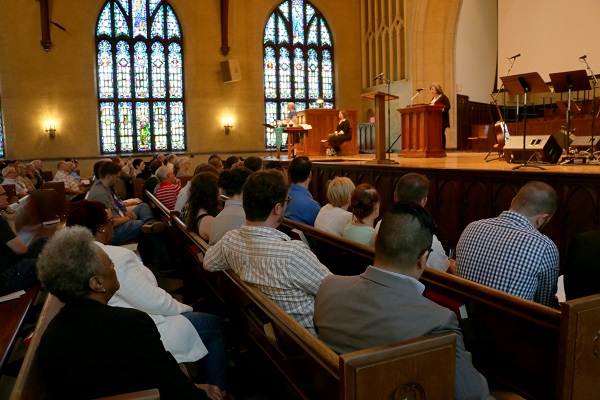
More Americans are leaning into their Christian faith in what some religious leaders and scholars are calling a “fourth Great Awakening.”

Bible sales in the United States have skyrocketed in 2024, religious colleges are seeing enrollment boosts despite overall declines in higher education attendance and several states are pushing for Bible-based curriculum in public schools. Some Bible scholars believe this may mark a significant cultural shift.
“While it has been apparent to a few of us for some time, millions are now realizing that ‘woke’ ideologies are, in fact, destructive attempts to re-found the nation according to a new civic religion which both parodies and persecutes Christianity,” Chad Pecknold, theologian and professor at The Catholic University of America, told the Daily Caller News Foundation.
Despite overall book sales increasing by only 1% compared to 2023, Bible sales in the U.S. have reached an impressive 22% increase as of October 2024, according to the Wall Street Journal.
The Cardinal Newman Society in October reported that enrollment at Catholic colleges has risen in 2024 despite an overall enrollment decrease at other institutions, with several schools such as Ave Maria University in Florida and Benedictine College in Kansas seeing record growth, increasing attendance by more than 20% over the last 10 years.
“There is a resurgence of Christianity among young people,” Wade Burleson, retired pastor and president of Istoria Ministries, told the DCNF. “I see what is happening [as] more of an Awakening. An Awakening occurs when the irreligious come to faith in Christ.”
Burleson pointed to several instances of young people coming into faith in droves in recent years, with hundreds of students being baptized on campuses across the nation, including several members of the four-time national champion Oklahoma University women’s softball team.
“There have been three Great Awakenings in America, and a few smaller ones,” Burleson continued. “I believe we are in the beginning of a fourth Great Awakening and it is a response to inflation (financial panic), pandemics (Covid), wars (global), and the sudden death of stability in America. There is no anchor in life better than the Anchor of Hope, and when the ship of life is tossed to and fro, faith awakens.”
Pecknold shared this sentiment, arguing that far-left politics have driven Americans towards Christianity.
“Democrats, and the corporations and institutions they controlled, embraced this pseudo-civic religion in their attempt to take total control over the American republic,” Pecknold said. “The American people saw their totalitarian appetites on display in everything from forced vaccinations to extreme racialism to the redefinition of marriage and the denial of sexual difference, all under the ever-evolving banner of ‘the Progress Flag.’”
“This is when the Democrats were defeated so thoroughly on November 5th, it was not only seen as a political victory, but also as a religious victory: it was a repudiation of the ersatz civic religion that Democrats had used to re-found the country.”
Catholic voters played a pivotal role in the 2024 presidential election, making up approximately 25% of the vote and overwhelmingly siding with President-elect Donald Trump, with other Christian voters following suit.
This was a surprising revelation considering tens of millions of Christians were expected to refrain from voting, citing a dislike of both candidates and general uninterest in politics, according to Relevant Magazine. Some religious organizations, however, made efforts to warn voters prior to the election that the Democratic ticket was “patently anti-religious.”
Greg Boyd, theologian and Pastor at Woodland Hills Church in St. Paul, Minnesota is less convinced of this religious revival.
“My concern is that a lot of it seems to be wrapped up with nationalism,” Boyd told the DCNF. “And it concerns me because whenever the Christian faith has gotten too close to political power, it’s been transformed by the political power, and we have Christians trying to control others and conquer others, the same as we’ve had throughout history. And in my opinion, that doesn’t look anything [like] what we find in the Gospel.”
Boyd pointed to examples of states like Texas, Louisiana and Oklahoma approving the implementation of Bible lessons into public school lessons. Texas’ law is meant to help “students to better understand the connection of history, art, community, literature, and religion on pivotal events” in history and Oklahoma’s is similarly meant “as an instructional support into the curriculum.”
“Where did Jesus ever impose himself on others?” the pastor asked.
“I mean, I would love to see a revival in the country,” Boyd said. “The evidence of that would be, I would think, people become more Christ-like, they become more loving. They would be trying to turn the other cheek, trying to reach out across the aisle and build bridges instead of walls. And I don’t see any of that happening with the church as a whole. Seems like it’s kind of gone deeply into political polarization.”
Boyd agreed that many issues in politics have driven people to view current affairs through a religious lens.
Cultural issues such as abortion, gender ideology and diversity, equity and inclusion (DEI) have been hot topics dividing Americans’ opinions, especially religious Americans. The ongoing war in Gaza, as well as the hundreds of protests that spanned the U.S. in response, also impacted Christians’ perspective, with many viewing the apparent prosecution of Jews on college campuses as an infringement on religious freedom as a whole.
Church attendance among Christians remains relatively low in the United States, with only 30% of Protestants and 23% of Catholics attending church every week, according to a March Gallup poll. However, more Americans than ever are consuming religious content, with the Hallow prayer app becoming the first religious app to top Apple’s App Store in 2024 and Fr. Mike Schmitz’s Bible In A Year podcast consistently topping charts in recent years, according to National Review.
Young men in particular are maintaining their devotion to faith, with more Gen Z men identifying as Christian than women for the first time, according to the New York Times.
“We are currently seeing a kind of clarity about the civilizational conflict that ‘woke’ ideologies provoked,” Pecknold told the DCNF. “In brief, the people are fed up with this fake religion, and even if they aren’t Christian themselves, they’re realizing that Christianity provides a far better ‘unwritten constitution’ for the nation than anti-Christian wokeism can supply. There’s a simple realization at work here.”
“Christianity is an ordering principle which elevates and ennobles souls, families, and societies — it’s inherently public, and cannot be ‘privatized,’ relegated to the margins, or separated from questions of education, heritage, public morality, family policy, law, or the aspirations of nations,” Pecknold said. “We still date time by the Incarnation because, deep down, everyone knows that Christianity is objectively true and good for all people — it roots us in reality, it helps us to promote the truly good, and avoid those evils which cause so much suffering — it elevates us by the Light of Christ. Public Christianity is literally what makes civilizational renewal possible. The fact that Americans are remembering this, and having the courage to state it, is a sign of great hope for the nation.”

Daily Caller
Minnesota Governor resigns from re-election campaign as massive government frauds revealed

From the Daily Caller News Foundation
Nick Shirley, the viral YouTuber who exposed the fraud happening at Somali daycare centers in Minnesota, took credit for Democratic Minnesota Gov. Tim Walz’s resignation from the 2026 gubernatorial race.
While Walz faced national scrutiny for his handling of fraud, Shirley posted a 42-minute documentary on Dec. 26, which found that nearly a dozen Somali daycare centers funded by taxpayer dollars were not actually providing services. In response to the governor accusing Shirley of being a “conspiracy theorist” who broke into daycare centers, Shirley posted on X that he “ended” Walz’s career.
Dear Readers:
As a nonprofit, we are dependent on the generosity of our readers.
Please consider making a small donation of any amount here.
Thank you!
Prominent conservatives, including tech mogul Elon Musk and YouTuber Brandon Tatum, praised Shirley for his role in making Walz step down.
“Thank God,” Elon Musk wrote in response to Shirley.
In his statement on Monday, Walz accused Republicans of “playing politics” by speaking to whistleblowers, exposing daycare centers and “demonizing” Somalis.
“But the political gamesmanship we’re seeing from Republicans is only making that fight harder to win. We’ve got Republicans here in the legislature playing hide-and-seek with whistleblowers,” Walz said. “We’ve got conspiracy theorist right-wing YouTubers breaking into daycare centers and demanding access to our children. We’ve got the President of the United States demonizing our Somali neighbors and wrongly confiscating childcare funding that Minnesotans rely on. It’s disgusting. And it is dangerous.”
Shirley responded on X by telling Walz he should have prevented the fraud from ever happening.
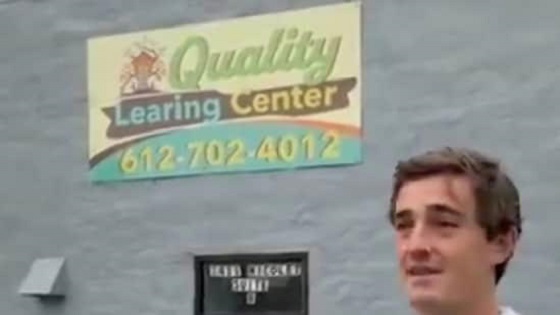
“You should’ve put Minnesota first when you had the chance, instead you let billions of dollars of fraud happen across your state… anywayssss … I hear Quality LEARING Center is hiring,” Shirley said.
The Quality “Learning” Center, which initially misspelled “Learning,” as “Learing,” is among the daycare centers that appeared to have no children inside when visited by Shirley. The center received $1.9 million in 2025 and $4 million in total funding from Minnesota’s Child Care Assistance Program (CCAP), Shirley reported in the documentary.
Ali Ibrahim, the son of the center’s owner, told the Post that Shirley visited the property outside of regular business hours.
In a separate case, federal prosecutors have charged over 90 individuals, whom are mostly of Somali descent, with stealing over $9 billion in taxpayer funds from federal social service programs in Minnesota. Five of the 10 daycare centers visited by Shirley operated as meal sites for Feeding Our Future, a program at the center of a $300 million scam that provided meals to children during the COVID-19 pandemic.
Between 2018 and 2021, those five businesses received nearly $5 million from Feeding Our Future, according to the Minnesota Star Tribune. One facility, the Minnesota Best Childcare Center, received $1.5 million from Feeding Our Future. The Sweet Angel Child Care center in Minneapolis had the same phone number as Walz’s office.
State employees in Minnesota stated in November that Walz bore full responsibility for the fraud by working to “discredit fraud reports” and ignore whistleblowers.
Democrats and state leaders defended Somalis while the fraud was uncovered, including Democratic Minneapolis Mayor Jacob Frey, who said that Somalis were part of the community’s family. Minnesota Democratic Lt. Gov. Peggy Flanagan appeared on a Somali TV station wearing a hijab.
Daily Caller
Scathing Indictment Claims Nicolás Maduro Orchestrated Drug-Fueled ‘Culture Of Corruption’ Which Plagued Entire Region
From the Daily Caller News Foundation
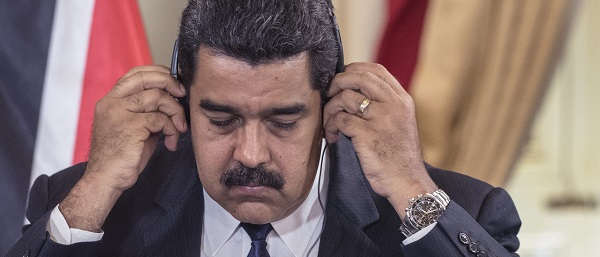
Ousted socialist Venezuelan dictator Nicolás Maduro was the mastermind of a pervasive drug-fueled “culture of corruption” which extended all the way to the U.S.’s backyard, according to the scathing indictment against him, his wife, his son, and others, released Saturday.
Hours after President Donald Trump announced Maduro’s capture and removal from power, Attorney General Pam Bondi confirmed the deposed despot and his wife, Cilia Flores, were indicted in the Southern District of New York on four charges, including narco-terrorism conspiracy, and “will soon face the full wrath of American justice” on U.S. soil. A grand jury found Maduro “and corrupt members of his regime enabled corruption fueled by drug trafficking throughout” the Latin American region, including in Mexico and Central America, and empowered notorious crime syndicates such as Tren de Aragua (TdA), according to the unsealed indictment.
Signed by Trump-appointed U.S. Attorney Jay Clayton, the 25-page indictment names six defendants, including the deposed Maduro, Flores, and Maduro’s 35-year-old son from his first marriage, Nicolás “Nicolasito” Maduro Guerra. It also names as defendants TdA leader Niño Guerrero and two high-profile members of Maduro’s United Socialist Party, Diosdado Cabello Rondón and Ramón Rodríguez Chacín.
Dear Readers:
As a nonprofit, we are dependent on the generosity of our readers.
Please consider making a small donation of any amount here.
Thank you!
Maduro, “like former President [Hugo] Chávez before him[,] participates in, perpetuates, and protects a culture of corruption in which powerful Venezuelan elites enrich themselves through drug trafficking and the protection of their partner drug traffickers,” the indictment alleges. “The profits of that illegal activity flow to corrupt rank-and-file civilian, military, and intelligence officials, who operate in a patronage system run by those at the top-referred to as the Cartel de Los Soles or Cartel of the Suns, a reference to the sun insignia affixed to the uniforms of high-ranking Venezuelan military officials.”
The Trump administration’s State Department announced it was designating the Cartel de Los Soles as a Foreign Terrorist Organization (FTO) in November 2025. Secretary of State Marco Rubio wrote in a statement at the time the cartel “is headed by Nicolás Maduro and other high-ranking individuals of the illegitimate Maduro regime who have corrupted Venezuela’s military, intelligence, legislature, and judiciary.”
The indictment also notes the South American nation “sits in a geographically valuable location for drug traffickers” and that, around the time Chávez came to power in 1999, “Venezuela became a safe haven” for them.
“In that environment, cocaine trafficking flourished,” the indictment continues, citing State Department estimates from arund 2020, with between 200 and 250 tons of the drug being trafficked through the country each year.
The charging document goes on to allege Maduro, his wife, son, and political allies had “partnered with narcotics traffickers and narco-terrorist groups, who dispatched processed cocaine from Venezuela to the United States via transshipment points in the Caribbean and Central America, such as Honduras, Guatemala, and Mexico.”
“Through this drug trafficking, [Maduro] and corrupt members of his regime enabled corruption fueled by drug trafficking throughout the region,” the indictment continues. “The transshipment points in Honduras, Guatemala, and Mexico similarly relied on a culture of corruption, in which cocaine traffickers operating in those countries paid a portion of their own profits to politicians who protected and aided them. In turn, these politicians used the cocaine-fueled payments to maintain and augment their political power.”
Maduro and his regime also “facilitated the empowerment and growth of violent narco-terrorist groups fueling their organizations with cocaine profits,” according to the indictment.
The charging document notably identifies organizations which collaborated with the Maduro regime: Colombian communist militant groups Revolutionary Armed Forces of Colombia (FARC) and National Liberation Army (ELN); Mexican syndicates the Sinaloa Cartel and Los Zetas; and Guerrero’s TdA.
The indictment also alleges Maduro Guerra, the captured dictator’s son, personally “worked to ship hundreds of kilograms of cocaine from Venezuela to Miami, Florida” around the year 2017. Maduro Guerra is a member of his father’s political party and served as a Deputy to the Venezuelan National Assembly since 2021.
“During this time, MADURO GUERRA spoke with his drug trafficking partners about, among other things, shipping low-quality cocaine to New York because it could not be sold in Miami, arranging a 500-kilogram shipment of cocaine to be unloaded from a cargo container near Miami, and using scrap metal containers to smuggle cocaine into the ports of New York,” the document reads.

The Canadian Energy Centre’s biggest stories of 2025
Minneapolis day care filmed empty suddenly fills with kids

DOOR TO DOOR: Feds descend on Minneapolis day cares tied to massive fraud

Resurfaced Video Shows How Somali Scammers Used Day Care Centers To Scam State

Dark clouds loom over Canada’s economy in 2026

In Contentious Canada Reality Is Still Six Degrees Of Hockey

The U.S. Just Removed a Dictator and Canada is Collateral Damage
-
 Daily Caller2 days ago
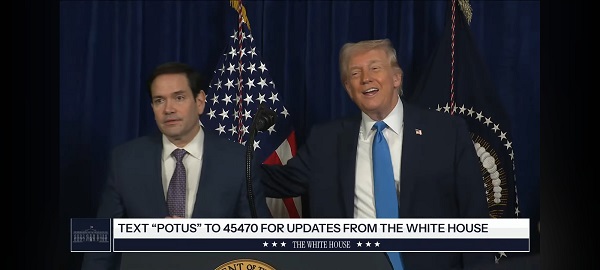
Trump Says US Going To Run Venezuela After Nabbing Maduro
-
Daily Caller2 days ago
Scathing Indictment Claims Nicolás Maduro Orchestrated Drug-Fueled ‘Culture Of Corruption’ Which Plagued Entire Region
-
 Business2 days ago
Virtue-signalling devotion to reconciliation will not end well
-
 Opinion2 days ago
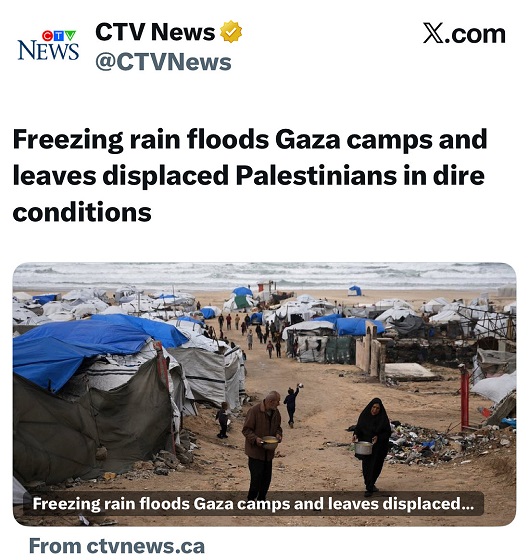
Hell freezes over, CTV’s fabrication of fake news and our 2026 forecast is still searching for sunshine
-
 Frontier Centre for Public Policy12 hours ago
Is Canada still worth the sacrifice for immigrants?
-
 International10 hours ago
Network of Nonprofits with Marxist and CCP Ties, and Elected Socialists Race to Counter Washington’s Narrative of the Maduro Raid
-
 Alberta9 hours ago
Trump’s Venezuela Geopolitical Earthquake Shakes up Canada’s Plans as a “Net Zero” Energy Superpower
-
 Energy9 hours ago
Trump’s Venezuela Move: A $17 Trillion Reset of Global Geopolitics and a Pivotal Shift in US Energy Strategy