
International
Secret Service slammed for failing to prevent assassination attempt against Trump

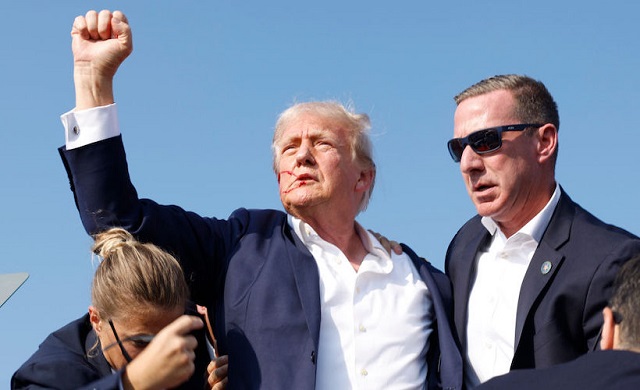

BUTLER, PENNSYLVANIA – JULY 13: Republican presidential candidate former President Donald Trump is rushed offstage during a rally on July 13, 2024 in Butler, Pennsylvania.
From LifeSiteNews

By Matt Lamb
“I don’t like making any assumptions, but it does look like some mistakes were made, that this was preventable”
Secret Service is blaming local law enforcement for not securing the rooftop where a 20-year-old tried to assassinate former President Donald Trump over the weekend.
But local law enforcement, and several experts who spoke to NBC News, said all responsibility for protecting the president ultimately lies with the Secret Service.
The agency is under widespread criticism for allowing a shooter, identified as Thomas Matthew Crooks, to have clear access to President Trump during his rally on Saturday in Pennsylvania. Crooks hit Trump’s right ear, but the president is reportedly in good condition.
It has been reported that Crooks was at one point a registered Republican but that he also made a $15 donation to Progressive Turnout Project, a left-wing Democratic Party-linked activist group, in 2021.
The rooftop “was identified by the Secret Service as a potential vulnerability in the days before the event, two sources familiar with the agency’s operations told NBC News,” the outlet reported last night.
“The Secret Service had designated that rooftop as being under the jurisdiction of local law enforcement, a common practice in securing outdoor rallies,” Secret Service spokesman Anthony Guglielmi said, according to NBC News’ paraphrase.
The outlet reported:
The Secret Service worked with local law enforcement to maintain event security, including sniper teams poised on rooftops to identify and eliminate threats, Secret Service spokesman Anthony Guglielmi said. But no officers were posted on the building used by the would-be assassin, outside the event’s security perimeter but only about 148 yards from the stage — within range of a semiautomatic rifle like the one the gunman was carrying.


From the Frontier Centre for Public Policy
By Lee Harding
Immigrants are beginning to question the sacrifices they made to come to Canada, signalling deeper problems facing the country
Whenever I meet someone who immigrated to Canada from a warm place, I am always remarkably impressed. The choice to deliberately leave a pleasant, warm homeland to endure our cold winters says a lot. Overall, living in Canada is apparently better, and that should make us grateful. But what should concern us is how that upside is becoming less apparent all the time.
I recall almost a decade ago sharing a meal with Filipinos. One showed me a picture of the oceanside home he left behind where he could successfully catch fish every day without leaving home. Why would he ever leave a place like that? The answer was jobs.
It’s remarkable how Filipinos can do any job with a smile and, regardless of how little it might pay, send money to their family in their country of origin. I once told a young Filipino working at a McDonald’s to keep the change from my purchase because he was sending money back to his family. He smiled with a bit of surprise that a stranger like me would know that. He also gave me back my change, just to stay honest.
Older stock Canadians used to be like Filipinos, characterized by faith, family, hard work and gratitude. I’m afraid all four aspects have eroded in mainstream Canadian culture in recent decades, especially in the past 10 years.
At my gym two years ago, I met a Sikh named Jagjeet Singh and asked him how he liked Canada. He said when he arrived in 2019, the country was paradise on earth. Now, he said, it was turning into a s___hole. My memory fails on some of his exact observations. I only recall his disdain for the Trudeau government and the NDP leader whose name sounded a lot like his own.
While immigration to Canada remains robust, some newcomers are souring on Canada for very good reasons. This is worthy of our attention.
Maclean’s has featured several stories about immigrant struggles over the past two years, including Eleanor Zhang’s. The international student started her studies at Dalhousie University in Halifax in 2016. Back then, rent was $700 a month, people were friendly, and life was good.
By 2021, she felt things had turned for the worse. The city’s population had grown by 9.1 per cent in five years. Congested traffic left drivers angry. Her friends shared stories of their cars being broken into and items stolen. Zhang’s rent was $1,670 per month, and her grocery bills had skyrocketed. For the first time, she saw people living in the park.
Zhang wanted to start her own gift shop, but commercial spaces were so expensive that she saw little room for profit. She had fallen in love with Canada but also fell out of it. Her pursuit of a prosperous life took her back to Beijing.
Canada used to be a patriotic country with robust free speech, a respectable military, strong family and moral values, an abundance of private sector jobs and quality education and health care. Today, not so much.
Some Canadians are aware of this decline and want a new direction, while others remain aloof, ignorant and insulated from the country’s erosion. Our last election offered fresh proof of the deep generational, occupational and regional divides in Canada.
The problem is, we have to build a country together. It is hard for a people so divided against itself to stand.
Like the story of Scrooge in Charles Dickens’ A Christmas Carol, this holiday season is a good time to reflect on our past, present and future. We’re not what we were, and we could get worse, but we can also get better. As Scrooge found out, it’s not too late to turn things around and lay hold of the best Canada possible.
Lee Harding is a research fellow with the Frontier Centre for Public Policy.
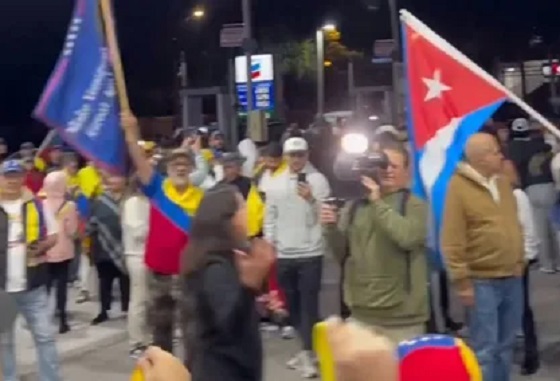

Celebrations broke out across South Florida Saturday as news spread that Venezuela’s longtime socialist strongman Nicolás Maduro had been captured and removed from power, a moment many Venezuelan exiles said they had waited their entire lives to see. In Doral, hundreds gathered outside the El Arepazo restaurant before sunrise, waving flags, embracing strangers, and reacting emotionally to what they described as a turning point for their homeland. Local television footage captured chants, tears, and spontaneous celebrations as word filtered through the community that Maduro and his wife had been “captured and flown out of the country” following U.S. military action announced by Donald Trump earlier that morning.
Venezuelans gathered early this morning in Doral to celebrate after news broke that the U.S. had captured Nicolás Maduro🇻🇪| #ONLYinDADE pic.twitter.com/mSNaF3IhR3
— ONLY in DADE (@ONLYinDADE) January 3, 2026
One young man, Edgar, spoke directly to reporters as the crowd surged behind him, calling the moment “history in the making.” He said his family had spent decades telling him stories about a Venezuela that once had real elections and basic freedoms. “My chest feels like it’s going to explode with joy,” he said, explaining that the struggle against the regime began long before he was born. Edgar thanked President Trump for allowing Venezuelans to work and rebuild their lives in the United States, adding that now, for the first time, he believed they could take those skills back home.
Similar scenes played out beyond Florida. Video circulating online showed Venezuelans celebrating in Chile and other parts of Latin America, reflecting the regional impact of Maduro’s fall. The dictator had clung to power through what U.S. officials and international observers have long described as sham elections, while presiding over economic collapse, mass emigration, and deepening ties to transnational criminal networks. U.S. authorities have pursued him for years, placing a $50 million bounty on information leading to his arrest or conviction. Federal prosecutors accused Maduro in 2020 of being a central figure in the so-called Cartel of the Suns, an international cocaine trafficking operation allegedly run by senior members of the Venezuelan regime and aimed, in prosecutors’ words, at flooding the United States with drugs.
After the overnight strikes, Venezuela’s remaining regime figures declared a state of emergency, even as images of celebration dominated social media abroad. In Washington, reaction from Florida lawmakers was swift. Rep. Carlos Gimenez, who represents a district with large Venezuelan, Cuban, and Nicaraguan exile communities, compared Maduro’s capture to one of the defining moments of the 20th century. “President Trump has changed the course of history in our hemisphere,” Gimenez wrote, calling the operation “this hemisphere’s equivalent to the Fall of the Berlin Wall.” He added that South Florida’s exile communities were “overwhelmed with emotion and hope,” and thanked U.S. service members for what he described as a decisive and successful mission.
For many gathered in Doral, the reaction was deeply personal. A CBS Miami reporter relayed comments from attendees who said they now felt safer about the possibility of returning to Venezuela to see family members they had not hugged in years. One man described it as the end of “26 years of waiting” for a free country, saying the moment felt less like politics and more like the closing of a long, painful chapter.
U.S. Attorney General Pam Bondi confirmed Saturday that Maduro and his wife have been formally indicted in the Southern District of New York. Bondi said the charges include narco-terrorism conspiracy, cocaine importation conspiracy, and weapons offenses involving machine guns and destructive devices. For Venezuelan Americans packed into South Florida streets, those legal details mattered less than the symbolism. After years of watching their country unravel from afar, many said they finally felt something unfamiliar when they looked south — relief, and the cautious hope that Venezuela’s future might no longer be written by a dictator.

The Canadian Energy Centre’s biggest stories of 2025

Minneapolis day care filmed empty suddenly fills with kids

DOOR TO DOOR: Feds descend on Minneapolis day cares tied to massive fraud

Resurfaced Video Shows How Somali Scammers Used Day Care Centers To Scam State

Dark clouds loom over Canada’s economy in 2026

Feds pull the plug on small business grants to Minnesota after massive fraud reports

In Contentious Canada Reality Is Still Six Degrees Of Hockey
-
 Energy2 days ago
The U.S. Just Removed a Dictator and Canada is Collateral Damage
-
 Haultain Research2 days ago
Trying to Defend Maduro’s Legitimacy
-
 International2 days ago
U.S. Claims Western Hemispheric Domination, Denies Russia Security Interests On Its Own Border
-
International2 days ago
US Justice Department Accusing Maduro’s Inner Circle of a Narco-State Conspiracy
-
International2 days ago
“It’s Not Freedom — It’s the First Step Toward Freedom”
-
 Daily Caller1 day ago
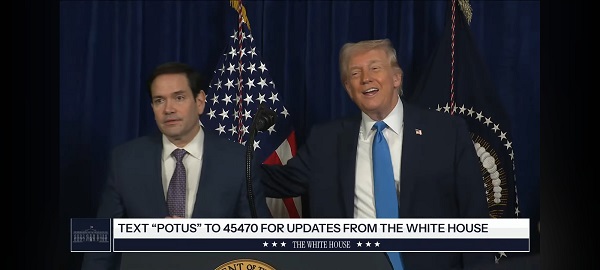
Trump Says US Going To Run Venezuela After Nabbing Maduro
-
 Daily Caller1 day ago
Scathing Indictment Claims Nicolás Maduro Orchestrated Drug-Fueled ‘Culture Of Corruption’ Which Plagued Entire Region
-
 Business1 day ago
Virtue-signalling devotion to reconciliation will not end well